Saints: December 2008 Archives

Saint Sylvester I, pope

| | Comments (0)

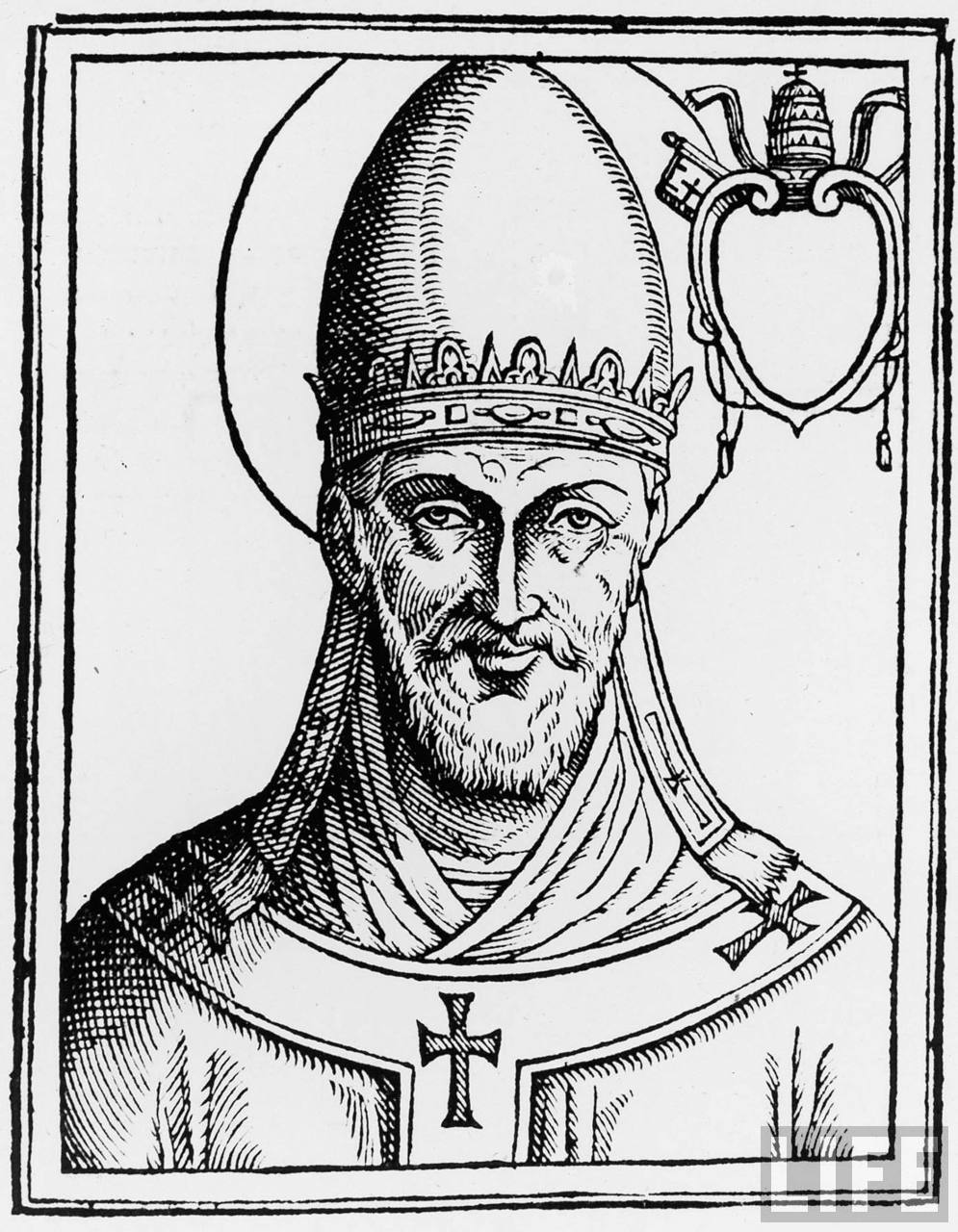
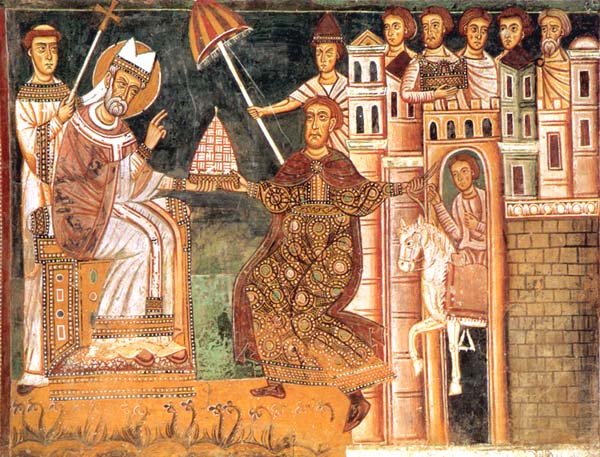
St Sylvester pope.jpgLord, help and sustain Your people by the prayers of Pope Sylvester. Guide us always in this present life and bring us to the joy that never ends.


Elected pope in 314, Saint Sylvester served the Church at a time when the Arian heresy and the Donatist schism had provoked great discord. After the peace of Constantine, he contributed greatly to the work of evangelization throughout the Roman world. The saintly pope died in 355. Some other thoughts on today's saint


Saint Thomas Becket

| | Comments (0)

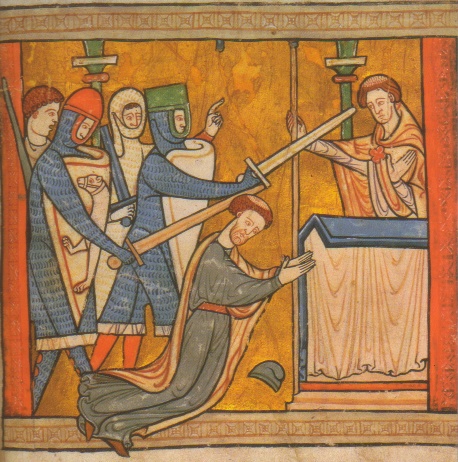
St Thomas Becket.jpgAlmighty God, You granted the martyr Thomas the grace to give his life for the cause of justice. By his prayers make us willing to renounce for Christ our life in this world so that we may find it in heaven.


A few words on Becket.

Feast of the Holy Family

| | Comments (0)

Holy Family.jpg


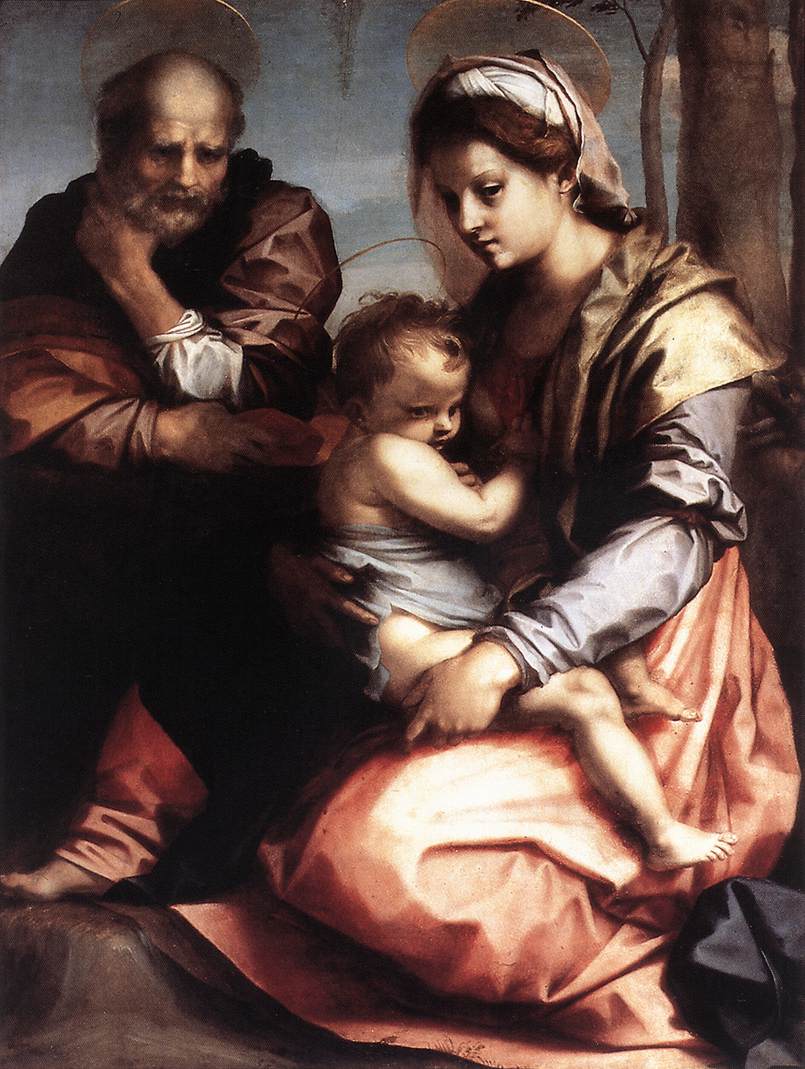
Father in heaven, creator of all, you ordered the earth to bring forth life, and crowned its goodness by creating the family of man.

In history's moment when all was ready You sent your Son to dwell in time, obedient to the laws of life in our world.

Teach us the sanctity of human love, show us the value of family life, and help us to live in peace with all men that we may share in your life forever.

Saint John, Saint John was Christ's disciple,
and Evangelist also;
He for the sake of Jesus Christ
Much pains did undergo,
Because he loved our Saviour Christ,
As Holy Scriptures say,
And was belov'd of him also,
And in his bosom lay.

Chorus
Saint John for love of our Saviour
Did undergo much pain
And never ceased during life
To preach Christ Jesus' name.

Saint John, he at Jerusalem
St John the Evan.jpgDid preach God's holy word,
And for the same the spiteful pagans
They did him cruel scourge.
Then did he for the same rejoice,
That he was counted worthy
To suffer for the sake of Christ,
And would him not deny.

To Patmos banish'd was Saint John,
As Scripture doth record,
For the testimony of Christ,
And his most holy word.
And as he was in the Spirit
On the Lord's blessed day,
Our Saviour by an Angel spake,
and unto him did say,

I am Alpha and Omega,
Which was and is to come;
And what thou seest write in a book
Thus said he to Saint John
And send it to the Churches then,
Which are in Asia seven.
And said the Angel to Saint John,
Which came to him from Heaven.

Then John turn'd him about to see,
And was astonished
At the sight of the Angel bright,
Who said, Be comforted,
For I was alive, and also dead,
Now I live for evermore,
And have the keys of death and hell;Take comfort now therefore.

Then wretched Caesar, as 'tis said,
The Emperor Domitian,
Into a tub of boiling oil
At Rome he thrust Saint John.
Therein received he no harm,
But safely from thence came,
And died at last at Ephesus
Writing declares the same.

William Sandys, Christmas Carols Ancient and Modern (London: Richard Beckley, 1833)

Yesterday, with exultation,
Join'd the world in celebration
Of her promised Saviour's birth;
Yesterday the Angel-nation
Pour'd the strains of jubilation
O'er the Monarch born on earth;


But today o'er death victorious,
By his faith and actions glorious,
by his miracles renown'd,
See the Deacon triumph gaining,
'Midst the faithless faith sustaining,
First of holy Martyrs found.


Thumbnail image for St Stephen.jpg 


Onward, champion, falter never,
Sure of sure reward for ever,
Holy Stephen, persevere;
Perjured witnesses confounding,
Satan's synagogue astounding
By thy doctrine true and clear.


Thine own Witness is in Heaven,
True and faithful, to thee given,
Witness of thy blamelessness:
By thy name a crown implying,
Meet it is thou shouldst be dying
For the crown of righteousness.


For the crown that fadeth never
Bear the torturer's brief endeavour;
Victory waits to end the strife:
Death shall be thy life's beginning,
And life's losing be the winning
Of the true and better life.


Fill'd with God's most Holy Spirit,
See the Heav'n thou shalt inherit,
Stephen, gaze into the skies:
There God's glory steadfast viewing,
Thence thy victor-strength renewing,
Pant for thy eternal prize.


See, as Jewish foes invade thee,
See how Jesus stands to aid thee,
Stands at God's right hand on high:
Tell how open'd Heav'n is shown thee,
Tell how Jesus waits to own thee,
Tell it with thy latest cry.


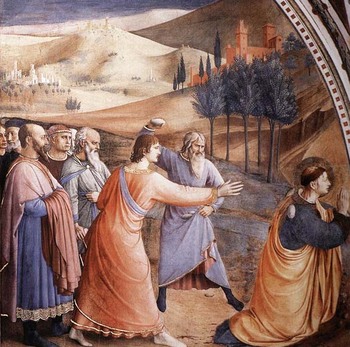
As the dying martyr kneeleth,
For his murderers he appealeth,
For their madness griefing sore;
Then in Christ he sleepeth sweetly,
And with Christ he reigneth meetly,
Martyr first-fruits, evermore.


Words: "Heri mundus exultavit," Adam of S. Victor (d. 1192). Translation by John Mason Neale; Music: "Heri Mundus Exultavit," by Walter Macfarren; Meter: 887 887. Hymns Ancient and Modern. London: William Clowes and Sons, Ltd., 1922, #64, p. 64-5.

Saint Peter Canisius

| | Comments (0)

St Peter Canisius.JPGO God, Who did strengthen blessed Peter Thy Confessor, in virtue and learning for the defense of the Catholic faith: mercifully grant that through his examples and teaching, those who are in error may be brought back to salvation and that the faithful may persevere in the confession of the truth.


Jesuit Father John Hardon's brief note on Saint Peter Canisius


 On the third centenary of the death of the Saint Peter Canisius, Pope Leo XIII wrote to the Bishops of Austria, Germany and Switzerland:


7. This is not the place to recall in detail the life of this man, so eminent in sanctity; the zeal with which he labored to restore harmony and union to his country torn by dissension and revolt; the ardor of his public debates with the teachers of error; his inspiring sermons; the persecutions he suffered; the many countries he travelled through; and the difficult missions he undertook in the interest of the faith. However, to return to the weapons of knowledge which we have mentioned: how constantly, readily, wisely and fitly he employed them! Upon his return from Messana where he went as a teacher of rhetoric, he committed himself to the teaching of the sacred sciences in the academies of Cologne, Ingolstadt and Vienna. Here he followed the royal road of the most approved learned men of the Christian school and revealed to the Germans the treasures of scholastic philosophy. As this philosophy was shunned at that time by the enemies of the faith because it was a great support of Catholic truth, he had it taught publicly in the schools and colleges of the Society of Jesus for whose establishment he had worked so hard.

8. He did not hesitate to descend from the heights of wisdom to the basics of writing. He undertook the instruction of children and even composed elementary writing books and grammars for their use. Indeed, just as he often came back from preaching to the courts of kings to address the people, so, after learned writings on dogma or morals, he used to compose pamphlets destined either to strengthen the faith of the people or to IHSa.jpgarouse and nourish their piety. He had wonderful success in preventing the inexperienced from getting caught in the nets of error. The Summa which he published for this purpose is a compact and tightly-knit work, written in beautiful Latin and not unworthy of the Fathers of the Church. This remarkable work was enthusiastically received by learned men in almost all the countries of Europe. Less voluminous, but no less useful, were the two famous catechisms which this blessed man wrote for less cultivated minds: one for the religious instruction of children, the other for young men already involved in the study of the arts. These two works had such a great success among Catholics immediately upon publication, that almost all professors charged with teaching the basics of the faith had them in hand. They were used not only in the schools as a spiritual milk for the children, but they were also explained publicly in the churches to the benefit of all. Thus, during three centuries Canisius has been regarded as the teacher of Catholics in Germany. In popular speech, "knowing Canisius" was synonymous with "preserving the Christian faith."


Pope Leo XIII, Militantis Ecclesiae (On St. Peter Canisius), August 1, 1897.


Saint John of the Cross

| | Comments (0)

Father, You endowed John of the Cross with a spirit of self-denial and a love of the cross. By following his example, may we come to the eternal vision of Your glory.


St John of the Cross.jpg

THE best exposition on the spiritual life --that is, in my estimation there is no other work that captures the essence of the various gifts of the Holy Spirit with regard to the spiritual life-- is the book Christian Spirituality by Dominican Father Jordan Aumann (1916-2007). Regrettably, I think the book is out of print and old copies tend to be expensive but you may search for an online copy of it. If you get a copy, don't let it out of your sight! Nevertheless, Father Jordan's thoughts on Saint John of the Cross easily expose the greatness of today's saint.


The fundamental principle of St. John's theology is that God is All and the creature is nothing. Therefore, in order to arrive at perfect union with God, in which sanctity consists, it is necessary to undergo an intense and profound purification of all the faculties and powers of soul and body. The Ascent--Dark Night traces the entire process of purgation, from the active purification of the external senses to the passive purification of the highest faculties; The Living Flame and The Spiritual Canticle describe the perfection of the spiritual life in the transforming union. The entire path to union is "night" because the soul travels by faith. St. John of the Cross presents his teaching in a systematic manner, with the result that it is spiritual theology in the best sense of the word; not because it is systematic, but because it uses as its sources Sacred Scripture, theology and personal experience.


In speaking of the union of the soul with God, St. John states that he is speaking of supernatural union, and not the general union by which God is present to the soul simply by preserving it in existence. The supernatural union of the mystical life is a "union of likeness" which is produced by grace and charity. But in order that this union of love be as perfect as possible and as intimate as possible, the soul must rid itself of all that is not God and of every obstacle to the love of God so that it can love God with all its heart and soul and mind and strength.


Since any deficiency in the union of love is due to the soul and not to God, St. John concludes that the soul must be completely purified in all of its faculties and powers -- those of the sensory order and those that are spiritual -- before it can be fully illuminated by the light of divine union. This results in the "dark night," which is so called because the point of departure is a denial and deprivation of one's appetite or desire for created things; the means or the road along which the soul travels to union is the obscurity of faith; and the goal is God, who is also a dark night to man in this life.


The necessity of passing through this dark night is due to the fact that from God's point of view, man's attachments to created things are pure darkness, while God is pure light, and darkness cannot receive light (Jn. 1:5). Stated in philosophical terms, two contraries cannot coexist in the same subject. The darkness which is attachment to creatures and the light which is God are contraries; they cannot both be present in the soul at the same time.

Saint Lucy

| | Comments (0)

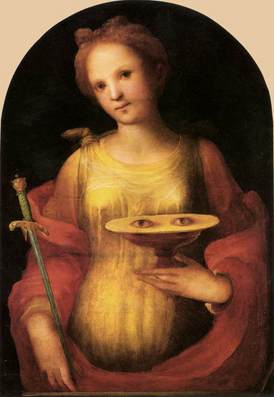
Thumbnail image for Thumbnail image for Thumbnail image for St Lucy.jpg


A Nocturnal upon St. Lucy's Day

by John Donne


'Tis the year's midnight, and it is the day's,

Lucy's, who scarce seven hours herself unmasks;

         The sun is spent, and now his flasks

         Send forth light squibs, no constant rays;

                The world's whole sap is sunk;

The general balm th' hydroptic earth hath drunk,

Whither, as to the bed's feet, life is shrunk,

Dead and interr'd; yet all these seem to laugh,

Compar'd with me, who am their epitaph.


Study me then, you who shall lovers be

At the next world, that is, at the next spring;

         For I am every dead thing,

         In whom Love wrought new alchemy.

                For his art did express

A quintessence even from nothingness,

From dull privations, and lean emptiness;

He ruin'd me, and I am re-begot

Of absence, darkness, death: things which are not.


All others, from all things, draw all that's good,

Life, soul, form, spirit, whence they being have;

         I, by Love's limbec, am the grave

         Of all that's nothing. Oft a flood

                Have we two wept, and so

Drown'd the whole world, us two; oft did we grow

To be two chaoses, when we did show

Care to aught else; and often absences

Withdrew our souls, and made us carcasses.


But I am by her death (which word wrongs her)

Of the first nothing the elixir grown;

         Were I a man, that I were one

         I needs must know; I should prefer,

                If I were any beast,

Some ends, some means; yea plants, yea stones detest,

And love; all, all some properties invest;

If I an ordinary nothing were,

As shadow, a light and body must be here.


But I am none; nor will my sun renew.

You lovers, for whose sake the lesser sun

         At this time to the Goat is run

         To fetch new lust, and give it you,

                Enjoy your summer all;

Since she enjoys her long night's festival,

Let me prepare towards her, and let me call

This hour her vigil, and her eve, since this

Both the year's, and the day's deep midnight is.


Donne, John. Poems of John Donne. Vol. I. E. K. Chambers, ed. London: Lawrence & Bullen, 1896. 45-46.
 

Saint Damasus I

| | Comments (0)

St Damasus Ic.jpgThe Lord led the just in right paths. And the Lord showed him the Kingdom of God.


Eternal Shepherd, graciously guard Thy flock, and through blessed Damasus, Thy Supreme Pontiff, whom Thou did appoint pastor of the universal Church, keep it under Thy continual protection.


Answering the question: who is Jesus Christ, we would say...


Pope Damasus I (366-384) in a letter to the bishops of the East dated around 374, pointed out and at the same time rejected the errors of both Arius and of Apollinaris, "These (i.e., the Arians) posit in the Son of God an imperfect divinity, while the others (i.e., the Apollinarists) falsely affirm that the humanity of the Son of Man is incomplete. If the Son of God did not become fully man, then God's work is imperfect and our salvation is imperfect, because the whole man has not been saved! We, who know that we have been saved in the fullness of the human being, profess according to the faith of the Catholic Church that God in the fullness of his being has assumed human nature in its fullness."


This letter of Damasus, written fifty years after Nicaea, was directed principally against the Apollinarists (cf. DS 146). A few years later the First Council of Constantinople (381) condemned all the heresies of the time, including Arianism and Apollinarism. It thereby confirmed what Pope Damasus I had declared about Christ's humanity, which has by nature a real human soul (and therefore a real human intellect and free will) (cf. DS 146, 149, 151). (from the Conciliar Definitions of Christ, 9 March 1988)


Two biographical sketches of Pope Saint Damasus I here and here.


Saint Juan Diego

| | Comments (0)

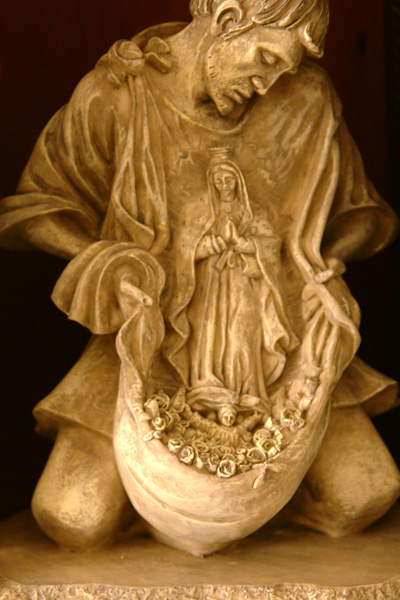
St Juan Diego.jpgLord God, through Saint Juan Diego you made known the love of Our Lady of Guadalupe toward your people. Grant by his intercession that we who follow the counsel of Mary, our Mother, may strive continually to do your will.


The information about him that has reached [the Church] praises his Christian virtues: his simple faith, nourished by catechesis and open to the mysteries; his hope and trust in God and in the Virgin; his love, his moral coherence, his unselfishness and evangelical poverty.  Living the life of a hermit here near Tepeyac, he was a model of humility. The Virgin chose him from among the most humble as the one to receive that loving and gracious manifestation of hers which is the Guadalupe apparition. Her maternal face and her Saint image which she left us as a priceless gift is a permanent remembrance of this. In this manner she wanted to remain among you as a sign of the communion and unity of all those who were to live together in this land. (Pope John Paul II, Beatification homily 6 May 1990)

Saint Ambrose

| | Comments (0)

St Ambrose writing.jpgO God, Who did give Thy people blessed Ambrose as a minister of eternal salvation, we beseech Thee; grant that we may deserve to have him as an intercessor in heaven, whom we had as a teacher of life on earth.


Pope Benedict reminds us that "Bishop Ambrose - who never tired of saying: 'Omnia Christus est nobis! To us Christ is all!' - continues to be a genuine witness of the Lord.' Read the Pope's brilliant address on Ambrose.


 Say a prayer for the Archdiocese of Milan, converts, theologians, bee keepers, domestic animals and learning.

Saint Nicholas

| | Comments (0)

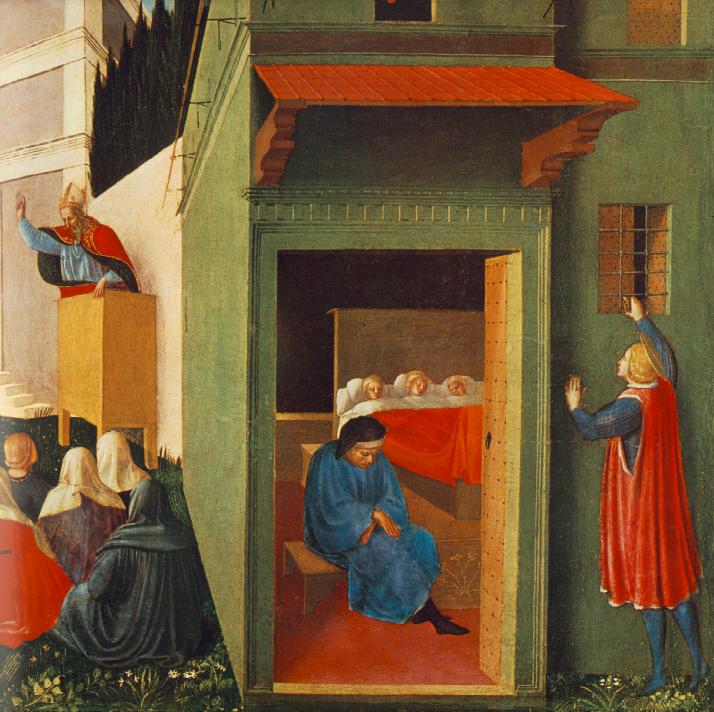
St Nicholas giving dowry.jpgThe Lord led the just in right path; and showed him the kingdom of God.


O God, Who did adorn the holy Bishop Nicholas with innumerable miracles; grant, we beseech Thee, that by his merits and prayers we may be delivered from the flames of hell.


Saint Nicholas is now known as Santa Claus the hagiography tells us that he was a man of great compassion for the weak and poor. He attended to his calling to proclaim the Gospel, teach the faith and to act justly to those in need.


Also on this feast I recall hearing that pious legend of Saint Nicholas that was feeling rather angered by Arius at the Council of Nicea that he got up and kicked Arius' butt, or perhaps he just slapped Arius and hard. I am trying to imagine the scene...Santa Claus had a backbone or was really a thug: theologian meets heretic. And I am trying to think how annoying Arius was to the Council Fathers and to Nicholas and if there is a Vatican II analog.


Saint Nicholas' relics are in Bari, Italy and he is honored by both the Eastern and Western Churches.

Saint Saba, abbot

| | Comments (0)

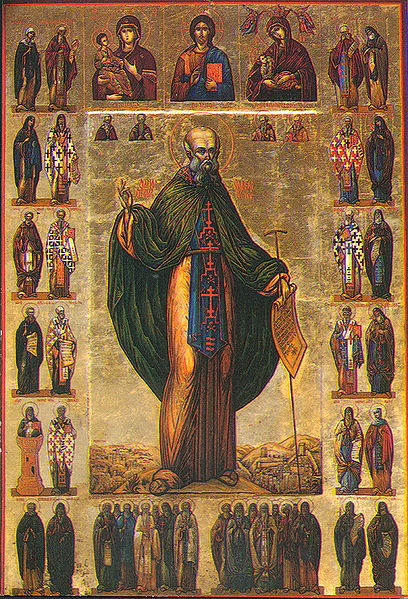
St Saba3.jpgThe just man will flourish like the palm tree. Planted in the courts of God's house, he will grow great like the cedars of Lebanon

(Psalm 91: 13-14)


Lord our God, in your providence you raised up blessed Saba to foster the monastic life and to defend and uphold the truth of the faith. May we always live that truth in love and serve only you until we attain everlasting joy and glory.


A hagiographical note:


St. Saba (Sava), First Archbishop of Serbia, was born in 1169, a son of the Serbian King Stephen and Anna, daughter of the Byzantine Emperor Romanus. Against the will of his father, St. Saba received monastic tonsure and sought to persuade his powerful parents to accept monasticism. His father became a monk and his mother a nun. The father and son founded Hilandar Monastery on Mount Athos. St. Saba became the first Archbishop of Serbia and successfully petitioned the Byzantine Emperor to grant permission for Serbian bishops to elect their own Archbishop in the future. St. Saba crowned his brother, Stefan, as the first king of Serbia. Sent to negotiate with the King of Hungary who had declared war on Serbia, St. Saba not only brought about peace but brought the Hungarian King to Orthodoxy. St. Saba's work in organizing the Serbian Church was accompanied by numerous signs and miracles. The Turks disinterred his body and burned it to ashes, which are now in the Serbian Church of Milshevo, and bestow healing on the faithful.


Saint John of Damascus

| | Comments (0)

Like a tree planted by streams of water,' Ps. 1:3 the soul is irrigated by the Bible and St John of Damascus.jpgacquires vigor, produces tasty fruit, namely, true faith, and is beautified with a thousand green leaves, namely, actions that please God. (The Damascene)


Almighty and eternal God, Who did imbue blessed John with heavenly doctrine and wonderful fortitude of heart for defending the veneration of sacred images; grant that through his intercession and example we may imitate the virtues, and experience the protection of those whose we venerate.


Saint John Damascene was an 8th century Syrian monk, a polymath, hymn writer, author and Doctor of the Assumption. He's known to be the last of the Greek Fathers.

Saint Francis Xavier

| | Comments (0)

St Francis Xavier the burning passion.jpgO God, who was pleased to gather unto your Church the people of the East by the preaching and miracles of blessed Francis, mercifully grant that we who honor his glorious merits, may also imitate the example of his virtues, through Jesus Christ our Lord.


Jesuit Father John Hardon's essay "The Miracles of Saint Francis Xavier."

The blood of the holy martyrs was poured out upon the earth for Christ; therefore Thumbnail image for St Edmund Campion3.jpgthey have won rewards everlasting.


Saint Edmund Campion, martyr for the Roman Primacy, obtain for us, but especially for the Church's bishops and priests, such obedient loyalty to the Vicar of Christ that like you, they will not be afraid to proclaim the truth and like you, they will be willing to shed their blood for Jesus Christ.


Some info on Campion can be read here and here.


Saint Edmund Campion (1540-1581) wrote the "Challenge to the Privy Council" but is commonly called today "Campion's brag." Some scholars say the Challenge is likely to be the earliest defense of the Catholic faith to appear in English at the time of the Reformation. No doubt Saint Edmund Campion takes 1 Peter seriously: give a reasoned defense for what you're believing. The duty and responsibility of Campion to act as a priest and a vowed Jesuit concerned for the spiritual welfare of the English is clear; reading the Brag you quickly know that he is not ashamed of the Gospel and desires to bring his listeners to the Truth. His style of speaking and acting is direct but courteous offered in friendship.


My favorite line is the last of section 8: "The expense is reckoned, the enterprise is begun; it is of God; it cannot be withstood. So the faith was planted: So it must be restored."


To the Right Honourable, the Lords of Her Majesty's Privy Council:


Whereas I have come out of Germany and Bohemia, being sent by my superiors, and adventured myself into this noble realm, my dear country, for the glory of God and benefit of souls, I thought it like enough that, in this busy, watchful, and suspicious world, I should either sooner or later be intercepted and stopped of my course.


Wherefore, providing for all events, and uncertain what may become of me, when God shall haply deliver my body into durance, I supposed it needful to put this in writing in a readiness, desiring your good lordships to give it your reading, for to know my cause. This doing, I trust I shall ease you of some labour. For that which otherwise you must have sought for by practice of wit, I do now lay into your hands by plain confession. And to the intent that the whole matter may be conceived in order, and so the better both understood and remembered, I make thereof these nine points or articles, directly, truly and resolutely opening my full enterprise and purpose.


1. I confess that I am (albeit unworthy) a priest of the Catholic Church, and through the St Ignatius & Paul III.jpggreat mercy of God vowed now these eight years into the religion [religious order] of the Society of Jesus. Hereby I have taken upon me a special kind of warfare under the banner of obedience, and also resigned all my interest or possibility of wealth, honour, pleasure, and other worldly felicity.


2. At the voice of our General, which is to me a warrant from heaven and oracle of Christ, I took my voyage from Prague to Rome (where our General Father is always resident) and from Rome to England, as I might and would have done joyously into any part of Christendom or Heatheness, had I been thereto assigned.


3. My charge is, of free cost to preach the Gospel, to minister the Sacraments, to instruct the simple, to reform sinners, to confute errors--in brief, to cry alarm spiritual against foul vice and proud ignorance, wherewith many of my dear countrymen are abused.


4. I never had mind, and am strictly forbidden by our Father that sent me, to deal in any respect with matter of state or policy of this realm, as things which appertain not to my vocation, and from which I gladly restrain and sequester my thoughts.


5. I do ask, to the glory of God, with all humility, and under your correction, three sorts of indifferent and quiet audiences: the first, before your Honours, wherein I will discourse of religion, so far as it toucheth the common weal and your nobilities: the second, whereof I make more account, before the Doctors and Masters and chosen men of both universities, wherein I undertake to avow the faith of our Catholic Church by proofs innumerable--Scriptures, councils, Fathers, history, natural and moral reasons: the third, before the lawyers, spiritual and temporal, wherein I will justify the said faith by the common wisdom of the laws standing yet in force and practice.


6. I would be loath to speak anything that might sound of any insolent brag or challenge, especially being now as a dead man to this world and willing to put my head under every man's foot, and to kiss the ground they tread upon. Yet I have such courage in avouching the majesty of Jesus my King, and such affiance in his gracious favour, and such assurance in my quarrel, and my evidence so impregnable, and because I know perfectly that no one Protestant, nor all the Protestants living, nor any sect of our adversaries (howsoever they face men down in pulpits, and overrule us in their kingdom of grammarians and unlearned ears) can maintain their doctrine in disputation. I am to sue most humbly and instantly for combat with all and every of them, and the most principal that may be found: protesting that in this trial the better furnished they come, the better welcome they shall be.


7. And because it hath pleased God to enrich the Queen my Sovereign Lady with notable gifts of nature, learning, and princely education, I do verily trust that if her Highness would vouchsafe her royal person and good attention to such a conference as, in the second part of my fifth article I have motioned, or to a few sermons, which in her or your hearing I am to utter such manifest and fair light by good method and plain dealing may be cast upon these controversies, that possibly her zeal of truth and love of her people shall incline her noble Grace to disfavour some proceedings hurtful to the realm, and procure towards us oppressed more equity.


8. Moreover I doubt not but you, her Highness' Council, being of such wisdom and discreet in cases most important, when you shall have heard these questions of religion opened faithfully, which many times by our adversaries are huddled up and confounded, Thumbnail image for IHS.jpgwill see upon what substantial grounds our Catholic Faith is builded, how feeble that side is which by sway of the time prevaileth against us, and so at last for your own souls, and for many thousand souls that depend upon your government, will discountenance error when it is bewrayed [revealed], and hearken to those who would spend the best blood in their bodies for your salvation. Many innocent hands are lifted up to heaven for you daily by those English students, whose posterity shall never die, which beyond seas, gathering virtue and sufficient knowledge for the purpose, are determined never to give you over, but either to win you heaven, or to die upon your pikes. And touching our Society, be it known to you that we have made a league--all the Jesuits in the world, whose succession and multitude must overreach all the practice of England--cheerfully to carry the cross you shall lay upon us, and never to despair your recovery, while we have a man left to enjoy your Tyburn, or to be racked with your torments, or consumed with your prisons. The expense is reckoned, the enterprise is begun; it is of God; it cannot be withstood. So the faith was planted: So it must be restored.


9. If these my offers be refused, and my endeavours can take no place, and I, having run thousands of miles to do you good, shall be rewarded with rigour. I have no more to say but to recommend your case and mine to Almighty God, the Searcher of Hearts, who send us his grace, and see us at accord before the day of payment, to the end we may at last be friends in heaven, when all injuries shall be forgotten.


About the author

Paul A. Zalonski is from New Haven, CT. After years of study, work and trying to find meaning in life, he still has a sense of humor. Paul is discerning God's plan and is preparing for ordination to the priesthood. Contact Paul at paulzalonski(at)yahoo.com.

Pages

Humanities Blog Directory

About this Archive

This page is a archive of entries in the Saints category from December 2008.

Saints: November 2008 is the previous archive.

Saints: January 2009 is the next archive.

Find recent content on the main index or look in the archives to find all content.