Recently in Faith & Reason Category

We the People.jpg

Today, the US bishops issued a call to action to defend religious liberty and urged laity to protect the First Freedom of the Bill of Rights. No doubt there is  considerable consternation surrounding the proposed usurpation of our legal freedom of religion: clearly the US President has forgotten the first clause of the Bill of Rights: "Congress shall make no law respecting an establishment of religion, or prohibiting the free exercise thereof...."

The statement, "Our First, Most Cherished Freedom," aims to inform and to encourage the entire Christian Church in North America -and beyond--in understanding what the Church teaches on religious liberty. Moreover, the US bishops want to encourage a rightful role in defending the first of our American liberties. Being Catholic -or a person of faith- does not mean that we give up a sense of reasonableness and citizenship. The bishops published this work in order to reassert their voice in the public square, thus bridging the gap of faith and reason for a coherent national debate on matters of concern. Religion cannot be relegated to the closet. Like most documents of the Church, this one also hopes not only to impart information but also to form Catholics (indeed, all Christians) as faithful citizens. It is our Christian belief that religious liberty is God-given and is not imparted by our elected officials. "Our First, Most Cherished Freedom" is a document of the Bishops' Ad Hoc Committee on Religious Liberty.

Bookmark and Share
Paul pp VI.jpgToday is the 45th anniversary of Populorum Progression (On the Development of Peoples) the 5th encyclical of the Servant of God Pope Paul VI. The 18,000 word letter deals with the socioeconomic issues of world sick building upon Blessed John XXIII's Mater et Magistra

Populorum Progressio was long accorded as the humanist manifesto because it examines and urges a tailored response of the educated and wealthier nations toward those who live in poverty (subhuman standards). 

The Pope questions many things among them the ownership of land that is not used for the good of people in need, of unbriddled capitalism, the regulation of markets, foreign aid to nations, the development of internal programs to aid citizens rather than exporting natural resources to other nations and the right of governments to develop performing lands for the good of others. Pope Paul urges some controversial things: higher taxes for the rich, the expansion of aid programs, higher prices for products from third world nations, a just wage for workers, and the establishment of just interest rates for monies loaned. Freedom, charity, justice, and peace are given to all by God.


Bookmark and Share

CDF updating its files

| | Comments (0)
CDF pic.jpg

The Pope's office which handles matters pertaining to the Faith, the Congregation for the Doctrine of the Faith, is updating itself. Well, it's updating its presentation of the Faith as it pertains to the documents it produces. The new "look" of a webpage is the same dull thing, but documentation is being added in more categories and languages. They're aiming at using the web more effectively for the sake of teaching Truth. Cardinal Levada's intention is to provide a wider distribution of the work of the CDF. Blessings!

The new website can be found here.

Bookmark and Share
The Jesuit-run School of Theology and Ministry has had a priest on their faculty who's refused to function as a Catholic until he gets an adequate explanation as to why women are not ordained as Catholic priests. He wrote to the Cardinal stating his position. John Shea, professor of pastoral care and counseling, now leaving his position because of dissent from Church teaching. Thanks be to God. The Jesuits have tolerated this act of scandal for too long. Shea's work in the classroom and beyond is not in line with his role as a professor who trains men for priesthood and the laity for ministry. He's not to pose his thinking as Catholic teaching nor is he asked by the Church to teach students for priesthood and ministry in dissenting theology. Recall: Saint Ignatius of Loyola asks an attitude of "thinking with the Church" not dissenting from the truth of Jesus Christ and His Church.

The Jesuits at BC and when Weston Jesuit School of Theology before subsumed into Boston College existed, have long accepted and promoted professors who not only challenge Church teaching but openly reject the teaching authority of the Church as a matter of pride. Thinking with the Church was no longer an accepted method of "doing" theology. When I was at WJST we had several Jesuits under investigation for their divergent teaching. Each one of them saw ecclesial investigation as a badge of honor; their investigation was act of imperialism by the Vatican. One Jesuit priest actually said that not dissent from the Church is a sin against the Holy Spirit and another said that the Society of Jesus is the loyal opposition to the Church. Really.

Good for BC, but I doubt the Jesuits are doing this because Father Shea is a dissenter and harming the formation of students.

Bookmark and Share

Many of say that conscience rights is under attack. And with good reason. Take for instance the US Senate's recent rejection of conscience rights viz. President Obama's healthcare fiasco. So, a reasonable question is what the understanding of the role of conscience in moral decision making?

The Catechism of the Catholic Church (par. 1790-93) states the following about erroneous judgement:

A human being must always obey the certain judgment of his conscience. If he were deliberately to act against it, he would condemn himself. Yet it can happen that moral conscience remains in ignorance and makes erroneous judgments about acts to be performed or already committed.

Bookmark and Share

PUG.png

"Building a New World" is new initiative Interdisciplinary Centre  for Social Communications of the Pontifical Gregorian University (Rome, Italy) beginning today, Friday, 2 March.


This project is focused on film and the power film has in our lives. The premise is: a good film liberates, forms and calls us to a new way of seeing and engaging in reality. Therefore, the good people at the Gregorian are exploring how a good movie or documentary can invite people to greatness through the imagination and research how a poorly written movie with mediocre images can severely handicap one's openness to the true, the beautiful and the good. Just think of the good Father Robert Barron's "Catholicism" project is doing for those learning the Catholic faith for the first time or those renewing their faith; or how damaging "The Deputy" was to to the person of Pope Pius XII and the rest of the Church.

Enhanced by Zemanta
Bookmark and Share

It was brought to my attention that we need to ask the Holy Spirit for wisdom. We need help. So ask for it. Let's look at what the Church said at the Second Vatican Council about our own times in Gaudium et Spes:

To carry out such a task, the Church has always had the duty of scrutinizing the signs of the times and of interpreting them in the light of the Gospel. Thus, in language intelligible to each generation, she can respond to the perennial questions which men ask about this present life and the life to come, and about the relationship of the one to the other. We must therefore recognize and understand the world in which we live, its explanations, its longings, and its often dramatic characteristics. Some of the main features of the modern world can be sketched as follows.

Today, the human race is involved in a new stage of history. Profound and rapid changes are spreading by degrees around the whole world. Triggered by the intelligence and creative energies of man, these changes recoil upon him, upon his decisions and desires, both individual and collective, and upon his manner of thinking and acting with respect to things and to people. Hence we can already speak of a true cultural and social transformation, one which has repercussions on man's religious life as well.


Bookmark and Share
Bishops of the Orthodox Churches --those of the various jurisdictions in the USA-- have called upon the Orthodox faithful to protest the Obama Administration's ruling which affects matters of conscience. Since this is NOT a Catholic issue --one needs to say it's a matter for all people, regardless of profession of faith. Exercising one's right to speak out against injustice, here it's a matter of injustice done by the government, Christians need to unite their hearts, minds, and voices and work for substantial change.

One doesn't hear of the Orthodox Church on Pro-Life matters too often but you do see a greater presence of the Orthodox Church at events like the Pro-Life March in Washington, DC. In recent years their bishops, priests, seminarians (from St Vladimir's) and laity have begun to show up to the March. They gather at the Orthodox Cathedral and walk with the others.

Here, we all need the Orthodox witness. Thanks goes to Greek Orthodox Metropolitan Savas (Pittsburgh) for his good work on the project.

Assembly of bishops.jpgThe Assembly of Canonical Orthodox Bishops of North and Central America, which is comprised of the 65 canonical Orthodox bishops in the United States, Canada and Mexico, join their voices with the United States Conference of Catholic Bishops and all those who adamantly protest the recent decision by the United States Department of Health and Human Services, and call upon all the Orthodox Christian faithful to contact their elected representatives today to voice their concern in the face of this threat to the sanctity of the Church's conscience.
Bookmark and Share


Wm levada.jpg

Today, in Rome, there is a Gregorian University sponsored Symposium entitled "Towards Healing and Renewal." It is a four day gathering of professionals and clergy-types who have responsibility for working with victims and family members of sexual abuse. While not personally in attendance, Pope Benedict XVI was present through his personal message sent to participants and with the presence of several cardinals and bishops, Including William Cardinal Levada, 76, Prefect of the Congregation for the Doctrine of the Faith. Cardinal Levada's address, "The Sexual Abuse of Minors: A Multi-faceted Response to the Challenge," follows.

The Pope's message iterates in this context, as he has done in the past, his hope and life's work that "healing for abuse victims must be of paramount concern in the Christian community," with "a profound renewal of the Church at every level." Further, he "supports and encourages every effort to respond with evangelical charity to the challenge of providing children and vulnerable adults with an ecclesial environment conducive to their human and spiritual growth" and he urges the participants in the Symposium "to continue drawing on a wide range of expertise in order to promote throughout the Church a vigorous culture of effective safeguarding and victim support."

The Sexual Abuse of Minors: A Multi-faceted Response to the Challenge Toward Healing and Renewal" is the title given to this Symposium for Catholic Bishops and Religious Superiors on the Sexual Abuse of Minors. For leaders in the Church for whom this Symposium has been planned, the question is both delicate and urgent. Just two years ago, in his reflections on the "Year for Priests" at the annual Christmas greetings to the Roman Curia, Pope Benedict XVI spoke in direct and lengthy terms about priests who "twist the sacrament [of Holy Orders] into its antithesis, and under the mantle of the sacred profoundly wound human persons in their childhood, damaging them for a whole lifetime." I chose this phrase to begin my remarks this evening because I think it important not to lose sight of the gravity of these crimes as we deal with the multiple aspects the Church's response.

Bookmark and Share

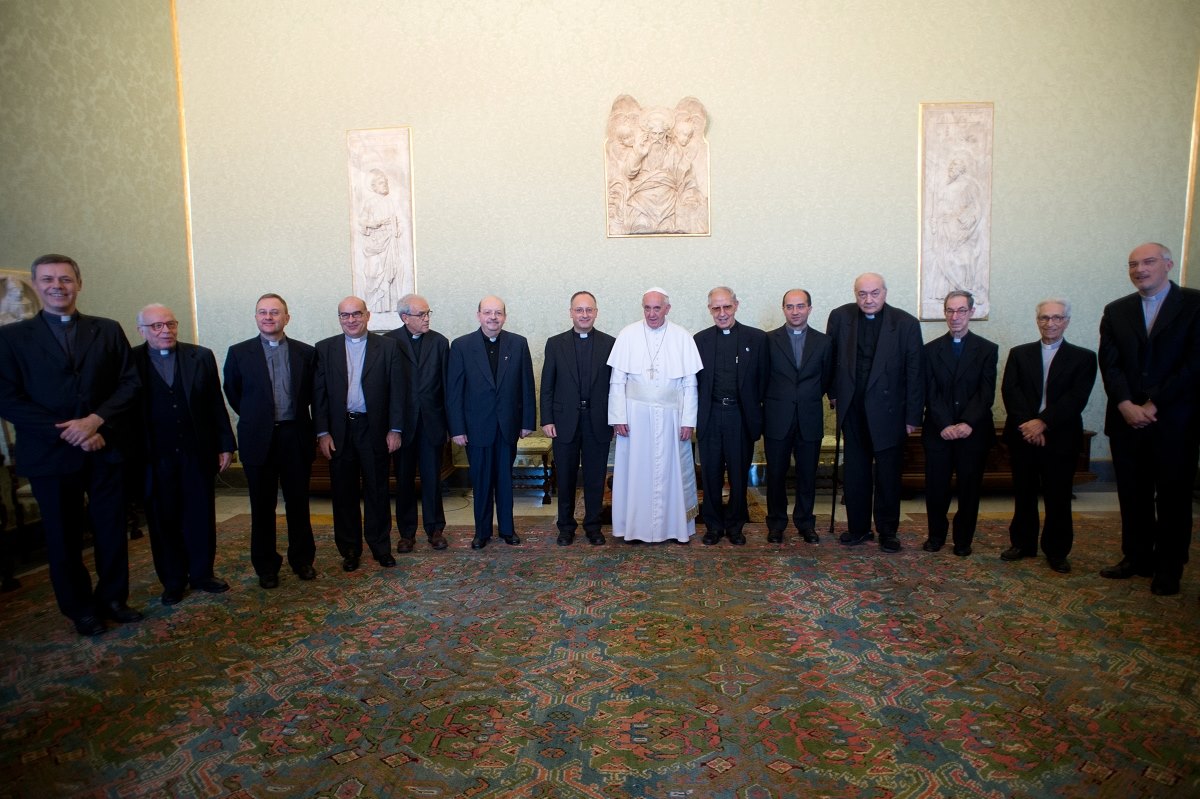
The full body of the Congregation for the Doctrine of the Faith met with the Pope on Friday, 27 January, to discuss his conviction that no other work of the Church, particularly this congregation, takes precedence to the work of evangelization. Everyone ought to be committed "to bringing God back into this world and to opening to all men access to the faith."


Benedict see now as the opportune moment "to point out to all the gift of faith in the Risen Christ, the clear teaching of the Second Vatican Council and the invaluable doctrinal synthesis offered by the Catechism of the Catholic Church." Recently, the Pope said that "we are facing a profound crisis of faith, a loss of religious meaning which constitutes the greatest challenge to the Church" (Message for World Mission Day).


Other things that concern us, the Pope noted were:


1. the unity among Christians:  maintaining "coherence in the ecumenical task with the Second Vatican Council and the whole of Tradition";

2. warned of the dangers of "a shallow moralism";

3. to promote "the logic" contained in the conciliar teaching: "the sincere search for the full unity of all Christians is a dynamism animated by the Word of God";

4. a need for a "discernment between Tradition with a capital letter and the traditions": "There exists," he said, "a spiritual wealth in the different Christian confessions, which is an expression of the one faith and gift to share" (reflecting the recent work done for the full communion of Anglicans).


The last concern of Benedict was that the entire Church speak with one voice with Peter.

Bookmark and Share
cardinal t. dolan.jpg

Fordham Law School's Institute on Religion, Law & Lawyer's Work hosted Archbishop Timothy Michael Dolan, PhD, for an inaugural address in the Law and the Gospel of Life series. 

Sadly, it didn't make the news, well not much was said around the area about it. Fordham University published this brief press release read here. The crowd exceed initial expectations and a change of venue was made. Cardinal-designate Dolan centered his comments on Blessed John Paul II landmark encyclical, the Evangelium Vitae (1995). An excerpt of Dolan's remarks follows, below is the link to his entire text:

The Gospel of Life proposes an alternative vision of law and culture, one that provides an antidote to the pragmatic nihilism that produces a Culture of Death. It seeks to recapture the essential relationship between the civil law and the moral law, and to foster a culture in which all human life is valued and authentic human development is possible.

Bookmark and Share
angle of the vatican basilica.jpg

The Papal General Audience given in the Paul VI Hall today, Benedict spoke of the desire for unity that our Lord expressed in his priestly prayer at the Last Supper (John 17):


Against the backdrop of the Jewish feast of expiation Yom Kippur, Jesus, priest and victim, prays that the Father will glorify him in this, the hour of his sacrifice of reconciliation. He asks the Father to consecrate his disciples, setting them apart and sending them forth to continue his mission in the world. Christ also implores the gift of unity for all those who will believe in him through the preaching of the apostles.


Sacred Scripture and sacred Tradition and now echoed by Pope Benedict, believes that Christ's priestly prayer is understood as His instituting the Church, the community of faith, the communio found  explicitly in a church that is one, holy, catholic and apostolic. Taking the Pauline manner of thinking, we are disciples of Christ who, through faith in Christ, are one and share in His saving mission:


In meditating upon the Lord's priestly prayer, let us ask the Father for the grace to grow in our baptismal consecration and to open our own prayers to the needs of our neighbors and the whole world. Let us also pray, as we have just done in the Week of Prayer for Christian Unity, for the gift of the visible unity of all Christ's followers, so that the world may believe in the Son and in the Father who sent him.

Bookmark and Share
Earlier today, Monsignor Paul Tighe, the Secretary to the Pontifical Council for Social Communications, talked about the Pope's 2012 message for World Communications Day (May 20, 2012). 

To some the combination of silence and word as a path to sharing the Good News of Jesus Christ is a contradiction, mutually exclusive and not an adequate response to making the Name of the Lord known and loved. Not at all. God reveals Himself in words and deeds but He also speaks to us in silence. Indeed, in silence. Wonder and awe before the Divine Mystery is only lived in silence. The Church Fathers knew this; medieval saints and theologians knew this, and so does the contemporary Church. Father Jean-Pierre Ruiz of St John's University (Queens, NY) speaks to the perceived contradiction here.

"Silence and Word: Path of Evangelization" is the 46th message of the pope's speaking in favor of social communications. It is terrific, it is necessary, read it!!!!
Bookmark and Share

About the author

Paul A. Zalonski is from New Haven, CT. After years of study, work and trying to find meaning in life, he still has a sense of humor. He is a member of the Fraternity of Communion and Liberation, a Catholic lay ecclesial movement and an Oblate of Saint Benedict. Contact Paul at paulzalonski[at]yahoo.com.

Categories

Archives

Humanities Blog Directory

About this Archive

This page is a archive of recent entries in the Faith & Reason category.

Faith & Ecology is the previous category.

Faith & the Public Order is the next category.

Find recent content on the main index or look in the archives to find all content.