Recently in Vocations Category

May the Lord grant you His peace!

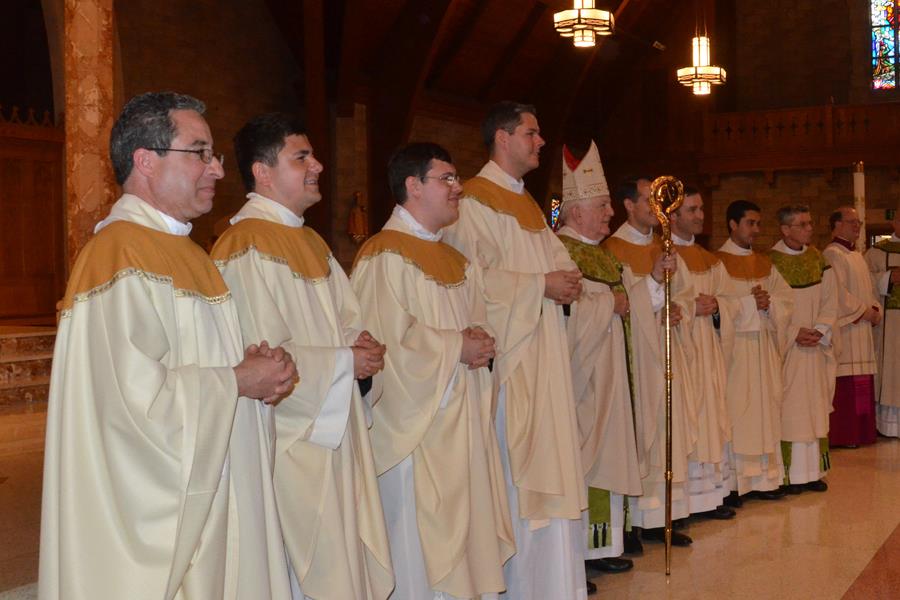
Great news echoes in the heavenly courts: 16 Franciscan Friars of the Renewal novices professed temporary vows (poverty, chastity and obedience) today at Saint Antoninus Church (Newark, NJ). Newly elected Community Servant (Fr. Provincial) Father Mariusz Koch received the vows. A reception followed at the novitiate of the Most Blessed Sacrament Friary also in Newark, NJ. Bishop Emmanuel Cruz, auxiliary bishop of the Archdiocese of Newark was present. Here are some pics of the community.

CFR novices 2010.jpg
The Friars also invested 10 new men as novices on Saturday. Names are always fun, especially when you think, "where did they get that name from?" Read the new names:

Br Frantisek Marie Chloupek, Br Vittorio Maria Pesce, Br Jude Thaddeus Boyden, Br. Tobias Marie Redfield, Br Simeon Mary Lewis, Fr. Maximillian Mary McGoldrick, Br Seamus Mary Laracy, Br Mark-Mary Maximilian Ames, Br Angelus Immaculata Montgomery, Fr Felipe Immaculee Casadia.

May Saints Francis and Clare bless the new friars abundantly!

Massimo Camisasca.jpgOn February 26th Zenit published an article by Father Massimo Camisasca looking at what he considers to be the pillars (prayer & Liturgy) of priestly reform in the Catholic Church. Reading a bit of Church history recently there's been a lot to consider when thinking about the state of the Catholic Church viz. the rise of Portestantism and then the decline of the Christian religion in some parts of the US and the world. Father Massimo Camisasca is the founder and superior general of the Priestly Fraternity of the Missionaries of St. Charles Borromeo. The Fraternity was founded in 1985 and recognized as a Society of Apostolic Life in 1999.


Statistical data of the past 30 years reveals an increase of 5% more diocesan priests worldwide, compared with an increase of 48% more baptized persons.
 
This alone could explain the question in the title of my latest book, "Padre ci saranno ancora sacerdoti nel futuro della Chiesa?" (Father, Will There Still Be Priests in the Future of the Church?) -- a theme that underlies the entire text.
 
However, even more than the number of priests, the Church is interested in the truth of their experience. For reasons connected with my work as superior of a fraternity of missionaries, I travel throughout the world and am in contact with the most diverse realities. And, meeting with priests of different regions, I note that many of them experience difficulties not so much of an ideological type as of an emotional order.
 
Why is it that today the priestly life -- which has made thousands of men happy and contributed enormously to the spiritual growth of humanity -- is going through such a profound qualitative crisis?
 
My [Italian-language] book stems from this question. It is an attempt to rethink the life of a priest from its roots.

Rebirth
 
The regeneration of priestly life is one of the conditions for the new flowering of Christianity in Europe, and more generally, in our jaded West (Asia and Africa merit separate treatment).
 
I have attempted to trace the path for a rebirth returning to the fundamentals of the priesthood. I find one of those fundamentals in prayer.
 
Today many priests lose themselves in action, in the infinite number of activities and preoccupations that entrap them. For the action of each one of us to always be a source of nourishment, it must be constantly redirected to our relationship with Christ. And the place of our relationship with Christ is prayer, inseparable from silence.
 
Silence, prayer, reflection and study are the answer to one of the evils that afflict the figure of the priest: activism, which remains on the surface of things and absorbs the time of our energies and our feelings. Instead, action that stems from charity introduces us in the work of God, who precedes and exceeds us.

Liturgy
 
Another pillar of the renewal of priestly life is the liturgy. I say this following the teaching of the Pope. I am not ruled by the desire to accommodate myself to a current, but by a profound conviction that is born from experience.
 
If the priest does not rediscover the true meaning of the liturgy in his life, he cannot find himself.
 
Surmounting the process of trivialization, which we have witnesses in the last 30 years, it is necessary to return to that "fons et origo" that the Second Vatican Council identifies in the liturgy.
 
When it is faithful to the one who instituted it, when it is lived in all its rigorous totality and is attentive to the tradition of the Church, the liturgy is the place of education to communion.
 
The protagonist of the liturgy is Christ. By living the liturgy, we can enter into the life of God, and only thus can we priests be an effective company of men.
 
In the third place, the emotional question is central in the life of a priest. Loneliness is the other great evil that today afflicts thousands of priests.
 
Only by discovering himself a son can the priest be a father.

Friendship is a positive experience in a person's emotional life. In the Church there is still much fear of friendship. Pathologies are not channeled if one is not helped to develop a healthy life.
 
Unhealthy and negative friendships, which because of this are not proper friendships, must not close us off from the essential value of these bonds of preference that open us to the love of others and help us to understand who God is.

From athlete to religious life

| | Comments (0)
Holum3.jpgA few weeks ago Yahoo sports posted a story that caught my attention (but I am only now getting around to posting it, sorry) about a former world-class speedskater now on a journey to the vowed life as a Franciscan Sister of the Renewal.

Holum2.jpg
Kirstin Holum, now Sister Catherine, stands out because she was once a high-profile athlete with promise now (she was at the 1998 Olympics in Japan) she's devoting her life to Christ and the Church in a new race outlined by Jesus, Saint Paul, Saint Francis and the Church.

Prayers for Sister Catherine's perseverance and for the Sisters of the Renewal.

Today the Dean of Students at St. Joseph's Seminary - Dunwoodie, Father Andrew King, was the principal celebrant and he preached the homily. The readings from sacred Scripture for today's Mass give us lots of grist for the mill given the question of discernment of spirits and God's call to the priesthood. How could one not think of mission, discipleship, preaching Christ crucified and risen and salvation when listening to Scriptures? He raises some excellent questions in the discernment of God's will viz. service as priest. One the points Fr King raises and that I find compelling is one that we at the dinner table frequently mention, the distinctions needed in vocation discernment: that priesthood and marriage are not of equal weight or of lasting importance. Marriage is a good and many people have a calling from God to be married. BUT priesthood is oriented to the supernatural, to salvation, to our final end, and thus not on the same level as marriage: its goal is different and higher as it concerns communion with the Blessed Trinity. Father King is quite good in pulling out some very central questions.


Christ on Lake Tiberias Fishing Duccio.jpg

One could not find a more fitting place than a seminary to reflect on the Sacred Scriptures presented to us this morning... readings that manifest the Divine sovereignty and initiative... and the free human response which is inspired, supported, and guided by Divine grace.

The Divine sovereignty is shown by the Lord's choice of who to call... He is not bound by human expectations of judgments of who is more deserving or less deserving.

St. Paul..... knows himself to be unworthy...  "I am not fit to be called an apostle, because I persecuted the Church of God."

Isaiah ... "I am a man of unclean lips, living among a people of unclean lips"

St. Peter.... "I am a sinful man"

Apparently, all this is true: there is no disagreement with Isaiah's assessment, nor with Paul's, nor with Peter's. Indeed, their self knowledge, and admission of being unfit to be in the presence of God is a necessary condition for the ever deeper conversion that allows them, to remove obstacles to a greater love for the Lord. 

The acknowledgement of their weakness is paradoxically united with a deep confidence in what God can work through them. Trusting less and less in themselves, they trust more in God.

Even more paradoxically, the less they trust in themselves, the more freedom they have to act.

Isaiah says:  "Send me." ... a bold statement!

St. Paul 'matter of factly' says that he has worked harder and done more than all the other apostles!

St. Peter says less, and lets his actions speak... leaving his boat, net, and life, to become a disciple of the Lord.

A reflection on the readings could go in a number of directions, and circumstances invite us to look at the vocation to the priesthood in particular.

There have been difficulties with the way priestly vocations are presented.

At the beginning of the last century, there was considerable controversy in France over the nature of a priestly vocation. It became so heated that an appeal was made to the Holy See, asking for an intervention. Pope Pius X established a commission of Cardinals to examine the particular matter of controversy, and on June 26, 1912 they issued a brief statement that noted that the judgment of the Church is integral to the definition of what a priestly vocation is. This corrected a tendency to overemphasize the subjective dispositions of one claiming to have a vocation, and marginalize the judgment of the Church (i.e. the bishop).

In our own day, I think that we often, with the best of intentions, speak of priestly vocations in a way that makes it very unlikely that a person will recognize such a vocation.

We begin with the questions: "Does God want you to be a priest?" "Is God calling you to be a priest?"

The response, and the appropriate one, for most young men is: "I don't know... after all, how do I know what God thinks about something like that, and how would I know?"

We continue: "Well, do you feel like God is calling you to the priesthood, do you feel an attraction to the priesthood?"

The response:  "I haven't thought about it all that much, but I know that I feel an attraction to marriage, so I guess God is calling me to be married."

This sort of conclusion is all the more likely, given the tendency to speak about marriage and the priesthood as vocations, without making any distinctions in the way we use the term 'vocation'. Frankly, even if we make the appropriate distinctions (that the attraction to marriage is written into our nature, while the priestly vocation is supernatural, so that both can be present in a person), the fact that both are called vocations will lead many of the faithful to view them as equivalent.

The questions: "Does God want you to be a priest?" "Is God calling you to be a priest?" are good ones... indeed essential ones.

Archbishop Dolan tells of a conversation he had while serving as rector:

Once, while rector of the North American College in Rome, I was interviewing on of our new students.

"Why do you want to be a priest?" I asked him.

He looked at me a bit awkwardly.

"Pardon me, Monsignor, but, what I really want has nothing to do with it. I want to be a priest because I have discerned - after a lot of prayer, soul searching, and talking with people I trust, - that the Lord wants me to be a priest. It's not about me. I'ts about Him. I only want to be a priest because I believe He wants me to!"

Bravo! He is right on target.   

[Source: Is Jesus Calling you to be a Catholic Priest?, National Conference of Diocesan Vocation Directors. 2008]

I suggest that in the current circumstances, a brief introduction can clear the way for someone to answer these essential questions more accurately - and thus to recognize a priestly vocation in themselves or in another.

Introduce the matter by asking: 

"Are you willing to be a priest?"

And also, "Why would a person be willing to be a priest?"

Why are you willing to be a priest?

            A person can say 'yes' to this without claiming to know the will or mind of God.

            They only have to know their own mind and will.

            Further their own mind should be informed in such a way that will lead them to say 'yes'.

Propose the reasons why a person would be willing to be a priest. Look to things such as:

            -mankind's need for salvation

            -Christ is savior

                        -Christ saves by means of His Church

                        -the necessity of the priesthood within the Church

                        -the glory given to God by a heroic priestly life

                        -friendship with Christ found within the priestly life

Are you willing to be a priest?

Are you willing, for the salvation of souls, and for the glory of God, to be a priest?

If you are willing to be a priest, this is a sign that very possibly you have a vocation. It is an indication, though not a guarantee, that God is calling you to the priesthood. 

If you are not willing to be a priest, pray about it some more, and ask yourself why not. Perhaps you don't have a vocation to the priesthood, but perhaps you do, and it will become clear to you through the work of grace in prayer.

Are you willing to be a priest? ..... It leads back to the question - the most essential question --  "Does God want you to be a priest?"... but it seems to offer more 'traction' so to speak for the young man hearing the question to get him moving to take practical steps towards the priesthood.

The point to get across is that if you are willing, and you also have the appropriate qualities (such as upright motives, generosity of spirit, physical health, mental ability etc.) then it is quite likely that God is in fact calling you to be a priest - that you have a vocation. In retreats, and even in the early years of seminary this is tested and examined, and through 'discernment' one comes to a greater confidence that that one does or does not have a vocation to the priesthood.

If you do have a vocation, you make a free decision as to whether or not you will accept it.

Finally, as emphasized in the 1912 declaration of the Holy See, the approval of the Church is an integral part of the vocation.     

A good treatment of this (and related topics) was written by a priest of New York:  Msgr. Charles Hugo Doyle, in Looking toward the Priesthood: the nature, dignity, necessity and signs of a sacerdotal vocation (1961).  Another priest of N.Y: Rev. Joseph W. Grundner translated in 1937 an excellent book called Vocation to the Priesthood by Wilhelm Stockums, an auxiliary bishop of Cologne (not to be confused with Stockums' book on the priesthood). A superb treatment of discernment is found in a 35 page booklet Is Jesus Calling you to be a Catholic Priest? published by the National Conference of Diocesan Vocation Directors. It was written by Fr. Thomas Richter, the vocation director of the Diocese of Bismark, ND.

 A few cautions:

We should be cautious about setting low human expectations on the number of priestly vocations that the Lord wills to raise up. Accounts (I have not seen official numbers) from years when the faith showed more vitality in New York, indicate that some Catholic boys' high schools were sending a significant number of their graduates to seminaries of one sort or another. I would not be surprised if ten percent of fit Catholic young men have a priestly vocation.

Does that sound excessive?

Suppose there were three Catholic families that between them had ten boys and ten girls. Would it be surprising that from those three families, there would be at least one priestly vocation?  There is your ten percent.

We should also be cautious about setting low human expectations on what is possible, even in the relatively near future. A priest I know in South Dakota is pastor of a large parish (unusually large for his diocese, but more common on the East Coast). The other year they had a prayer campaign in the parish - asking that two young men from their parish would go to a seminary that year. They got it. Two entered. I have to get in touch with him to see if they continued the prayer campaign this year, and what has happened.

The contribution that Catholic couples can make is evident: grow in holiness, and should God bless them with continued fertility, have more children.

As priests, you can do a lot to help make these things happen.

In all of this we turn to Mary, the Mother of Jesus the Priest, to Mary the Mother of Priests. I don't know of any title that identifies Mary particularly as mother of seminarians, but there is no doubt that she has a special maternal care for seminarians. Many priests will tell you of the particular evidences of her maternal care and intercession for them as they made their way through the seminary to ordination. She helps us to respond well to our own vocation, and to be effective in leading others to do the same.

We need Mary's continual presence to guide us, preserve us, and protect us. The devil has strategies not only to lead us into distractions or despair, but also, should we avoid those pitfalls, to misguide our zeal. Mary our Mother will counter our adversary, and obtain what the Church needs - a love and high regard for priestly vocations, and what we - both priests and those preparing for priesthood -  need, particularly the grace of humility.

Interesting issues regarding the pastoral care of the sick viz. the numbers of priests available to be sacramentally present. USA Today a story that deserves some attention. Catholics are sacramental people: no priesthood, no sacraments...

On the same page as the story noted above is a video clip of Father Denis Robinson, OSB, Rector of Saint Meinrad Seminary talking about the up-tick of vocations.
Grant Desme.jpgMaking the rounds is the story that a top baseball player is following his true love, Jesus Christ by becoming a Catholic priest. Grant Desme, 23, is leaving the Oakland A's for Saint Michael's Abbey, a Norbertine community of priests and brothers in southern California. The community of Saint Michael's is young, dynamic and they think with the Church...no surprise they're getting vocations. Famous for their white habit and white biretta, the Canons Regular of Premontre were founded by Saint Norbert c. 1121.

Desme isn't the only high profile athlete to enter the seminary in recent times, soccer player Chase Hilgenbrinck, left his sport to be a secular priest. He's studying at Mount Saint Mary's Seminary.
PNAC Coat of Arms.jpg

As part of the 150th anniversary celebration of the Pontifical North American College, Pope Benedict XVI addressed a gathering of cardinals, bishops, priests, students and friends of the College on January 9, 2010. The PNAC was founded by Blessed Pius IX.


I am pleased to welcome the alumni of the Pontifical North American College, together with the Rector, faculty and students of the seminary on the Janiculum hill, and the student priests of the Casa Santa Maria dell'Umiltà. Our meeting comes at the conclusion of the celebrations marking the one hundred and fiftieth anniversary of the College's establishment by my predecessor, Blessed Pius IX. On this happy occasion I willingly join you in thanking the Lord for the many ways in which the College has remained faithful to its founding vision by training generations of worthy preachers of the Gospel and ministers of the sacraments, devoted to the Successor of Peter and committed to the building up of the Church in the United States of America.

It is appropriate, in this Year for Priests, that you have returned to the College and this Eternal City in order to give thanks for the academic and spiritual formation which has nourished your priestly ministry over the years. The present Reunion is an opportunity not only to remember with gratitude the time of your studies, but also to reaffirm your filial affection for the Church of Rome, to recall the apostolic labors of the countless alumni who have gone before you, and to recommit yourselves to the high ideals of holiness, fidelity and pastoral zeal which you embraced on the day of your ordination. It is likewise an occasion to renew your love for the College and your appreciation of its distinctive mission to the Church in your country.

Bl Pius IX.jpg

During my Pastoral Visit to the United States, I expressed my conviction that the Church in America is called to cultivate "an intellectual 'culture' which is genuinely Catholic, confident in the profound harmony of faith and reason, and prepared to bring the richness of faith's vision to bear on the pressing issues which affect the future of American society" (Homily at Nationals Stadium, Washington, 17 April 2008). As Blessed Pius IX rightly foresaw, the Pontifical North American College in Rome is uniquely prepared to help meet this perennial challenge. In the century and a half since its foundation, the College has offered its students an exceptional experience of the universality of the Church, the breadth of her intellectual and spiritual tradition, and the urgency of her mandate to bring Christ's saving truth to the men and women of every time and place. I am confident that, by emphasizing these hallmarks of a Roman education in every aspect of its program of formation, the College will continue to produce wise and generous pastors capable of transmitting the Catholic faith in its integrity, bringing Christ's infinite mercy to the weak and the lost, and enabling America's Catholics to be a leaven of the Gospel in the social, political and cultural life of their nation.

PNAC courtyard.jpeg

Dear brothers, I pray that in these days you will be renewed in the gift of the Holy Spirit which you received on the day of your ordination. In the College chapel, dedicated to the Blessed Virgin Mary under the title of the Immaculate Conception, Our Lady is portrayed in the company of four outstanding models and patrons of priestly life and ministry: Saint Gregory the Great, Saint Pius X, Saint John Mary Vianney and Saint Vincent de Paul. During this Year for Priests, may these great saints continue to watch over the students who daily pray in their midst; may they guide and sustain your own ministry, and intercede for the priests of the United States. With cordial good wishes for the spiritual fruitfulness of the coming days, and with great affection in the Lord, I impart to you my Apostolic Blessing, which I willingly extend to all the alumni and friends of the Pontifical North American College.

Br Stephen's Obedience.jpgOne the subtle joys in life that I relish is the fact that some people respond to the Lord's call to follow and serve Lord and His Church. Among the various ways to respond to the Lord is the monastic way of life under the Rule of Saint Benedict, living side-by-side others doing the same. Some may follow the monastic way as a Benedictine monk (nun) or perhaps as Cistercian monk (nun); AND just for the record, Cistercians are an 11th century reform of Benedictine monasticism. In this country there are few monasteries of Cistercian monks (only 4) but there are 12 houses of the reform of the reform called Cistercians of the Strict Observance (AKA Trappists).

Just the other day Brother Stephen from the Cistercian Abbey of Our Lady of Spring Bank (Sparta, WI) professed his temporary vows for a period of three years. He came into full communion with the Catholic Church, left a good job and put himself under obedience (friendship as Luigi Giussani would say) unto his salvation. Many God give him the grace of perseverance.

See what I am talking about by going to Brother Stephen's blog, Sub Tuum.

The monks of Our Lady of Spring support themselves by their industry, Laser Monks. Perhaps you can patronize their good work! I have bought things from them and so has my mom.

About the author

Paul A. Zalonski is from New Haven, CT. After years of study, work and trying to find meaning in life, he still has a sense of humor. Paul is discerning God's plan and is preparing for ordination to the priesthood. Contact Paul at paulzalonski(at)yahoo.com.

Categories

Pages

Humanities Blog Directory

About this Archive

This page is a archive of recent entries in the Vocations category.

Vatican II is the previous category.

World Youth Alliance is the next category.

Find recent content on the main index or look in the archives to find all content.