Recently in Interfaith Dialogue Category

A recognitio from the Holy See following a vote from the US Bishops, was received allowing for a clarification that all the covenants God made with the Jewish people are fulfilled in Jesus Christ.

Don't think this is change is revisionist theology or fancy foot work on the part of the Holy See or the US Bishops. Rather, it is standard theology and it is what the Church has consistently taught for a very, very long time. The editors of the Adult Catechism slipped up by being a bit imprecise in their work, shall we say. Of course, the statement announcing the clarification notes that the Adult Catechism is a catechetical work and not a theological text. True enough, we know...but this rationalization is a bit much. Does that mean we have to check each and every fact in the second printing of the AC, too? The Bishops' Conference statement is here.
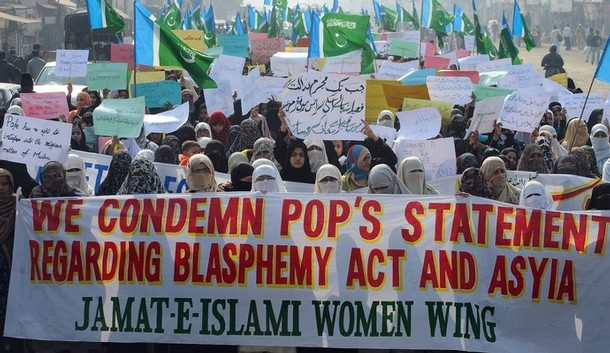
Muslims burned alive 6 Christians based on false accusations. What a crime!

Read the story. And here.

Will the international Christian community raise their voice fraternal support of the Pakistani Christians and their plight? Boy, I hope so. This is a real tragedy for all concerned and human and religious failure.

Eternal rest grant unto them O Lord. And let perpetual light shed upon them.
The Anti-Defamation League (ADL) wants the US Catholic bishops to revise the statement, Reflections on Covenant and Mission (2002) to emphasize that Catholics don't want to convert Jews to Christianity. Here's the US Bishops' recent statement on clarifications made to RCM. This is not a document of the Roman Catholic Church, i.e., the Magisterium, nor of the US Bishops. It is a work of a group of theologians, Jewish and Catholic, reflecting on mutual interests in theology.

Our theology is such that Jesus Christ is The Way, the Truth and the Life: all people come to salvation in and through Jesus Christ; God's promises through Abraham, Isaac and Jacob are fulfilled in Jesus as the definitive revelation of God. Jews are not the singular group here; Catholics believe this is true for all the world's peoples. This is revealed by the Lord Himself. It was not dreamed up by a committee. Having said all this, the Church's missiology is governed by the Vatican II document Nostra Aetate which understands Judaism in special light when it comes to evangelization but nowhere in Vatican II theology (or praxis) does it say that the Church capitulates to another faith group because of its belief is "controversial."

If someone doesn't understand or even like or wants to reject this theology, OK. We propose belief in Christ as salvific and not impose this belief on others. We have to be clear on what we believe so as to be clear on the method of sharing our belief. But why does the ADL presume to tell the Church what to believe. Do Catholics tell the Jews what remove from their theology because Catholics don't like it? Not likely.

I think RCM is fair-minded and accurate. 

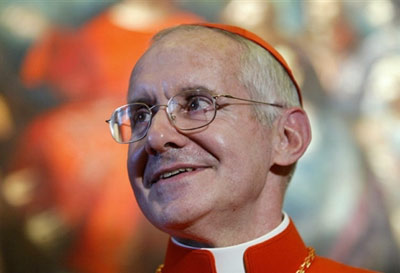
WKasper.JPGOn March 25, 2009, Cardinal Walter Kasper, helped rededicate a Holocaust memorial in Braintree, MA. (Globe Staff Photo/John Tlumacki)

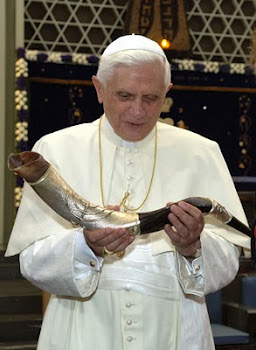
B16 meet a rabbi.jpgPope Benedict received members of the Conference of Presidents of Major American Jewish Organisations today. Speaking English, the Pope recalled his visit to a synagogue in Cologne, Germany in August 2005, and to the extermination camp of Auschwitz-Birkenau in 2006. His Holiness said,


As I walked through the entrance to that place of horror, the scene of such untold suffering I meditated on the countless number of prisoners, so many of them Jews, who had trodden that same path into captivity at Auschwitz and in all the other prison camps. How can we begin to grasp the enormity of what took place in those infamous prisons? The entire human race feels deep shame at the savage brutality shown to your people at that time.


The Church is profoundly and irrevocably committed to reject all anti-Semitism and to continue to build good and lasting relations between our two communities. If there is one particular image which encapsulates this commitment, it is the moment when my beloved predecessor Pope John Paul II stood at the Western Wall in Jerusalem, pleading for God's forgiveness after all the injustice that the Jewish people have had to suffer


The hatred and contempt for men, women and children that was manifested in the Shoah was a crime against God and against humanity. ... It is beyond question that any denial or minimisation of this terrible crime is intolerable and altogether unacceptable.


This terrible chapter in our history must never be forgotten. Remembrance - it is rightly said - is 'memoria futuri', a warning to us for the future, and a summons to strive for reconciliation. To remember is to do everything in our power to prevent any recurrence of such a catastrophe within the human family by building bridges of lasting friendship.


It is my fervent prayer that the memory of this appalling crime will strengthen our determination to heal the wounds that for too long have sullied relations between Christians and Jews. It is my heartfelt desire that the friendship we now enjoy will grow ever stronger, so that the Church's irrevocable commitment to respectful and harmonious relations with the people of the Covenant will bear fruit in abundance.


See the Pope speak about the Shoah.


Are we clear? Are there any questions about where the Church (and the Pope) stand on this matter?

The rights of Christians in Muslim countries is always threatened. A Reuters story sheds some light on the problems that the Mor Gabriel monastery in Midyat, Turkey faces right now. The monastery of Syriac Christian monks has been present on this site for 1600 years and now faces a reduction if not factual extinction. Can you imagine the extinction of a monastery built in A.D. 397 dedicated to the witness to Jesus Christ???

Is this one more reason to consider NOT admitting Turkey to the European Union??? Religious freedom is not a valued in Muslim countries and there are countless examples of this fact. Many will point to the fact that millions of dollars of land and other cultural artifacts have been stolen by the Turkish government over the years but the matter is not merely about the material wealth but about the existence of the Christian presence in the land of their birth. What has to be done is to convince the nations of Islamic rule that religious reciprocity is a value and significant to the greater freedom of all people as well as a part of the cultural heritage of the respective countries. Now a minority Christians were once a majority in many of these Muslim countries.

This article is interesting because of the facts presented, particularly the facts that show how the Christians have diminished since the radical state secularization of the country.

Let us pray to Our Lady of Lourdes, February 11th, on whose feast day the court will determine the fate of the Mor Gabriel monastery.

by Manuela Borraccino

Rome - December 9, 2008


Christians in the Holy Land face innumerable hardships, but one organization committed to helping ease their suffering - and those of other religions who are struggling - is the Catholic Near East Welfare Association, a pontifical agency for humanitarian and pastoral support. The organization's Secretary General, Msgr. Robert L. Stern, spoke with Terrasanta.net recently about the challenges facing Christians there, the Pope's planned visit to the Holy Land next year, the possible impact of a new American President, and the importance of international aid to the region.


Monsignor Stern, what are the main problems from your perspective?

Christians in the Middle East are in a sense strangers in a strange land, even though they have been born there, because if they live in Israel, they live in a Jewish state and society. In all the other countries, they live in a Muslim state and in Muslim society. So even though they are descendants of the original inhabitants of the land, still they are made to feel that they don't "fit" anymore. Sometimes, the way they live and talk encourages this because Christians identify with the West. The paradox is that sometimes in the Holy Land they say: you Christians don't belong here, you belong to Western Europe. And yet, this is where Christianity started.


So they are second class citizens?

In Islam, Christians and Jews are considered people of the Book, and therefore they are respected as forerunners of Islam but not fully conforming to the Will of God. And so they are second class citizens, but they have a unique status. In Israel of course, in a Jewish state, if you are not a Jew, even though it's a democratic society, you are in fact a second class citizen as well. So it's the very nature of being a Christian in that part of the world. And in that part of the world your religious identity comes first; in the West it's more your national identity that comes first.


In which countries is there discrimination against Christians?


If you don't identify entirely with all their values, then, depending on the countries, it varies. Let's take Egypt for example: to really succeed in many roles, in politics and business, your chances are better if you are Muslim. It doesn't mean that to succeed is impossible, but it's human nature...There's a kind of discrimination which is the way people act when they deal with someone who is not quite a member of their own group.   


0223114808.jpgWhat is the future for Christians in the Middle East?


Well, if you look at it very dispassionately, from a sort of sociological point of view (sociologists look at trends and the statistics of 500 years ago, 1000 years ago, 100 years ago), what seems to be happening is the exodus of Christians from all over the Middle East. Right now, Israel-Palestine has the smallest proportion of Christians than in any country of the Middle East...What we are really seeing over the centuries is an accelerating movement of Christians away from that part of the world.


What role can Christians play in those societies?


Christians as minorities are, generally speaking, well-educated professionals and compared to their numbers they have an important influence in each of the countries in which they live. And that's a contribution. I also feel that the Christians can be a sort of bridge because in most of the countries they are Arabs, but they are not Muslims. They can be a connection between the modern societies of the Western world and emerging societies in the Islamic world because they are Arabs and they are Christians.


What are your expectations for Barack Obama's presidency?


I guess my hope, especially as an American citizen, is that the new president will bring certain perspectives. If you grow up as a child of an American mother and an African father, if you grow up as a child of a Christian mother and a Muslim father, if you are born in Hawaii and you go to school in Indonesia, then you understand differences better - at least during his campaign he seemed to speak of that. So I hope that he would bring a type of perspective.


Next year the Pope will visit to Israel. Do you have any thoughts on that?


It'll be a great shot in the arm for them. It's exciting because when the Pope comes, the whole world follows him. I was there when Pope John Paul II came and, at that moment, everybody in the Holy Land - Muslim, Jew, Christian - everybody spent the whole day watching this white little man in a white robe praying and talking and offering Masses, visiting people. It was a moment of peace in the midst of the storm. In that period, and for a short while after, everybody seemed to be calm, and then, of course, the Second Intifada exploded and tensions renovated.  I hope that Pope Benedict will be the same. He's "Pontifex", the bridge-builder. I hope he's very "pontifical" when he's there. I hope that his presence, his words and his prayers will bridge these terrible gaps between groups, religions and politics.


What are your views on international aid to Christians in the Holy Land?

We have to be concerned about the people who live there, our brothers and sisters, and all the people who live there, not only Christians. Sometimes we say: charity begins at home. At least, we have to be concerned about our fellow believers and with them and through them be concerned about them. Yes, they need a lot of help. They need to know that somebody cares. That's the most important thing of all. They don't quite "fit" in their own societies, and they don't seem to have much consolation from their brothers and sisters elsewhere.


[...]

Dormition Abbey3.jpgJERUSALEM (CNS) -- Perched atop Jerusalem's Mount Zion, just outside the walls of the Old City, the Benedictine Dormition Abbey has long been a place of informal encounters among all residents of the city. Through its concert series held monthly in the basilica, the Benedictine monks have brought adherents of various traditions and many tourists to their monastery to be inspired by the beauty of the music and the monastery. They also quietly have hosted other ecumenical meetings, peace dialogues and interreligious gatherings over the years. But following the outbreak of the second intifada, the monks sensed an urgent need for a more formalized format for peace encounters as a response to the suffering in the Holy Land, said Benedictine Father Johannes Oravecz, a monk at the abbey and director of the new Beit Benedict Peace Academy. But with the increasing level of violence and the ever-growing impasse in Palestinian-Israeli dialogue, the monks felt an urgent need to do more. Thus, in 2003 at the height of the intifada when they presented their annual peace award to two young peacemakers -- one Israeli and one Palestinian -- the monks realized that they were in a unique position to create a peace academy where both Israelis and Palestinians felt safe and comfortable to meet.


About the author

Paul A. Zalonski is from New Haven, CT. After years of study, work and trying to find meaning in life, he still has a sense of humor. Paul is discerning God's plan and is preparing for ordination to the priesthood. Contact Paul at paulzalonski(at)yahoo.com.

Pages

Humanities Blog Directory

About this Archive

This page is a archive of recent entries in the Interfaith Dialogue category.

Ignatian Spirituality is the previous category.

John Henry Newman is the next category.

Find recent content on the main index or look in the archives to find all content.