Recently in Franciscans Category
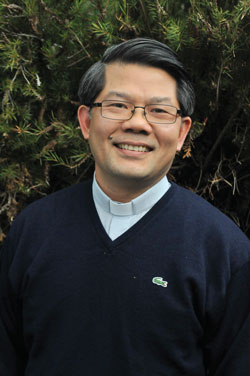
Where else would a seminarian and a priest be doing on a rainy, Thursday afternoon in the middle of prep work for midterm exams & papers? If you guessed wine making then you answered correctly. Taking a break from an afternoon of meetings, paper writing and exam prep, Father Philip (from Burma) and I took a ride over to Saint Leopold Friary to see what the good Franciscan Friars of the Renewal are doing with their wine making project. Brother Giuseppe Maria is spear-heading a Franciscan making effort for two years. This second try seems to be off and running well.
Sacred Scripture supports wine drinking (and wine making, of course). Can one ever think of true Christianity without wine? If you
don't believe me look at 1 Timothy 5:23 which says: "No longer drink only water, but use a little wine for the sake of your stomach and your frequent ailments." If you want more holy Scripture, try on Revelation 6:5-6 for size: When he opened the third seal, I heard the third living creature say, "Come!" And I looked, and behold, a black horse! And its rider had a pair of scales in his hand. And I heard what seemed to be a voice in the midst of the four living creatures, saying, "A quart of wheat for a denarius, and three quarts of barley for a denarius, and do not harm the oil and wine!"
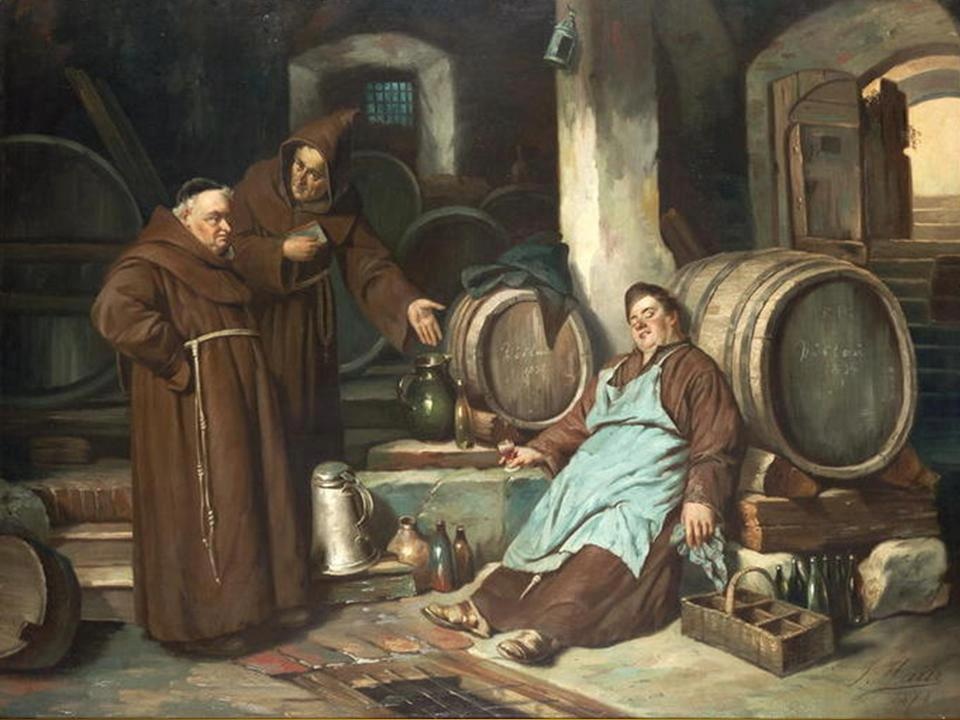
Looking into the spiritual tradition you can see monks and friars making wine and beer for medicinal purposes. Let's just look a the Benedictine tradition for a second. In chapter 40 of his Rule for Monasteries, Saint Benedict doesn't think wine should be served to monks but he concedes that it may be served to the
sick and those who can't be persuaded otherwise. Saint Benedict writes: "However, with due regard for the infirmities of the sick, we believe that a half a bottle of wine a day is sufficient for each. And then he says: "We read it that monks should not drink wine at all, but since the monks of our day cannot be convinced of this, let us at least agree to drink moderately and not to the point of excess, for "wine makes even the wise fall away" (Eccles. 19:2). OK, so tradition is a beautiful thing and so let's enjoy a little bit of life. Just for the record, Mount Angel Abbey has a Festival of Arts and Wine.
So it is no wonder Brother Giuseppe and his Franciscan brothers are making wine. This IS serious work!
Here are some photos of step two in making homemade wine.
Our Lady of Cana, pray for us.
Poor and humble in Christ's way,
Let us sing of good Saint Francis,
Heartfelt homage let us pay!
Leaving home and wealth behind him,
Francis heard the Savior's call,
Serving God as poor and needy,
Trusting God to care for all.
Francis made the Cross his boast,
Loving Christ within the Manger,
Praised His presence in the Host.
God in mercy gave him brothers
Joined in poverty and grace,
Vowed to serve Christ in obedience,
Freed by chastity's embrace.
What was hidden from the learned
To the simple has been giv'n:
To the child-like are revealed now
All the truths and joys of heav'n.
Preaching only Jesus' Gospel,
Francis sang of endless care
Which God, author of creation,
With each person wants to share.
Most high God, all good and mighty,
Father, Son, and Spirit blest,
With Saint Francis we would love You
And with Christ-filled lives attest:
From You, Lord, comes our salvation!
As did Francis, help us live
Lives of peace and true devotion,
That we thanks and praise may give!
87 87 D, suggested tune: Nettleton
James Michael Thompson, (c) 2009, World Library Publications
Blind Francis, waiting to welcome Sister Death,
Worn though he was by ecstacies and fame,
Had heart for tune. With what remained of breath,
He led his friars in canticles. Then came
Brother Elias, scowling, to his side,
Small-souled Elias, crying by book and candle,
This was outrageous! Had the friars no pride?
Music at deathbeds! Ah, the shame! the scandal!
Elias gave him sermons and advice
Instead of song; which simply proves once more
What things are sure this side of paradise:
Death, taxes, and the counsel of the bore.
Though we outwit the tithe, make death our friend,
Bores we have with us even to the end.
(Phyllis McGinley, 1950)