Recently in Franciscan saints & blesseds Category

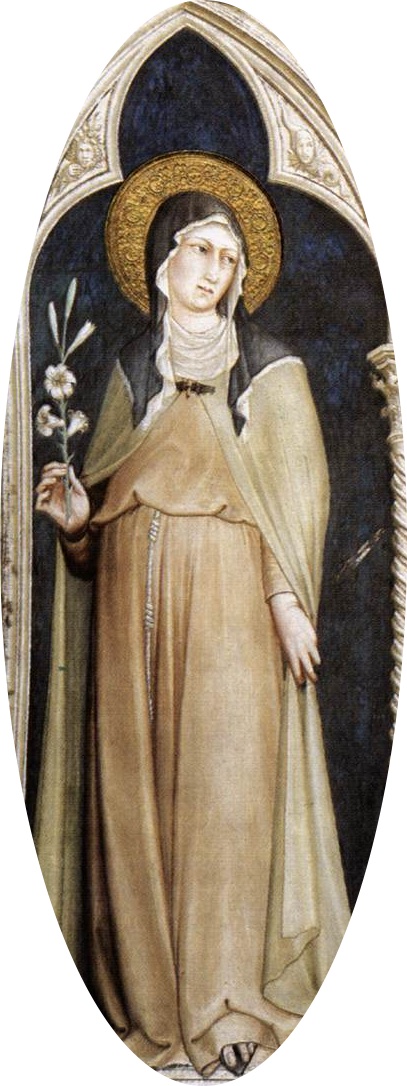
St Clare SMartini.jpg

The world's Catholics -not merely the Franciscans--are celebrating "Clarian Year," to observe the eighth centenary of the conversion and consecration of Saint Clare of Assisi (1193-1253) which tradition tells us took place on Palm Sunday 1211 or 1212. Pope Benedict XVI wrote to Bishop Domenico Sorrentino of Assisi - Nocera Umbra - Gualdo Tadino to express his own affection for the continued witness of Saint Clare.

Saint Clare's history "also speaks to our generation, and has a particular fascination for the young. All Christian life, and thus also consecrated life is the fruit of the Paschal Mystery and of our participation in the death and resurrection of Christ. In the Palm Sunday liturgy pain and glory come together, a theme which will be developed over the following days through the dark night of the Passion up to the ultimate light of Easter. With her choice Clare relived this mystery.

At its most profound level, Clare's 'conversion' is a conversion of love. No longer would she have the refined dress of the Assisan aristocracy, but an elegance of soul expressed in praise of God and giving of self. Day by day a fraternity came into being within the confines of the monastery of San Damiano, at the school of the Eucharistic Christ, ... a fraternity regulated by love of God and prayer, by concern for others and service. It was in this context of profound faith and great humanity that Clare came to interpret the Franciscan ideal, imploring the 'privilege' of poverty and renouncing even the shared possession of material goods, something which left even the Supreme Pontiff perplexed, until in the end he too surrendered to the heroism of her sanctity.


Bookmark and Share
St Paul Miki.jpg

O God, strength of all the Saints, who through the Cross were pleased to call the Martyrs Saint Paul Miki and companions to life, grant, we pray, that by their intercession we may hold with courage even until death to the faith that we profess.


The question of who was Saint Paul Miki is dealt with on Rome Reports today. The video gives a brief intro the life of the martyr and his companions.

From the cross, Paul said: "The sentence of judgment says these men came to Japan from the Philippines, but I did not come from any other country. I am a true Japanese. The only reason for my being killed is that I have taught the doctrine of Christ. I certainly did teach the doctrine of Christ. I thank God it is for this reason I die. I believe that I am telling only the truth before I die. I know you believe me and I want to say to you all once again: Ask Christ to help you to become happy. I obey Christ. After Christ's example I forgive my persecutors. I do not hate them. I ask God to have pity on all, and I hope my blood will fall on my fellow men as a fruitful rain."

The 2011 post on Saint Paul Miki and his companions

The 2010 post on Nagasaki martyrs Paul Mike, et al.

Bookmark and Share
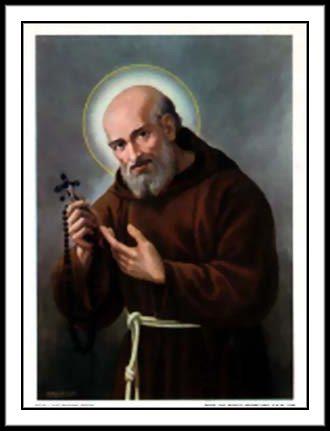
St Seraphin of Montegranaro.jpg

More of the simple lay friars were made saints than the Capuchin priest friars. I wonder why? But a snippet from a biography on Saint Seraphin may be helpful to get a sense of the man:


In 1556, Felix repeated his request to the provincial minister who admitted him to the novitiate at Jesi, where Felix received the name, Seraphin. Upon his reception into the Order, Seraphin remarked, "I have nothing‹just a crucifix and a rosary‹but with these I hope to benefit the friars and become a saint."


Although he was not totally illiterate, Seraphin could speak about God more eloquently than any theologian. Even the bishop of Ascoli, the eminent theologian, Cardinal Bernerio, sought Seraphin's advice in especially difficult cases. 


With himself, Seraphin was austere. Only once in his life did he accept a new habit, and then, only out of obedience. For 40 continuous years, all he ate was soup or salad. In keeping with the spirituality prevalent at the time, Seraphin had a personal devotion of serving as many eucharistic liturgies as possible.

Bookmark and Share

Saint Francis of Assisi

| | Comments (0)
St Francis of Assisi Andrea diVanni d'Andrea.jpgFrancis, the man of God, left his home behind, abandoned his inheritance and became poor and penniless, but the Lord raised him up.

O God, by whose gift Saint Francis was conformed to Christ in poverty and humility, grant that, by walking in Francis' footsteps, we may follow your Son, and, through joyful charity, come to be united with you.

The mystery of the Cross is likely never made more evident in Christianity than through the life of Saint Francis of Assisi. The above prayer, in fact, the new collect for the Roman Missal brings this to bear on us. Francis' life of charity and apostolic zeal effected God's love for all.

The Pope offers a glimpse into the Poor Man of Assisi:
Bookmark and Share

Saint Pio of Pietrelcina

| | Comments (0)

The question I am asking myself: is it possible to follow this man? Alternately, Can I even think that it is possible to be a man like Padre Pio, and seek after God without reservation? What Padre Pio has left us is a clear model of holiness and a path to walk. Holiness here is not meant to be an artificial , showy display of piety (beating the breast, hours of Adoration of Eucharistic adoration, days of fasting, no bathing, etc) but it is a way of life where we shed everything that is not ourselves, living in the manner that is coresponds to the way God the Father has educated us through His Son, Jesus (read the NT). Padre Pio's ministerial life as a priest and as a professed Franciscan Capuchin focussed on the sanctification of souls. No greater work needed his attention and energy. The path given us to walk by Padre Pio is one that leads us back to God hearing the words of Jesus: I love you, I have mercy on you no matter what. Three tools to use on this path: prayer, confession and charity. Beauty and joy will shine through our conversation with God and by our love. If you really want to know more about the path Pio gives us, read what the Pope spoke in 2009 when he made a pilgrimage to the relics of Saint Pio:
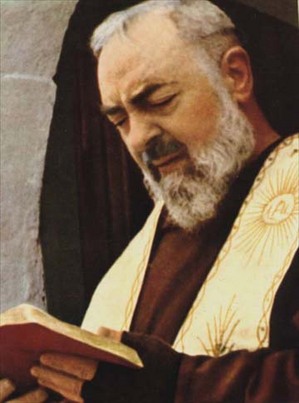

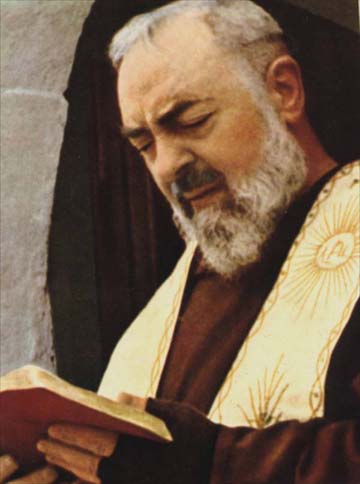
St Padre Pio with book.jpg

Some saints have lived intensely and personally this experience of Jesus. Padre Pio of Pietrelcina is one of them. A simple man of humble origins, "seized by Christ" (Phil. 3:12) -- as the Apostle Paul writes of himself -- to make of him an instrument chosen by the perennial power of his cross: power of love for souls, of forgiveness and of reconciliation, of spiritual paternity, of effective solidarity with those who suffer. The stigmata, which marked his body, united him closely to the Crucified and Risen One. A true follower of St. Francis of Assisi, he made his own, like the Poverello, the experience of the Apostle Paul which he describes in his letters: "I have been crucified with Christ and I no longer live, but Christ lives in me" (Gal 2:20), or: "in us death is at work, but in you life" (2 Cor 5, 12). This does not mean alienation, loss of personality: God never annuls that which is human, but he transforms it with his Spirit and he ordains it to the service of his plan of salvation. Padre Pio kept his natural gifts, and even his own temperament, but he offered everything to God, who has been able to freely use them to extend the work of Christ: to proclaim the Gospel, forgive sins and heal the sick in body and spirit.


As it was for Jesus, the real struggle, the radical combat Padre Pio had to sustain, was not against earthly enemies, but against the spirit of evil (cf. Ephesians 6, 12). The biggest "storms" that threatened him were the assaults of the devil, against which he defended himself with "the armor of God" with "the shield of faith" and "the sword of the Spirit, which is the word of God" (Ephesians 6:11,16,17). Remaining united to Jesus, he always kept in mind the depths of the human drama, and because of this he offered himself and offered his many sufferings, and he knew how to spend himself in the care and relief of the sick, a privileged sign of God's mercy, of his kingdom which is coming, indeed, which is already in the world, of the victory of love and life over sin and death. Guide souls and relieve suffering: thus we can sum up the mission of St. Pio of Pietrelcina, as the servant of God, Pope Paul VI said about him: "He was a man of prayer and suffering" (To the Capuchin Chapter Fathers, 20 February 1971).


Pope Benedict XVI

Homily during the 2009 visit to the Shrine of Saint Pio

Bookmark and Share

Saint Maximillian Kolbe

| | Comments (0)
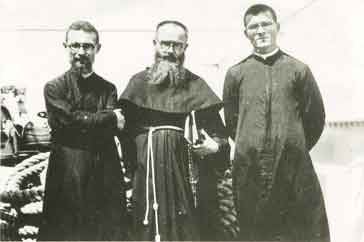
Kolbe in Rome.jpg"Without sacrifice, there is no love. May his intercession further purge us of our idolatries and the sentimentalities that so mar our worship, our loves, our fatuous claims to modernity and maturity." 

(Saint Maximilian Kolbe writing to a fellow priest)
Bookmark and Share
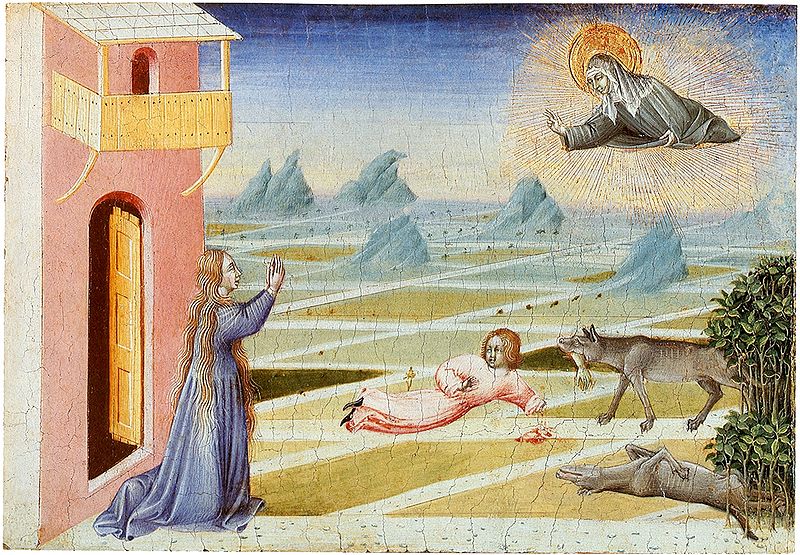
St Clare of Assisi saving a child from a wolf.jpgToday we observe the feast day of one the brilliant gems in the crown of Christ the King, Saint Clare of Assisi. 

Clare, as you know, is the close companion to the great saint Francis of Assisi, who some have called the "other Francis" because of singular vision of living with Christ poor. In time, Clare founded a group of "poor ladies" living together following the Rule written by Clare for God's greater glory in enclosed life. First known as the Order of San Damiano, The Poor Clares as they have been known, live a life of joyous poverty in imitation of Christ. Clare's Rule was an extraordinary act of confidence since the establishment only accepted the Rule of St Benedict for monastic living.

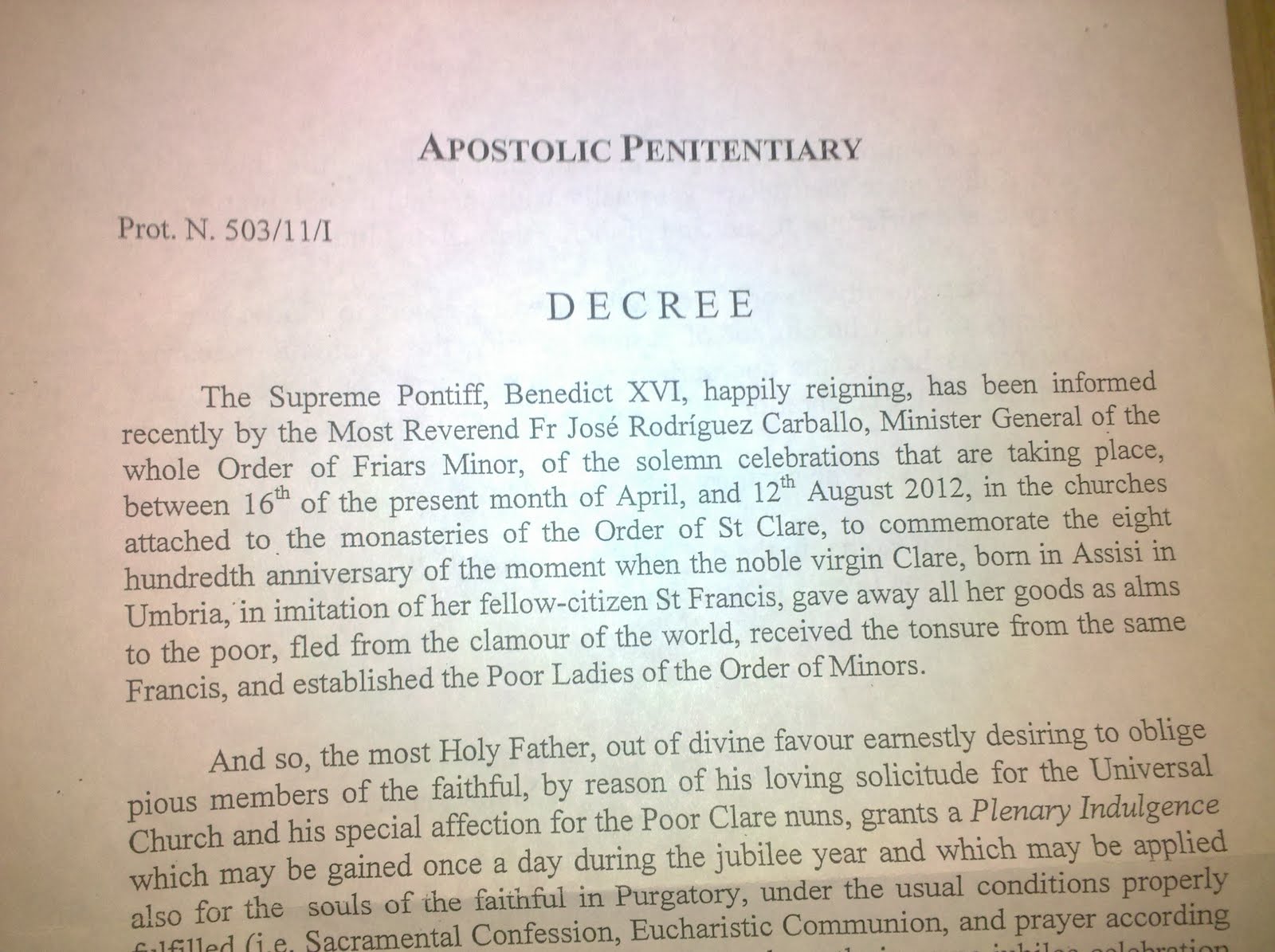
grant of indulgence for St Clare.jpg
Saint Clare was born on July 16, 1194 and died at the age of 59 on August 11, 1253. She was canonized by Pope Alexander IV on September 26, 1255. Our Saint is the patron of those with diseases of the eye, communication systems, goldsmiths and good weather. Perhaps brides and builders should pay more attention to Saint Clare!

For the 800th anniversary of Saint Clare's birth holy Mother Church is offering the faithful --with the usual conditions-- an indulgence.

The four minister generals of the large Franciscans groups wrote the Poor Sisters of Saint Clare a letter for the anniversary where they say they rely on the continued witness of the daughters of Clare today in the monastic life. The friars propose a consolidation that maintains a "healthy and necessary complementarity" among the friars and sisters. Here's the letter: Letter to the Poor Clares.pdf

You may want to read an excellent t book on Saint Clare edited and translated by Capuchin Father Regis J. Armstrong, The Lady: Clare of Assisi: Early Documents (NY: New City Press, 2006).
Enhanced by Zemanta
Bookmark and Share

Saint Bonaventure

| | Comments (0)
St Bonaventure.JPG


Grant, we pray, almighty God, that, just as we celebrate the heavenly birthday of the Bishop Saint Bonaventure, we may benefit from his great learning and constantly imitate the ardor of his charity.


Pope Benedict gave these 3 addresses on March 3March 10,  and March 17. Read these Wednesday audience addresses if you are serious about Saint Bonaventure!


My friend Father Charles at A Minor Friar has a brief thought on this great Franciscan friar, doctor, bishop of the Church.

Bookmark and Share
Vision of St Anthony VCarducho.jpg
The great saint from Lisbon and Padua, Anthony, was an outstanding preacher and intercessor. He was --and continues to be-- a terrific guide to a fuller life in the Gospel of Jesus Christ and the sacrament of the Church. There is no shortage of the faithful who visit a shrine of Saint Anthony to ask for his help in a particular need. In my church I am amazed of people's tender love for Anthony today. The famous Paduan was known for his holy life, his knowledge of sacred Scripture and Theology.

Anthony's first vocation was lived with the Augustinian Canons and after seeing the bodies of the first martyrs of the Franciscan Order brought through Portugal, he was moved to join the Friars in their mission of preaching for the salvation of souls, especially among the Muslims.

Here's the traditional blessing of lilies for the feast of Saint Anthony of Padua.
Bookmark and Share
Oboedientia et Pax.jpg


St Padre Pio is a much beloved, internationally famous and yet not entirely known. That is, until now with Stefano Campanella's new published book, Oboedientia et Pax: The True Story of a False Prosecution.

The author researches the history of the rocky relationship the Capuchin saint Padre Pio had with the blessed Pope John XXIII. Much misinformation was rampant that soured the Pope's and other's, view of Saint Pio who lived with the sacred Stigmata.

Both are icons of holiness and priesthood but there some fragility in human relations...

The author speaks to his work here.
Bookmark and Share

Blessed John of Parma

| | Comments (0)
Blessed John of Parma.jpgBlessed John of Parma (1209-1289) was born at Parma. He studied and taught philosophy and known to be a devoted man to the Lord. Sensing the Lord's call to serve Him more intensely, John entered the newly founded Friars Minor, the group that followed Saint Francis of Assisi. Completing his theological studies John was ordained priest and taught theology at Bologna, Naples and eventually in Rome. Father John was sent to the Council of Lyons in 1245.

In 1247, Father John was elected the 7th minister general of the Franciscans, an election presided over by Pope Innocent IV, who thought very highly of Father John. John set in motion several initiatives to keep the friars focussed on the mission of Francis and his spirit looking keenly on poverty and humility as hallmarks of the Franciscan way of living the Gospel.

Father John was sent as a papal legate to Constantinople in an attempt healed the schism between Catholics and the Greek Orthodox. He had limited success.

Our peripatetic friar died on March 19, 1289 and his feast is kept on March 20. Father John was beatified in 1777.

More on Blessed John of Parma can be read here.
Bookmark and Share

Saint Colette

| | Comments (0)
Saint Colette.jpgSaint Colette is the famous 15th century reformer of the Poor Clare nuns. You see her reform noted as the Colettine Poor Clares. She follows to a "T" the rigorous life set down by Saint Clare herself in hearing the words "If any want to become my followers, let them deny themselves and take up their cross and follow me." She did; so did others.

King Henry VIII would compare Saint Colette to "a diligent bee that gathers exquisite honey from the precious flowers of the most rare virtues."

The Prayer Over the Gifts for Saint Colette's Mass reads:

Lord, may the gifts we bring You help us to follow the example of Saint Colette. Cleanse us from our earthly way of life, and teach us to live the new life of Your kingdom.

Here the Church wants us to receive the gift of singular focus on the new we've received already through Baptism, Confirmation and the Holy Eucharist. The new life preached by Christ and the Church today.

According to the Roman-Franciscan Sacramentary of 1974, February 7 is the liturgical memorial of Saint Colette, not March 6 as noted in other places. A previous blog post on Saint Colette can be read here.
Bookmark and Share
St Catherine of Genoa.jpg

"Since I began to love, love has never forsaken me. It has ever grown to its own fullness within my innermost heart." 

Our catechesis today deals with Saint Catherine of Genoa, a fifteenth-century saint best known for her vision of purgatory. Married at an early age, some ten years later Catherine had a powerful experience of conversion; Jesus, carrying his cross, appeared to her, revealing both her own sinfulness and God's immense love. A woman of great humility, she combined constant prayer and mystical union with a life of charitable service to those in need, above all in her work as the director of the largest hospital in Genoa. Catherine's writings on purgatory contain no specific revelations, but convey her understanding of purgatory as an interior fire purifying the soul in preparation for full communion with God. Conscious of God's infinite love and justice, the soul is pained by its inadequate response, even as the divine love purifies it from the remnants of sin. To describe this purifying power of God's love, Catherine uses the image of a golden chain which draws the soul to abandon itself to the divine will. By her life and teaching, Saint Catherine of Genoa reminds us of the importance of prayer for the faithful departed, and invites us to devote ourselves more fully to prayer and to works of practical charity.

Pope Benedict XVI
summary of Wednesday Catechesis on Saint Catherine of Genoa

Vatican City State, 12 January 2011

Bookmark and Share

About the author

Paul A. Zalonski is from New Haven, CT. After years of study, work and trying to find meaning in life, he still has a sense of humor. He is a member of the Fraternity of Communion and Liberation, a Catholic lay ecclesial movement and an Oblate of Saint Benedict. Contact Paul at paulzalonski[at]yahoo.com.

Categories

Archives

Humanities Blog Directory

About this Archive

This page is a archive of recent entries in the Franciscan saints & blesseds category.

Family, Youth & Young Adult Formation is the previous category.

Franciscans is the next category.

Find recent content on the main index or look in the archives to find all content.