Recently in Saint Benedict Category

God our Father, You made Saint Benedict an outstanding guide to teach men how to live in your service. Grant that be preferring your love to everything else we may walk in the way of your commandments.
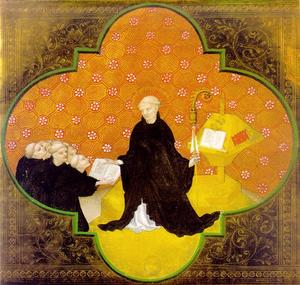
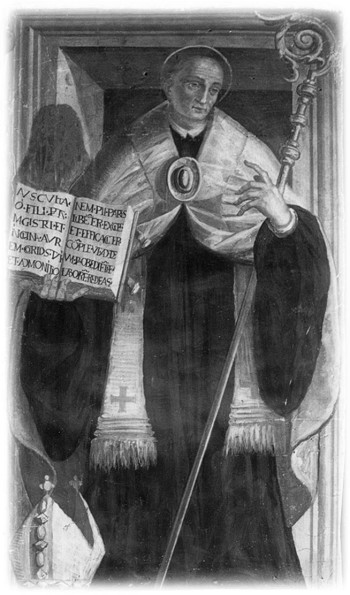
St Benedict a Bohemian artist.jpg

Famous for his work on the 12 degrees of humility, Saint Benedict proposes the following for those who want to advance in the spiritual life. The degrees of humility are given below.

The first degree of humility, then, is that a man always have the fear of God before his eyes (cf Ps 35[36]:2), shunning all forgetfulness and that he be ever mindful of all that God hath commanded, that he always consider in his mind how those who despise God will burn in hell for their sins, and that life everlasting is prepared for those who fear God. And whilst he guard himself evermore against sin and vices of thought, word, deed, and self-will, let him also hasten to cut off the desires of the flesh.

The second degree of humility is, when a man love not his own will, nor is pleased to fulfill his own desires but by his deeds carried out that word of the Lord which said: "I came not to do My own will but the will of Him that sent Me" (Jn 6:38). It is likewise said: "Self-will hath its punishment, but necessity win the crown."

The third degree of humility is, that for the love of God a man subject himself to a Superior in all obedience, imitating the Lord, of whom the Apostle said: "He became obedient unto death" (Phil 2:8).

The fourth degree of humility is, that, if hard and distasteful things are commanded, nay, even though injuries are inflicted, he accept them with patience and even temper, and not grow weary or give up, but hold out, as the Scripture said: "He that shall persevere unto the end shall be saved" (Mt 10:22). And again: "Let thy heart take courage, and wait thou for the Lord" (Ps 26[27]:14).

The fifth degree of humility is, when one hides from his Abbot none of the evil thoughts which rise in his heart or the evils committed by him in secret, but humbly confesses them. Concerning this the Scripture exhorts us, saying: "Reveal thy way to the Lord and trust in Him" (Ps 36[37]:5). And it said further: "Confess to the Lord, for He is good, for His mercy endures forever" (Ps 105[106]:1; Ps 117[118]:1). And the Prophet likewise said: "I have acknowledged my sin to Thee and my injustice I have not concealed. I said I will confess against myself my injustice to the Lord; and Thou hast forgiven the wickedness of my sins" (Ps 31[32]:5).

The sixth degree of humility is, when a monk is content with the meanest and worst of everything, and in all that is enjoined him holds himself as a bad and worthless workman, saying with the Prophet: "I am brought to nothing and I knew it not; I am become as a beast before Thee, and I am always with Thee" (Ps 72[73]:22-23).

The seventh degree of humility is, when, not only with his tongue he declares, but also in his inmost soul believeth, that he is the lowest and vilest of men, humbling himself and saying with the Prophet: "But I am a worm and no man, the reproach of men and the outcast of the people" (Ps 21[22]:7).

The eighth degree of humility is, when a monk doeth nothing but what is sanctioned by the common rule of the monastery and the example of his elders.

The ninth degree of humility is, when a monk withholds his tongue from speaking, and keeping silence doth not speak until he is asked; for the Scripture shows that "in a multitude of words there shall not want sin" (Prov 10:19); and that "a man full of tongue is not established in the earth" (Ps 139[140]:12).

The tenth degree of humility is, when a monk is not easily moved and quick for laughter, for it is written: "The fool exalts his voice in laughter" (Sir 21:23).

The eleventh degree of humility is, that, when a monk speaks, he speak gently and without laughter, humbly and with gravity, with few and sensible words, and that he be not loud of voice, as it is written: "The wise man is known by the fewness of his words."

The twelfth degree of humility is, when a monk is not only humble of heart, but always lets it appear also in his whole exterior to all that see him; namely, at the Work of God, in the garden, on a journey, in the field, or wherever he may be, sitting, walking, or standing, let him always have his head bowed down, his eyes fixed on the ground, ever holding himself guilty of his sins, thinking that he is already standing before the dread judgment seat of God, and always saying to himself in his heart what the publican in the Gospel said, with his eyes fixed on the ground: "Lord, I am a sinner and not worthy to lift up mine eyes to heaven" (Lk 18:13); and again with the Prophet: "I am bowed down and humbled exceedingly" (Ps 37[38]:7-9; Ps 118[119]:107)

It's expected that on June 29th the Pope will publish his latest encyclical, Caritas in Veritate (Love in Truth).

Last week he said: "As you know, my encyclical on the vast theme of economics and labor will soon be published. It will highlight what, for us Christians, are the objectives to be pursued and the values to be promoted and tirelessly defended, with the purpose of realising a truly free and human coexistence in solidarity."

Pope Benedict's two previous encyclicals are Deus Caritas Est (God is Love, 2005) and Spe Salvi (Saved by Hope, 2007).

It's time to get excited because the Pope's words are always germane.

Guarding speech

| | Comments (0)

Here the prophet shows that, if at times we ought to refrain from useful speech for the sake of silence, how much more ought we to abstain from evil words on account of the punishment due to sin. Rule of Saint Benedict, Chapter 6


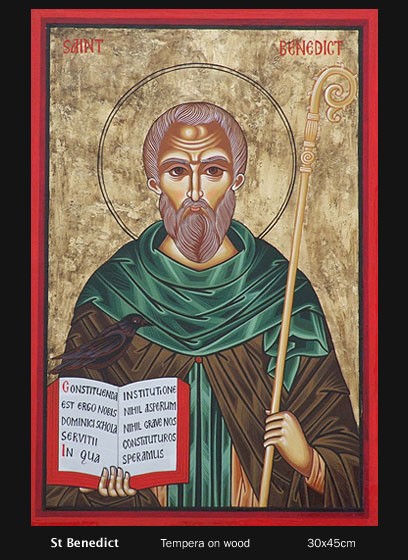
St Benedict SDimitrova.jpg

Here is a wonderful story of an icon writer from Bulgaria using her God-given talent so that God may be glorified with the bonus of falling in love. Plus, the Benedictine monks in England are commissioning Silvia to paint for them.


Silvia Dimitrova's webpage can seen here.


May God grant Silvia many years!


A question of what is the difference between the March and July observances of the feast of Saint Benedict.

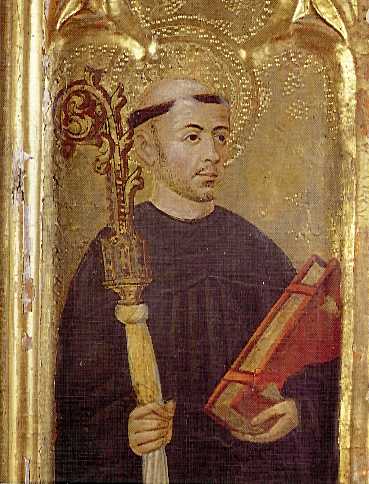
san benito.jpgThe July feast was the one celebrated in France, as being the date of the alleged translation of his bones to the Abbey of Fleury. Monte Cassino always disputed this claim made by Fleury, and it does seem doubtful, as the remains of Benedict and Scholastica (datable to the correct period) were found in the tomb at Monte Cassino after the Second World War.

The Church, however, certainly never rejected the July 11 feast, as the celebration of the translation of the bones is really not about Fleury-vs.-Monte Cassino but rather the establishment of a cultus of Saint Benedict beyond Italy, as a saint of universal importance for the whole Church and for all the monks of the West. So this feast (which is more convenient for a solemn celebration since it falls outside of Lent) was made by Pope Paul VI the feast of Saint Benedict as Patron of Europe, later changed to be a "co-patron" of Europe.

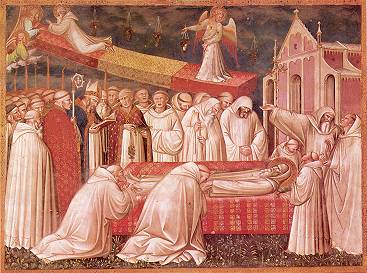
March 21 is the feast of Saint Benedict's death. It more specifically concerns his entry into heaven and his role as Father of Western Monasticism.

Death of Benedict.jpgLet the whole multitude of the faithful exult in the glory of our beloved Father Benedict; but most of all let that army of monks be glad who on earth are celebrating the feast of him with whom the Saints in heaven are rejoicing. (Magnificat antiphon)


Today was a glorious day. The weather was particularly beautiful and the grounds of the Abbey and College were manicured on Friday plus the flowering trees are bursting forth with color. Our many guests attested to value of the charism of Saint Benedict and the witness of the monastic community here in the Charlotte metro area. We can say that the monks and friends are intertwined in a very real way.


The 4th bishop of the Diocese of Charlotte, the Most Reverend Peter J. Jugis, JCD, presided his choir robes and many priests of the diocese concelebrated the Mass with Father Abbot Placid, celebrating. All of the monks and guests staying at the abbey were present. It was particularly fitting to have some of the priests of the diocese who in some way collaborate with the abbey here because of the strong connection that exists between the abbey and the diocese: the abbey was the seat of the diocese and the monks either founded and staffed some of the parishes or provided weekend assistance. Heartwarming for me was the clear sense of fraternal love and unity with Saint Peter in the Episcopal office with the presence of Bishop Jugis because there are monasteries live in friction with the local bishop and by extension the Holy Father. Hence it was evident to me that there's been a genuine affection between the bishop and the monks. I'd be remiss if I didn't mention the presence of the Religious Sisters of Mercy. They've held a close relationship with the monks of this abbey since the 19th century and the monks continue to be their chaplains down to today.


As an historical note, the Holy See erected the Diocese of Charlotte on January 12, 1972. But beginning in 1944 and then again in 1960 the territory of the abbey nullius was gradually restricted before being suppressed on January 1, 1977, at the request of the US bishops.


In the homily Father Abbot spoke of Saint Benedict personally hearing the voice of Christ calling him to follow. As Benedict listened with the ear of his heart, so we should listen to the call of the Master (Christ). We know that through baptism we are reborn as adopted children of God and our lived experience tells us that we are being formed into saints, or at least the hope is that we'd become saints. Being a saint, however, is not being a plastic sort of character but a person who really lives what his conviction in Christ is. It's the saint that lets know that God is real and that His love and creative power endures; it's the saint that knows and shows us that the divine promise is a fact. Two aspects of this the divine promise bear mentioning because they are constituent parts of Benedict's life: forgiveness (mercy) and providence (life will be set right). In forgiveness our sins are forgiven and we are given the grace to transform our lives from ugliness to beauty. Providence tells us that we don't hold others hostage for their sinfulness toward us; just as the Lord forgives, so ought we to forgive. Providence is the revelation of hope, that there all of us have a destiny based on faith in Christ.


The abbot also noted for us that Benedict is an example of being "watchful" in the face of grace and sin; he was attentive to sustaining others in the struggle against Satan. One can say, therefore, that Benedict is a living Gospel: he lived the Gospel faithfully and his witness to Christ was substantial. While it seems odd that on a joyous occasion such as this feast to tell people to keep death before our eyes as Benedict admonished his monks, it is nevertheless true that we ought to do so because it is an expression of Christian hope: we desire our destiny, we desire the infinite. As Pope Benedict reminded us in last encyclical, the distinguishing mark of the Christian is that we know we have a future. Just as Saint Benedict was converted, the abbot said, by the Paschal Mystery of the Lord, so by that same Mystery shall we be transformed if we give ourselves over the Lord without reserve.


One may note in the Ordo for liturgical services that March 21 is a liturgical memorial of Saint Benedict, co-patron of Europe and Father of Western monasticism. The ritual form of today's sacred Liturgy takes on different observances in the various worldwide congregations of Benedictine monasteries. That is to say, some monasteries observe today as a solemnity even though it is Lent; let us not forget that March 21st comes between two other solemnities, Saint Joseph (March 19) and the Annunciation of the Lord (March 25). Monasteries who don't keep today as a solemnity will keep liturgical memorial as a simple feast and celebrate July 11 as a solemn day.


By the use of the word "solemnity" I mean the use of festive hymns and antiphons for the saint or the Lord are sung, incense and white vestments are used, and the Gloria is sung and the Creed recited at Mass. The above Magnificat antiphon is a good example. Therefore, the special Mass texts written and approved for the liturgical memorial are used in conjunction with the sung Ordinary of the Mass. On days of solemnity the community will have a festive meal with special foods and prepared and often wine is served. The opposite would be true for a day in Lent or an average in Ordinary Time where things are much more sober. I savor today as a solemn break from the joy of Lent!


For the monks of Belmont solemnities never end: the anniversary of the Dedication of the Abbey Church falls on March 28 but that day, even though it is a solemn occasion, will be simplified I can assure you. All these special celebrations can obscure the sober liturgical sense that's supposed to be followed for Lent and yet there is a particular Catholic sense of the Incarnation that's manifested when we properly observe feasts on their proper days. Given that Mary, Help of Christians - Belmont Abbey is a monastery of the American-Cassinese Congregation of Benedictine monks it's keeping to a privilege granted in 1972 by the Sacred Congregation for Divine Worship.


St Benedict3.jpgAt the solemn Vespers last eve, the Father Abbot was suitably decorated in mitre with crosier, symbols of his office as a head of the abbey. A special vesperal hymn for the Transitus of Benedict, "Whate'er of Yore," was sung. According to Father Prior this hymn is of unknown provenance and yet highly revered. It speaks of the prophets and the Law, Abraham and Moses, perfect virtue, especially asceticism, obedience and peace viz. the witness of blessed Benedict amidst the storms of era. The lyrics bear our attention:


Whate'ver of yore the tuneful prophets teach

Or Law of olden days,

Great monarch of ascetic multitudes,

Thy life displays.


A glorious progeny is Abram's boast;

Meekness in Moses shone;

Faultless obedience and a beauteous spouse

Were Isaac's crown.


But our exalted heav'nly Patriarch,

Immeasurably blest,

Concentrates all their glory, virtue, praise,

In his sole breast.


O may his arm of might that caught us up

From the world's stormy tide,

Here keep us evermore where halcyon calm

And peace abide.


Glory eternal to the Father be,

And sole-begotten Son,

With Thee Great Paraclete: eternal Three

And trinal One.

The reading at Lauds this morning is both apropos for Lent and for the Solemnity of Saint Benedict. Father Abbot, decorated with a beautiful pectoral cross of ancient days, read Sirach 2:1-18. Without knowing at first where the reading came from, I first thought it to be from one of the Fathers of the Church, or even Pope Benedict; all of what Sirach speaks of resonates strongly for me because it corresponds with what I've experienced and know deeply in my heart, and I hope it's the similarly for you. The text follows:


Sirach.jpgMy son, if you come forward to serve the Lord, prepare yourself for temptation. Set your heart right and be steadfast, and do not be hasty in time of calamity. Cleave to him and do not depart, that you may be honored at the end of your life. Accept whatever is brought upon you, and in changes that humble you be patient. For gold is tested in the fire, and acceptable men in the furnace of humiliation.


Trust in him, and he will help you; make your ways straight, and hope in him. You who fear the Lord, wait for his mercy; and turn not aside, lest you fall. You who fear the Lord, trust in him, and your reward will not fail; you who fear the Lord, hope for good things, for everlasting joy and mercy. Consider the ancient generations and see: who ever trusted in the Lord and was put to shame? Or who ever persevered in the fear of the Lord and was forsaken? Or who ever called upon him and was overlooked? For the Lord is compassionate and merciful; he forgives sins and saves in time of affliction.


Woe to timid hearts and to slack hands, and to the sinner who walks along two ways! Woe to the faint heart, for it has no trust! Therefore it will not be sheltered. Woe to you who have lost your endurance! What will you do when the Lord punishes you? Those who fear the Lord will not disobey his words, and those who love him will keep his ways. Those who fear the Lord will seek his approval, and those who love him will be filled with the law. Those who fear the Lord will prepare their hearts, and will humble themselves before him. Let us fall into the hands of the Lord, but not into the hands of men; for as his majesty is, so also is his mercy.

Father, you revealed in Benedict your desire to live and die in grace that transcends all earthly cares; listen to our supplications as we strive toward salvation.


Benedict, blessed in name and grace, lived a holy life; may we follow worthily in his footsteps by praying and working to glorify you.


Holy father Benedict, pray for us.


Benedict, desiring to please you alone, left home and patrimony to found his religious family; may we live in peace in his family to add luster to your monastic way of life.


Holy father Benedict, pray for us.


Benedict withdrew from the world, knowingly unacquainted with its ways, and wisely unlearned in its wisdom; may we learn your wisdom, and guide our actions by it.


Holy father Benedict, pray for us.


Benedict, filled with the spirit of all the just, left us a rule of life in Christ; may we remain faithful to his teaching and come to prefer nothing whatsoever to Christ.


Holy father Benedict, pray for us.


Benedict, the patron of a happy death, showed us how to live in order to die in you; may he obtain this reward from you for each of us.


Holy father Benedict, pray for us.


Through Christ our Lord.

About the author

Paul A. Zalonski is from New Haven, CT. After years of study, work and trying to find meaning in life, he still has a sense of humor. Paul is discerning God's plan and is preparing for ordination to the priesthood. Contact Paul at paulzalonski(at)yahoo.com.

Pages

Humanities Blog Directory

About this Archive

This page is a archive of recent entries in the Saint Benedict category.

Sacred Triduum is the previous category.

Saint Paul is the next category.

Find recent content on the main index or look in the archives to find all content.