Recently in Year of the Priest Category

Meeting Fr Z in NYC

| | Comments (0)
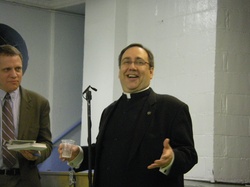
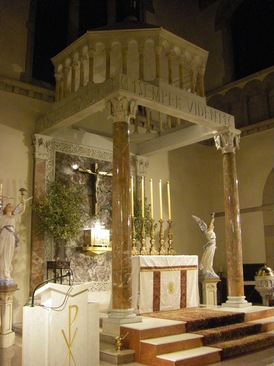
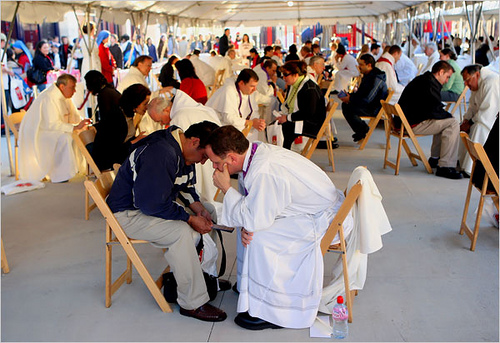
Thumbnail image for Fr John Zuhsldorf-2 Nov 6 2009.jpgMeeting "blog personalities" is always fun, especially meeting a popular blogging priest. Father John Zuhlsdorf writes the blog, What Does The Really Say? He's an affable priest with a good sense of humor and a good thinker. He celebrated a Solemn Requiem Mass in the Extraordinary Form for First Friday at the beautiful Church of the Guardian Angels (NYC). The particular intention for the Mass was for deceased priests.

The priesthood is the love of the heart of Jesus

In his homily, Father Zuhlsdorf spoke about the priesthood as the result of the outpouring of love of the Sacred Heart of Jesus. Mindful of the human condition and the Incarnation, we have Perfect Love choosing imperfect men to be priests to preach the Gospel and to celebrate the sacraments. And because the priest is a normal human being with the normal failings as other men, we know the imperfect minister needs conversion. Our job is to beg for God's mercy upon our priests, living and deceased, as an act of love for the priests. Priests are fallible, sinful human beings like everyone else and yet they are called by God to serve Him as priests for the good of His people. It is an awesome thing to consider that our souls are fed by priests, some of whom are worthy ministers of the Lord and some not. Nevertheless, the effectiveness of a priest's ministry does not depend on the state of his soul (something part of our doctrine since the time of Saint Augustine).

We believe that two sacraments give permanent character to our souls that lasts into eternity: Baptism and Holy Orders. So, when a priest dies his soul is recognized as a priestly soul in heaven by God and whole heavenly court. The priesthood, therefore, does not end on the day when the priest's body dies.

Thumbnail image for Guardian Angels Church NYC-2 Nov 6 2009.jpg
In this Year for Priests, indeed even outside of this special year, we ought to care for the priests who serve our parishes and other ministries in concrete ways. We ought to pray for the souls of the priests who have died, too. I am particularly thinking of the priests and bishops who gave us new Life in Christ through the sacraments of Baptism, Confirmation, Eucharist and Penance, and the other sacraments as applicable.

I have an immense sense of gratitude for the faith I received from the priest who baptized me, the bishop who confirmed me, the priests who heard my confessions and gave me the Body of Christ.

Could we offer a prayer once a day during November for the deceased priests we knew? After November, could we offer a prayer for the priests at least once a month in the years to come? 

It would be good to read (or re-read) the Pope's letter to the Church announcing the Year for Priests. There you will find some startlingly beautiful points to reflect upon and live out of. In my opinion, the Pope's letter has so much to consider that it would take a lifetime to understand.

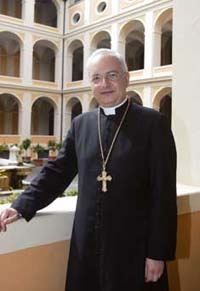
In the August-September 2009 issue of Inside the Vatican, Angela Ambrogetti interviews Archbishop Mauro Piacenza, the archbishop-secretary of the Congregation of the Clergy on the year dedicated to the priest. In the interview Archbishop Piacenza notes:

1. "Among the new generations [of priests] there is a certainly a great desire for commitment, spirituality, rigorous training, a life of ascesis and penance.

2. "...the Church does not invent its doctrine [on the priesthood] but has received it from the Lord Jesus."

3. "Believers need to find a unique paternity in the priest. The priest's personal virtues, then the cassock itself, are indicative of his identity, which must be recognized by everyone. His presence in all fields, especially education, is fundamental for the Church's mission. Unless we resume our educational work, we won't be able to accomplish our apostolic mission! The Church cannot give up the education of the young, as most society is doing. It would be like renouncing our future."

4. "The Lord Jesus gave Himself completely to man. Everything and forever are in the logic of Christian love. This complete devotion requires order and disciple. The rule of prayer, for example, must be observed. Should it fall into disuse, for any reason, it must be restored immediately. The same importance must be attached to daily rest, to a wholesome diet and to holidays, which are for the priest, time of the spirit."

5. "The priest plays a decisive and irreplaceable role in the liturgy. He is not just an organizer of prayers and celebrations, as he is sometimes thought to be! In the liturgy, the priest stands for Christ Himself. In his offering to God, he repeats Christ's words and gestures with effectiveness. The thing which the priest really needs in the celebration of the liturgy is prayer. The risk of triviality, superficiality and secularization can be avoided through the education of the priest and the people of God. If we all think of ourselves as being in the presence of the Lord, the liturgy will look quite different to us, along with our faith."
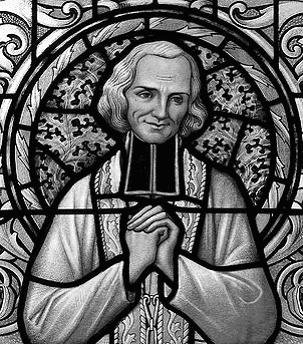
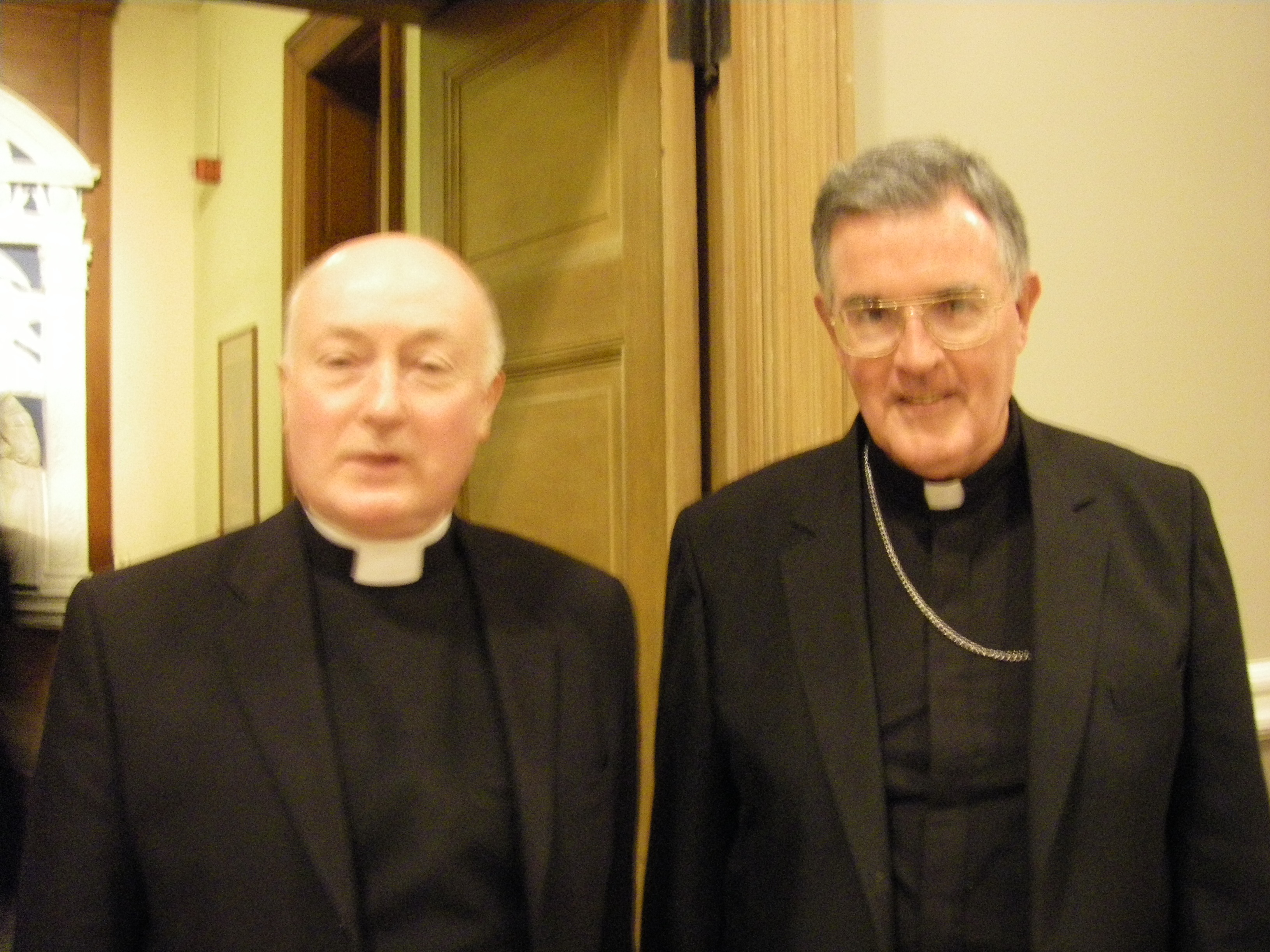
Rutler & Walsh.jpgThe life we lead is based on the influences we have. For some, like Father George Rutler, John Newman and John Vianney are two such influences. George Rutler, a priest of the Archdiocese of New York and pastor of the Church of Our Saviour (NYC) gave the Terrence Cardinal Cooke Theology Lecture tonight at Saint Joseph's Seminary. Himself a convert, author, TV personality tried to dispel the florid presentations of the saint which detach reality from the soul. John Vianney (8 May 1786 - 4 August 1859) knew himself well as a farm boy who desired to serve the Lord as a priest in love. What ought to be resisted when thinking about Vianney is sugar coating his ministry and manner of living. His was not a life akin to pouring molasses on roast beef. The saint, in Catholic theology and as reminded by Rutler, is a person who shows us that living the gospel is possible, that conversion is possible, that real, self-giving love is possible because the saint shows us Christ. And since Christianity is not speculation but fact, the fact of the saint is a testament to the reality of Christ today.

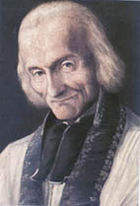
John Vianney.jpg
Saint John Vianney loved his people in substantial ways: he revealed Christ to them and allowed Christ to speak through his priestly life in ways that challenged each person to take more seriously the desires of their heart and their state of life. Vianney was direct when it came to sin and sinful ways; he was devoted to the humanity of those whom he encountered, and he responded as Christ would if someone presented himself. Vianney may have been a poor student and a man of little sophistication as judged by the world, but he was a brilliant disciple of the Lord who acted like a shepherd for the flock. Like the apostle who is known for his zeal, the martyr his patience, the virgin her purity and the confessor his intellect, Vianney is known for his love. Can we model our lives accordingly?

Nearly 125 people attended the lecture tonight.
Below is an extract of a homily given by Franciscan Cardinal Claudio Hummer to new bishops at a gathering in Rome on 21 September 2009. The stage is set...

Our priests need to be loved and supported in their vocation and mission, above all by their own Bishop and by their community. They wish to be recognised for that which they are and that which they do. They also need to be assisted and guided to renew in their hearts the true identity of the priesthood and the true meaning of celibacy. In this context, the renewal and reinvigoration of their priestly spirituality will be decisive, which has as its foundation in being true and unconditioned disciples of Jesus Christ, who has configured them to Himself, Head and Shepherd of the Church. For this discipleship, so determining of their lives, it will be of great help for priests to listen and to pray aloud the Word of God, the daily celebration of the Eucharist, the frequent use of the Sacrament of Confession, the recitation of the Liturgy of the Hours, frequent visits to the Most Blessed Sacrament, the recitation of the Holy Rosary and other means of spiritual enrichment and of personal encounter and intimacy with Jesus Christ. Also of great importance are the annual Spiritual Exercises and ongoing formation.

Moreover, it is necessary to awaken the missionary consciousness of priests. The Church knows there is a missionary urgency being experienced throughout the world, not only ad gentes, but also within the very flock of the Church already established for centuries in the Christian world. It is necessary to promote a true missionary urge in our Dioceses and in our parishes. All our countries have become a land of mission, in the strict sense. A new fire needs to be lit in our priests and in us ourselves, a new passion to make us arise and go to meet people where they live and work, to bring to them anew the Kerygma, the first proclamation of the person of Jesus Christ, Crucified and Risen, and of his Kingdom, to lead them to a personal and then a communitarian encounter with the Lord. Our beloved Pope, Benedict XVI, referring to the situation in the lands of age-old Christian tradition, has said, "We should give serious thought as to how to achieve a true evangelization in this day and age [...] It is not enough for us to strive to preserve the existing flock" (Discourse to the German Bishops, 21st August 2005), but we need a true mission. It is not enough merely to welcome those who come to us, in the parish or in the parish house. There is an urgent necessity to arise and go in search above all of the many baptised who are distanced from participation in the life of our communities, and then to seek also those who know little or nothing of Jesus Christ. The mission has always renewed the Church. The same will also be true for priests when they go into the mission. This, then, is a whole programme to develop during this Year for Priests.

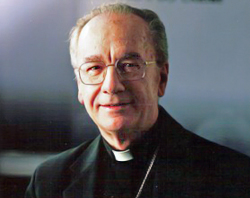
CHummes4.jpg
Cardinal Cláudio Hummes, OFM
Archbishop Emeritus of São Paulo
Prefect of the Congregation for the Clergy

What is a priest's identity?

| | Comments (0)
Archbishop Mauro Piacenza looks briefly at this question and explores some key points of what a priest's identity is. Watch the video clip.
Thumbnail image for St Gaetano Catanoso.jpg

Many think that Saint John Vianney is the only canonized parish priest. Vianney is certainly the most known for his extraordinary life. And it helps that popes and other notable authors have drawn our attention to him. But there is another saint who has a persuasive personality who is also a parish priest and worthy of our attention. In this Year of the Priest it fitting to have yet another intercessor before God. Today the Church celebrates the liturgical memorial of Saint Gaetano Catanoso.

Pope Benedict XVI canonized him on October 23, 2005. In the homily of the Mass of Canonization said:

Saint Gaetano Catanoso was a lover and apostle of the Holy Face of Jesus. "The Holy Face," he affirmed, "is my life. He is my strength". With joyful intuition he joined this devotion to Eucharistic piety.

He would say: "If we wish to adore the real Face of Jesus..., we can find it in the divine Eucharist, where with the Body and Blood of Jesus Christ, the Face of Our Lord is hidden under the white veil of the Host."

Daily Mass and frequent adoration of the Sacrament of the Altar were the soul of his priesthood: with ardent and untiring pastoral charity he dedicated himself to preaching, catechesis, the ministry of confession, and to the poor, the sick and the care of priestly vocations. To the Congregation of the Daughters of Saint Veronica, Missionaries of the Holy Face, which he founded, he transmitted the spirit of charity, humility and sacrifice which enlivened his entire life.

More of Saint Gaetano can be read here.

The American cousin of the saint has a book on Saint Gaetano Catanoso, see it at this link.

On the feast of Saint Lawrence (August 10), the Cardinal Prefect of the Congregation for Clergy, Claudio Cardinal Hummes, OFM, wrote to the world's permanent deacons that what the Year of the Priest is also oriented toward the Order of Deacon and what is said to the priests applies very much to the deacons. This is welcome news! 

I admire the vocation of deacons but I have had my fill of deacons who believe their vocation is undervalued, mis-understood or abused by priests. While there are tensions among some deacons and priests, the problem is often grossly reported. In recent weeks since the pope inaugurated the Year of the Priest I have heard deacons complaining that they feel "left out" by not having a spiritual/intellectual year dedicated to them as one is to the priesthood. The moaning distracts. Complaining is rather 

7 deacons .jpg

tedious when you see the connections among the various hierarchies in our Church because none can exist without the other (even though the Church didn't have the permanent deaconate for long a period of time). Look at the witnesses of the sainted deacons through the millennia: Stephen, Ephrem, Francis among many. Quoting Pope "to work in favor of this pull of priests toward spiritual perfection, upon which, above all, depends the efficacy of their ministry," (discourse of March 16, 2009). Hence, I am happy to see something on the value of the permanent deacons in the Year of the Priest because the call and ministry of priests and deacons are intimately interrelated as is the call to the episcopacy in the service of the Gospel. Additionally, I am elated the Cardinal once again drew our attention to the need to know our Scripture and the practice of lectio divina. Proper and ongoing formation in the Lord and the Church requires careful attention to the place of Scripture and lectio. The letter said in part:

To know Revelation, to adhere unconditionally to Jesus Christ as a fascinated and enamored disciple, to base oneself always upon Jesus Christ and to be with Him in our Mission, this is then what awaits a permanent deacon, decisively and without any reservation. From a good disciple a good missionary is born.

The ministry of the Word which, in a special way for Deacons, has as its great model St. Stephen, Deacon and Martyr, requires of ordained ministers a constant struggle to study it and carry it out, at the same time as one proclaims it to others. Meditation, following the style of lectio divina, that is, prayerful reading, is one well traveled and much counseled way to understand and live the Word of God, and make it ones own. At the same time, intellectual, theological and pastoral formation is a challenge which endures throughout life. A qualified and up to date ministry of the Word very much depends upon this in depth formation.

St Lawrence distrutes money to poor Fra Angelico.jpg

The second reflection regards the ministry of Charity, taking as a great model St. Lawrence, Deacon and Martyr. The diaconate has its roots in the early Church's efforts to organize charitable works. At Rome, in the third century, during a period of great persecution of Christians, the extraordinary figure of St. Lawrence appears. He was archdeacon of Pope Sixtus II, and his trustee for the administration of the goods of the community. Our well beloved Pope Benedict XVI says regarding St. Lawrence: "His solicitude for the poor, his generous service which he rendered to the Church of Rome in the area of relief and of charity, his fidelity to the Pope, from him he was thrust forward to the point of wanting to undergo the supreme test of martyrdom and the heroic witness of his blood, rendered only a few days later. These are universally recognized facts." (Homily Basilica of St. Lawrence, November 30, 2008). From St. Lawrence we also take note of the affirmation "the riches of the Church are the poor." He assisted the poor with great generosity. He is thus an ever more present example to permanent deacons. We must love the poor in a preferential way, as did Jesus Christ; to be united with them, to work towards constructing a just, fraternal and peaceful society. The recent encyclical letter of Benedict XVI, Caritas in Veritate (Charity in Truth), should be our updated guide.  In this encyclical the Holy Father affirms as a fundamental principle "Charity is the royal road of the social doctrine of the Church" (n. 2). Deacons must identify themselves in a very special way with charity. The poor are part of your daily ambiance, and the object of your untiring concern. One could not understand a Deacon who did not personally involve himself in charity and solidarity toward the poor, who again today are multiplying in number.

Yesterday's general audience (August 19, 2009) Pope Benedict took the opportunity to draw our attention to the saint being memorialized in the Liturgy, Saint John Eudes, as a model for personal renewal which will lead to the renewal of the priesthood. The zeal, the desire for the face of God, the need for conversion will lead, I am convinced, not only the renewal of the priesthood (and seminarians) but also the entire Church. Christ is the one thing we are seeking, the one person we are seeking. As the Baptist said, "He must increase; I must decrease." AND focus on CHRIST!!!!!  Read a portion of the Pope's address.

While contempt was being spread for the Christian faith by some currents of thought that were prevalent then, the Holy Spirit inspired a fervent spiritual renewal, with prominent personalities such as that of Berulle, St. Vincent de Paul, St. Louis Mary Grignion de Montfort and St. John Eudes. This great "French school" of holiness also had St. John Mary Vianney among its fruits. By a mysterious design of Providence, my venerated predecessor, Pius XI, proclaimed John Eudes and the Curé d'Ars saints at the same time, on May 31, 1925, offering the Church and the whole world two extraordinary examples of priestly holiness.
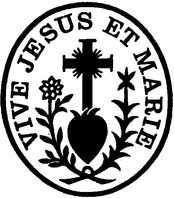
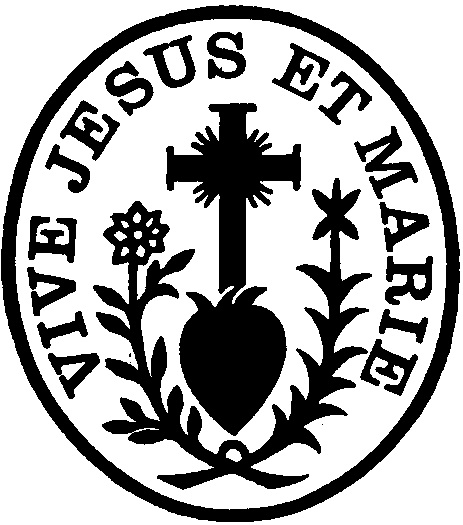
Eudists arms.jpg

In the context of the Year for Priests, I wish to pause to underline the apostolic zeal of St. John Eudes, directed in particular to the formation of the diocesan clergy.

The saints have verified, in the experience of life, the truth of the Gospel; in this way, they introduce us into the knowledge and understanding of the Gospel. In 1563, the Council of Trent issued norms for the establishment of diocesan seminaries and for the formation of priests, as the council was aware that the whole crisis of the Reformation was also conditioned by the insufficient formation of priests, who were not adequately prepared intellectually and spiritually, in their heart and soul, for the priesthood.

This occurred in 1563 but, given that the application and implementation of the norms took time, both in Germany as well as in France, St. John Eudes saw the consequences of this problem. Moved by the lucid awareness of the great need of spiritual help that souls were feeling precisely because of the incapacity of a great part of the clergy, the saint, who was a parish priest, instituted a congregation dedicated specifically to the formation of priests. He founded the first seminary in the university city of Caen, a highly appreciated endeavor, which was soon extended to other dioceses.

The path of holiness he followed and proposed to his disciples had as its foundation a solid confidence in the love that God revealed to humanity in the priestly Heart of Christ and the maternal Heart of Mary. In that time of cruelty and loss of interior silence, he addressed himself to the heart so as to leave in the heart a word from the Psalms very well interpreted by St. Augustine. He wanted to remind people, men and above all future priests of the heart, showing the priestly Heart of Christ and the maternal Heart of Mary. A priest must be a witness and apostle of this love of the Heart of Christ and of Mary.

Today we also feel the need for priests to witness the infinite mercy of God with a life totally "conquered" by Christ, and for them to learn this in the years of their formation in the seminaries. After the synod of 1990, Pope John Paul II issued the apostolic exhortation Pastores Dabo Vobis, in which he took up and actualized the norms of the Council of Trent and above all underlined the need for continuity between the initial and permanent moments of formation. For him, for us, this is a real point of departure for a genuine reform of priestly life and apostolate, and it is also the central point so that the "new evangelization" is not simply an attractive slogan, but rather is translated into reality.

The foundations of formation in the seminary constitute that irreplaceable "humus spirituale" in which it is possible to "learn Christ," allowing oneself to be progressively configured to him, sole High Priest and Good Shepherd. The time in the seminary should be seen, therefore, as the actualization of the moment in which the Lord Jesus, after having called the Apostles and before sending them out to preach, asks that they stay with him (cf. Mark 3:14).

When St. Mark narrates the vocation of the Twelve Apostles, he tells us that Jesus had a double objective: The first was that they be with him, the second that they be sent to preach. But in going always with him, they truly proclaim Christ and take the reality of the Gospel to the world.

In this Year for Priests, I invite you to pray, dear brothers and sisters, for priests and for those preparing to receive the extraordinary gift of the priestly ministry. I conclude by addressing to all the exhortation of St. John Eudes, who said thus to priests: "Give yourselves to Jesus to enter into the immensity of his great Heart, which contains the Heart of his Holy Mother and of all the saints, and to lose yourselves in this abyss of love, of charity, of mercy, of humility, of purity, of patience, of submission and of holiness" (Coeur admirable, III, 2).
About the author

Paul A. Zalonski is from New Haven, CT. After years of study, work and trying to find meaning in life, he still has a sense of humor. Paul is discerning God's plan and is preparing for ordination to the priesthood. Contact Paul at paulzalonski(at)yahoo.com.

Pages

Humanities Blog Directory

About this Archive

This page is a archive of recent entries in the Year of the Priest category.

Year of Saint John Mary Vianney is the previous category.

Find recent content on the main index or look in the archives to find all content.