Culture: October 2008 Archives

From the News Services...

Moscow - Two Jesuit priests died of knife wounds in Moscow, Russian news agencies said IHS.jpgWednesday. Father Igor Kovalevsky, the general secretary of the Catholic Bishops' Conference, said the priests bodies were found in their central Moscow apartment late Tuesday.

Kovalevsky called the incident a "brutal murder."

Police at the scene said the two men had died of blows to the head and knife wounds. Authorities said the motive for the killing was unknown.

News agency Ria-Novosti named the victims as Russian national Otto Messmer, 46, and South American priest Victor Betancourt, 42.


From the General Curia of the Society of Jesus...

On Saturday 25 October, Father Victor Betancourt, an Ecuadorian Jesuit working in the St. Thomas Philosophical, Theological and Historical Institute in Moscow, was killed in his home. Two days later, after returning from a trip abroad, Father Otto Messmer, Superior of the Russian Region, was also killed in the same place. On Tuesday 28 October, alarmed by the fact that he hadn't heard from the two men, a fellow Jesuit who lives in another community went to visit them at home. On finding the dead bodies, he immediately contacted the police.


The police investigations have yet to come to any firm conclusions about cause of these violent deaths.


Father Otto Messmer, son of a profoundly Catholic family of German origin and a Russian citizen, was born on 14 July 1961 in Karaganda, Kazakhstan. He entered into the Society of Jesus on 1 September 1982 in Vilnius and was ordained a priest on 29 May 1988 in Riga. He took his final vows in Novosibirsk on 7 October 2001 and was appointed Superior of the Independent Region of Russia of the Society of Jesus on 13 October 2002. Two of his brothers are Jesuits: Monsignor Nikolaus, Bishop of the Kyrgyzstani city of Bishkek, and Hieronymus, from the German Province.


Father Victor Betancourt was born on 7 July 1966 in Guayaquil, Ecuador. He entered into the Society of Jesus on 14 September 1984 in Quito and was ordained a priest in the same city on 31 July 1997. He undertook his Jesuit training in Argentina, Ecuador, Germany and Italy. In 2004, he defended his doctoral thesis in Theology in the city of Rome. Since 2001, he had been responsible for those considering a vocation as Jesuits and at the time of his death he was a theology professor in the St. Thomas Philosophical, Theological and Historical Institute in Moscow

May their memory be eternal!

...will be meeting this coming Saturday, All Saints Day, November 1st


Adoration of the Most Blessed Sacrament and Vespers followed by music by

Keith Moore


The evening will start at 6pm with a conversation on faith & politics antipicating the Presidential Election; prayer at 7:30...


Our Lady of Good Council Church
230 East 90th Street
New York, NY 10128


The Catholic Underground happens every 1st Saturday of the month, from 7:30pm - 10:30pm. Parking: Parking garage available, $10 a night with Catholic Underground stamp dispensed by Friar Charles, CFR.

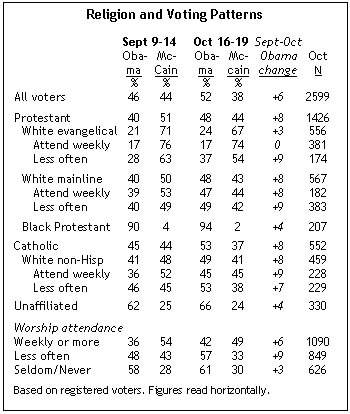
religion voting patterns.jpgposted originally on Beliefnet.com

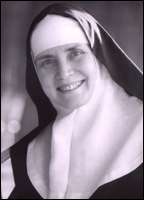
When Rev. Mother Dolores Hart walked away from her life as an actress in Hollywood Mother Dolores.jpgto become a nun in Connecticut, she thought she had put acting behind her forever.


For the actress formerly known as Dolores Hart, who starred opposite Elvis Presley, Montgomery Clift and Anthony Quinn, acting would eventually come back into her life. She now sees it as part of her vocation as a Benedictine nun, although her role is solely backstage. At the Abbey of Regina Laudis in Bethlehem, she has helped cultivate a passionate theater community as an artistic director. In a 200-seat outdoor theater, The Gary-The Olivia Theater, built on the grounds, a play is presented each summer by the community, which has made Mother Dolores see that the arts can bring one closer to God.


On Wednesday, Oct. 29 at Fairfield University, Mother Dolores will discuss how spirituality and theater are entwined in a talk, "The Gary - The Olivia Theater: An Expression of Benedictine Monasticism's Contribution to the Arts." Presented by the University's Center for Catholic Studies, the event is the 3rd annual Catholicism & The Arts Lecture. It is free and open to the public and will take place in the Charles F. Dolan School of Business dining room at 8 p.m. Mother Dolores, who received an honorary doctorate from Fairfield in 2004, will share the story of her early life as an actress, her calling, and the theater's unique origins (involving an Oscar winner) with the ways in which she understands that theater can be to some degree an expression of the Benedictine spirituality.


The Gary-The Olivia is a home for quiet contemplation, a vehicle for positive change, and ultimately, a holy place. Mother Dolores has come to realize that she can help young people discover their own vocation in Christ through the medium of theater. "Theater can lead to spiritual transformation," she said. "Every year when we stage a play, I see some type of transformation happen in certain actors," she said. "That's because the theater calls on actors to be grounded in their body and the truth of their feelings and who they really are. This causes people - young people who have never been on stage and older individuals who know the stage well - to see clearly, to see, perhaps not in full form quite yet, their vocation in life and the path that they must forge. Those who really understand acting know you have to be in touch with your own truth, and this truth is rooted in God."


Dolores Hart Elvis.jpgThe daughter of actors and the niece of singer Mario Lanza, Mother Dolores fell in love with movies watching them with her grandfather, who was a movie theater projectionist. She decided she wanted to be a movie actress and got her start barely out of high school. Her first film was also Elvis Presley's first film, "Loving You," released in 1957. She also worked with Presley in "King Creole." She starred with Connie Francis in "Where The Boys Are." During her brief yet very busy career, she worked with prominent directors Hal Wallis and George Cukor, and actors Walter Matthau, Maureen Stapleton, Frances Farmer, Robert Wagner, and Karl Malden. She received a Tony nomination for her work in the Broadway play, "The Pleasure of His Company."  In 1962, she made a film, "Lisa," which was the story of a Dutch holocaust survivor trying to make her way to Palestine, a role that had a profound impact on her life and prompted her to hear God's calling. She left Hollywood for Bethlehem in 1963.


The Abbey of Regina Laudis is a cloistered order of about 40 Benedictines who live on Regina Laudis.jpgthe Abbey's 400 acres. Mother Dolores is the Prioress. The nuns' daily life includes chanting the Divine Offices seven times a day in Latin, and tending to their dairy farm, where they make cheese, look after a beef herd, pigs, sheep, lamma and a donkey. They take care of the property's extensive orchards, and try to be as self-sufficient as possible. It is a life in keeping with St. Benedict's dictum that their lives should be a balanced combination of prayer and work. A special part of the nuns' lives is the theater, which has evolved over the past nearly three decades. Productions staged there have included "My Fair Lady," and "West Side Story," as well as plays by Chekhov and Jean-Paul Sartre.


Preparing for the upcoming talk at Fairfield has caused her to look back over the last 40 years or so of her Benedictine life and to marvel at how her life and that of her monastery have been shaped. She sees how her vocation as an actress has come to a full and gratifying expression through the mysterious development of The Gary - The Olivia.


Mother Dolores 1970.jpgInterestingly, The Gary - The Olivia owes it origins in part to the inspiration of another film actress, Patricia Neal, who won an Oscar for her work in "Hud." In 1980, Neal sought refuge in the Abbey during trying personal times. Uncertain that she could ever be on stage again, Neal was encouraged by the nuns to give a poetry reading on the Abbey land. With her help and other friends, the theater was built in 1986. It was named in part after Neal's late daughter, and for her friend, Gary Cooper.


For information about attending the talk, please call (203) 254-4000, ext. 3415.


Read a Barbara Middleton interview with Mother Dolores 


Also, you ought to read this article in The New York Times is interesting.

Receive guests as Christ

| | Comments (0)

Let all guests who arrive be received as Christ, because He will say: "I guesthouse.jpgwas a stranger and you took Me in" (Mt 25:35). And let due honor be shown to all, especially to those "of the household of the faith" (Gal 6:10) and to wayfarers. (Rule of Saint Benedict, 53)

The New York Times Travel section today has a good article promoting monastic guesthouses. The author Jane Margolies has an appreciation for the simplicity and serenity of the monastic cloister which in turn welcomes travelers. Read the article and consider a monastery guest on your next trip.

Bishop Arthur J. Serratelli writes:

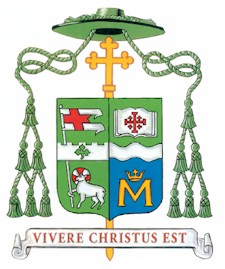
Arthur J Serratelli.jpg 

After committing a murder in Rome, the famous 17th century Italian painter Caravaggio went to Malta to avoid the death penalty. While there, the Great Master of the Order of the Knights of Malta commissioned him to do a painting for the chapel of the Co-Cathedral of St. John in Valletta. Caravaggio chose as his theme the martyrdom of John the Baptist. He produced The Beheading of St. John, his largest work, the only one he ever signed. No doubt the scene touched him personally. 


Herod was married to Herodias, his brother Philip's wife. Because John the Baptist preached against this sin, he incurred the hatred of Herod's wife. The day her daughter Salome delighted Herod with her seductive dance, Herodias had her make Herod promise to kill John the Baptist. Within the severe architecture of a 16th century prison, Caravaggio vividly depicts the grisly moment when Herod kept his promise.


Caravaggio's work, considered his greatest masterpiece, immortalizes the misguided fidelity of a ruler to his gruesome promise. With the stroke of the soldier's sword, John dies and so does freedom. Freedom is based on the truth of the human person as created by God and protected by his law.


When a ruler can decide against God's law, true freedom is sentenced to death.


Recently, a politician made a promise. Politicians usually do. If this politician fulfills his promise, not only will many of our freedoms as Americans be taken from us, but the innocent and vulnerable will spill their blood.


On April 18, 2007, in Gonzales v. Carhart, The Supreme Court upheld the Partial-Birth Abortion Ban. The very next day prominent Democratic members of Congress reintroduced the Freedom of Choice Act (FOCA). The bill is misleadingly packaged as a freedom bill. It is not! It is a clear act of unreasoned bias to end abruptly and brutally the debate on the pressing and fundamental moral issue of the right to life.


For thirty-five years, Americans have been wrestling with The Supreme Court's decision legalizing abortion in Roe v. Wade.  Most Americans now favor some kind of a ban on abortion. Most who allow abortion would do so only in very rare cases. In fact, in January, 2008, the Guttmacher Institute published its 14th census of abortion providers in the country. Its statistics showed that the abortion rate continues to decline. Abortions have reached their lowest level since 1974. There is truly a deep sensitivity to life in the soul of America. 


 The Freedom of Choice Act (FOCA) would mortally wound this sensitivity. In effect, it would dismantle the freedom of choice to do all that is necessary to respect and protect human life at its most vulnerable stage. FOCA goes far beyond guaranteeing the right to an abortion throughout the nine months of pregnancy. It arrogantly prohibits any law or policy interfering with that right. While advocates trumpet this law as the triumph of the freedom of choice, they hide the dark reality that the law would actually inhibit choice.


Laws protecting the rights of nurses, doctors and hospitals with moral objections to abortion would no longer stand. Health and safety regulations for abortion clinics would also vanish. Gone the freedom of health care professionals to be faithful to the Hippocratic Oath "to prescribe regimens for the good of...patients...and never do harm to anyone, to please no one [by prescribing] a deadly drug nor [by giving] advice which may cause his death." Gone the freedom of conscience so essential for a civil society!


If a minority of avid abortionists succeed to impose this law because of the ignorance or apathy of the majority, the law would force taxpayers to fund abortions. Gone the freedom of taxation with representation!


In its 1992 Casey decision, The Supreme Court ruled as constitutional state laws requiring that women and young girls who seek an abortion receive information on the development of the child in the womb as well as alternatives to abortion. The ruling also determined that a period of waiting, usually 24 or 48 hours before making a decision about an abortion is not an undue burden. The Freedom of Choice Act would nullify these laws immediately. Gone the freedom of women and young girls to have all the information they need to make their own choices!


In about half of the States, there are parental notification or consent laws in effect for minors seeking an abortion. The Supreme Court has ruled that these laws are permitted under Roe v. Wade. With the stroke of a pen, these laws would be abolished. Gone the freedom of parents to care for and protect their children and grandchildren!


 Advocates of FOCA redefine a woman's "health" so as to expressly permit post-viability abortions. Thus, a child who survives an abortion can be left to die for the health of the mother. No politically correct word can mask this reality for what it is. This is infanticide. Gone the freedom for a baby, once born, to live!


Science does not dispute that the child in the womb already has all the characteristics that he or she will develop after birth. Notwithstanding, abortionists obstinately refuse the right of the child within the womb to live as a fundamental human right. They are not happy that Americans have not swallowed their distorted propaganda that denies the dignity of the human person from the first moment of conception.


Pro-abortion advocates close their eyes to the fact that abortion even hurts women as it undermines the very fabric of our society. Their zeal for the Freedom of Choice Act sounds the alarm for decent Americans to wake up! The more the right to life is denied, the more we lose our freedoms. The "pro-choice" movement is not pro-choice. It stands against the freedom to choose what is right according to the truth of the human person.


In 2002, as an Illinois legislator, the present democratic candidate voted against the Induced Infant Liability Act. This law was meant to protect a baby that survived a late-term abortion. When the same legislation came up in the Judiciary Committee on which he served, he held to his opposition. First, he voted "present." Next, he voted "no."


Along with 108 members of Congress, the present democratic candidate for President continues his strong support for the Freedom of Choice Act. In a speech before the Planned Parenthood Action Fund last year, he made the promise that the first thing he would do as President would be to sign the Freedom of Choice Act. What a choice for a new President!


At the time when Herod murdered John the Baptist because of his promise, Rome practiced the principle "one man, one vote." Whoever the emperor in Rome placed in authority over a subject people, ruled. Today we live in a democracy. We choose our leaders who make our laws. Every vote counts. Today, either we choose to respect and protect life, especially the life of the child in the womb of the mother or we sanction the loss of our most basic freedoms. At this point, we are still free to choose!


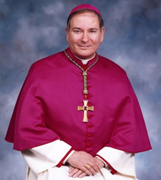
AJ Serratelli.jpgThe Most Reverend Arthur J. Serratelli is the bishop of the Diocese of Patterson. He earned a Licentiate in Sacred Theology from the Gregorian University, a Licentiate in Sacred Scripture from the Biblical Institute and a doctorate in Sacred Theology from the Gregorian University.


LOsservatore Romano.jpg

VATICAN CITY -- The newspaper industry might be on the ropes, but one staid broadsheet is getting a makeover at the behest of a lofty patron: Pope Benedict XVI.


In its 147 years as the Vatican's newspaper of record, L'Osservatore Romano has rarely chased advertisers, or even news. Hard to find beyond the world's smallest state, the Vatican's daily paper largely dedicated its pages to theological monologues with headlines like "The Leprosy of Sin."


Those days are over. Now, the Vatican mouthpiece has orders to carry hard-hitting news, international stories and more articles by women.


The Vatican's newspaper of record, L'Osservatore Romano, has been undergoing a makeover at the behest of Pope Benedict XVI.


"There was a really precise request from the paper's publisher," Giovanni Maria Vian, the paper's new editor in chief, said in a recent interview at his office within the medieval walls of Vatican City. "In this case, the publisher just happened to be the pope."


To read the rest of Davide Berretta's article in The Wall Street Journal visit this link.

Christopher Columbus

| | Comments (0)

IN 1492

In fourteen hundred ninety-two
Columbus sailed the ocean blue.

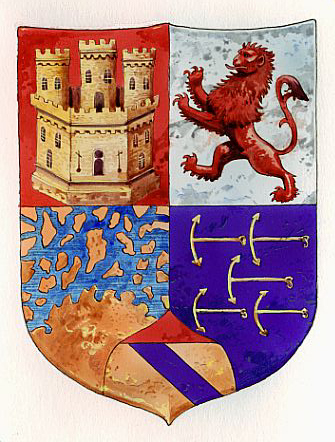
Christopher Columbus.jpgHe had three ships and left from Spain;
He sailed through sunshine, wind and rain.

He sailed by night; he sailed by day;
He used the stars to find his way.

A compass also helped him know
How to find the way to go.

Ninety sailors were on board;
Some men worked while others snored.

Then the workers went to sleep;
And others watched the ocean deep.

Day after day they looked for land;
They dreamed of trees and rocks and sand.

October 12 their dream came true,
You never saw a happier crew!

"Indians!  Indians!"  Columbus cried;
His heart was filled with joyful pride.

But "India" the land was not;
Christopher Columbus arms.jpgIt was the Bahamas, and it was hot.

The Arakawa natives were very nice;
They gave the sailors food and spice.

Columbus sailed on to find some gold
To bring back home, as he'd been told.

He made the trip again and again,
Trading gold to bring to Spain.

The first American?  No, not quite.
But Columbus was brave, and he was bright.

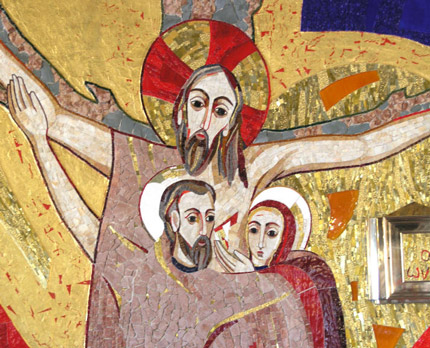
Crucifixion.jpgSacred Heart University in Fairfield, Connecticut is building a new University Chapel and has commissioned a rather unique team of artists to create original works of art for use in the sacred Liturgy.


Jesuit Father Marko I. Rupnik heads the artistic and theological team from the Aletti Center in Rome, Italy. He is a world-renowned artist whose works grace Pope John Paul II's Redemptoris Mater chapel at the Vatican and at the Basilica of Notre Dame du Rosaire, at Lourdes in France (a recent installation). His first work in the USA was commissioned by the Knights of Columbus Supreme Office in New Haven, Connecticut in 2005.


Virginaletti.jpgThis art doesn't just decorate a space. It is liturgical art that is integrated into a particular space for the celebration of the sacred Liturgy. In relation to the sacred Liturgy, the liturgical art together with word and ritual gesture articulate the Church's interior life of holiness. By this, a church is an ecclesial edifice that not only allows a person to encounter the dynamic work of the Blessed Trinity, but it allows you to pray, think and relate at a real human level about the Divine Presence. The experience of good liturgical art, like the work of Father Rupnik, is not a mere static experience; it is an experience that vivifies our humanity. The artwork Rupnik has created in the Fairfield and in New Haven like that of the works in Rome and other places, is an expression of a dynamic spiritual quest of the divine and human, oriented in Church with a totality and energy of the living Trinitarian love communicated in Christ.


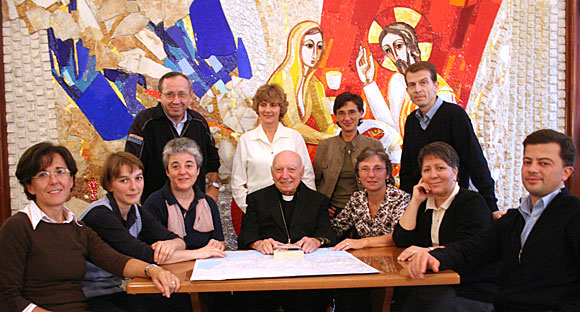
The Aletti Center is animated by a team of Jesuits and religious. The members of the team Aletti team.jpgare specialists in Eastern theology and in related arts brought together to promote and to develop activities for theological-cultural reflection. A well-known member of the Aletti team is Jesuit Cardinal

Tomáš Špidlík from the Czech Republic but who has spent more than 50 years teaching in Rome (pictured in the center). Founded in 1991, the Aletti Center is part of the Pontifical Oriental Institute which specializes in the study and research of the theology of the Eastern Churches.


CU.jpg


The Catholic Underground NYC is meeting on Saturday, October 11th. You know the plan: people gather at Our Lady of Good Counsel Church (230 East 90th Street, NYC) at 7:30 pm for Vespers and adoration of the Blessed Sacrament. Confessions will be heard. From 8:30-10:30 the crowd moves to the church hall for a musical performance. At this Underground NYC's Messengers of Christ (M.O.C.) will be performing.


Parking: Parking garage across the street from the Church available, $10 a night with Catholic Underground stamp.


Contact:
e-mail: catholicunderground@gmail.com


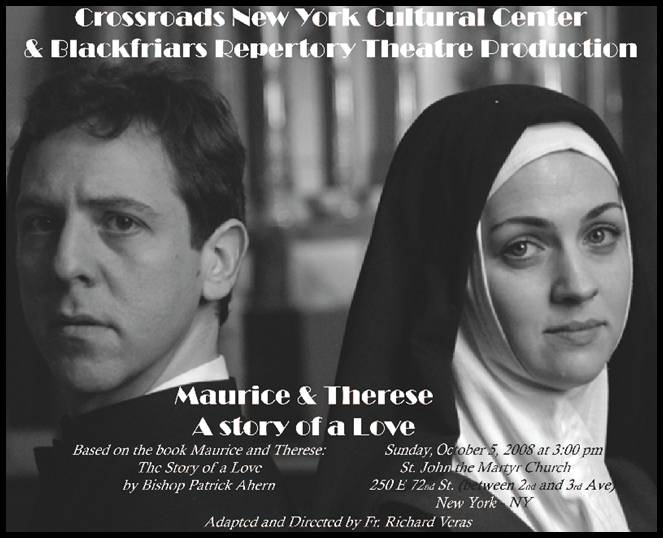
On the occasion of the Feast of Saint Therese of the Child Jesus, we invite you to attend the first presentation of "Crossroads on the Road." The 75-minute theatrical production, Maurice & Therese: A Story of a Love will be performed this Sunday, October 5, at 3 pm at St. John the Martyr Church in Manhattan. The performance is free of charge and open to the public. See below for more details.


Maurice & Therese.JPG

The centuries of Catholic life reveal a variety of "violations" of the Eucharist, Holy Communion, the real Presence of our Lord and Savior Jesus Christ. These violations include heretical writings, sermons, plays, burnings, descration of the sacred Host, etc. Now we are dealing with technology's assistance in abusing the eucharistic Lord.


A problem we face is invinsible ignorance and flagrant behavior meant to shock and discourage the faithful. One of the disappointing things is the lack of media coverage on this topic and how relatively few Catholics standing up for their confessed faith in Jesus Christ. Of 65 million Catholics in the USA, how many are protesting this act of sacrilege? By protesting I don't mean shaking their fingers and heads and saying, "That's terrible!" but actually saying and doing something in a public way with friends, colleagues, etc. to make it clear that abusing something as sacred as the Communion is not to be tolerated.


In an era when religious sensitivity has lots of currency, even to an extreme, why isn't this  a matter significant discussion and reaction from the Christians of all stripes? Here I take issue with a point in the article below: I don't see this act getting people mobilized to correct an abuse. Even though the other ecclesial communities who have some belief in Communion should stand up and demonstrate. Where are they??? Why aren't the Catholics as vocal as the Jews and Muslims are when they experience a preceived abuse of their theology? Think of the Danish cartoons that got Muslims excited.


Elizabeth Ela writes a piece for HeadlineBistro.com which is helpful. AND write to YouTube at the email address noted below to register your complaint.
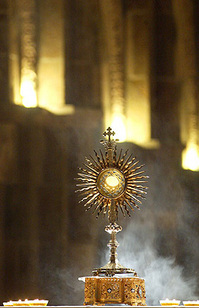
 

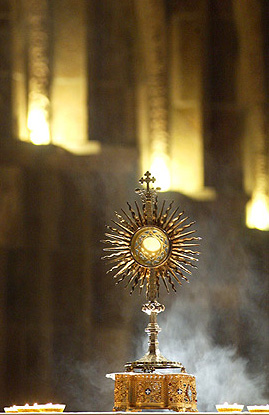
adoration.jpgPeople can find a video of almost anything on YouTube: babies' first steps, Saturday Night Live skits, news clips, concerts and now - to the shock of Catholics everywhere - desecration of the Eucharist.


YouTube has long been a destination for Catholics seeking video clips of Masses, apologetics lectures or devotions, but now Catholic outrage is growing as the site has become home to a string of videos depicting acts of Eucharistic desecration, including flushing a host down the toilet, putting one in a blender, feeding one to animals, shooting one with a nail gun and more. "I don't know what to say," said a stunned Msgr. C. Eugene Morris, professor of sacramental theology at Kenrick Glennon Seminary in St. Louis, when told about the videos. "I am outraged that YouTube is tacitly supporting this and giving this behavior an audience."


The most prominent series of videos come from one YouTube user who claims to steal a consecrated host every day and desecrate each one in a different way. His videos began two months ago with the user saying into a webcam that he denied the Holy Spirit, then splitting a host in half and eating it with disrespect.


Most of the videos only have a few hundred views - relatively low for YouTube standards - although the latest installment, "Eucharistic Desecration #33: Nail Gun," has been watched over 1,000 times.


The user, who lists his first name as Dominique, has also posted a video of his receiving communion at an unidentified Catholic church and removing the host from his mouth in the church parking lot. Msgr. Morris said people need to "stand up" for their faith in cases like this. Some have taken up the challenge.


Thomas Serafin is president of the International Crusade for Holy Relics, an internet watchdog group of Catholic laymen. His group has been fighting online affronts to the Catholic Church, including the sale of the Eucharist and of relics of the saints online, for more than a decade. "YouTube has to be held accountable and stopped," Serafin said from Los Angeles. "If Catholics don't take a stand right now, they can expect such outrages to continue."


Serafin added: "The internet is, in many ways, a new world, and it is our duty to evangelize this world, but we have to speak up and be heard to do that."


YouTube's content policy technically restricts users from posting videos that contain hate speech or "shocking and disgusting" elements.


"We encourage free speech and defend everyone's right to express unpopular points of view," YouTube's Community Guidelines state. "But we don't permit hate speech (speech which attacks or demeans a group based on race or ethnic origin, religion, disability, gender, age, veteran status, and sexual orientation/gender identity)."


YouTube spokesperson Kathleen Fitzgerald asked for additional links to the desecration videos, but did not respond to a request for comment prior to the publication of this story.

However, YouTube defines hate speech as "content that promotes hatred against members of a protected group. For instance, racist or sexist content may be considered hate speech. Sometimes there is a fine line between what is and what is not considered hate speech. For instance, it is generally okay to criticize a nation, but not okay to make insulting generalizations about people of a particular nationality."


The guidelines add, "YouTube is not a shock site. Don't post gross-out videos of accidents, dead bodies or similar things intended to shock or disgust."


Users may "flag" offensive videos, which YouTube says will alert their reviewers to videos that may violate content guidelines. A video featuring the Eucharist desecrated with a knife was flagged by Headline Bistro staff but remains on YouTube.


"Here you have someone attacking another group, and there's no outcry," Msgr. Morris said. "We're not hurting anybody or attacking other's beliefs," he added, saying he would ask perpetrators of Eucharistic desecration, "Why are you so concerned about this? Why is it your business?"


One name still making the rounds in YouTube and bloggers' discussions on Eucharistic desecration is Paul Z. Myers, the University of Minnesota professor who asked his blog readers in July to "score" him "some consecrated communion wafers."


"If any of you would be willing to do what it takes to get me some, or even one, and mail it to me, I'll show you sacrilege, gladly, and with much fanfare," Myers wrote in response to the case of a University of Central Florida student who stole a consecrated host the previous month.


Myers later posted a picture of a host - which he claimed was consecrated and sent to him via mail - as well as pages from the Koran and atheist Richard Dawkins' "The God Delusion" in a trash can, underneath coffee grounds and a banana peel.


As for the current YouTube videos, Dominique cited Myers as inspiration for the video series. In terms of the response he's received for his own acts of Eucharistic desecration, Dominique said most reactions are "quite funny."


"The best I have are from moderate Catholics," he wrote in an email to Headline Bistro. "Catholics who really believe that a cracker can become somebody after a magic ritual don't get the point, but some moderate Catholics who see the wafer as a symbol of Jesus' flesh realize something. Sometimes they disagree with what I do, but they realize that some of their friends are quite insane and that something must be done about that."
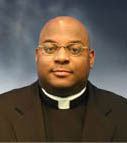
 

Fr Eugene Morris.jpgMsgr. Morris refuted Dominique's portrayal of believing Catholics as "insane."

"If you don't believe in the mystery of Christ, then of course you don't understand the sublime mystery of the Eucharist," Morris said.


"We have confidence," he added, in what "(Christ) has said to us" in regards to the Eucharist. Morris also pointed out the many examples of men and women who died for their faith in the Eucharist over the past 2,000 years.


Serafin said people should call or write YouTube to demand that the videos be taken down. YouTube's public relations email address is press@youtube.com


"Christ died on the cross for us," said Serafin. "The least we can do is defend him in cases like this."
About the author

Paul A. Zalonski is from New Haven, CT. After years of study, work and trying to find meaning in life, he still has a sense of humor. Paul is discerning God's plan and is preparing for ordination to the priesthood. Contact Paul at paulzalonski(at)yahoo.com.

Pages

Humanities Blog Directory

About this Archive

This page is a archive of entries in the Culture category from October 2008.

Culture: September 2008 is the previous archive.

Culture: November 2008 is the next archive.

Find recent content on the main index or look in the archives to find all content.