Pope remembers Manuela Camagni: a witness to a relationship that’s stronger than death

Manuela Camagni2.jpgWhat follows is Pope Benedict XVI’s message sent on
the occasion of the Mass of Christian Burial for Manuela Camagni, 56, a member
of the association of Memores Domini (the consecrated lay group of Communion
& Liberation) who with 3 other Memores worked for the Pope in his personal apartments
at the Vatican. As mentioned in a blog post last week, Manuela was killed
Tuesday/Wednesday after being struck by a car. The Reverend Monsignor Georg
Ganswein, the Pope’s personal secretary, read the message at the funeral, Monday
in Bagno di Romagna, Emilia-Romagna (northern Italian city). The Mass of Christian Burial was celebrated at La Chiesa di San Piero in Bagno di Romagna.


I would willingly
have presided over the funeral of dear Manuela Camagni, but –as you can
imagine– it was not possible for me. However, communion in Christ allows us
Christians a real spiritual closeness, in which we share the prayer and
affection of the heart. In this profound bond I greet all of you, in particular
Manuela’s family, the diocesan bishop, the priests, the Memores Domini, and her
friends.

I would like to give here very briefly my testimony of our sister, who
has gone to heaven. Many of you knew Manuela for a long time. I was able to
benefit from her presence and her service in the papal apartment, in the last
five years, in a family dimension. Because of this I wish to thank the Lord for
the gift of Manuela’s life, for her faith, for her generous response to her
vocation
. Divine Providence led her to a discreet but precious service in the
Pope’s house. She was happy about this and took part joyfully in family
moments: at Holy Mass in the morning, at vespers, at meals in common and in the
various and significant happenings of the house.

Her departure, so sudden, and
also the way in which she was taken, have given us great grief, which only
faith can console. I find much support in thinking of the words that form the
name of her community: Memores Domini
. Meditating on these words, on the
meaning, I find a sense of peace, because they call to a profound relationship
that is stronger than death
. Memores Domini means: “those who remember the
Lord,” namely, persons who live in the memory of God and Jesus, and in
this daily remembrance, full of faith and love, they find the meaning of
everything, from small actions to great choices, of work, study and fraternity.
The memory of the Lord fills the heart with profound joy, as an ancient hymn of
the Church
says: “Jesu dulcis memoria, dans vera cordis gaudia
[Jesus sweet memory, that gives true joy to the heart].


Hence, because of this
it gives me peace to think that Manuela is a “memor Domini,” a person
who lived in the memory of the Lord. This relationship with him is more
profound than the abyss of death. It is a bond that nothing and no one can
break, as St. Paul says: “[Nothing] can separate us from the love of God,
in Christ Jesus our Lord” (Romans 8:39). Yes, if we remember the Lord, it
is because he first remembers us. We are “memores Domini” because he
is “memor nostri,” he remembers us with love of a parent, a brother,
a friend, also at the moment of death.
If at times it seems that at that moment
he is absent, that he forgets us, in reality we are always present to him, we
are in his heart. Wherever we fall, we fall into his hands. Precisely there,
where no one can accompany us, God awaits us: He is our Life.


Dear brothers and
sisters, in this faith full of hope, which is Mary’s faith near the cross of
Jesus, I celebrated the Mass for Manuela’s soul the very morning of her death.
And while I accompany with prayer the Christian rite of her burial, I impart
with affection to her family, her fellow sisters and all of you my blessing.

Pope Benedict XVI’s monthly prayer intentions for December 2010

Pope on June 2 2010.jpgPope Benedict’s invitation to prayer for the month of December, these last days of the calendar year for our unity with him before the Throne of Grace. Ask the Sacred Heart of Jesus to hear and answer our prayers:

The general intention
That our experience of suffering may help us better understand the pain of the many people who are alone, sick, or aged, and stir us to generous help.
The mission intention
That the peoples of the earth may open their doors to Christ and to his gospel of peace, brotherhood, and justice.

Autumn days at the Abbey of Regina Laudis

St Benedict, Lower Monastery Chapel.JPGThe Abbey of Regina Laudis is a special place in Connecticut; and one of the special Benedictine monasteries in the USA. I’ve been spending more time there in recent months either attending the Divine Office and/or Mass or spending a few days in St Joseph’s Guest House (for men, there are guests for women, married folks, & clergy).

One thing I learn going to monasteries or other types of religious houses is the wide variety of people who come for a brief visit to the gift shop and chapel to those visiting for professional reasons and those who are there to spend a few days making a retreat, bugging out of the “world” for a respite or those like me who just love monasteries, nuns and the culture. This past weekend we had Jesuit seminarians and a man from North Carolina connecting with distant family who happens to be a nun.
rose on chapel grill.JPG

chapel side.JPG

Being among the guests you see the monastic life unfold in profound and simple ways. The profound is exemplified in thinking about contours of the nuns and a couple of laymen considering making a monastic foundation of brothers and priests at the abbey. And there were the simple ways of spending time with one of the Oblate brothers who was Holy Apostles Seminary, or another Oblate brother preparing for his diaconate ordination on Saturday. And your own learning discerning a new of living what the Lord has given. So much at Regina Laudis is rooted in the prayer and work of the land. Being a land preserve, the nuns care for the land in extraordinary ways like farming, caring for the natural way supplies, raising much of their own food, etc.
cow2.JPG
ram3.JPG
harp.JPG
crèche - nativity.JPG
Mother Benedict by Antoinette Bosco.jpg
Want to know more about the Abbey of Regina Laudis and the monastic culture found there? Come for a visit, spend a few days at the abbey and/or read Antoinette Bosco’s Mother Benedict (and read Bosco’s essay on the book).
Antoinette Bosco, a resident of Connecticut, journalist and friend of the nuns, wrote an accessible and inspiring account of the abbey’s founder, Mother Benedict Duss, OSB (+October 5, 2005). Mother Benedict was forward thinking and a pioneering nun who founded an abbey of nuns who take seriously prayer, work, culture and humanity. Bosco’s narrative tells the story of a woman who risked everything, was obedient to the Church, and trusted profoundly in God.
The abbey is home to a nun who bears a tired clichè –but all clichès are shopworn– of “the cheese nun,” who went back to school at a later age for further education which landed her a stellar PhD in microbiology that has enabled her to make brilliant contributions in the field of making cheese and promoting culture the world over. A Fullbright scholar, Mother Noella never thought that entering a monastery would lead to studying science, milking a cow, making artisanal cheese, travel extensively. Except that in all these things she followed the aphorism, that in all things God is gloried.

Thumbnail image for Cheese Nun.jpg

So, watch the 2006 PBS presentation “The Cheese Nun” telling the story of Mother Noella Marcellino learning the ways of God and humanity through the exacting study of science, cheese-making and prayer all in an effort to know the grace of creation given by God: biodiversity reveals the ever beautiful face of the Creator.
Other Communio blog posts on Regina Laudis: the Crèchevarious pics, the Benedictine approach to holinesson a visit in August, and a story on Mother Dolores Hart.

Saint Andrew: the Ecumenical agenda

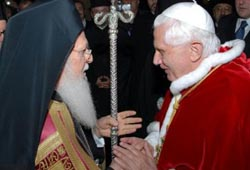
Constantinople & Rome.JPGSaint Andrew is the first of the 12 Apostles called by Jesus to follow Him. Today is his feast day, the day traditionally remembered as the day of his death.

Official delegations of prayer and fraternal exchange happen for the June feast of Saints Peter and Paul (in Rome) and for today’s feast of Saint Andrew (in Constantinople). The protocol followed is that Patriarch Bartholomew I sends a message and a group to Rome in June and the Pope does the same on November 30 for today’s feast. Often there’s a series of meetings, discussions, academic exchanges, and a festive meal. Kurt Cardinal Koch and Bishop Brian Farrell, LC, (president and secretary of the Pontifical Council for Christian Unity) represented the Holy Father today.

The meeting was covered by Vatican Radio. Visit here.
 
The Catholic News Agency reports that the Pope is urging greater efforts to realize unity between the Catholic and Orthodox Churches.
The Pope’s message to the Patriarch: Benedict XVI to Bartholomew I Nov 30 2010.pdf

Saint Andrew, the First Called, martyr

St Andrew FDuquesnoy.jpg

Saint Andrew, pray for us.
Ask Saint Andrew to ask the Lord for the grace to carry the cross in humility, dignity and in the face of great opposition, opposition found within ourselves and from others. May he ask the Lord to bless the Bishop of Rome, the Patriarch of Constantinople, Scotland, Russia, the Archdiocese of Amalfi and for fish mongers, old maids and singers.

Blessed Bernard Francis de Hoyos, priest

Today is the first time the Jesuits and Spain celebrate the liturgical memorial of the new beatus, Blessed Bernard Francis de Hoyos. When Blessed Bernard was lifted to the altars in April, I posted on him, and here. For me, he’s an attractive contemporary apostle of the Sacred Heart Jesus. The second reading for the Office of Readings of the Divine Office follows:

From the Instruction of
Blessed Bernard Francis de Hoyos to Brother Ignatius Osorio

(Vallalodid, 14
September 1732, nn. 40-41; MS 1596, University Library of Salamanca.)

A divine
and heavenly peace in your heart

Bl Bernard Francis de Hoyos2.JPG

Try to have, my beloved brother, a divine and
heavenly peace in your heart. I do not speak of peace with others, called by
another name, charity; for that I repeat (the words) of the Apostle to the
Thessalonians: Now concerning love of the brothers, you do not need to have
anyone write to you, for your yourselves have been taught by God to love one
another (1 Thessalonians 4:9).  I speak of peace within one’s own heart,
which often is the greater struggle for us, arousing in the soul a thousand
disturbances, anguishes, and disquiet with which the demon succeeds in his aim
of thwarting us in the way of perfection.  The distinguishing
characteristic of the friends of God consists in this interior peace, which
Christ so often recommended to his disciples, repeating: Peace be with you
(Luke
10:5; 24:36) for he is called “Prince of Peace” (Isaiah 9:6).
 Disturbance, on the contrary, is characteristic of reprobates: There is
no peace for the wicked. (Isaiah 48:22).  Jesus cannot abide where there
is no peace
. The soul is a mirror; it is a crystal-clear steam which
reflects all the beauties placed before it; in which the image of our God is
reflected: into the same image we are being transformed (2 Corinthians 3:18),
so long as the waters of this stream are nit disturbed or agitated, so long as the
clarity of this mirror is not dimmed or obscured.

Continue reading Blessed Bernard Francis de Hoyos, priest

Gianfranco Ravasi on the move to Milan, next Pope?

Gianfranco Cardinal Ravasi.jpgA week ago today, Archbishop Gianfranco Ravasi, 68, was created a cardinal by Pope Benedict XVI. Ravasi, since 2007, is the well-equipped, critically acclaimed, lover of art and music, and a man who has a great sense of humor President of the Pontifical Council for Culture, the “Minister of Culture” (some might say he’s a “culture vulture”) and he heads the Pontifical Commission for the Cultural Heritage of the Church, and the Pontifical Commission for Sacred Archeology. He’s the former head of the Ambrosian Library in Milan. He turned the Library into a cultural and intellectual destination.

Continue reading Gianfranco Ravasi on the move to Milan, next Pope?

Pope Benedict XVI’s Prayer for Nascent Life

Lord Jesus,

You who faithfully visit and fulfil with your Presence
the Church and the history of men;
You who in the miraculous Sacrament of your Body and Blood
render us participants in divine Life
and allow us a foretaste of the joy of eternal Life;
We adore and bless you.
Prostrated before You, source and lover of Life,
truly present and alive among us, we beg you.
Reawaken in us respect for every unborn life,
make us capable of seeing in the fruit of the maternal womb
the miraculous work of the Creator,
open our hearts to generously welcoming every child
that comes into life.
Bless all families,
sanctify the union of spouses,
render fruitful their love.
Accompany the choices of legislative assemblies
with the light of your Spirit,
so that peoples and nations may recognise and respect
the sacred nature of life, of every human life.
Guide the work of scientists and doctors,
so that all progress contributes to the integral well-being of the person,
and no-one endures suppression or injustice.
Gift creative charity to administrators and economists,
so they may realise and promote sufficient conditions
so that young families can serenely embrace
the birth of new children
Console the married couples who suffer
because they are unable to have children
and in Your goodness provide for them.
Teach us all to care for orphaned or abandoned children,
so they may experience the warmth of your Charity,
the consolation of your divine Heart.
Together with Mary, Your Mother, the great believer,
in whose womb you took on our human nature,
we wait to receive from You, our Only True Good and Saviour,
the strength to love and serve life,
in anticipation of living forever in You,
in communion with the Blessed Trinity.

Advent Vespers 2010 with Pope Benedict XVI

The Pope began Advent 2010 this evening –it’s evening in Rome– in the Vatican Basilica by celebrating First Vespers of Advent in the Presence of the Blessed Sacrament.

“To you, my Lord God, my eyes are turned, my refuge, protect my life”; “Here the Lord comes, and with Him His great saints”; “The Lord will come in glory; every man will see that He is the Savior.” With these words our preparation has begun.

B16 Advent Vespers I 2010.jpg

The Pope’s homily:

With this evening’s celebration, the Lord gives us the grace and joy of opening the new liturgical year beginning with its first stage: Advent, the period that

commemorates the coming of God among us. Every beginning brings a special grace, because it is blessed by the Lord. In this Advent period we will once again experience the closeness of the One who created the world, who guides history and cared for us to the point of becoming a man. This great and fascinating mystery of God with us, moreover of God who becomes one of us, is what we celebrate in the coming weeks journeying towards holy Christmas. During the season of Advent we feel the Church that takes us by the hand and – in the image of the Blessed Virgin Mary – expresses her motherhood allowing us to experience the joyful expectation of the coming of the Lord, who embraces us all in his love that saves and consoles.

While our hearts reach out towards the annual celebration of the birth of Christ, the Church’s liturgy directs our gaze to the final goal: our encounter with the Lord in the splendour of glory. This is why we, in every Eucharist, “announce his death, proclaim his resurrection until he comes again” we hold vigil in prayer. The liturgy does not cease to encourage and support us, putting on our lips, in the days of Advent, the cry with which the whole Bible concludes, the last page of the Revelation of Saint John: “Come, Lord Jesus “(22:20).

Dear brothers and sisters, our coming together this evening to begin the Advent journey is enriched by another important reason: with the entire Church, we want to solemnly celebrate a prayer vigil for unborn life. I wish to express my thanks to all who have taken up this invitation and those who are specifically dedicated to welcoming and safeguarding human life in different situations of fragility, especially in its early days and in its early stages. The beginning of the liturgical year helps us to relive the expectation of God made flesh in the womb of the Virgin Mary, God who makes himself small, He becomes a child, it speaks to us of the coming of a God who is near, who wanted to experience the life of man, from the very beginning, to save it completely, fully. And so the mystery of the Incarnation of the Lord and the beginning of human life are intimately connected and in harmony with each other within the one saving plan of God, the Lord of life of each and every one of us. The Incarnation reveals to us, with intense light and in an amazing way, that every human life has an incomparable, a most elevated dignity.

Man has an unmistakable originality compared to all other living beings that inhabit the earth. He presents himself as a unique and singular entity, endowed with intelligence and free will, as well as being composed of a material reality. He lives simultaneously and inseparably in the spiritual dimension and the corporal dimension. This is also suggested in the text of the First letter to the Thessalonians which was just proclaimed: “May the God of peace himself – St. Paul writes – make you perfectly holy and may you entirely, spirit, soul, and body, be preserved blameless for the coming of our Lord Jesus Christ “(5:23). Therefore, we are spirit, soul and body. We are part of this world, tied to the possibilities and limits of our material condition, at the same time we are open to an infinite horizon, able to converse with God and to welcome Him in us. We operate in earthly realities and through them we can perceive the presence of God and seek Him, truth, goodness and absolute beauty. We savour fragments of life and happiness and we long for total fulfilment.

God loves us so deeply, totally, without distinction, He calls us to friendship with him, He makes us part of a reality beyond all imagination, thought and word; His own divine life. With emotion and gratitude we acknowledge the value of the incomparable dignity of every human person and the great responsibility we have toward all. ” Christ, the final Adam, – says the Second Vatican Council – by the revelation of the mystery of the Father and His love, fully reveals man to man himself and makes his supreme calling clear…. by His incarnation the Son of God has united Himself in some fashion with every man. “(Gaudium et Spes, 22).

Believing in Jesus Christ also means having a new outlook on man, a look of trust and hope. Moreover, experience itself and reason show that the human being is a subject capable of discernment, self-conscious and free, unique and irreplaceable, the summit of all earthly things, that must be recognized in his innate value and always accepted with respect and love. He has the right not to be treated as an object of possession or something to manipulate at will, not to be reduced to a mere instrument for the benefit of others and their interests. The human person is a good in and of himself and his integral development should always be sought. Love for all, if it is sincere, naturally tends to become a preferential attention to the weakest and poorest. In this vein we find the Church’s concern for the unborn, the most fragile, the most threatened by the selfishness of adults and the darkening of consciences. The Church continually reiterates what was declared by the Second Vatican Council against abortion and all violations of unborn life: “from the moment of its conception life must be guarded with the greatest care ” (ibid., n. 51).

There are cultural tendencies that seek to anesthetize consciences with misleading motivations. With regard to the embryo in the womb, science itself highlights its autonomy capable of interaction with the mother, the coordination of biological processes, the continuity of development, the growing complexity of the organism. This is not an accumulation of biological material, but a new living being, dynamic and wonderfully ordered, a new unique human being. So was Jesus in Mary’s womb, so it was for all of us in our mother’s womb. With the ancient Christian writer Tertullian we can say: “he who will be a man is already one” (Apologeticum IX, 8), there is no reason not to consider him a person from conception.

Unfortunately, even after birth, the lives of children continue to be exposed to abandonment, hunger, poverty, disease, abuse, violence or exploitation. The many violations of their rights that are committed in the world sorely hurt the conscience of every man of good will. Before the sad landscape of the injustices committed against human life, before and after birth, I make mine Pope John Paul II’s passionate appeal to the responsibility of each and every individual: ” respect, protect, love and serve life, every human life! Only in this direction will you find justice, development, true freedom, peace and happiness!” (Evangelium vitae, 5). I urge the protagonists of politics, economic and social communications to do everything in their power to promote a culture which respects human life, to provide favorable conditions and support networks for the reception and development of life.

To the Virgin Mary, who welcomed the Son of God made man with faith, with her maternal womb, with loving care, with nurturing support and vibrant with love, we entrust our commitment and prayer in favour of unborn life . We do in the liturgy – which is the place where we live the truth and where truth lives with us – worshiping the divine Eucharist, we contemplate Christ’s body, that body who took flesh from Mary by the Holy Spirit, and from her was born in Bethlehem for our salvation. Ave, verum Corpus, natum de Maria Virgine!

“Show us, O Lord, Your infinite mercy.”