95th Anniversary of the Armenian Genocide

Today is the 95th anniversary of the Armenian genocide, beginning in present day Istanbul. This Great Crime lasted until 1923. This genocide is widely recognized as the first of the 20th century genocides from which humanity learned little from. No surprise that the Turkish government denies the genocide. It is estimated that about 1.5 million people were killed at the time of the First World War.


May our Lord, Who promised to wipe away every tear, console His Armenian children: her Vehapar, hierarchy, clergy, monastics, seminarians and faithful as they sing with Jeremiah: ‘How lonely sits the desolate city!’ and ‘Great as the sea is my sadness!’

Saint Vartan’s Cathedral, 630 Second Avenue, NYC, has a list of events to remember the failure of man.

Various Armenian Churches have organized events, see the list here.

May the memories of the Armenians victims be eternal.

Saint Fidelis of Sigmaringen

St Fidelis Sigmaringen.jpgI thank Christ Jesus our Lord, who has strengthened me, that he has made me his servant and judged me faithful, alleluia.

God, our Father, You were pleased to adorn Saint Fidelis with the palm of martyrdom. He burned with love for You in propagating the faith. Through his prayers grant that we may be firmly rooted in love and merit to experience with him the power of Christ’s resurrection.
An academician by training (philosophy and law) he knew the difficulties of being faithful in passing on the truth to eager students. It seems that university life was not particularly Christian in Saint Fidelis’ time as we would claim for our own. Even before his time as a Capuchin friar, Fidelis (in history he was Mark Roy) had a habit of frequent attendance at Mass, adoration of the Blessed Sacrament and  works of charity among the sick and the poor.
At the age of 35 (a late vocation) Fidelis entered religious life having always wanted to be a Capuchin friar. He’s known to have lived a life of penance and prayer. As a newly ordained priest he celebrated his first Mass on the feast of Saint Francis making a strong personal connection with the man who changed civilization. 
Early in his religious and priestly life the Capuchin superiors thought of Fidelis as a key figure in the counter-reformation. Designated a guardian of a friary in Switzerland, Fidelis set out to use his learning to lead the Calvinists and Zwinglians back to the Church. In fact, the Holy See missioned Fidelis to establish a preaching band to teach the true faith and to contradict the errors of Magisterial reformers in Switzerland. Angered by his faithfulness to Christ and to the Church, the radical, heretical Protestants ambushed Fidelis, hacking him to death. Prior to death, Fidelis witnessed to the mercy of Christ by asking God to forgive his killers. It is reported that Fidelis’ body, though in pieces, was incorrupt for a long period; at the request of the ecclesial authorities Fidelis’ remains were placed in two reliquaries for the faithful to venerate. Among the Capuchin saints, Saint Fidelis has the distinction of having the fewest years of Capuchin vows (he was only 9 years a friar) than the others at the time of his canonization.

Bono talks about Christ: Grace over Karma

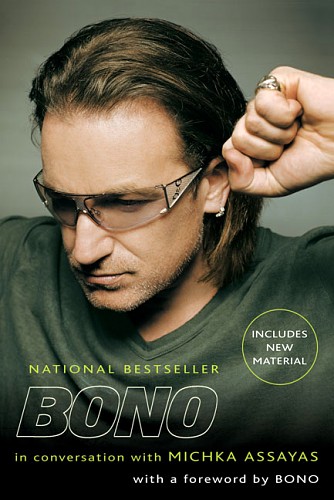
Bono.jpgThere’s a good  excerpted interview published by Christianity Today from 2005 with Bono (of U2 fame) about his faith, Scripture and Christ is insightful and dare I say, heart-warming.

You may have read it, but if not, then I recommend reading the interview.
Perhaps after reading the interview you’ll be tempted to read the book, Bono: In Conversation with Michka Assayas.

The sacred Liturgy shapes freedom & is the principle of our renewal


Cardinal Canizares at Mass.jpg

Curious to what others think, I was elated to see the connections the Prefect of the Congregation for Divine Worship (Rome), Cardinal Antonio Cañizares Llovera, made with the sacred Liturgy in an interv: evangelization, civilization and freedom. It is not very surprising to me that the Prefect of this particular Vatican office said that the Liturgy is the vehicle for our intellectual and cultural renewal. It is new data for those see the Church’s liturgical life as a method for community organizing and feeling good about themselves. I was surprised however, that the Cardinal indicated that the Pope is in favor of Sacrosanctum Concilium. Not that the Pope is radically in disfavor  of it but that the Pope’s committed to the document. With all that document’s flaws and the misinterpretations, this is something for me to chew on. May be the Pope is right in that we have to re-evaluate our interpretation of SC. Since 2013 is the 50th anniversary of SC, I am hoping for a brilliant liturgical letter from the Pope. Ultimately, the point is, do we really know what the sacred Liturgy is and how it is a path unto our eternal destiny? Do we really understand that the Liturgy, not our ideology, sets bar for our interior conversion?

Here are some excerpts of the Cardinal’s interview:

“To evangelise the culture means having one’s gaze
fixed on Christ
because a man who accepts Christ – who is truly man – will have
Christ’s mentality, thoughts, and feelings,” he said.

“[To build] a civilisation of love, as John Paul II and
Benedict XVI have called for, seems to be a work of evangelisation because in
such a society, God really is recognized as God. The problem of our times is a
culture built without God.”

When it comes to re-evangelising the West in general he [the Cardinal] pointed to the example of St Benedict of Norcia and his search for God and
imitation of Christ. But changing the mentality, he said, includes measures
such as “renewing the liturgy”, reintroducing a “correct sense
of freedom” and presenting “a true and stronger” sense of
religiosity.

Being of similar mind to Benedict XVI he [the Cardinal] naturally has the
same approach to the liturgy which he sees not only as important for the
Church, but also for the world at large.

“Benedict XVI reminds us that the first document of the
Second Vatican Council was Sacrosanctum Concilium [the Constitution on the
Sacred Liturgy], and the last document was Gaudium et Spes, [the Pastoral
Constitution on the Church in the Modern World].” he said.

“If we want to be present as Christians in the world,
to form and renew the world, to bring peace, freedom et cetera, we cannot do
that without leaning on the liturgy
, on Sacrosanctum Concilium. For this
reason, the Holy Father is very committed to renew the liturgy, to recover
Sacrosanctum Concilium.”

“The liturgy is the first banquet of God; it’s where we can
identify God, it’s prayer, it’s where we can discover salvation, the work of
Grace – all of which are God’s initiative,” he said. “When this is
lived, when it is at the centre of one’s life, the heart changes, the mentality
changes, and also society.”

~Taken from Edward Pentin’s Catholic Herald article of April 16, 2010.

Blessed Giles of Assisi

The just man will flourish like the palm tree. Planted in the courts of God’s house, he will grow great like the cedars of Lebanon, alleluia.

Lord God, You were pleased to raise Giles to the heights of exalted contemplation. Through his intercession grant that we may always direct our actions to You and attain the peace which surpasses all understanding.
Blessed Giles of Assisi was among the very first companions of Saint Francis of Assisi. Unlettered, Giles devoted himself to the pious life: everything he set out to do was squarely focussed on God. In fact, one observes in the hagiography Giles relentlessly seeking God’s face and strongly urging others to the same. Giles did what the Lord asks of us: to be in relationship with Him. He once told Pope Gregory IX, who was looking for counsel from Giles, that he had to have two eyes of the soul: one eye fixed on matters of heaven and the other matters of earth. His life and preaching was simple but his goal was sublime. After speaking with Saint Bonaventure who at the time was a theologian and provincial, Giles understood that prayer and contemplation was possible for all people. Have at it.
May Blessed Giles lead us to the face of Christ. 

Blessed Maria Gabriella Sagheddu: Apostle for Spiritual Ecumenism


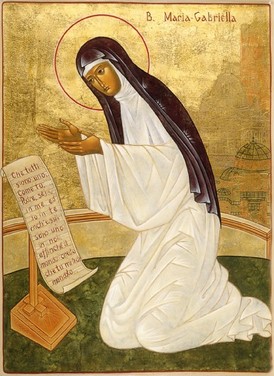
Thumbnail image for Bl Maria Gabriella Sagheddu.jpgLord God, eternal Shepherd, You inspired the blessed virgin, Maria Gabriella, generously to offer up her life for the sake of Christian unity. At her intercession, hasten, we pray, the coming of the day when, gathered around the table of Your word and of Your Bread from heaven, all who believe in Christ may sing Your praises with a single heart, a single voice.

Blessed Maria Gabriella, Sardinian by birth in 1914, she died a Trappistine nun in 1939 at Grottaferrata, having entered the monastery four years earlier. Taking up the invitation to work for spiritual ecumenism among Christians from Father Paul Couturier who stressed that all Christians must learn to pray together for unity in union with Jesus’ own prayer for the same (Jn 17). Couturier advocated a spiritual unity founded on common prayer, charity, friendship, mutual forgiveness and humility which precedes doctrinal and hierarchical unity.

Father Couturier’s work found a natural habitat in the monastic life which then became fruitful among the wider church (he called the latter the invisible monastery). As a side note, Couturier was greatly influenced by the his work in Lyon, France and by Dom Lambert Beaudoin and the monks of the Belgian abbey of Amay-sur-Meuse (now at Chevetogne).

Blessed Maria Gabriella’s offering of self in 1938 for the spiritual ecumenism made known by Father Paul Couturier was a renewal of the same offering made on the day of her monastic profession of vows: not only to give her early life for Christian unity also to die for unity. This self-gift was closely connected to the notion that the profession of monastic vows is not isolated from the Church universal but deeply at the center of it because of the desire to totally give oneself to God. It is THE reversal of the sin of disunity that is based on ego and not on personal conversion.

Pope John Paul II beatified her on January 25, 1983. Blessed Maria Gabriella is buried at the Trappistine abbey of Our Lady of Saint Joseph at Vitorchiano (near to Viterbo) where her original community moved. She is known as the Apostle for Spiritual Ecumenism.

I recommend to you Sister Martha Driscoll, OCSO’s A Silent Herald of Unity: The Life of Blessed Maria Gabriella Sagheddu (Cistercian Publications, 1990).

The death of Jesuit psychoanalyst, Fr William W. Meissner

William Meissner.jpgI haven’t seen him in nearly 7 years, but I was very sad to hear of the death of Jesuit Father William W. Meissner, 79, the other day. A New York Province Jesuit priest who was trained as a psychiatrist at Harvard, Bill was a great man in my mind with lots of quirks, probably too many to speak of. Bill was the sort of man who didn’t suffer fools gladly; he was one of those Jesuits who worked very hard and play well but didn’t do pastoral work. His life as a priest is was dedicated to the ministry of research and teaching. All the same, I loved being on vacation with Bill and I remember fondly our many serious conversations. When I studied in Boston in the early 1990s he gave a series of lectures on the psychology of Saint Ignatius of Loyola which I attended and found incomprehensible; the lectures eventually became a book, Ignatius of Loyola: The Psychology of a Saint, you may have seen it. I have to admit that psychoanalyzing a dead saint is a bit weird –with or without a couch– but fascinating nonetheless because we got a glimpse into the heart and mind of terrific saint.

Here’s one of Bill’s obit.
May Bill Meissner’s memory be eternal.

Saint Anselm: beauty as as order

St Anselm detail.jpgSaint Anselm is a towering figure in monastic, theological and philosophical circles whose works take diligence in getting your mind around. Even centuries later he speaks with precision. Saint Anselm of Canterbury (c. 1033-1109) an Italian by birth, Anselm held various academic and ecclesial titles; he was the archbishop of Canterbury from 1093 until his death in 1109. The Church tells us he is the father of scholasticism and famous for the ontological argument for God’s existence. Though never formally canonized –the process was not developed then– Anselm was acknowledged a saint by Clement XI and named a Doctor of the Church (1 of 33). One point I noticed recently about Saint Anselm and the promotion of truth is this…

…when each single creature keeps, either by nature or by reason, its proper place [in the order of things] –it is said to obey God and to honor him. … When a rational nature wills what it ought to, it honors God –not because it confers anything on Him but because it willingly submits itself to His will and governance. And, as best it can, it stays in its proper place in the universe and preserves the beauty of the universe. 
Cur Deus Homo, 1:15
So what Saint Anselm is saying, the premise from which order and beauty is deduced is Saint Benedict’s intention that the monk [and today, all Christians] seek the glory of God in all things. For Anselm and therefore us, beauty in keeping the proper order of things is obediential in front of God; that is, it is about keeping a fitting sense of friendship with the Trinitarian God. On this feast of Saint Anselm, let us prefer nothing to Christ seeking God’s glory above all.
You may be interested in reading Pope Saint Pius X’s encyclical for the 800th anniversary of Saint Anselm’s birth, Communium rerum (1909).

Saint Conrad of Parzham

St Conrad of parzham.jpgAsk and you shall receive; seek and you shall find; knock and it shall be opened to you, says the Lord, alleluia.

Merciful God, through the service of Saint Conrad You were pleased to open wide to the faithful the portal of mercy. May we pursue his spirit of poverty and humility of heart in serving our brothers [and sisters].
Saint Conrad was known to focus his life by the rule of charity in and out of the Capuchin friary. His daily goal was to remain in the presence of God striving to be free of sin and in constant conversation with God. Hence his devotion to adoration of the Blessed Sacrament which he spent every free moment doing. The 11 Resolutions of a Novice, from which some of these ideas come, are his maxims to orient one’s behavior toward the Holy. Besides Mass which was his greatest joy, Conrad had great devotion to the Crucified Lord and Our Lady of Sorrows. Of the latter, he promoted devotion to the Blessed Virgin Mary by distributing rosaries to those whom he encountered in the porter’s lounge or on the street.
Saint Conrad is the patron saint of doorkeepers, one of the most important jobs in any home or institution.