McGill University professor of History John Zucchi, Canada’s national leader for Communion and Liberation, asks the provocative question in a brief essay, “Why I am a Catholic.” John is a great guy, he’s serious about his faith and he’s sensitive to the movement of the Holy Spirit, but no one would claim he’s a mediocre follower of Christ. The claims of faith in Christ, Zucchi tells us, have to have two criteria borrowing from Luigi Giussani: faith in Christ has to be reasonable and it has to broaden my humanity, a gift given by God Himself. Reason and humanity lead to and exude Mercy. Paraphrasing Cardinal Ratzinger in God and the World, to be a Christian means that you are sympathetic toward one’s humanity that of another; a Christian is accepting of one’s injuries and within these wounds a deeper healing is found.
NT Wright to retire
The Right Rev’d Nicholas Thomas (NT) Wright, 61, Anglican bishop of the Diocese of Durham, announced his retirement effective on August 31, 2010. Wright has been the Lord Bishop of Durham since 2003. He’s an Oxford educated scholar of the New Testament. He’ll be taking a professorial position at the University of Saint Andrews, Scotland.
St Catherine of Siena Priory (NYC) hosts Mass and award for all healthcare professionals who bring healing and hope to the sick & dying
Blessed Luchesio Modestini of Poggibonzi
Blessed Luchesio (Luchesius; Lucius) died in 1242 was the first to accept the invitation of Saint Francis of Assisi to live the Rule of 1221; today we call the people living this Rule the Secular Franciscan Order, or sometimes the Third Order Laity. Lechesio was a husband, a businessman, a penitent who was dedicated to prayer, penance and works of charity. But Luchesio was not always the most pious, bible believing, Christian man in his neighborhood: he had a reputation for being greedy and ambitious; he was the 13th century equivalent to our financial and political scam artists today.
New liturgical texts approved by Pope today, Mass to change
The Holy Father addressed Vox Clara during a lunch meeting, and approved the new translation of the 2002 Roman Missal. This is tremendous news. I look forward to praying the new texts! Not a perfect text but one that’s more theologically correct than the current missal. Some work still needs to be done but that ought to be finished shortly so that publishers, musicians, priests, and laity can make the new texts available for the anticipated inauguration for the First Sunday of Advent 2011. Each of the 11 English speaking conferences of bishops will get to work on rolling out the new missal in their countries with the proper catechetical formation for clergy and laity alike. The Pope’s words today:
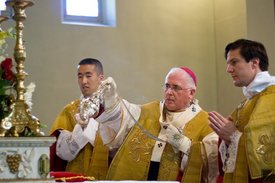
I thank you for
the work that Vox Clara has done over the last eight years, assisting and
advising the Congregation for Divine Worship and the Discipline of the
Sacraments in fulfilling its responsibilities with regard to the English
translations of liturgical texts. This has been a truly collegial enterprise.
Not only are all five continents represented in the membership of the
Committee, but you have been assiduous in drawing together contributions from
Bishops’ Conferences in English-speaking territories all over the world. I
thank you for the great labour you have expended in your study of the
translations and in processing the results of the many consultations that have
been conducted. I thank the expert assistants for offering the fruits of their
scholarship in order to render a service to the universal Church. And I thank
the Superiors and Officials of the Congregation for their daily, painstaking
work of overseeing the preparation and translation of texts that proclaim the
truth of our redemption in Christ, the Incarnate Word of God.
Saint Augustine
spoke beautifully of the relation between John the Baptist, the vox clara that
resounded on the banks of the Jordan, and the Word that he spoke. A voice, he
said, serves to share with the listener the message that is already in the
speaker’s heart. Once the word has been spoken, it is present in the hearts of
both, and so the voice, its task having been completed, can fade away (cf.
Sermon 293). I welcome the news that the English translation of the Roman
Missal will soon be ready for publication, so that the texts you have worked so
hard to prepare may be proclaimed in the liturgy that is celebrated across the
anglophone world. Through these sacred texts and the actions that accompany
them, Christ will be made present and active in the midst of his people. The
voice that helped bring these words to birth will have completed its task.
A
new task will then present itself, one which falls outside the direct
competence of Vox Clara, but which in one way or another will involve all of
you – the task of preparing for the reception of the new translation by clergy
and lay faithful. Many will find it hard to adjust to unfamiliar texts after
nearly forty years of continuous use of the previous translation. The change
will need to be introduced with due sensitivity, and the opportunity for
catechesis that it presents will need to be firmly grasped. I pray that in this
way any risk of confusion or bewilderment will be averted, and the change will
serve instead as a springboard for a renewal and a deepening of Eucharistic
devotion all over the English-speaking world.
Dear Brother Bishops, Reverend
Fathers, Friends, I want you to know how much I appreciate the great
collaborative endeavour to which you have contributed. Soon the fruits of your
labours will be made available to English-speaking congregations everywhere. As
the prayers of God’s people rise before him like incense (cf. Psalm 140:2), may
the Lord’s blessing come down upon all who have contributed their time and
expertise to crafting the texts in which those prayers are expressed. Thank
you, and may you be abundantly rewarded for your generous service to God’s
people.
Saint Gianna Berretta Molla: wife and doctor with a passion for life
Holy Spirit,
Source of every perfection, give us wisdom, intelligence, and courage so that,
following the example of Saint Gianna and through her intercession, we may know
how to place ourselves at the service of each person we meet in our personal,
family and professional lives, and thus grow in love and holiness. Amen.
As Saint Gianna said, “Every
vocation is a call to motherhood or fatherhood, earthly, spiritual or moral.
God has placed in us an instinct for life. A priest is a father, nuns are
mothers, mothers of souls.”
Read the Holy See’s biography of Saint Gianna Berretta Molla
On this feast of Saint Gianna we look for
heavenly assistance with the certain hope that our prayers will be answered.
Our prayerful request of Saint Gianna is for her to ask the Lord for abundant
graces to carry on the great work of Catholic Healthcare in New York and beyond
at The Gianna Center –The Catholic
Healthcare Center Women. It’s Pro-life, Pro-woman, Pro-Marriage,
Pro-family and Pro-God!!!!
Saint Peter Canisius
The Roman calendar of saints lists Saint Peter Canisius’ feast day as December 21; on the Jesuit ordo his feast is observed today.
Saint Peter
Canisius is well known for his theological expertise, his teaching and preaching and the work of evangelization he did in Germany and other places where the Protestants destroyed the unity of the Church. His approach to theological engagement is noteworthy for his judgment based on prudence and charity. Saint Peter neither wanted to heighten division nor to embitter relations with the
Magisterial Reformers with intellectual engagement on the “hot button issues” because in his mind, theological
disputation only succeeded in fueling deeper resentment and hysteria toward the
Catholics and did not advance the argument and knowledge of the Truth. In a letter to his Jesuit superior, Saint Peter Canisius said:
It is
plainly wrong to meet non-Catholics with bitterness or to treat them with
discourtesy. For this is nothing else than the reverse of Christ’s example
because it breaks the bruised reed and quenches the smoking flax. We ought to
instruct with meekness those whom heresy has made bitter and suspicious, and
has estranged from orthodox Catholics, especially from our fellow Jesuits.
Thus, by whole-hearted charity and good will we may win them over to us in the
Lord. Again, it is a mistaken policy to behave in a contentious fashion and to
start disputes about matters of belief with argumentative people who are
disposed by their very natures to wrangling. Indeed, the fact of their being so
constituted is a reason the more why such people should be attracted and won to
the simplicity of the faith as much by example as by argument.
With Saint Peter Canisius, let us pray:
Let my eyes take
their sleep, but may my heart always keep watch for you.
May your right hand
bless your servants who love you. May I be united with the praise that flows
from you, Lord Jesus, to all your saints; united with the gratitude drawn from
your heart, good Jesus, that causes your saints to thank you; united with your
passion, good Jesus, by which you took away our guilt; united with the divine
longing that you had on earth for our salvation; united with every prayer that
welled from your divine heart, good Jesus, and flowed into the hearts of your
saints. Amen.
A new Vatican office: Pontifical Council for the New Evangelization?
Writing for il Giornale.it today, veteran vaticanista Andrea Tornielli, speaks of a new pontifical council to be created specifically for the work of the new evangelization, a term coined by Pope John Paul II in 1979 while visiting the Poland’s Nowa Huta. Pope Benedict is expected to release an Apostolic Letter soon. The idea comes to fruition because of the diligence of Venice’s cardinal-archbishop, Angelo Scola, and Josef Cordes and the inspiration of Monsignor Luigi Giussani, founder of the Fraternity of Communion and Liberation. A new council with this work is seen as keenly central to the work of Benedict’s papacy. The first head of the new council is expected to be according to Tornielli, Archbishop Rino Fisichella, the current head of the Pontifical Academy of Life and the rector of the Lateran University.
Blessed Osanna of Kotor
God of compassion, enkindle anew in our hearts the
love of your cross. By the life and prayers of Blessed Osanna, who suffered for
the unity of the Church, may we become sharers in both your passion and your
glory.
Anti-Catholicism, Again: a deeper look into clergy sex abuse
Joseph (Jody) Bottum, Editor of First Things and a contributing editor at the Weekly Standard, wrote what may go down as THE best essay on the sex abuse crisis facing the Catholic Church in the current issue of the Weekly Standard, “Anti-Catholicism: The permanent scandal of the Vatican” (May 3, 2010). Bottum’s piece is long but it’s worth a thorough read. For those looking for the print edition, the article hit the news stands on Saturday in most places but the link is noted above.