4 Pillars of the Catholic Faith

A question was asked of me about the building blocks of the Catholic faith. Is there such a thing? Do Catholics actually have a structure of belief? Well, yes, there are 4 essential building blocks of our life of faith. These 4 areas are the very same areas by which the Catechism of the Catholic is structured.


The 4 Pillars of the Catholic Faith:

-Creed
-10 Commandments
-7 Sacraments
-The Lord’s Prayer (Christian prayer)

Christ giving the keys to Peter.jpg

Catholics believe in revealed
truth. Spirituality needs to be founded on truth otherwise you have nothing.
Hence creed, code & cult are essential aspects of Catholic Faith.

The study of faith needs two distinctions to understand what’s going with the army of words and ideas associated with theological reflection: fides quae and fides
qua.  

Fides quae (“faith which”) is the faith which is held by
the Church through divine revelation or sacred tradition (it is what is considered to be objective, verifiable faith).

Fides qua
(“faith by which”) is the faith by which a person is moved to respond
to God. A person’s understanding of his or her personal relationship
to God is spoken of here; here we usually filter what hear of divine revelation; in some instances personal
revelation is located in this type of faith, e.g., the teachings of the saints would be a distinction of fides qua (we’ll say this is subjective faith, a faith known through concrete experience).

Theologically speaking, a theologian be able to
distinguish between fides quae and fides qua and to always maintain conformity
in study and work with fides quae. Only a few theologian have held a personal
faith that has been enlightened enough to illuminate fides quae. The task of
theology is gain a deeper understanding of faith; it is, as St Anselm said:
faith seeking understanding. Our study of theology is done on our knees; that
is, we study the fact of God and the allied theological sciences from a posture of adoration of
God first, in the sacred Liturgy and second, in personal prayer. 

The student of
theology takes his or her first presupposition from the position of “faith.” Faith is not a gift of God it is also the manner by which we look at
reality, it’s the “starting point for a new way -that is, a true way of
becoming aware of reality itself.” Through faith we have access to truth and through we live truth.  Without faith in the study of theology
we have mere religious studies.

Supporting Catholic Schools

This morning the Archbishop of Hartford, Henry J. Mansell hosted what has become the annual Columbus Day Breakfast to provide scholarship grants to students attending Catholic elementary schools in greater New Haven. The Archbishop assisted by the Foundation for the Advancement of Catholic Schools helped us to look with fresh eyes at the need for Catholic education in greater New Haven. I am very happy to have been invited to attend this morning’s breakfast.

Some thoughts though… It was a good networking opportunity but something was missing, the reason why we dragged ourselves out of bed to have breakfast with people vaguely known but connected through our concern for Catholic education: Jesus Christ and our friendship with Him. While we are all very grateful for the $60K raised for Catholic elementary students, the absence of noting who sustains our efforts and why we are at all interested in Catholic education was for me problematic. Do-gooders are well-meaning; they can be helpful and advancing a good mission such as education. Yet, as I mentioned to a friend, I don’t care about Catholic education or any other program if we’re not helping each other seek a relationship with Jesus and try to live as Catholics (Christians, if you will). It is not a “what” that sustains our efforts in education but a “who” –it is Jesus Christ. “Remember Him,” I’d like to say?

I agree that “An education would be most impoverished if it were limited to providing notions and information and neglected the important question about truth, especially that truth which can be a guide in life” (Benedict XVI, January 21, 2008). That truth is none other than unique offer of love and salvation given to us by the Lord. It is the pursuit of Truth that makes education, formal or informal, worth it. Everything else pales. 
Anthony Cernera, President of Sacred Heart University (Fairfield, CT) spoke well of remembering the past and dreaming for the future. When we remember the past we hold in ourselves an attitude of gratitude for graces received. When we dream we look forward in hope for realization of the desires of the heart given by God Himself. If the Church is correct, then those who believe in Christ are obligated to hope, to live concretely in the present yet looking to the fulfillment of the promises God has made personally with each of us. Catholic education is indeed in a difficult place today with the great divorce of remembering and dreaming, faith and reason, and faith and justice. SO, yes, support Catholic education because as Mansell said, “Our schools not only provide a rigorous curriculum, but also an education for a lifetime….”

Sacred Duties, Episcopal Ministry: what’s wrong with the US Conference of Bishops

Few people in these parts (in the Eastern part of the USA) know the name Robert F. Vasa except ecclesial-philes like myself, but that’s because he’s on the other side of the country. Never mind. Who could say with honesty that there’s a genuine concern for knowing ecclesial affairs viz. from a person who has little name recognition such as Robert Vasa. That is, until now, who, with some excellent, even controversial ideas, is sure to anger the round heads. Only now Vasa’s thinking is gaining some currency. But let’s give him his just due respect. Robert F. Vasa, 59, is the Bishop of Baker, OR, a priest of the Lincoln Diocese who delivered an extraordinarily good address titled, “Sacred Duties, Episcopal Ministry” on September 16, 2010 at the 2010 InsideCatholic Partnership Award Dinner in Washington, DC, that has not received the attention it deserves.

The Bishop is taking a critical look at the contemporary ministry of the bishop, at least in the USA, as we’ve seen it unfold with the existence of the United States Conference of Catholic Bishops (USCCB).
I DON’T like the USCCB and would prefer to see it close, or at least downsize significantly. I find USCCB officials intrusive, their work open to misinterpretation, the bishops not doing what they are supposed to do for “needy bishops” –to give fraternal constructive correction to bishops not doing or incapable of doing their episcopal ministry as expected– and I find the USCCB documents compromised or agenda driven. In addition, I find the tax paid on each “Catholic head” in the dioceses to be excessive and it’s a genuine burden on many dioceses, particularly the Eastern Church dioceses who don’t have access to large amounts of money. One last word on the bishops’ documents: they are often not written by the bishops themselves (who would have the time?) but are produced by the staffers of the USCCB or outsiders and are vague and lack substance that would clearly address the issues at hand; when the documents are “committee documents” they are often ground for the lefty-loonies to manipulate for their own ends.
There are few instances where I think a conference of bishops in the USA is useful but not absolutely necessary. The usefulness of a conference of bishops would be seen in knowing the needs of the Church in North America, in the work done in the fields of the sacred Liturgy, certain questions on immigration, healthcare and pro-life and certain relief agencies like CRS. The translation of texts is labor intensive and it needs wider episcopal oversight and input that 10 bishops can give. BUT let’s be clear, the USCCB is not an alternative teaching body for the Church in America; it has no authority to teach or make laws over and above the Universal Church or the individual diocesan bishop; it does not speak for the Church’s bishops. Diocesan bishops can’t absolve themselves of the duty to rightly to teach, govern and sanctify the people entrusted to them personally by the Holy Spirit and for the Church in general. Episcopal ministry is exercised not with strategies and programs but by listening, praying and teaching when needed. 
Some people who are USCCB favorable will be dramatic by saying, “The USCCB said and demands thus and such….” AND the response you should give is, “SO what.”
Read, study and pray with Bishop Vasa’s address noted above. You may want to say a prayer for him, too. He’ll likely get hate mail for his attempt to teach what is true. In my mind this address is necessary reading for informed Catholics. The point here is not be disrespectful of the sacred duties and responsibilities of bishops. My point here is to live, to act and to think with the Church under the Roman Pontiff and the bishops in communion with him. As Catholics we are to be total and radically centered on the person of Jesus Christ lived in the sacrament of the Church and under her magisterium. I follow Christ through the ministry of the Pope, the bishop of this diocese but not in a bureaucracy of bishops.

Our Lady of the Rosary


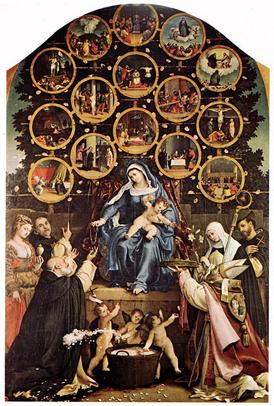
Madonna of the Rosary LLotto.jpgI once told a youth director who was getting “heat” from his colleagues for having his parish youth group pray the rosary that that prayer is really Scripture study. What else could you call the each of the mysteries, the Hail Mary and the Lord’s Prayer? On the simplest level praying the rosary is not only a tool of spiritual education in the School of Mary, but also uniting oneself more and more closely to the Lord.

It is often said that if you want to end sin in your life, evil in the world, that is, to slice the head off evil, then pray the Rosary. I see more rosaries around the rear view mirror or around the neck but so rarely in those same hands fingering the beads of the Mysteries of the Jesus’ life, death and resurrection. In the rosary we trace the lines of salvation history and the beautiful mission of Jesus.

Pope, saints, good priests and religious and grandmothers recommend wholeheartedly our attachment to this divine gift of love.

The previous year’s post for this feast is here.

The infant church in prayer was gathered round

Th’apostles and the Mother of the Lord;

In faithfulness to Christ’s farewell command,

They prayed and waited, trusting in the Word.

With joy we think on incarnation’s grace;

With light we meditate upon Christ’s life;

With sorrow, all his passion keep in mind;

And in his glory, hope beyond all strife.

For Mary’s faithfulness we praise you, Lord,

who heard and trusted in your promise strong;

To you we sing, O Trinity most blessed,

In praise that through the ages echoes long.

10 10 10 10

SURSUM CORDA

Saint Faustina Kowalska


St Faustina.jpg

Clued-in Catholics know the Chaplet of Divine Mercy. They are, however, unlikely to know the person who made this devotion known to the world and who was instrumental in getting the work of divine mercy known in the world today. Today, the Church gives us the woman who made the Lord’s mercy known to men and women of today. 


Sr Faustina
Kowalska wrote in her Diary:  “I feel tremendous pain when I see the
sufferings of my neighbours. All my neighbours’ sufferings reverberate in my
own heart; I carry their anguish in my heart in such a way that it even
physically destroys me. I would like all their sorrows to fall upon me, in
order to relieve my neighbour” (Diary, p. 365). This is the degree of
compassion to which love leads, when it takes the love of God as its
measure!

It is this love which must inspire humanity today, if it is to face
the crisis of the meaning of life, the challenges of the most diverse needs
and, especially, the duty to defend the dignity of every human person. Thus the
message of divine mercy is also implicitly a message about the value of every
human being. Each person is precious in God’s eyes; Christ gave his life for
each one; to everyone the Father gives his Spirit and offers intimacy. (Pope John Paul II, Canonization homily, April 30, 2000).

Prayer for a friend, Pauline Fahey

Pauline Fahey.jpgToday, we are praying the Mass of Christian Burial for a friend, Pauline Marie Fahey, who died last Thursday after living with cancer. Join me in praying for her peaceful repose thanking God for this blessing.

Let’s also remember Father Michael A. Fahey, SJ, Pauline’s brother and a very dear friend, who survives her.

May Pauline’s memory be eternal.

Let’s also pray for those who served in the medical profession as nurses, as Pauline did for decades.

Prayer through the intercession of Saints Benedict & Maurus

The Benedictines celebrate the feast of Saint Maurus, a first disciple of Saint Benedict on January 15 and the Roman Martyrology notes his feast day as today. Liturgical calendars of religious aren’t always the same, sometimes for very good reasons. For Saint Maurus’ feast day in January I posted a prayer for the sick through his intercession which may interest you. Today, we’re honoring Saint Benedict and his student Maurus, by giving this prayer more “press” recalling the profound love they had for the Cross of Christ.

Sts Maurus & Placid with Benedict.jpg
Let us pray:
Through the intercession of the Immaculate Mother of God, ever a virgin, and by the intercession of St. Benedict and of St. Maurus, may the power of God + the Father, the wisdom of God + the Son, and the might of God + the Holy Spirit, deliver you from this infirmity. Amen.

May God’s will be done in all things, and so may it be done in your case, just as you seek and desire only the praise and honor of the all-holy Cross of our Lord Jesus Christ.

Lastly, the priest blesses the sick person with the relic of the holy cross, saying:
May the blessing of almighty God, Father, Son + and Holy Spirit, come upon you and remain with you forever. Amen.
This formula provided by Abbot Maurus Wolter OSB, the then Abbot-President of the Beuronese Congregation, was approved by the Sacred Congregation for all priests and deacons, to impart the blessing, provided the formula approved by the Holy See is used.

The life of Saint Maurus is filled with terrific narratives of healings at the request of this saint at the Throne of Grace. One such miracle was a man’s diseased arm that needed healing Maurus prayed prostrate “at the foot of the altar, pouring forth his soul in fervent prayer. Having finished praying, he took from the altar the case of relics which had been sent him by his master, St. Benedict, and went to the bedside of the sick man. Having exposed the relic of the Cross, he made the sign of the Cross over every part of the arm from the shoulder to the fingers,” saying:

O God, the Creator of all things, You ordained that Your only Son should take flesh of the Virgin Mary by the power of the Holy Spirit for the restoration of your people, and You deigned to heal the wounds and infirmities of our souls by the redemption accomplished upon the sacred and glorious wood of the life-giving Cross: do You also vouchsafe through this powerful sign to restore health to Your servant.

Firsts for the US Supreme Court 2010

US Supreme Court.jpgThere are several “firsts” for the new session of the Supreme Court of the United States. Among the firsts:

  • members of the bench are either Catholic (6) or Jewish (3)– there are no Protestants serving
  • 1/3 of the members of the bench are women
  • first time in 35 years that Justice John Paul Stevens will not serve as a Justice
  • Justice Kagan is the 100th Supreme Court Justice
Read the brief overview of the Supreme Court

Saint Francis of Assisi

St Francis FZurbaran.jpgSaint Francis seems to be a model of holiness for many, many people. Protestants of all flavors, the Muslims and Jews honor dear Francis for a variety of reasons. They’ve met Francis in as many ways as I have.

This morning I am pondering why I love Francis. Preparing for my reception of the sacrament of Confirmation I chose as my “confirmation name” Francis of Assisi because he not only seemed to reasonable guide for life, especially the spiritual life, but I was drawn to him through the stained glass in the parish church, the secular Franciscans were present but more important, the narrative of Saint Francis’ life was verifiably compelling.

Over time I’ve come to know Francis as not only poor, humble, loving, faithful, guru of the human condition but also that he preached what he received from the Lord Himself: the mercy of Christ crucified is real, the truth of faith, hope and love in Christ is the path to salvation, that he preached the reality of knowing who in fact God is (that is, Father, Son, Holy Spirit) and not what he thought, guessed about God. Saint Francis emblematic of the Catholic second chance, that is, one can be given another chance for happiness. So, the real Saint Francis is not the personage hijacked by the lefty-looines who use him to justify all sort of liberalities of theology, Liturgy, social concern and life in the public order. Francis is not the stereotypical garden statue nor is he a man unconcerned with true conversion of life. He’s quite the opposite: he life was a life in Christ firmly rooted in the Mystical Body of Christ –the Church– nourished by the sacraments, most especially the Holy Eucharist.

Friar Charles, OFMCap had this to say about Saint Francis

The Transitus of Saint Francis of Assisi


Death of St Francis Giotto.jpg

Saint Francis died during the evening of October 3/4. The Church observes the death of Saint Francis on October 4.

As he lay dying, Francis prayed Psalm 142 and during the closing verse he died. This human and liturgical event is solemnly remembered each year by Franciscans to honor their holy
Father’s entrance into the joy of being the Most Blessed Trinity be prayerfully remembering the passage –a transitus– of Francis from life to Life today, October 3.

Alleluia, Alleluia, Francis, poor and humble, enters
heaven rich and is welcomed with celestial hymns. Alleluia.

Psalm 142

I cried to the Lord with my voice; with my voice to the Lord did I make my supplication.

I poured out my complaint before him; I showed before him trouble.

When my spirit was overwhelmed within me, then he knew my path.

In the way where I walked have they secretly laid a snare for me.

I looked on right hand, and held, but there was no man that would know me: refuge failed me; no man cared for my soul.

I cried to You, O Lord: I said, You are my refuge and my portion in the land of the living.

Attend to my cry; for I am brought very low: deliver me from my persecutors; for they are stronger than I.

Bring my soul out of prison, that I may praise Your name: the righteous shall compass me about; for You shall deal bountifully with me.

Glory to the Father
and to the Son and to the Holy Spirit, as it was in the beginning, is now, and
will be forever. Amen.

Alleluia, Alleluia, Francis, poor and humble, enters
heaven rich and is welcomed with celestial hymns. Alleluia.

O God, you granted
our blessed Father Francis the reward of everlasting joy: grant that we, who
celebrate the memory of his death, may at last come to the same eternal joy;
through Christ our Lord. Amen.