Entertainment Weekly and the crass cliché of a slutty nun


EW nun.jpg

I am not a subscriber to
Entertainment Weekly but this week when I saw the magazine I had another reason
for not reading this rag.  The well-known actress Jessica Lange is on the
cover wearing a religious sister’s habit, a crucifix around her neck, brandishing
a cane and wearing fire-engine red lipstick and painted nails advocating “American Horror Story.” Hmmm, the
artists got the look of many women religious, right?  It doesn’t take a
brain surgeon to see the ugliness of this image viz. with conversation the
Church is having with the Leadership Conference of Women Religious (LCWR). 

While I am not a fan of what the LCWR stands for, or perhaps more accurately, what some members
of the LCWR stand for, there is no need perpetuate the crass cliché through
mocking portrayals of ruler-wielding nuns  who are seen as backwards and stupid. The vast
majority of religious sisters and nuns are not this way. One ought to ask, “What about the beautiful work of teaching children
Catechism, their work with the poor and the marginalized, all those women of prayer and
learning in hospitals, and schools?

I think EW has stooped way too low in publishing a cover with anti-Catholic stereotyping. One can’t claim
that some members of the media are not anti-Catholic when a prominent magazine puts silly things on the cover. Really, a terrifying nun to advance a fictional
plot?

What does one say when EW describes Sister Jude (Miss Lange’s
character) as a “scarily stern woman of faith…and a fan of corporal
punishment…who has a penchant for red lingerie and vivid fantasies about her
superior, Monsignor Timothy O’Hara.” Further, EW quotes Joseph Fiennes who
says, “Clearly she’s attracted to the monsignor for his grace and
religiousness.” Fiennes plays O’Hara, “the monsignor might play with that,
manipulate that.”  Slutty nun.  Manipulative priest.

The show’s
co-creator, Ryan Murphy says, “I’m scared of aliens and I’m scared of Nazis and
I’m scared of nuns.”

To posit that there is no anti-Catholicism, I would think you might want to revise your opinion given the presence of fact:  anti-Catholicism has a history,  it’s alive and well. Some Catholics are not bothered by dysfunctional nuns priests. Art, in this case, is claimed to be in the realm of opinion,
that is, subjective.  It is said that what is one person’s
good-natured ribbing is another person’s offensive stereotype. Do we
really think it is appropriate to hold this idea at all, never mind if we apply the whole issue to
those who hold Judiasm or Islam as their faith? Would the media think that
making fun of a rabbi, an iman or a Buddhist monk is a good thing? That doing so is good natured? Why do it
to Catholics?

EW’s incredibly sad portrayal of a Catholic sister as the
centerpiece of fictional show on TV is wrong, disrespectful, especially when
the reality is very different. The concept is ill-conceived.

Blessed Teresa of Calcutta


Bl Mother Teresa young image.jpg

The most well-known face of 20th century Catholicism and care for the human person after Pope John Paul is Blessed Mother Teresa of Calcutta. Her life and work is incomparable as well as her relationship with God even if there was distance between the two. Nothing is more beautiful in the spiritual life than an honest relationship, especially with God. Mother Teresa died on this date in 1997. Soon after her death, the Church waived the waiting period before a cause for canonization could be submitted to the Holy See. She was beatified on October 19, 2003.

The Church prays

O God, who
called blessed Teresa, Virgin, to respond to the love of your Son thirsting on
the cross with outstanding charity to the poorest of the poor, grant us, we
beseech you, by her intercession, to minister to Christ in his suffering
brothers.

You may want to listen to Veronica Scarisbrick’s interview with Monsignor Leo Maasburg, a close friend of Mother, posted at Vatican Radio. He recently published a book, Mother Teresa of Calcutta: A Personal Portrait, 50 Inspiring Stories Never before Told (Ignatius, 2011).

A prior post on Blessed Teresa and Divine Mercy


Saint Moses

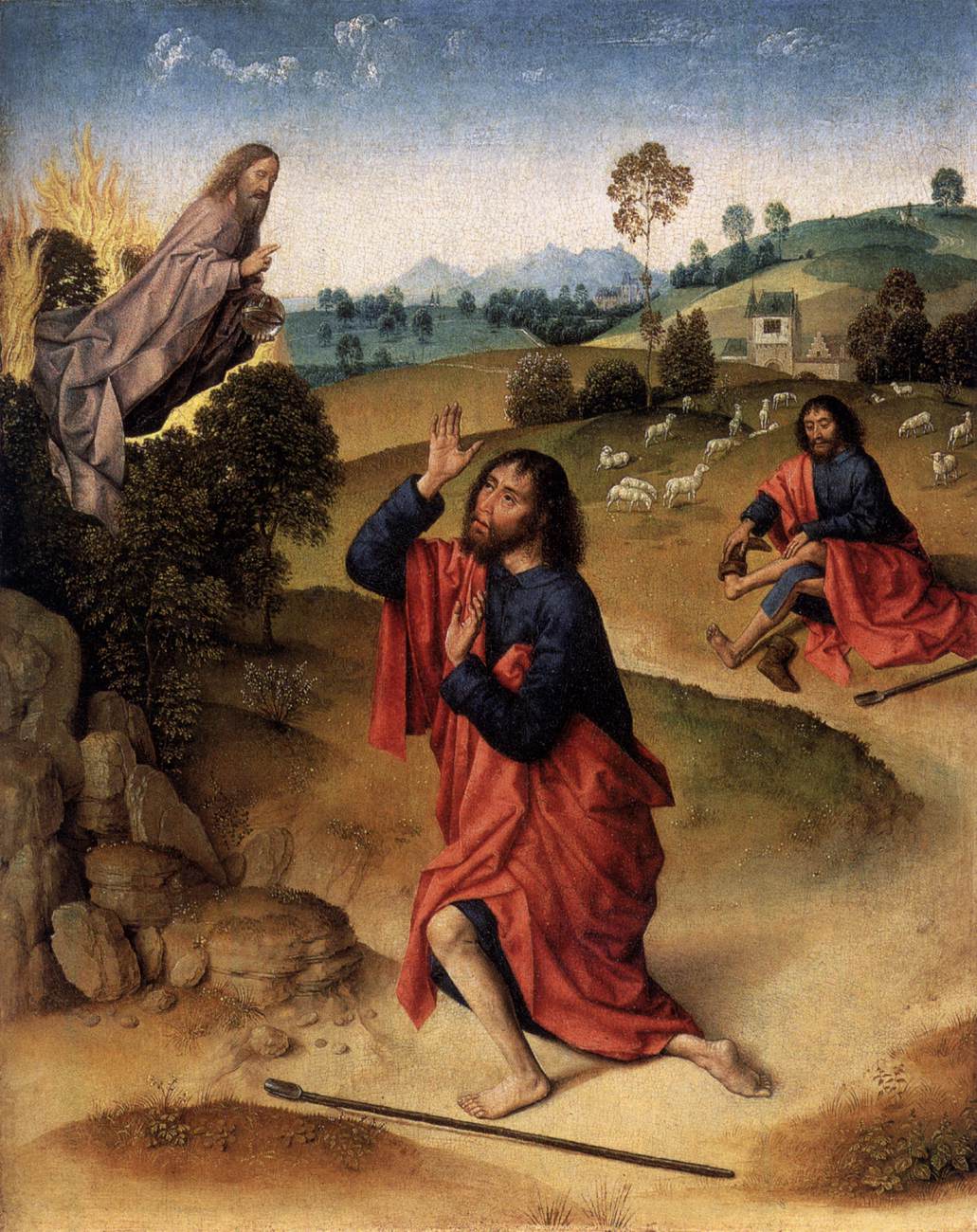
Moses and the Burning Bush DBouts.jpgThe Kontakian of the Byzantine Liturgy the Church prays,

With the divine and righteous Moses and Aaron, the Prophets’ choir today rejoices with gladness, seeing their prophecy fulfilled now in our midst; for Your Cross, O Christ our God, whereby You have redeemed us,, shine in the sight of all as the end and fulfillment of that which they foretold in ancient times. By their entreaties, have mercy upon all of us.

The Church honors Old Testament figures liturgically, and today we recall Moses, a Holy Forefather. However, these Old Testament people do not appear on the Roman Calendar but they do in the Eastern Calendar. In the Roman Martyrology (an official liturgical book that catalogues the cult of saints, including the ecclesial acts of beatification and canonization) we find Saint Moses.

It is to Moses, whom we call a holy prophet and lawgiver. He was chosen by God to lead the oppressed people out of Egypt to the Promised Land. To Moses we learn that God has revealed Himself through the burning but unconsumed bush and it is on Mount Sinai through Moses that we learn God’s name, “I Am Who I Am.” It is through Moses that we receive the Law and “at a ripe old age” Moses died before entering the Promised Land and designed by God.
According to Catholic theology, Moses is an Old Testament type of Jesus, who in the Gospel of Matthew, is known as the “new Moses” and and is said to be Elias on Tabor at the Lord’s Transfiguration.
Moses is a particular appropriate saint for Benedictines to know, follow, and imitate. His life and vocation to be a prophet –that is, a witness, to the encounter with God, ought to motivate us to a deeper call to seek the face of God. The Benedictine vocation to be present to the Divine Mystery in front of us.
So, yes, Catholics call Moses “saint.”

Enhanced by Zemanta

Saint Gregory the Great

St Gregory the Great statue, Portsmouth.jpegBlessed Gregory, raised upon the throne of Peter, sought always the beauty of the Lord and lived in celebration of that love.


O God, who care for the your people with gentleness and rule them in love, though the intercession of Pope Saint Gregory, endow, we pray, with a spirit of wisdom those to whom you have given authority to govern, that the flourishing of a holy flock may become the eternal joy of the shepherds.

Let us pray for the Pope, Benedict XVI and his ministry as pastor. Likewise, I would like to remember in prayer the monks of Portsmouth Abbey who live under the patronage of Saint Gregory the Great.
Enhanced by Zemanta

Pope Benedict’s prayer intentions for September 2012


Pope at Word Synod 2008.jpg

“… it is the community prayer of the Word of God that stands out for … [St Benedict] as the most vital prayer for everyone because everyone is involved in it, because the whole Church and all mankind are included in it…”

Saint Benedict’s Rule
Abbot Patrick Barry, OSB

Ampleforth Abbey


For September, let’s offer a rosary and other good works for the intentions of the Pope. As Abbot Patrick said above, the community’s prayer includes all people.

The general
intention

That politicians may always act with honesty, integrity, and love for
the truth. 

The missionary intention

That Christian communities may have a
growing willingness to send missionaries, priests, and lay people, along with
concrete resources, to the poorest Churches.

Pope Benedict sends note on death of Cardinal Martini

The typical protocol is for the Pope, often through the Secretary of State, to send a telegram on the death of a churchman, or on the occasion of another significant event. In the case of cardinals, a pope sends a more personal message. Pope Benedict knew Cardinal Martini well, and even saw him in June when he was in Milan. The pope writes…

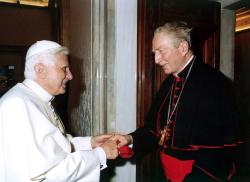
B16 and Carlo Maria.jpgHaving heard with sadness the news of the death of Cardinal Carlo Maria Martini after a long illness, which he lived with a tranquil soul and with confident abandonment to the will of the Lord, I wish to express to you and to the entire diocesan community, as well as to the family of the late Cardinal, my profound share in their sorrow, recalling with affection this dear brother who served the Gospel and the Church so generously. I recall with gratitude the intense and profuse Apostolic work of this zealous, spiritual child of St. Ignatius, an expert teacher, an authoritative biblical scholar, and a beloved Rector of the Pontifical Gregorian University and of the Pontifical Biblical Institute, and a wise and diligent Archbishop of the Ambrosian Archdiocese. I think also of the competent and fervent service he gave to the Word of God, always opening to the ecclesial community the treasures of the Sacred Scriptures, especially through the promotion of Lectio Divina. I raise fervent prayers to the Lord that, through the intercession of the Blessed Virgin Mary, He will receive His faithful servant and worthy shepherd into the heavenly Jerusalem; and upon all those who mourn his death, I warmly impart the comfort of the Apostolic Blessing.

Cardinal Carlo Maria Martini dies

Carlo Maria Martini, SJ.jpg

The famed Jesuit Cardinal Carlo Maria Martini, 85, died today following a long battle with Parkinson’s disease. He had been living at a Jesuit retirement home near Milan.

Born in Turin, Carlo Maria Martini entered the Society of Jesus in 1944, was ordained a priest in 1952, being solemnly professed of four vows as a Jesuit in 1962, a bishop in 1980 and created a cardinal in 1983. He retired in 2002 and participated in the conclave that elected Benedict.

By training Martini earned two doctorates and he is known as a Scripture scholar (working on the Gospel of Luke)  having been the head of the Biblicum at the time of his appointment to the archbishopric of Milan. A man of great sensitivity for the spiritual life and sacred Scripture, Martini, in his healthy years, was sought after as a retreat master. His insight in Ignatian spirituality has aided many people.

With Cardinal Martini’s death the College of Cardinals numbers 206 members, 118 of whom are able to enter a conclave to elect a new pope.

Saint Ambrose and Blessed Ildefonso, pray Cardinal Carlo Maria, and for us.

Kellen Clemens is ‘Catholic by Blood’


Until I read this story in the National Catholic
Register (NCR) I didn’t know who Kellen Clemens was. Those who know me know
that I am not a follower of football, let alone any other sport for that
matter. I am not anti-sport, I am just not a sports-type-of-person. But, I fact
I fully advocate an integration of faith and morals in the world of sports;
something that many other sports-people could benefit from. What caught my eye
in the NCR were the words “Catholic” and “St Louis Rams.” Interest piqued. I am
glad it did. Until now one would think that Tim Teabow was the only man in
American football that had a faith life. As it turns out, Kellen Clemans also
believes in God, is a Catholic and a family man. Let’s pray that these virtues
remain solid for a very long time. The NCR story is not only a good human
interest piece but it emboldens the rest of us (I hope).


Read Trent Beattie’s
article “St. Louis Rams’ Quarterback Is ‘Catholic by Blood‘.” But one section
is worth quoting here (emphasis mine).

Did you grow up in a devout family?


Kellen Clemens.jpeg

I’m a cradle
Catholic, with four sisters, and the faith was always an integral part of our
lives. I went to confession, received holy Communion and was confirmed. We were
taught the difference between right and wrong and enjoyed the stability that
brings. We also benefited from being so close to nature on our family’s cattle
ranch. That encourages you to be humble and also to respect and work with God’s
creation.

Continue reading Kellen Clemens is ‘Catholic by Blood’

Blessed Ildefonso Schuster

Bl Idelfonso Schuster, card.jpg

Almighty God, who through your grace, the Blessed Alfredo Ildefonso, by his exemplary virtue built up the flock entrusted to him, grant that we, under the guidance of the Gospel may follow his teaching and walk in sureness of life, until we come to see you face to face in your eternal Kingdom.

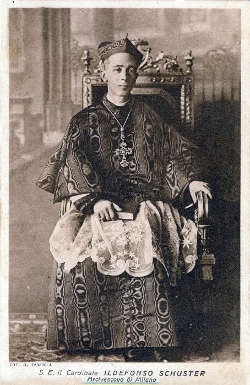
Today we honor the Church honors a great 20th century Benedictine monk, priest, bishop and cardinal, Blessed Alfredo Ildefonso Schuster. He died on this date in 1954. At the time of his death he was the cardinal-archbishop of Milan.

Blessed Ildefonso is one of my great Benedictine heros. He’s known for promoting catechetics and the role of the laity in life of the Church in a time prior to it becoming a “normal” thing. Moreover, he diligently looked after the poor, denounced the totalitarian thinking of Facism, Nazism and racism, proposed models of holiness for all people –not just the clerical elite– and he lived the sacred Liturgy and founded the Institute of Ambrosian Chant and Sacred Music.
When the process of beatification came to a certain point, church officials opened Cardinal Schuster’s tomb and found his body to be incorruptible. A more certain sign of holiness. He was announced as a Venerable Servant of God on March 26, 1994 and beatified by Blessed John Paul II on May 12, 1996.
For more info, see his birthday post and another post on his feast day.
Enhanced by Zemanta