Prayer enables us to discern the events of history in
the light of God’s plan for the spread of his Kingdom. That plan is symbolized
by the book closed with seven seals which only the Lamb, the crucified and
risen Lord, can open. In prayer, we see that Christ’s final victory over sin
and death is the key to all history. While giving thanks for this victory, we
continue to beg God’s grace for our earthly journey. Amid life’s evils, the
Lord hears our prayers, strengthens our weakness, and enables us to trust in
his sovereign power. The Book of Revelation concludes with Jesus’ promise that
he will soon come, and the Church’s ardent prayer “Come, Lord
Jesus!”. In our own prayer, and especially in our celebration of the
Eucharist, may we grow in the hope of Christ’s coming in glory, experience the
transforming power of his grace, and learn to discern all things in the light
of faith.
“For Greater Glory” now available on DVD
The movie, “For Greater Glory,” is now available on DVD on Amazon, but it is also available from Ignatius Press.
What price would
you pay for freedom? In the exhilarating action epic “For Greater Glory” an
impassioned group of men and women each make the decision to risk it all for
family, faith and the very future of their country, as the film’s adventure
unfolds against the long-hidden, true story of the 1920s Cristero War the
daring people’s revolt that rocked 20th Century North America.
This movie is an excellent addition for your Catholic library of film and appropriate for a high school Catholic curricula, the RCIA and adult faith formation work of your parish. This forgotten part of our North American history needs to be better known.
Fr. Carrón gives tribute to Cardinal Martini, calls Communion and Liberation to live differently with the bishop
The President of the Fraternity of Communion and Liberation,
Father Carrón’s, said the following in tribute to Carlo Maria Cardinal Martini in a September 4th editorial in Corriere della Sera:
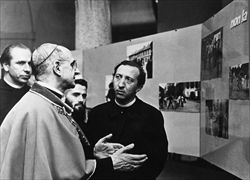
“And like Archbishop Montini, who initially confessed that he did not understand
Fr. Giussani’s method, though he did see its fruits, Cardinal Martini also
encouraged us to go forward. I am still moved by the words that he addressed to
Fr. Giussani in 1995, during a meeting of priests, when he thanked ‘the Lord,
who gave Msgr. Giussani this gift for continually re-expressing the core of
Christianity. ‘Every time that you talk, you always return to this core, which
is the Incarnation, and – in a thousand different ways – you propose it again.'”
The full text of the editorial: Julian Carron Letter on Carlo Martini’s death.pdf
This text is a brief, honest and yet key reflection not only on the life and influence of Cardinal Martini, perhaps an excellent synthesis of Christian life and how it is extroverted in a human being. There are some very tiresome reviews of who the Cardinal was, and what he meant to the Church too often in political language. To my mind those authors who evaluate a man such as Martini in this manner does not abide with the Gospel and faith.
The letter of Father Carrón acknowledges the fact that Communion and Liberation has significantly neglected the various opportunities of collaboration with Cardinal Martini that presented themselves over the years. This admission to members of CL should help all of us to reassess how we live and breathe in our given ecclesial context. This is a serious point that we can’t pass off to circumstance. That is to say, we who claim to be faithful members of CL need to work more diligently with the Diocesan Ordinary “in giving reasons for our hope” in concrete ways so that we are witnesses as the Servant of God Pope Paul VI said (cf. the letter).
The Most Holy Name of Mary
The Church has offered us a “Marian sandwich.” Let me explain. This week we are honoring the Mother of God with three distinct memorials: The Nativity of Mary (Sept. 8) and Our Lady of Sorrows (Sept 15) and today the commemoration of the Holy Name of Mary. In liturgical history this feast has been observed on various days before settling on this day. The feast was reintroduced to our Roman Missal by Pope John Paul II.
Getting a handle on Benedictine life — Subiaco style
You might ask why I care about the Subiaco Congregation… well, I care about the Congregation because it’s the largest and most diverse of all the groupings of those who follow the Benedictine Rule, and many of the monasteries do interesting things outside the typical works of parochial and educational ministries. And, because I care. Subiaco monks and nuns tend to be more focused on living the monastic life with intensity. One may also say that the English Benedictines have certain intensity in life and ministry which distinguishes them from other groupings.
9/11 – eternal memory
Subiaco Congregation of monks meet
The General Congregation of the Subiaco Congregation of Benedictine monks are meeting this week at one of the monasteries founded by Saint Benedict, Saint Scholastica Monastery, Subiaco, Italy.
Praying for Charles Chaput and Philadelphia
Every bishop needs prayers. Yesterday was the year anniversary of Philadelphia Archbishop Charles Joseph Chaput’s taking over the work of being the pastor. He’s had a very tough year but not one without the finger of God directing his way. If there is a bishop that we ought to follow on this side of the Atlantic, this is the one. Here’s an insightful story of the Archbishop’s past year…. Read it please, and offer a prayer for both the archbishop and the archdiocese.
Be opened!
The gospel for today has the word, “Be opened” –in other words, listen. It is a word that is most known by Christians in the Rite of Baptism where the priest touches the ears of the person to be christened saying, “Be opened.” Later in history, the word is made more famous for being the first word in the Rule of Benedict, Listen.
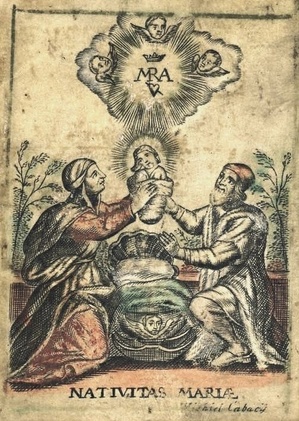
Nativity of the Blessed Virgin Mary
Let us celebrate with joy the Nativity of the Blessed Virgin Mary, for from her arose the sun of justice, Christ our God. (antiphon)
Impart to your servants, we pray, O Lord, the gift of heavenly grace, that the feast of the Nativity of the Blessed Virgin may bring deeper peace to those for whom the birth of her Son was the dawning of salvation.
Several things to pray for today,
- the Most Rev. Edoardo Aldo Cerrrato, CO, on the day of his episcopal ordination in Rome;
- the Cistercian Order;
- those who professed vows today;
- the Benedictines of Saint Mary’s Monastery (Petersham, MA);
- Archbishop Charles Chaput, OFM, Cap, on the first anniversary of being the archbishop of Philadelphia;
- Michael Maggiore who is healing.
Keeping in mind what Saint Thomas of Villanova reflected upon for today’s feast,
“What joy, what happiness there is in heaven! The shoot for the root of Jesse, sown so long ago in the patriarchs, has today sprung up and began to grow, and will bear a Flower which is destined to heal the world; a Flower whose scent revives the dead, whose taste heals the sick, whose beauty delights the angels; a Flower both white and red, which the angels long to see.”
Father Francis Weiser, S.J., in his The Holyday Book writes about today’s feast thus:
On Our Lady’s birthday the Church celebrates the first dawning of redemption with the appearance in the world of the Saviour’s mother, Mary.
The Blessed Virgin occupies a unique place in the history of salvation, and she has the highest mission ever commended to any creature. We rejoice that the Mother of God is our Mother, too.
Let us often call upon the Blessed Virgin as “Cause of our joy,” one of the most beautiful titles in her litany.
Since September 8 marks the end of summer and beginning of fall, this day has many thanksgiving celebrations and customs attached to it. In the Old Roman Ritual there is a blessing of the summer harvest and fall planting seeds for this day.
The winegrowers in France called this feast “Our Lady of the Grape Harvest”. The best grapes are brought to the local church to be blessed and then some bunches are attached to hands of the statue of Mary. A festive meal which includes the new grapes is part of this day.
In the Alps section of Austria this day is “Drive-Down Day” during which the cattle and sheep are led from their summer pastures in the slopes and brought to their winter quarters in the valleys.
This was usually a large caravan, with all the finery, decorations, and festivity. In some parts of Austria, milk from this day and all the leftover food are given to the poor in honor of Our Lady’s Nativity.
The 2010 post which includes a portion of a homily Saint Andrew of Crete is here.