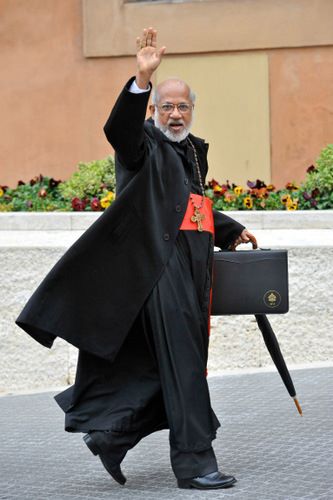
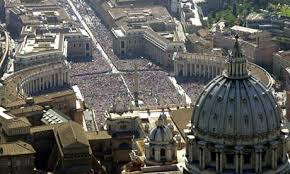
The Cardinals have determined that the Conclave will begin on 12 March 2013. The Votive Mass Pro Eligendo Pontifice (For the Election of the Pontiff) will be offered in the morning at Saint Peter’s Basilica by the Cardinal Dean and later that afternoon the cardinals will process from the Pauline Chapel to the Sistine praying the Litany of Saints.
Formal Apology or reconciliation
One of the things I did this week was to available myself to the sacrament of Confession. As a spiritual disciple I try to get to the sacrament every month; regrettably it was more than a month since the last time I received the sacrament. Let me also recognize that Father Luigi Giussani encouraged the Memores Domini and other followers in Communion and Liberation to go to confession every 15 days. It was great to go to confession: a refreshed sense of life in Christ, especially in my relations with others, in the reception of Holy Communion, but I had the distinct feeling of having a “new humanity.” Going to confession is a recognition of Someone greater in my life, that the living of my is not merely about me and my selfish interests, and that sin is corrosive, but the sacrament of confession (aka penance, or reconciliation), helps me recognize the truth about me: that I am truly loved by God, whose other name is Mercy.
Change your clocks Saturday
Newman: God has created me to do Him some definite service
I am visiting the Benedictine Abbey of St Anselm (Washington, DC) to get away from “stuff” where I normally live. Life there is particularly tense these days. A topic for another time. Time in quiet, time in prayer, time to think, to ponder bigger questions, time to read and to enjoy life in a different key for a short time. Life is fine. It won’t last long, don’t worry. I have friends here. Yesterday I was trying to understand happiness. Newman gave perspective. Today, I am trying to understand my place is a world of utter chaos, not exclusively my own chaos but more importantly the world’s.
At breakfast another guest at the abbey said he thought the US was heading to another civil war. I received an email and later texts that the two year old son of a friend is in the hospital with a serious ear infection, an acute illness that has made itself a longtime, and unwelcomed guest in this person’s life; there is also the fact that we are working toward the conclave but problems that need discussion, and the list goes on. This afternoon I sat for an hour with my friend Aidan, the abbot-emeritus of this abbey, who is just a delight to speak converse with, and who is living with the grace of Parkinson’s. (Blessed John Paul II, pray for Aidan!) Aidan can track a conversation for the most part; he loses words and can be side-tracked; but he’s capacity for friendship is great.
BUT what am I supposed to do? How do I approach the reality of life? Where is God leading me, why, and for what reason? Do I have a part to play in life? Newman has a helpful answer…
1. God was all-complete, all-blessed in Himself; but it was His will to create a world for His glory. He is Almighty, and might have done all things Himself, but it has been His will to bring about His purposes by the beings He has created. We are all created to His glory–we are created to do His will. I am created to do something or to be something for which no one else is created; I have a place in God’s counsels, in God’s world, which no one else has; whether I be rich or poor, despised or esteemed by man, God knows me and calls me by my name.
2. God has created me to do Him some definite service; He has committed some work to me which He has not committed to another. I have my mission–I never may know it in this life, but I shall be told it in the next. Somehow I am necessary for His purposes, as necessary in my place as an Archangel in his–if, indeed, I fail, He can raise another, as He could make the stones children of Abraham. Yet I have a part in this great work; I am a link in a chain, a bond of connexion between persons. He has not created me for naught. I shall do good, I shall do His work; I shall be an angel of peace, a preacher of truth in my own place, while not intending it, if I do but keep His commandments and serve Him in my calling.
3. Therefore I will trust Him. Whatever, wherever I am, I can never be thrown away. If I am in sickness, my sickness may serve Him; in perplexity, my perplexity may serve Him; if I am in sorrow, my sorrow may serve Him. My sickness, or perplexity, or sorrow may be necessary causes of some great end, which is quite beyond us. He does nothing in vain; He may prolong my life, He may shorten it; He knows what He is about. He may take away my friends, He may throw me among strangers, He may make me feel desolate, make my spirits sink, hide the future from me–still He knows what He is about.
O Adonai, O Ruler of Israel, Thou that guidest Joseph like a flock, O Emmanuel, O Sapientia, I give myself to Thee. I trust Thee wholly. Thou art wiser than I–more loving to me than I myself. Deign to fulfill Thy high purposes in me whatever they be–work in and through me. I am born to serve Thee, to be Thine, to be Thy instrument. Let me be Thy blind instrument. I ask not to see –I ask not to know–I ask simply to be used.
John Henry Newman
Meditations on Christian Doctrine with A Visit to the Blessed Sacrament Before Meditation, 299
7 March 1848
The Chicken Church
Father Augustine Thompson lectured on “Baptismal Theology and Practice in the Age of St. Thomas Aquinas”
Father Augustine Thompson, OP, delivered the 23rd annual Aquinas Lecture “Baptismal Theology and Practice in the Age of St. Thomas Aquinas”
I highly recommend watching the video presentation.
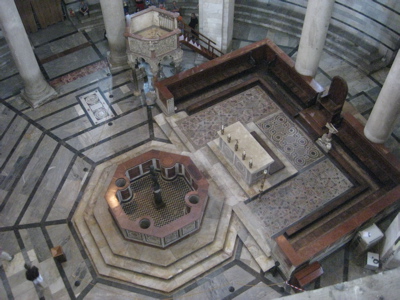
On Wednesday, February 27, 2013, Fr. Augustine examined and presented research on his discoveries of the liturgical and social significance of baptism in Northern Italian cities of the thirteenth-century. He also discussed developments in the Catholic theology of baptism from the twelfth century to Aquinas in the late thirteenth, including Aquinas’ disagreements with other theologians. I found his presentation compelling because he speaks of how Northern Italy preserved the unity of the sacraments of initiation, the role of the bishop in being the prime minister of Christian initiation, the role of city government, the faith community, and many other things like the fast of infants.
A New York native, Fr. Augustine is Professor of History at the Dominican School of Philosophy and Theology, Berkeley, CA. He earned a PhD from UC Berkeley and in 2007 was given the STM from the Order of Friars Preachers. He is the author of the recently published Francis of Assisi: A New Biography, Cities of God: The Religion of the Italian Communes, 1125-1325 and Revival Preachers and Politics: The Great Devotion of 1233; Ad Completorium Liturgiae Horarum secundum Usum Ordinis Fratrum Praedicatorum. Oakland, CA: Provincia Ss. Nominis Jesu Ordinis Praedicatorum, 2010 (Liturgical Music); Cities of God: The Religion of the Italian Communes, 1125-1325. 2005; and edited John Williamson Nevin. The Mystical Presence: A Vindication of the Reformed or Calvinist Theology of the Holy Eucharist, 2000.
Newman: Happiness, the ways by which perfection is reached
Discernment of God’s will difficult, and living with the gift of happiness God hasgiven each of one us is a challenging thing. We can get in the way and obscure what is real and what is fantasy. I was speaking with a friend yesterday and our conversation at one point turned to John Henry Newman. Newman knows all! (So does Balthasar, Ratzinger Giussani, to name a few people). My friend and I are trying to locate happiness: what it is, what it is not, how do I experience it, and where, etc. Happiness is not easy to categorize, accept, give, reverence, promote, etc. What is clear is that true happiness involves God and life in God; what is less clear are the contours of that happiness and even lesser is knowing how my participation in happiness is supposed to be as God wants. If you find theway to happiness that is coherent, let us know. In the meantime, Newman makes sense especially in pointing to the fact that we have to have a level of abandonment to the will of God.
On this day in 1848 Newman wrote the following:
1. GOD has created all things for good; all things for their greatest good; everything for its own good. What is the good of one is not the good of another; what makes one man happy would make another unhappy. God has determined, unless I interfere with His plan, that I should reach that which will be my greatest happiness. He looks on me individually, He calls me by my name, He knows what I can do, what I can best be, what is my greatest happiness, and He means to give it me.
2. God knows what is my greatest happiness, but I do not. There is no rule about what is happy and good; what suits one would not suit another. And the ways by which perfection is reached vary very much; the medicines necessary for our souls are very different from each other. Thus God leads us by strange ways; we know He wills our happiness, but we neither know what our happiness is, nor the way. We are blind; left to ourselves we should take the wrong way; we must leave it to Him.
Continue reading Newman: Happiness, the ways by which perfection is reached
Holy Hour for Conclave today – cardinals call Church to pray

TODAY, let’s join with the cardinals when they dedicate Wednesday afternoon to prayer and adoration in St. Peter’s Basilica for the upcoming papal election.
The Holy Hour begins at 5pm Rome time (11a.m. EST).
Edward Pentin’s NCRegister article, “Entire Church Invited to Pray for Conclave.”
The worship program.
Please, do your part!
Cultivating Peace –the Benedictine way
You be interested in this video presentation, “Cultivating Peace in One’s Own Life and in Society” by Abbot James Wiseman of St Anselm’s Abbey (Washington, DC).
PAX!
Newman Bookstore, Washington, DC to close doors
Was just at the Newman Bookstore in DC today. Sadly, it is closing on 31 May. 35% discount available now, more discounts in April. Sad another bookstore is closing its doors. Newman has been a true asset to the Catholic intellect community.
St Paul College, Hecker Center
3025 4th Street NE
Washington DC 20017
-next the US Conference of Catholic Bishops