Daily Rule of Prayer: Mass, adoration, lectio divina…

For the most part, the time for priestly and diaconal ordinations have come and gone. Where I am for the summer, a newly ordained priest is due to arrive in a few days. Having heard plenty of ordination homilies over the years none are as insightful as Benedict XVI’s especially when he proposes a plan to be spiritually fit. Of course, all what is said is not restricted to priests but applicable to the laity as well. All of us reading this post are familiar with all the points made about developing a prayer life and seeing them together constitutes a serious plan. Father Mark draws our attention to one item that is near-and-dear to many of us: lectio divina. I am re-posting a portion of my friend Father Mark’s recent May blog entry because I think it’s helpful.

What is Father Everypriest’s daily Rule of Prayer according to Pope Benedict XVI? Let’s consider the elements of the Rule in the order in which the Holy Father presents them.

1) Daily Holy Mass. Daily. Not 6 days week, not 5, or 4 days a week, but daily. The liturgical cycle in its hourly, daily, weekly, and yearly rhythms is given us precisely to facilitate our “abiding” in Christ hour by hour, day by day, week by week, and year after year. Integral to the liturgical cycle is daily Holy Mass. The Eucharistic Sacrifice sends the divine lifeblood coursing through one’s spiritual organism. Without daily Mass, the priest will succumb to spiritual anemia.
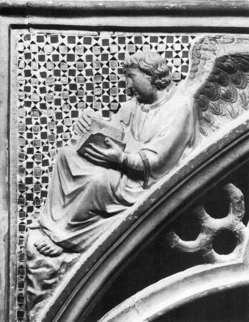
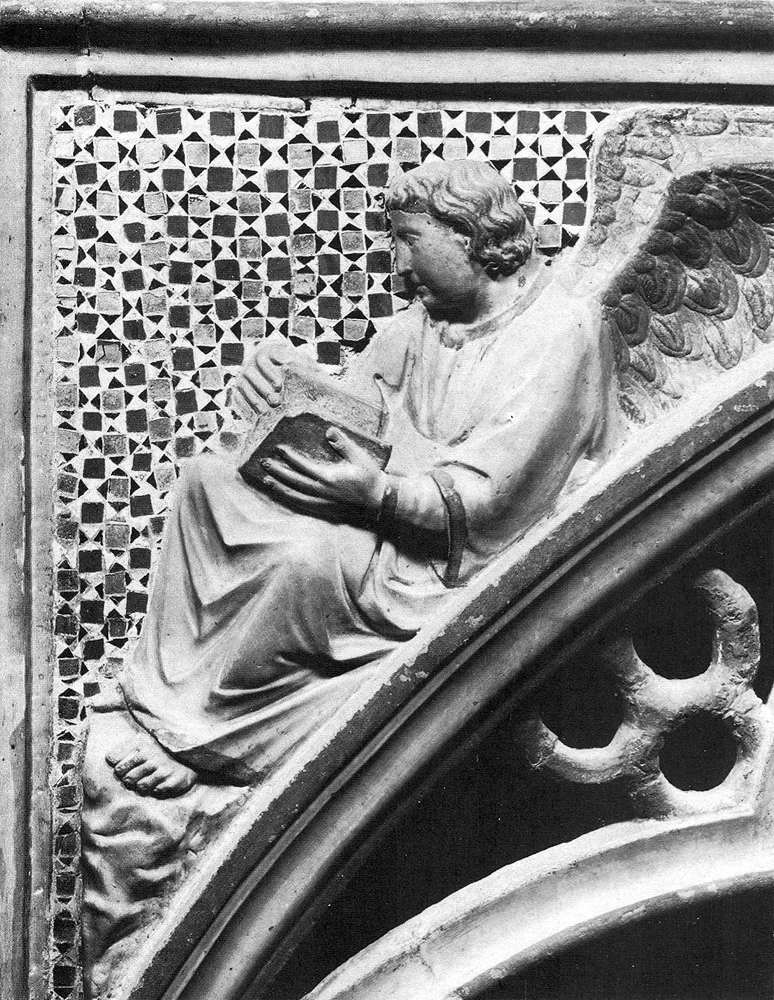
detail of angel.jpg

2) The Liturgy of the Hours. The Hours give rhythm and grace to daily life. They are a school of discipline (discipleship), a supernatural system of irrigation channeling grace into every moment of the day, a privileged way of offering thanks in communion with all who, “in heaven, on earth, and under the earth,” confess the Name of Jesus and bend the knee before Him. A priest who loves the Divine Office will enjoy an interior life that is sane, and sound, and wholly ecclesial. Fidelity to the Divine Office refines the Gifts of the Holy Spirit, sharpens one’s discernment, and imparts to everything the priest does a certain Eucharistic and doxological quality.

3) Eucharistic Adoration. Are you surprised? Eucharistic adoration has known a kind of springtime since The Year of the Eucharist (2004-2005) that was also the year of the death of Pope John Paul II and of the election of Pope Benedict XVI. Two Americans known for loving their brother priests and ministering to them tirelessly –Archbishop Fulton J. Sheen and Father Gerald Fitzgerald of the Holy Spirit– insisted on a daily hour before the Blessed Sacrament as a sine qua non of priestly spirituality. The priest who adores the Blessed Sacrament exposes his weaknesses and wounds to the healing radiance of the Eucharistic Face of Jesus. Moreover, he abides before the Eucharistic Face of Jesus as the representative of his people: of the sick, the poor, the bereaved, and of those locked in spiritual combat. The priest who looks to the Eucharistic Face of Jesus, and draws near to His Open Heart in the Sacrament of the Altar, will, just as the psalm says, be radiant, and he will not be put to shame.

4) Lectio Divina. Again — a monastic thing? No, a Catholic thing. The quality of a priest’s preaching is directly proportionate to his commitment to lectio divina. Neglect of lectio divina leads to mediocre preaching. Opening the Scriptures is like opening the tabernacle: therein the priest finds the “hidden manna” his soul craves. The four steps of lectio divina can be accommodated to any length of time: 1) lectio, i.e. the Word heard; 2) meditatio, i.e. the Word repeated; 3) oratio, i.e. the Word prayed;

4) Contemplatio; i.e. the indwelling Word. Lectio divina cannot be occasional;
it is not a random pursuit. Learn to say, “I am not available.” Get over feeling guilty about taking time for God!

5) Holy Rosary. Yes, the daily Rosary. It’s a spiritual lifeline that has saved many a priest from spiritual shipwreck. The brilliant and holy exegete and founder of the École biblique in Jerusalem, Father Marie-Joseph Lagrange, was observed praying fifteen mysteries of the Rosary each day, and asked, “Why, Father, do you, a great exegete, need to pray the Rosary?” “Because, ” he answered, “it decapitates
pride.” I would add that not only does the Rosary decapitate pride; it decapitates each of the seven capital sins: pride, greed, lust, anger, gluttony, envy, and sloth. With the passing of the years I have come to appreciate the profound wisdom of an old Dominican priest to whom I used to make my confession years ago. Invariably, after confessing my miseries, Father would ask, “Do you say the Rosary, son?” And invariably I would reply, “Yes, Father.” And then he would say, “Aye, then you’ll be alright.” A priest who prays the Rosary daily will be alright and, almost imperceptibly, will grow in purity and humility.
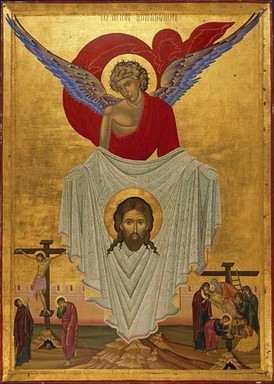
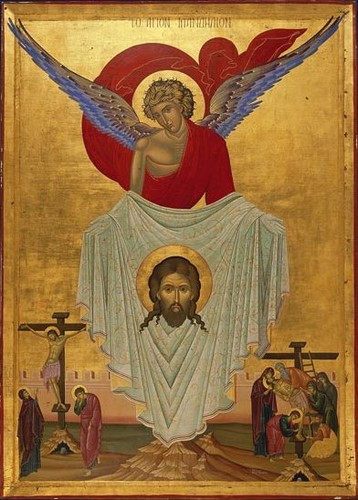
Ange de la SteFace.jpg

6) Meditation. Meditation can mean many things, even within our Catholic tradition. It is integral to the prayerful celebration of Holy Mass and the Hours. “it nourishes Eucharistic adoration. It is the second “moment” of lectio divina. It is the soul of the Rosary. In my own experience, meditation is related to “remembering the things the Lord has done.” Saint Gertrude the Great, a model of the mystical life grounded in the liturgy, used to say, “A grace remembered is a grace renewed.” Understood in this sense, meditation, by recalling the mercies of the Lord in the past, infuses the present with hope, and allows the priest to go forward with a holy boldness.

Is it necessary to set a period of time apart for meditation as such? That depends on whom you ask. The Carmelite, Jesuit and Sulpician traditions would hold fast to some form of meditation as a daily exercise. The monastic tradition has, on the whole, taken a more supple approach to meditation. It is a daily practice, but one diffused in every form of prayer, including the liturgy itself. One learns to pace one’s prayer, to pause, to breathe, to linger over a phrase, a word, or an image. Whether one espouses the Ignatian way or the monastic approach, meditation is an integral to every priest’s daily Rule of Prayer.

The mind of Christ is not myopic: the event of Pentecost broadens us


holy spirit1.jpgThe Holy Spirit makes the Christian experience truly Catholic and universal, open to all human experience. To be Catholic is to be universal and open to the world. Not only to Canada, North America Europe or Asia, or a certain familiar part of the world or segment of society, but it must be open to all, to every single person. The mind of Christ is not intended to be a selective mentality for a few but the perspective from which the whole world will be renewed and redeemed. An insight like this, the universal scope of salvation did not however come easily and without much pain and confusion.

In fact, the whole of the New Testament can be understood precisely as the emergence of the Catholic, the universal, in Christian life. Christianity, had it not moved from where it was particular and small would have just been a small modification of the Jewish experience, a subset of Jewish piety that was still focused in and around Jerusalem and the restoration of a literal kingdom of Israel. The first two generations of Christians discovered that Christianity could not be just that. Because they had received the Holy Spirit, which is the universal principle, the Holy Spirit opened peoples’ eyes to the universal import of the Christian truth and through the encounter with non-Jews who received the Holy Spirit.

The artists of the Middle Ages often contrasted the Tower of Babel with the “Tower” of the Upper Room. Babel symbolizes the divisions of people caused by sin. Pentecost stands for a hope that such separations are not a tragic necessity. The babbling mob of Babel compares poorly with the heartfelt unity of the Pentecost crowd. Babel was a mob. Pentecost was a community. A people without God lost the ability to communicate. A people suffused with the Spirit spoke heart to heart.

At Pentecost the full meaning of Jesus’ life and message is poured into our hearts by the Spirit alive in the community. The New Testament seems to say that – for a fleeting moment – the nations of the earth paused from their customary strife and experienced a community caused by God. The brief and shining hour of Pentecost remains to charm and encourage us to this day.

These paragraphs come from Basilian Father Thomas Rosica’s essay on the Pentecost scriptures published on Zenit.org for May 28, 2009. Father Rosica is the executive director of Salt and Light TV.

A video on Pentecost can be seen here.

The Suscipe

The Suscipe prayer of Saint Ignatius of Loyola is a regular part of my spiritual regimen –and it has been so for many years– because it reminds me of the total abandonment to God’s will that I want to live. I offer the prayer here in English and Latin for your convenience. It is a perfect part of morning prayer.

Receive, O Lord, all my liberty. Take my memory, my understanding, and my entire will. Whatsoever I have or possess Thou hast bestowed upon me; I give it all back to Thee and surrender it wholly to be governed by Thy Will. Give me love for Thee alone along with Thy grace, and I am rich enough and ask for nothing more.

Suscipe, Domine, universam meam libertatem. Accipe memoriam, intellectum, atque voluntatem omnem. Quidquid habeo vel possideo mihi largitus es; id tibi totum restituo, ac tuae prorsus voluntati trado gubernandum. Amorem tui solum cum gratia tua mihi dones, et dives sum satis, hec aliud quidquam ultra posco.

(Saint Ignatius of Loyola, Spiritual Exercises)

International Priests’ Retreat: Ars 2009

There will be a retreat offered for priests September 27th to October 3rd in Ars, France. 

JMV.jpg


“You who are priests are invited to participate in this moment of spiritual strengthening. It will enable all of us to be renewed in our ministry and to taste the joy of a fraternal encounter among priests from the world over. This will be the occasion to pray fervently for priestly vocations.” 

Mgr Bagnard

The program looks very promising. For more information found here.

Praying with the Mysteries of the Holy Spirit

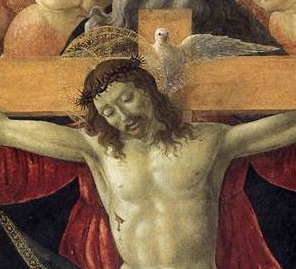
Father, Son, H Spirit.jpgThat we are in the days prior to the great feast of Pentecost our prayer ought to be more intensely centered on the third Person of the Blessed Trinity, God the Holy Spirit. My friend Dom Mark calls to mind the seven mysteries of the Holy Spirit found in the Rosary dealing with the action of the Holy Spirit in salvation history, especially attentive to the fact that these mysteries personally, deeply touch our own lives. His blog entry is helpful —read for yourself.

What gifts ought we to pray for? What about a fuller appreciation of and living out of the Gifts of the Holy Spirit. They are: Wisdom, Understanding, Counsel, Courage (fortitude), Knowledge, Piety (reverence), and Fear of the Lord (Awe of God).
Veni Sanctae Spiritus. Veni per Mariam.

Saint Augustine of Canterbury


St Augustine of Canterbury.jpg

O God, Who by the preaching and wondrous deeds of blessed
Augustine, Thy Confessor and Bishop, did vouchsafe to enlighten the English
nation with the light of true faith; grant that his intercession the
hearts
  of the erring may return to
the unity of Thy truth, and that we may be one mind in doing Thy holy will.


Saint Augustine of Canterbury (d. 604), was the first bishop
of Canterbury, sent by Pope Saint Gregory the Great to evangelize the pagan
English peoples.

Saint Augustine had been a monk of Saint Gregory’s monastery
on the Caelian Hill in Rome. In 595/596  he was sent to England first as the abbot of a group of
monks. He established himself at Canterbury, the capital of the then powerful
Kingdom of Kent, and in time baptized King Ethelbert.

Augustine is credited for laying the very foundation of the Ecclesia Anglicana because of his pastoral vision. That he was a close associate to Gregory the Great one thinks that the friendship had some role in the former’s zeal for the Kingdom. Augustine’s method of evangelizing England was not notable: he sent missionaries to all parts of England –how else would you preach the Gospel. But what was notable was his establishing Benedictine monastic life there, especially adjacent to the cathedral. So, looking at English ecclesial life you will notice the pattern of cathedrals have abbeys attached to them.

Saint Philip Neri


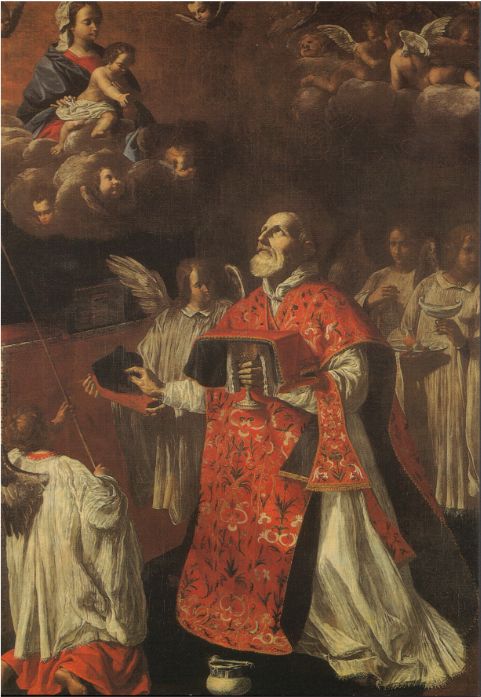
Paolo Domenico Finoglio, Abbazia di Montserrat, Spain.jpg


Rejoice in the Lord always; again I will say, Rejoice. Let
all men know your forbearance. The Lord is at hand.

Father, You continually raise up Your faithful to the glory
of holiness. In Your love kindle in us the fire of the Holy Spirit who so
filled the heart of Philip Neri.

More information about the charism of Saint Philip Neri and the
Oratorians may be found here and here.

Christ is the answer, Pope reminds the Benedictines and all peoples


montecassino1.jpgIn speaking to the Benedictines at Montecassino, the Pope was speaking to all Benedictines, solemnly professed and oblates, and to the laity, in general. He proposes once again the person of Saint Benedict as a person who knew well that Christ is the answer to all things. The Pope’s homily at Vespers follows:

Almost at the end of my visit today, I am particularly pleased to pause in this sacred place, in this abbey, four times destroyed and rebuilt, the last time after the bombings of World War II, 65 years ago. “Succisa virescit” [in defeat we are strengthened; when cut down, this tree grows again]: the words of its new coat of arms represent well its history. Monte Cassino, just as the secular oak tree planted by St. Benedict, was “pruned” by the violence of war, but has risen more vigorous. More than once I also have had the opportunity to enjoy the hospitality of the monks, and in this abbey I spent many unforgettable hours of quiet and prayer. This evening we entered singing “Laudes Regiae” together to celebrate the Vespers of the Solemnity of the Ascension of Jesus. To each of you I express the joy of sharing this moment of prayer, greeting everyone with affection, grateful for the welcome that you have reserved for me and those who accompany me in this apostolic pilgrimage.

Pietro Vittorelli.jpg

In particular, I greet Abbot Dom Pietro Vittorelli, who has made himself the spokesman of your common sentiments. I extend my greetings to
the abbots, the abbesses, and to the Benedictine communities present here.

Today the liturgy invites us to contemplate the mystery of the Ascension of the Lord. In the brief reading taken from the first letter of Peter, we were urged to fix our gaze on our Redeemer, who died “once and for all for sins” in order to lead us back to God, at whose right hand he sits “after having ascended to heaven and having obtained sovereignty over the angels and the principalities and the powers” (cf. 1 Pt 3, 18.22). “Raised on high” and made invisible to the eyes of his disciples, Jesus has not however abandoned them, but was: in fact, “put to death in the body, but made to live in the spirit” (1 Pt 3:18). He is now present in a new way, inside the believers, and in him salvation is offered to every human being without distinction of people, language, or culture. The first letter of Peter contains specific references to the fundamental Christological events of the Christian faith. The Apostle’s intention is to highlight the universal scope of salvation in Christ. A similar desire we find in St. Paul, of whom we are celebrating the two thousandth anniversary of his birth, who to the community of Corinth, writes: “He (Christ) died for all, so that those who live, live no longer for themselves but for him, who has died and is risen for them.” (2 Cor 5, 15).

To live no longer for themselves but for Christ: this is what gives full meaning to the lives of those that let themselves be conquered by him. The human and spiritual journey of St. Benedict attests to this clearly, he who, leaving all things behind, dedicated himself to the faithful following of Jesus. Embodying in his own life the reality of the Gospel, he has become the founder of a vast movement of spiritual and cultural renaissance in the West. I would now like to refer to an extraordinary event of his life, which the biographer St. Gregory the Great relates, and with which you are certainly well acquainted. One could almost say that the holy patriarch was “lifted up” in an indescribable mystical experience. On the night of October 29 of the year 540 — reads the biography — and, facing the window, “with his eyes fixed on the stars he recollected himself in divine contemplation, the saint felt that his heart was inflamed … For him, the star filled firmament was like the embroidered curtain that revealed the Holy of Holies. At one point, he felt his soul felt itself carried to the other side of the veil, to contemplate the revealed face of him who dwells in inaccessible light” (cf. AI Schuster, History of Saint Benedict and his time, Ed Abbey Viboldone, Milan, 1965, p. 11 et seq.). Of course, similar to what happened to Paul after his heavenly rapture, St. Benedict, following this extraordinary spiritual experience, also found it necessary to start a new life. If the vision was transient, the effects were lasting, his very character — the biographers say — was changed, his appearance always remained calm and his behavior angelic, and even while he was living on earth, he understood that in his heart he was already in heaven.

St. Benedict received this gift of God not to satisfy his intellectual curiosity, but rather because the charism with which God had endowed him had the ability to reproduce in the monastery the very life of heaven and reestablish the harmony of creation through contemplation and work. Rightly, therefore, the Church venerates him as an “eminent teacher of the monastic life” and “doctor of spiritual wisdom in the love of prayer and work; shining guide of people in the light of the Gospel” who,”raised to heaven by a luminous road” teaches people of all ages to seek God and the eternal riches prepared by him (cf. Preface of the Holy in the monastery to the MR, 1980, 153).

St Benedict3.jpg

Yes, Benedict was a shining example of holiness and pointed the monks to Christ as their only great ideal; he was a master of civility, who proposed a balanced and adequate vision of the demands of God and of the final ends of man; he also always kept well in mind the needs and the reasons of the heart, in order to teach and inspire a genuine and constant brotherhood, so that in the complexity of social relationships the unity of spirit capable of always building and maintaining peace was never lost sight of. It is not by
chance that the word Pax [peace] is the word that welcomes pilgrims and visitors at the gates of the abbey, rebuilt after the terrible disaster of the Second World War, which stands as a silent reminder to reject all forms of violence in order to build peace: in families, within communities, between peoples and all of humanity. St. Benedict invites every person that climbs this mountain to seek peace and follow it: “inquire pacem et sequere eam” [seek peace and follow it.] (Ps. 33,14-15) (Rule, Prologue, 17).

By its example, monasteries have become, over the centuries, centers of fervent dialogue, encounter and beneficial union of diverse peoples, unified by the evangelical culture of peace. The monks have known how to teach by word and example the art of peace, implementing in a concrete way the three “ties” that Benedict identifies as necessary to maintain the unity of the Spirit among men: the cross, which is the very law of Christ, the book which is culture, and the plow, which indicates work, the lordship over matter and time. Thanks to the activity of the monastery, articulated in the three-fold daily commitments of prayer, study and work, entire populations of Europe have experienced a genuine redemption and a beneficial moral, spiritual and cultural development, learning in the spirit of continuity with the past, of concrete action for the common good, and of openness to God and the transcendent aspect of the world. We pray that Europe always exploit this wealth of principles and Christian ideals, which constitutes an immense cultural and spiritual wealth.

mercy1.jpg

This is possible but only if the constant teaching of St.
Benedict is embraced, the “quaerere Deum,” to seek God, as the fundamental commitment of man. Human beings cannot achieve full self-realization or ever be truly happy without God. It is your special responsibility, dear monks, to be living examples of this interior and profound relationship with him, implementing without compromise the program that your founder summarized in the “nihil amori Christi praeponere” [put nothing before the love of Christ.] (Rule 4.21). In this holiness consists, a valid proposal for every Christian, more than ever in our time, in which the need to anchor life and history to solid spiritual principles is felt.

Therefore, dear brothers and sisters, your vocation is a timely as ever, and your mission as monks is indispensable.

From this place, where his mortal remains rest, the patron saint of Europe continues to urge everyone to continue his work of evangelization and human promotion. I encourage you in the first place, dear brethren, to remain faithful to the spirit of your origins and to be authentic interpreters of this program of social and spiritual rebirth. The Lord grants you this gift, through the intercession of your holy founder, of his holy sister St. Scholastica, and of the saints of your order. And may the heavenly Mother of the Lord, who today we invoke as “Help of Christians,” watch over you and protect this abbey and all your monasteries, as well as the diocesan community that lives around Monte Cassino. Amen!

Pope Benedict XVI
Homily at Vespers II
The Abbey of Monte Casino
May 24, 2009