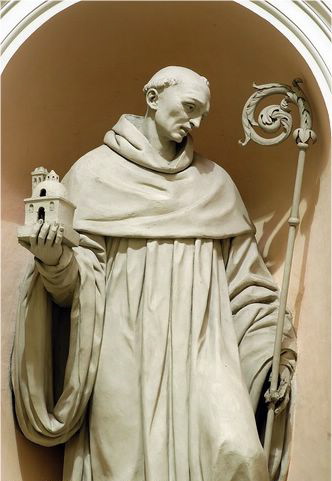
Saint Hilary of Poitiers


St Hilaire Poitiers.jpg

Saint Hilary worked tirelessly to defend the faith from wrong-thinking Christians, typically called heretics. What follows is Hilary’s teaching on God the Father.

It is the Father from whom everything that exists has been
formed. He is in Christ and through Christ the source of all things. Moreover,
His being is in Himself and He does not derive what He is from anywhere else,
but possesses what He is from Himself and in Himself. He is infinite because He
Himself is not in anything and all things are within Him; He is always outside
of space because He is not restricted; He is always before time because time
comes from Him…. But, God is also present everywhere and is present in His
entirety wherever He is. Thus, He transcends the realm of understanding,
outside of whom nothing exists and of whom eternal being is always
characteristic. This is the true nature of the mystery of God; this is the name
of the impenetrable nature in the Father.

(On the Trinity, Bk. 2, Ch.6; ML 10,
54; FC XXV, 39-40) 

The Liturgical prayer for Saint Hilary may be prayed here.

What a difference a Motu Proprio makes

… sing to the tune of “What a difference a day makes


What a difference a Motu Proprio makes 
Twenty-four little hours 
Brought the sun and the flowers 
Where there used to be rain 

My yesterday was blue, dear 
Today I’m part of you, dear 
My lonely nights are through, dear 
Since you said you were mine 


What a difference a Motu Proprio makes 
There’s a rainbow before me 
Skies above can’t be stormy 
Since that moment of bliss, that thrilling kiss 

It’s heaven when you find Latin on your menu

What a difference a Motu Proprio makes
And the difference is you 


What a difference a Motu Proprio makes 
There’s a rainbow before me 
Skies above can’t be stormy 
Since that moment of bliss, that thrilling kiss 

It’s heaven when you find Latin on your menu 


What a difference a Motu Proprio makes
And the difference is you 


Thanks to MEL for making this available.
Our Lady of Banneux: The Blessed Virgin of the Poor

OL Banneux.jpg

Mary, the Mother of God, introduced herself as “I am the Blessed Virgin of the Poor” to an 11 year old girl in 1933. I am not all that familiar with this devotion to Our Lady of Banneux, but it is very appealing to me because of the gentleness of the vision and connection with the poor and the sick.

Read an account of this Marian apparition.

A Litany to Our Lady of Banneux

This video clip gives a good introduction into this new (relatively speaking) title of Our Lady.
Bob & Penny Lord did a video on Banneux
The Congregation for the Doctrine of the Faith outlines what makes for a legitimate Marian apparition; an unofficial translation of the 1978 French document may be read here.

Saint Meinrad receives grant for youth program


Saint Meinrad Seminary and School of Theology, St.
Meinrad, IN, has been awarded an $895,000 grant from Lilly Endowment Inc. of
Indianapolis. The grant will be used as supplemental support for the “One
Bread, One Cup
” youth liturgical leadership program.


The funds will underwrite
a portion of the operating expenses of the program for five years. During that
time, Saint Meinrad will continue to build an endowment to replace the grant as
a source of operating revenue. Other costs of the program are covered by
participant fees.


“Lilly Endowment has played a crucial role in supporting our
program over the years,” said Fr. Godfrey Mullen, OSB, interim manager for the
“One Bread, One Cup” program. “Their support empowers Saint Meinrad to pass on
the Benedictine heritage of community and liturgy to another generation of
Catholics. Catholic youth and those who serve them will benefit greatly from
‘One Bread, One Cup’ because of the generosity of the Lilly Endowment.”

Continue reading Saint Meinrad receives grant for youth program

Understanding Atheism

Dominican Father Brian Davies is delivering the St Thomas Day Lecture entitled, “The New Atheism: Its Virtues and Its Vices,” on Thursday, January 28, 2010 at 7 p.m. at the Church of St Vincent Ferrer (Lexington & 66th Street, NYC).

Father Davies is a Dominican of the English Province but of Welsh heritage and a professor of philosophy at Fordham University

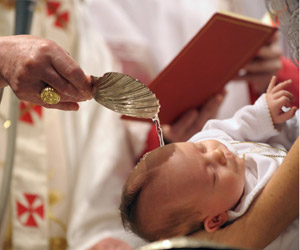
Baptism

A substantial part of the Pope’s Sunday Angelus address is worth thinking about: the reality of Baptism. Why? Because I think many of us have yet to grasp some of the essential points of what the Catholic Church believes and teaches. What I notice, as you may have, that even the clergy have a faulty understanding of what the sacrament of Baptism is meant to do for the person. It is not a social event for the family. It is not an opportunity to quiet the screams of family members (grandma) regarding “the way it is done in this family”, etc. Baptism is about a life in Christ. Period.

BUT what is the sacrament of Baptism all about? At the time of baptizing children or baptizing adults we are given a supreme gift by God: love. Let me briefly explain what baptism is and what it gives to us. These points don’t exhaust the teaching and the conversation of what happens when one is baptized:

A. there’s a forgiveness of sins –the baptized person “dies to sin” (Romans 6); for the adult person there is repentance and deliberate renunciation of personal sin, AKA, conversion;

B. there’s a configuration to Christ, that is, a person comes to a close union with Jesus: baptism unties the Christian with Christ–it is a union of mind and will; the person is made new; the the baptized person is a sharer in Christ’s own paschal mystery (life, death, resurrection and ascension, Romans 6:1-11); the soul is changed permanently, which we call sacramental character;

baptizing.jpg

C. the baptized person is given the gift of the Holy Spirit–he or she is “re-generated” in the Holy Spirit (1 Cor. 12:13); the gift of the Holy Spirit is personally present and dwelling in each person; the Holy Spirit gives eache person the grace of becoming sons and daughters of God the Father, also the Spirit gives each person the power to say, “Abba, Father” (Romans 8:15; Galatians 4:6): St Paul is clear, by the Holy Spirit we can utter the holy name, Jesus Christ and call Him “Lord”;

D. as baptized persons we have a new relationship with God the Father as adopted children of God; this new relationship speaks of our destiny–God wants us to be saved–He offers each person salvation through Jesus Christ AND His Church;

E. baptism gives each person membership in the Church, not like a membership at a gym or a country club or Sam’s Club; we are brought into, incorporated in the Church as a communion of faith and a communion of saints; in the Church we receive grace AND we work out our salvation through the worshipping community and together as a community in mission to realize the Gospel.
And now the Pope’s address:

The Baptism of the Lord [the feast celebrated this past Sunday, Jan 10] suggests quite well the general sense of the Christmas festivity in which the theme of “becoming sons of God” thanks to the only-begotten Son’s taking on of our humanity constitutes a dominant element. He became man so that we could become sons of God. God is born so that we could be re-born.


These concepts continually return in the liturgical texts of Christmas and constitute a powerful motive for reflection and hope. We think of what St. Paul writes to the Galatians: “God sent his Son, born of a woman, born under the law, to ransom those under the law, so that we might receive adoption” (Galatians 4:4-5); or again, of St. John in the prologue to his Gospel: “To those who received him he gave the power to become sons of God” (John 1:12). This stupendous mystery that is our “second birth” — the re-birth of a human being from “above,” from God (cf. John 3:1-8) — is realized and summarized in the sacramental sign of baptism.


With this sacrament man really becomes son — son of God. From that point the goal of his life consists in arriving at, in a free and conscious way, that which from the very beginning was his destination as man. “Become what you are” — represents the basic educational principle of the human person redeemed by grace. Such a principle has many analogies with human growth, where the relationship between parents and children passes, through separation and crisis, from total dependence to the awareness of being children, to recognition through the gift of life received and to the maturity and capacity to give one’s life. Born to new life through baptism, the Christian too begins his journey of growth in the faith, which will carry him to consciously invoke God as “Abba — Father,” turning to him with gratitude and living in the joy of being his son.


A model of society is also derived from baptism: that of being brothers. Fraternity cannot be established through an ideology, much less through the decree of just any power that has been set up. We recognize ourselves as brothers through a humble but profound awareness of being sons of the one heavenly Father. As Christians, thanks to the gift of the Holy Spirit received in baptism, we have the gift and task of living as sons of God and brothers, to be like “leaven” in a new humanity, united and rich in peace and hope. We are helped in this by the consciousness of having, besides a Father in heaven, a mother too, the Church, of whom the Virgin Mary is the perennial model. To her we entrust the newly baptized children and their families, and we ask for all the joy to be re-born every dayfrom above,” from the love of God, that makes us his children and brothers among ourselves.

Saint Aelred of Rievaulx

St Aelred3.jpgPour into our hearts, O God, the Holy Spirit’s
gift of love, that we, clasping each the other’s hand, may share the joy of
friendship, human and divine, and with Your servant Aelred draw many to Your
communion of love; through Jesus Christ the Righteous, who lives and reigns
with You in the unity of the Holy Spirit, one God, now and forever.


On friendship

There are four qualities which characterize a friend: loyalty, right intention, discretion and patience. Right intention seeks for nothing other than God and natural good. Discretion brings understanding of what is done on a friend’s behalf, and ability when to know when to correct faults. Patience enables one to be justly rebuked, or to bear adversity on another’s behalf. Loyalty guards and protects friendship, in good or bitter times.

Saint Aelred of Rievaulx

Another note on Saint Aelred may be found here.

Pope reminds the Pontifical North American College (Rome) to remain faithful to its founding principals


PNAC Coat of Arms.jpg

As part of the 150th anniversary celebration of the Pontifical North American College, Pope Benedict XVI addressed a gathering of cardinals, bishops, priests, students and friends of the College on January 9, 2010. The PNAC was founded by Blessed Pius IX.

I am pleased to welcome the alumni of the Pontifical North
American College, together with the Rector, faculty and students of the
seminary on the Janiculum hill, and the student priests of the Casa Santa Maria
dell’Umiltà. Our meeting comes at the conclusion of the celebrations marking
the one hundred and fiftieth anniversary of the College’s establishment by my
predecessor, Blessed Pius IX. On this happy occasion I willingly join you in
thanking the Lord for the many ways in which the College has remained faithful
to its founding vision by training generations of worthy preachers of the
Gospel and ministers of the sacraments, devoted to the Successor of Peter and
committed to the building up of the Church in the United States of America.

It
is appropriate, in this Year for Priests, that you have returned to the College
and this Eternal City in order to give thanks for the academic and spiritual
formation which has nourished your priestly ministry over the years. The
present Reunion is an opportunity not only to remember with gratitude the time
of your studies, but also to reaffirm your filial affection for the Church of
Rome, to recall the apostolic labors of the countless alumni who have gone
before you, and to recommit yourselves to the high ideals of holiness, fidelity
and pastoral zeal which you embraced on the day of your ordination
. It is
likewise an occasion to renew your love for the College and your appreciation
of its distinctive mission to the Church in your country.

Bl Pius IX.jpg

During my Pastoral
Visit to the United States, I expressed my conviction that the Church in
America
is called to cultivate “an intellectual ‘culture’ which is
genuinely Catholic, confident in the profound harmony of faith and reason, and
prepared to bring the richness of faith’s vision to bear on the pressing issues
which affect the future of American society”
(Homily at Nationals Stadium,
Washington, 17 April 2008). As Blessed Pius IX rightly foresaw, the Pontifical
North American College in Rome is uniquely prepared to help meet this perennial
challenge. In the century and a half since its foundation, the College has
offered its students an exceptional experience of the universality of the
Church, the breadth of her intellectual and spiritual tradition, and the
urgency of her mandate to bring Christ’s saving truth to the men and women of
every time and place
. I am confident that, by emphasizing these hallmarks of a
Roman education in every aspect of its program of formation, the College will
continue to produce wise and generous pastors capable of transmitting the
Catholic faith in its integrity, bringing Christ’s infinite mercy to the weak
and the lost, and enabling America’s Catholics to be a leaven of the Gospel in
the social, political and cultural life of their nation.

PNAC courtyard.jpeg

Dear brothers, I pray
that in these days you will be renewed in the gift of the Holy Spirit which you
received on the day of your ordination. In the College chapel, dedicated to the
Blessed Virgin Mary under the title of the Immaculate Conception, Our Lady is
portrayed in the company of four outstanding models and patrons of priestly
life and ministry: Saint Gregory the Great, Saint Pius X, Saint John Mary
Vianney and Saint Vincent de Paul
. During this Year for Priests, may these
great saints continue to watch over the students who daily pray in their midst;
may they guide and sustain your own ministry, and intercede for the priests of
the United States. With cordial good wishes for the spiritual fruitfulness of
the coming days, and with great affection in the Lord, I impart to you my
Apostolic Blessing, which I willingly extend to all the alumni and friends of
the Pontifical North American College.