Romanian witches are soon to be licensed. Why, you
ask. So when their spells fail to provide the desired results, the government
can jail them. There’s a bill on parliament’s desk. On January 1, Romania
changed its laws witchcraft requiring receipts and prohibiting them from
exercising their craft near churches and schools.
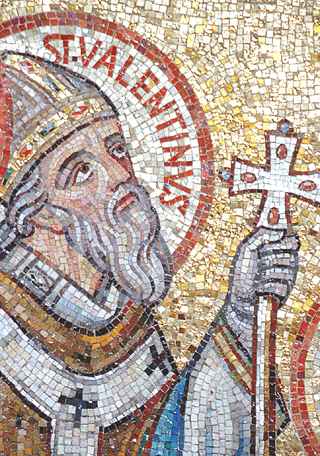
Saint Valentine
The Church’s hagiographical
tradition (lives of the saints) the Roman Emperor Claudius prohibited
young men from getting married because he wanted them for his army. Valentine,
a priest of Rome, contradicted the Emperor’s wishes and married couples in
secret. This act of deviance, and the fact that he helped martyrs at the time of persecution, landed Valentine in prison with a death
sentence. He was beaten and beheaded. Saint Valentine’s relics repose in the Church of Saint Praxedes (near to the papal basilica of Santa Maria Maggiore). Corresponding with some married couples Valentine would sign his
letters, ‘Your Valentine’.
Valentine was martyred in 269 at Rome and buried on
the Flaminian Way. He is the patron saint of beekeepers, engaged couples,
epilepsy, fainting, greetings, happy marriages, love, lovers, plague,
travelers, and young people. Valentine is often portrayed with birds and roses
in iconography.
As a cultural note, the Flaminian Way is one of the principal Roman roads leading from
Rome to Gaul. The road’s construction was begun in 220 BC by Caius Flaminius.
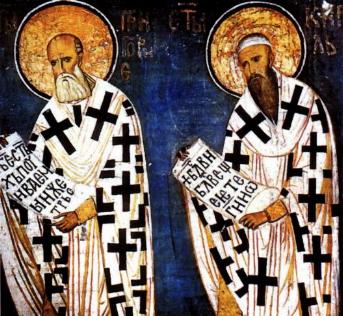
Saints Cyril and Methodius
O Cyril Methodius, glorious teachers, with brilliance you taught
the Moravians to bless God in their own words, by translating the law of the
Lord from Greek into Slavonic. You taught His righteousness. Therefore, the
Slav peoples now give glory to God in joy.
Lord, which Cyril and Methodius did to his glory? They overcame the poison of the Saracens. They tore apart the heavy nets. Their language closed the mouths of the corrupt
Khazars with the faith of the Lord. They made sweet the bitter waters and
delighted the good people that had sat in darkness.
Tone 8
Charity is the only good reason to do anything
The Cistercian
monk, philosopher and theologian Isaac of Stella (1100-1169) was featured in
the Office of Readings today: Charity is the reason why anything should be done
or left undone.
Charity is the only good reason to do anything, but it also
sometimes demands that we not do something we might think we want to do. There
are a lot of fine distinctions one has to make in this area to live spiritually
in common life and ministry. For example:
- We are called to support one another,
but not to enable maladaptive behaviors, debilitating addictions, and sins. We
must bear with the burdens of others, and be willing to wash feet, but we
should not take responsibility for the feelings of others. - We must seek ways to
invite both individuals and institutions to benefit from our strengths, and
invite them into the success that derives from them, but–again–we should be
careful not to take interior or exterior responsibility for situations that the
Holy Spirit has not, or not yet, seen fit to put in our care. - Sometimes the
greatest charity–and often the most painful–is not giving someone what he
thinks he wants. - We must be good to ourselves, practicing good self-care, but
that doesn’t mean taking it easy and just ‘being nice’ to ourselves. On the one
hand, we must not be so hard on ourselves that our whole spiritual life becomes
a rehearsal of faults and sins, for this is one of the devil’s tricks in making
us fail to notice God, and on the other we must also be careful not be overly
forgiving of ourselves so as to effectively give up struggling with certain
selfishnesses and sins. - We must practice the sort of self-charity that
nourishes our gifts and virtues, and is ruthless in the unwillingness to put up
with sin.
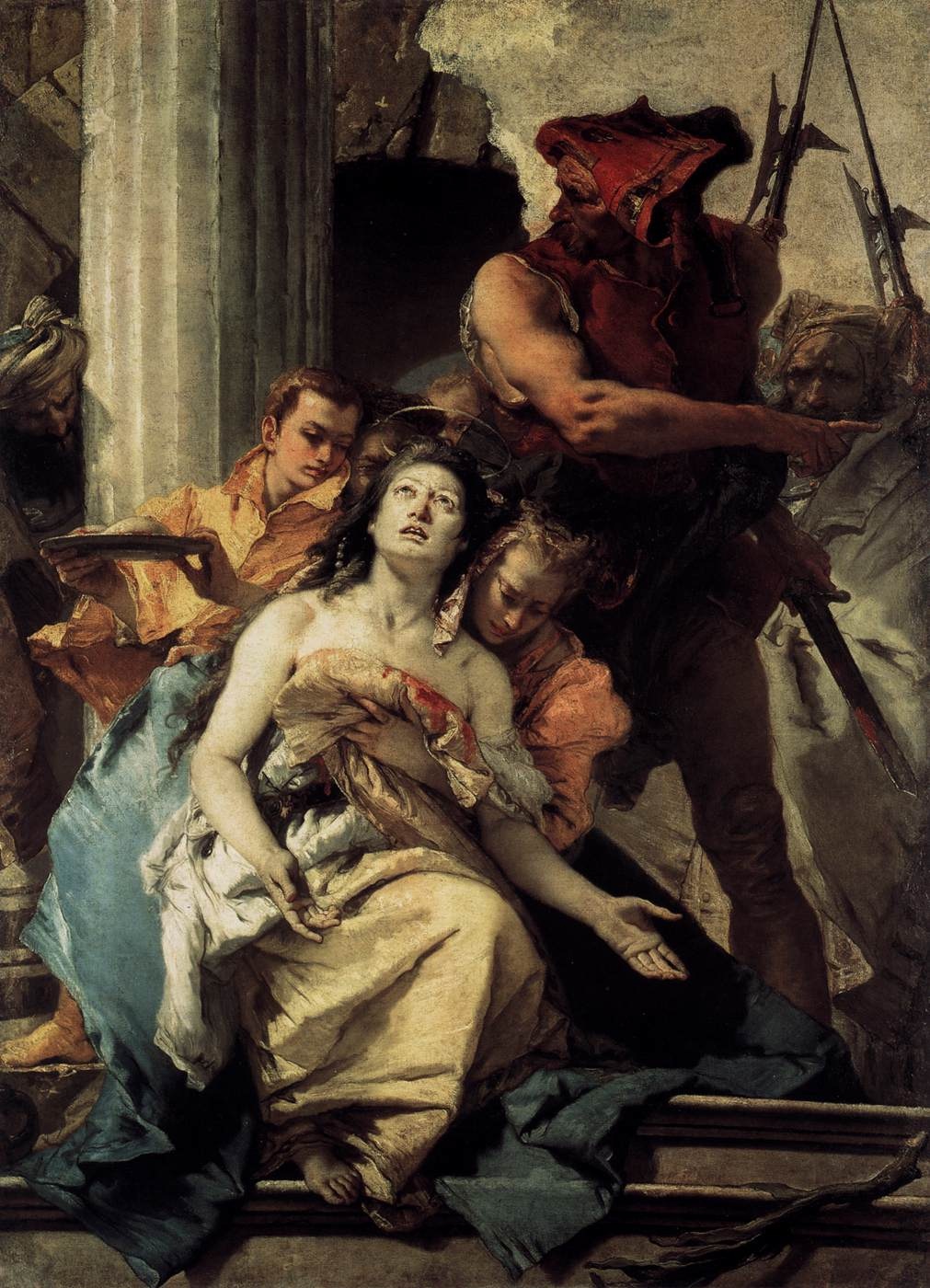
Breast cancer and St Agatha: supporting those who live with the disease
The Church has a ministry, a role, a work, in helping to restore a person to health and wholeness because the Church is the continuation of Jesus’ ministry of healing in the world today.
- curing and healing, a distinction here: we ask God for a cure, we ask also ask for a healing; the person is looking for God to bestow the grace of a comprehensive experience of restoration of body and spirit — “the whole person is helped and saved, sustained by trust in God, and strengthened against the temptations of the Evil One and against anxiety over death”; the relationship between God and the person is bridged in the sacrament;
- the gift of strengthening against debilitating effects of despair, depression, fear and anger; this Sacrament asks God for the grace to recognize and hopefully to unite any and all suffering to the experience Christ faced on the cross; the strength prayed for is not to allow illness to define their person because one’s humanity is more than a medical diagnosis;
- forgiveness of one’s sins: no human person –except Jesus (and He was also divine) and the Virgin Mary were sinless– and therefore sins are forgiven with this Sacrament; our human condition is frail and sickness can enhance the ugly side of ourselves and what we need and want is a healing of the soul; the effect of forgiveness is the reconciliation of the person to God, self and others; I think it is true that an illness has the potential to bring out of ourselves sinful attitudes, actions and patterns of speech that are not truly who we are as persons;
- a preparation for life with God, i.e., eternal life: no one is going to live for ever; perhaps the sickness is an opportunity to take stock in one’s life as it has been lived up to now and to patiently and lovingly make a life’s examination to see where there’s been love and to see where love has been absent; sickness is God’s way to call us to a deeper conversion that we’ve never experienced prior to this moment; here the Sacrament is asking us to look at our immortal soul with a degree of seriousness and the sickness as an education to greater freedom in Christ;
- conforming oneself to Christ crucified and risen: to be conformed to Christ means to adhere to Him, to listen to Him as we would listen to a loved one in friendship; there is a new reality in the life of a Christian –Jesus Christ is no longer dead, He’s risen; that Christ is risen and seated at the right hand of God the Father tells us of a new reality, a fact, in our human existence; the Sacrament brings us closer to cross Christ carried and died on and tells us that our salvation is there on the cross with Christ; we are not alone –we are with Jesus who is total love, total compassion; the healing offered in this sacrament is one of total trust and love in the One who made us, sustains us and carries us along with Him.
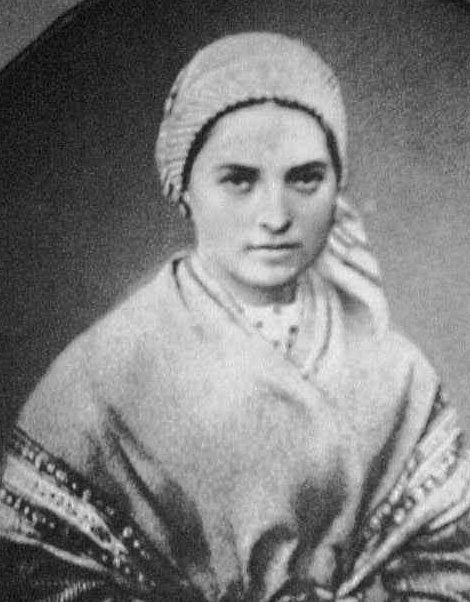
Bernadette Soubirous is the lens Communion & Liberation engages reality
The yearly Communion and Liberation Mass was celebrated earlier this evening by our friend Bishop Peter A. Rosazza, auxiliary bishop emeritus of the Archdiocese of Hartford, at Saint Mary’s Church, New Haven, CT. His homily focused on the young girl that had the vision of Our Lady of Lourdes, Saint Bernadette Soubirous.
Continue reading Bernadette Soubirous is the lens Communion & Liberation engages reality
In Christ’s wounds we are healed: World Day of the Sick and Our Lady of Lourdes
Many in the world suffer. That is a given and we ought to keep the suffering of others in the forefront of our minds. I think this is appropriate for no other reason than the example of Jesus who showed had compassion on all suffering people, healing them in body, mind, and soul. He even allowed Himself to be conquered by evil and suffering, though we know that He ultimately defeated death by death itself when on the third day he rose from the dead. Jesus’ own suffering and rising is proof of a love that knows know limits. As Benedict has said in various places that “Only a God who loves us to the extent of taking upon himself our wounds and our pain, especially innocent suffering, is worthy of faith.”
Continue reading In Christ’s wounds we are healed: World Day of the Sick and Our Lady of Lourdes
Saint Scholastica
Vocations: “…everyone will know that you are my disciples…”
Released earlier today, the Pope gave the Church his thinking and hopes for the living and the promotion of vocations. Very clear is the Pope’s insistence on one’s being familiar with the Scriptures, friendship with the Lord cultivated through personal and liturgical prayer. Also, one’s own self-awareness factors into the discernment of one’s vocation, whether to religious life, priesthood or to the lay state. May the Lord of the Harvest grant an increase.
The 48th World
Day of Prayer for Vocations, to be celebrated on 15 May 2011, the Fourth Sunday
of Easter, invites us to reflect on the theme: “Proposing Vocations in the
Local Church”. Seventy years ago, Venerable Pius XII established the Pontifical
Work of Priestly Vocations. Similar bodies, led by priests and members of the
lay faithful, were subsequently established by Bishops in many dioceses as a
response to the call of the Good Shepherd who, “when he saw the crowds,
had compassion on them, because they were like sheep without a shepherd”,
and went on to say: “The harvest is plentiful but the labourers are few.
Pray therefore the Lord of the harvest to send out labourers into his
harvest!” (Mt 9:36-38).
Continue reading Vocations: “…everyone will know that you are my disciples…”