


On the way back from Newport, Rhode Island, this afternoon, my family stopped in Noank, Connecticut for a New England lobster dinner. This is quiet New England seaside town is beautiful. As you can see, I enjoyed my lobster!
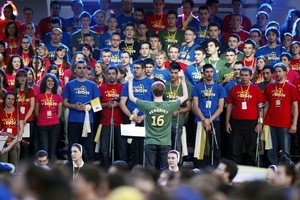
I am very glad that the first engagement of my visit should
be with you, representing as you do key sectors of Croatian society and the
Diplomatic Corps. My cordial greetings go to each of you personally and
also to the important communities to which you belong: religious, political,
academic and cultural, the world of the arts, finance and sport. I thank
Archbishop Puljic and Professor Zurak for the kind words they have addressed to
me, and I thank the musicians who have welcomed me in the universal language of
music. This dimension of universality, characteristic of art and culture,
is particularly appropriate for Christianity and the Catholic Church. Christ is fully human, and whatever is human finds in him and in his word the
fullness of life and meaning.

Continue reading Society is built upon gift of self and a well-formed conscience tells Croats, us
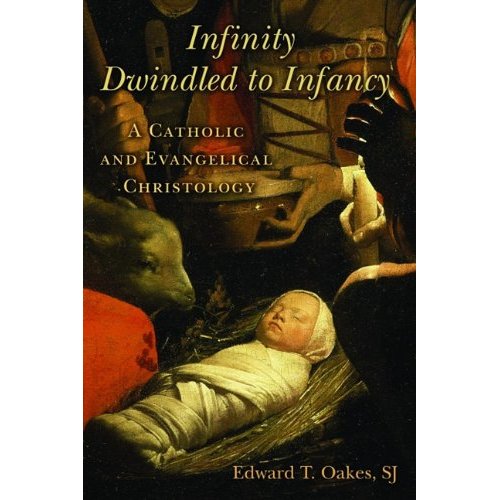
Father Edward T. Oakes, SJ, is a professor of systematic theologian teaching at Mundelein Seminary. He is a member of the some time meeting of the Dulles Colloquium (a theological discussion group that was organized by Father Richard J. Neuhaus and Cardinal Avery Dulles) and he is a member of the ecumenical theological discussion group Evangelicals and Catholics Together. Oakes is a frequent writer for First Things and several other periodicals. Oakes is the author of Pattern of Redemption and a co-editor of The Cambridge Companion to Hans Urs Von Balthasar. There are several translations done by Father Oakes of Balthasar to note.
 Pope Benedict XVI nominated as the new bishop of Aberdeen (Scotland) the Right Reverend Dom Hugh Gilbert, OSB, 59. This appointment was made public today.
 Some of senior age will remember Pope John XXIII who reigned only 5 years but did a lot in those few years: he called the 21st Ecumenical Council, aka Vatican II.
Our Lord ascended to Heaven so that the Holy Spirit
might come at Pentecost and fill the Church with His truth. The greatest art
expresses that truth and is far superior to vain “self-expression.”
John Keats said “Beauty is truth, truth beauty,” but T.S. Eliot
rightly thought that the expression was meaningless sentimentality. The
craftsman ignorant of the Creator becomes a vain aesthete expressing nothing
more than the ego. While truth is beautiful, beauty is not truth itself but
expresses that truth. In the classical tradition, beauty consists in
proportion, integrity and clarity: it is harmonious, suited to its purpose, and
intelligible. This is sublimely seen in Christ Himself, Who incarnated this
beauty as the Way (guiding to a harmony of virtue) and the Truth (revealing
God) and the Life (enlightening with creative love). St. Macarius, an Egyptian
monk of the fourth century said, “The soul which has been fully illumined
by the unspeakable beauty of the glory shining on the countenance of Christ overflows
with the Holy Spirit . . . it is all eye, all light, all countenance.”
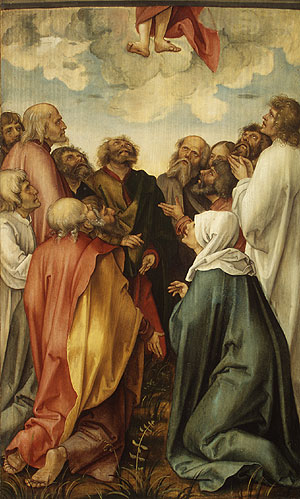
“He in fact came
to the world to bring men back to God, not on the level of ideas – like a
philosopher or master of wisdom – but really, as a shepherd who wants to lead
his sheep back to the fold . . . It is for us that he came down from Heaven,
and it is for us that he ascended there after making himself like men in all
things, humiliated to the point of death on the cross, and after touching the
abyss of the greatest separation from God”.
“And what does man need more in
every age if not this: a solid anchoring for his existence? After the Ascension
the first disciples remained gathered together in the Cenacle around the Mother
of Jesus, in fervent expectation of the gift of the Holy Spirit, promised by
Jesus (cf. Acts 1:14)…. [this divine invitation is offered to us] “to remain
united together in prayer, to invoke the gift of the Holy Spirit. In fact, only
to those who ‘are born again from above,'”, that is, of the born of the Holy
Spirit.
Pope Benedict XVI, Ascension, 2008
Stats for those living with HIV-AIDS is somewhere around 33 million, records the World Health Organization (WHO). Recently, the HIV-AIDS epidemic was studied at a Rome conference hosted by the Holy See and the Good Samaritan Foundation. The conference was titled “The Centrality of Care for the Person in the Prevention and Treatment of Illnesses caused by HIV and AIDS.”
Various experts and Vatican officials, including the Pope’s Secretary of State, Cardinal Tarcisio Bertone, where he said that our work ought to be centered on the patient in way that a holistic approach is followed: the whol person and not only the disease needs to competent assistance and friendship. Experts from 26 countries attended the conference.
It is estimated that there are some thing like 117,000 health centers across the globe that treat AIDS patients. With all the money wasted on frivolous things, the WHO said their research revealed that in 2009 about $16 million was used for AIDS research and treatments. Problems exist in medical care and safety because only 35 percent of patients in third world countries have access to treatment. Do the math: roughly 10 million people don’t have access to any type of medication and proper health care.
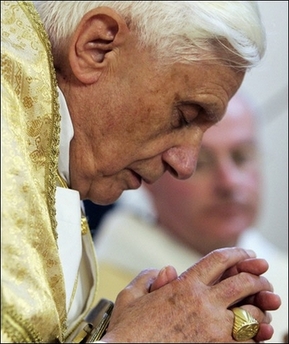
The general intention
That priests, united to the Heart of Christ, may always be true witnesses to the caring and merciful love of God.
The missionary intention
That the Holy Spirit may bring forth from our communities many missionaries who are ready to be fully consecrated to spreading the Kingdom of God.
When the bishop of a diocese celebrates the Chrism Mass during Holy Week each year he does two things: he blesses and consecrates the holy oils used for the sacraments and he leads the assembled priests in the “Renewal of Commitment to Priestly Service.” The laity are asked by the bishop to pray for their priests asking “the Lord to bless them with the fullness of his love, to help them be faithful ministers of Christ the High Priest, so that they will be able to lead” the faithful to their eternal destiny: life with the Most Blessed Trinity.