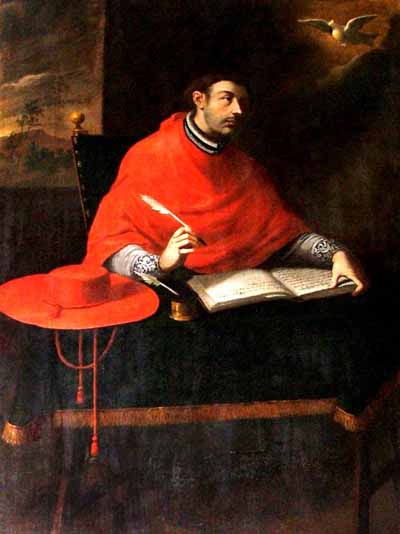
Saint Bonaventure
Grant, we pray, almighty God, that, just as we celebrate the heavenly birthday of the Bishop Saint Bonaventure, we may benefit from his great learning and constantly imitate the ardor of his charity.
Pope Benedict gave these 3 addresses on March 3, March 10, and March 17. Read these Wednesday audience addresses if you are serious about Saint Bonaventure!
My friend Father Charles at A Minor Friar has a brief thought on this great Franciscan friar, doctor, bishop of the Church.
Truly an ecumenical approach born from the good news of Christianity
The head of the Communion and Liberation Movement, Father Julián Carrón wrote an editorial for tomorrow’s (July 14, 2011) edition of the L’Osservatore Romano about the forthcoming Day of Prayer in Assisi on October 27, recognizing the theme of peace and justice.
The Day for
Reflection, Dialogue and Prayer for Peace and Justice in the World, convoked in
Assisi next October 27 by Benedict XVI is an audacious gesture, just as Blessed
John Paul II’s initiative was, 25 years ago.
“In the name of what can (Pope
Wojtyla) call exponents of all religions together to pray in Assisi?” asked Don
Luigi Giussani twenty-five years ago. He answered, “If one understands the
nature of man, the heart of man, it is his religious sense, it is in the
religious sense that all men find equality and identity. The most profound
meaning in the human heart is religious sentiment, destiny on the one hand and
the usefulness of the present on the other. If we want to use the right terms,
a sense of religion is the only sense which is truly catholic, which means
suitable for everyone and belonging to everyone.”
Continue reading Truly an ecumenical approach born from the good news of Christianity
Fisichella’s Metropolitan mission to secularized cities
Rino Fisichella, the archbishop who head’s the Pope’s evangelization office has rolled out his newest, that is, the first, endeavor since the founding of the office in the July 12 L’Osservatore Romano. They’re calling it the “Metropolitan
mission” The goal is simple:
To avoid the
risk of the new evangelization becoming just another formula adapted for every
season, it is important that it be filled with content which informs the
pastoral action of the different Christian communities. In this sense, everyday
pastoral work, which has always animated the life of the Church, must renew its
ways of presenting itself and implementing its activities.
Benedict XVI,
speaking to the first plenary assembly of the Pontifical Council for Promoting the New Evangelization, said that it was of decisive importance to go beyond
the fragmentation of society and offer concrete answers to the great challenges
of today. To fill this need, a “metropolitan mission” has been put into action.
The goal is simple: to give a sign of unity among the diverse dioceses present
in the largest European cities that have been particularly affected by
secularization.
Continue reading Fisichella’s Metropolitan mission to secularized cities
Saint Henry: Benedictine Oblate and patron of sovereign leaders
The Church recalls the witness of an emperor and a Benedictine Oblate, Saint Henry (972-1024), Duke of Bavaria. Henry was crowned king in Rome by Pope Benedict VIII in 1014. It is said that Henry was assisted by the saints throughout his life but especially at Mass when he was anointed king. He was an insightful leader, lay man who had concern for the discipline of the Church and who had love for the Benedictine monastic life. He was a supporter of Cluny’s reforms. It was through Saint Henry that the King of Hungary and later saint, Stephen, met Christ and was baptized.
The promise made by Christ: error won’t prevail

Continue reading The promise made by Christ: error won’t prevail
St Basil’s Cathedral at 450
Understanding Saint Benedict
“St. Benedict’s is best understood as the spirituality
of ordinary life… The Benedictine is a spirituality of work: man’s by labor,
God’s by prayer.” (John Senior)
understand in depth his personality and life, he can find in the disposition of
the Rule the exact image of all the actions of the master, because this saintly
man is incapable of teaching other than he lived.” (Saint Gregory)
A bold abbot, Communion and Liberation, the BVM and Saint Benedict
Today is the 31st anniversary of the foundation of Fraternity of Communion and Liberation. The narrative of the Fraternity’s founding is told in “The Greatest Grace in the History of the Movement” by Giorgio Feliciani (Traces, February 2007). Here’s the story.
A priest in the direct service of the Holy See, Monsignor Mariano De Nicolò, currently Bishop of Rimini [he retired 3 July 2007], happened to review, as part of his official duties, a file that illustrated and documented the Movement’s desiderata. Feeling that these aspirations deserved attention and further study, he suggested to Father Francesco Ricci, who at the time was sharing responsibility for the Movement with Father Giussani [for more about this priest, who died in 1991, see Francesco Ricci. Una passione, cento passioni,
San Martino in Strada, Lit. Citienne, 1996], that he consult with Monsignor Giuseppe Lobina, an expert in Canon Law who, along with a solid formal training, had an unusual amount of experience with ecclesiastical praxis.
This advice was promptly taken and, only a few months later, Monsignor Lobina, after acquiring all the necessary information in various meetings with CL figures and Father Giussani himself, was drawing up what would soon be the Statute of the Fraternity, which has remained largely unchanged up to now.
Monsignor Lobina also undertook to find the ecclesiastical authority willing to approve the Movement, and found him in Abbot Martino Matronola, who, as provost [abbot] of the monastery of Montecassino, had the same powers over the surrounding territory as the bishop of a diocese. This acceptance was even more welcome because Father Giussani felt that the concept of his Movement was very close to that of the Benedictines (see Giussani, op.cit., pp. 74-75).
The formal establishment of the Fraternity came shortly thereafter in a very discreet, unassuming way. On July 11, 1980-the solemnity of Saint Benedict, Patron of Europe, on the fifteenth centenary of his birth-a small group of twelve stood together with Father Giussani in front of the Abbot to be constituted as a canonical association. On that same day, Monsignor Matronola,* by a specific formal decree, granted juridical status in the Church to the ecclesial movement called “Fraternity of Communion and Liberation” and approved its statutes and “works of apostolate and individual and social formation,” placing it under the “protection of the Immaculate Virgin and our Patron Saint Benedict” (see the Bollettino Diocesano di Montecassino, no. 3, 1980, pp. 223-224).
Thus, the Fraternity was born as a reality in the Church, recognized to all effects by the ecclesiastical authority and by virtue of this formal empowerment to act, in communion with its respective bishops, not only in Montecassino but also in the other dioceses. Indeed, in the same decree, the Abbot expressed his “fervent wish that wherever the Association exercises its apostolic activity, it may be benevolently welcomed, aided, and encouraged by their Excellencies the Ordinaries.”…
Despite the lack of any kind of organized promotion, adherence to the Fraternity was growing rapidly, to the point that within a year the number of members went from the original 12 to almost 2,000. …
The Abbot of Montecassino was certainly aware that his decree would provoke harsh criticism from those bishops who did not view CL with a favorable eye. One of the leading figures in the Italian Bishops Conference went so far as to state that the decree had been illegally extorted from him. And, realistically, an attentive Canon lawyer noted, “The Abbot of Montecassino was brave (some would say bold) to approve an association that is not diocesan, but evidently multi-diocesan.” In this situation, the recognition generously and courageously granted by the Abbot of Montecassino was no longer sufficient to give the association a juridical form that corresponded with its actual reality. By now, the approval of a higher authority was needed, which could only be the Holy See, and more specifically the Pontifical Council for the Laity, the dicastery set up by Pope Paul VI to handle matters concerning the participation of the laity in the life and mission of the Church.
Consequently, as early as April 7, 1981, less than a year after the decree issued by the Abbot of Montecassino, Father Giussani, with the continued encouragement and advice of Monsignor Lobina, sent the President of the Council, at that time Cardinal Opilio Rossi, a formal application for pontifical recognition of the Fraternity. …
In the end, the Holy Father, John Paul II himself, intervened: after being fully informed about the question, he encouraged the Pontifical Council to proceed to grant the desired approval without further delay (according to the Decree of the Pontifical Council for the Laity, p. 235).
Thus, we come to the Decree, issued on February 11, 1982, the liturgical feast of Our Lady of Lourdes, which “establishes and confirms as a juridical entity for the universal Church” the Fraternity, “declaring it to all effects an Association of Pontifical Right and decreeing that it be recognized as such by all.”
As is known, February 11, 1982, the Feast of Our Lady of Lourdes, is recognized as the establishment of the Fraternity of Communion and Liberation. It is this date that CL prays the Mass for the good of the Fraternity. Historically, as noted above, the Archabbot of Monte Cassino, on Saint Benedict’s 1500th birthday, recognized the CL as an ecclesial movement, an act that caused much criticism for being perceived as taking authority not his own. Two years later Pope John Paul II addressed the criticism, and on the feast of Our Lady of Lourdes had the Fraternity of Communion and Liberation recognized by the Pontifical Council for the Laity under the leadership of Opilio Cardinal Rossi. Hence, Our Lady of Lourdes and Saint Benedict are patrons of the Fraternity Communion and Liberation.
*Martino Matronola (1903-1994) was born in Cassino, Italy, the city below the great Benedictine abbey of Monte Cassino where he was elected the archabbot in 1971 and appointed bishop in 1977. The Abbey of Monte Cassino is known as the archcoenobium because it is the one of the monasteries founded Saint Benedict; the abbey is also distinguished for being an abbey-nulius (a territorial abbey, meaning the abbey is responsible for a number of parishes). Therefore, the man elected the archabbot of Monte Cassino is also the Diocesan Ordinary of the Diocese of Cassino which has 53 parishes, 68 priests and 79,000 faithful to care for (according to 2004 stats). He retired from the position of abbot-bishop of Monte Cassino in 1983.
A Benedictine’s art collection
Benedictine culture is very interesting. I find this to be true for 2 reasons: after 1500 years of Benedictine monasticism a refined style of humanity and relationship with God is constitutive and monasteries have interesting people as monks and nuns. The famous Rule of Saint Benedict encourages the monk to praise and worship God through a proper ordering of life and interest. Few Benedictines I know are not proficient in works of culture (in the true meaning of the word) like music, vestment making, bee keeping, keeping the library, preparing good lessons for the classroom, cooking, music writing, preaching, study and the like.