This is old news by now, and yet it bears keeping in mind that one of the world’s longest serving abbot, Benedictine Father Abbot Matthew Leavy, OSB, PhD, will retire as the 4th abbot of Saint Anselm’s Abbey in Manchester New Hampshire after 26 years of service to his monastic community, Saint Anselm’s College, and the Church in the Diocese of Manchester.
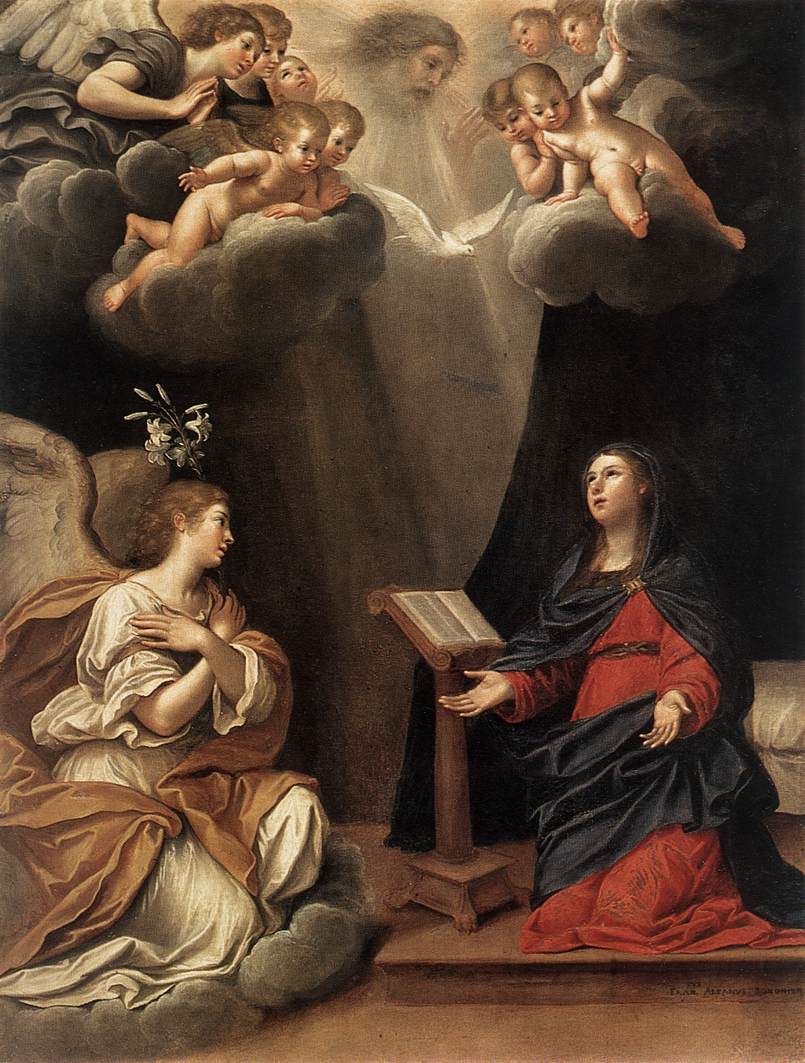
The Annunciation of the Lord
The mystery of the annunciation to Mary is not just a
mystery of silence. It is above and beyond all that a mystery of grace.
feel compelled to ask ourselves: Why did Christ really want to be born of a
virgin? It was certainly possible for him to have been born of a normal
marriage. That would not have affected his divine Sonship, which was not
dependent on his virgin birth and could equally well have been combined with
another kind of birth. There is no question here of a downgrading of marriage
or of the marriage relationship; nor is it a question of better safeguarding
the divine Sonship. Why then?
and see that the mystery of Mary is prepared for at every important stage in
salvation history. It begins with Sarah, the mother of Isaac, who had been
barren, but when she was well on in years and had lost the power of giving life,
became, by the power of God, the mother of Isaac and so of the chosen people.
process continues with Anna, the mother of Samuel, who was likewise barren, but
eventually gave birth; with the mother of Samson, or again with Elizabeth, the
mother of John the Baptizer. The meaning of all these events is the same: that
salvation comes, not from human beings and their powers, but solely from
God–from an act of his grace.
for Every Day of the Year (1992), 99-100.
The authentic Church is an extension of Good Samaritan today
At Vespers
(evening prayer) with the gathered bishops of Latin America at the
Cathedral-Basilica of Our Lady of Light, (Leon, Guanajuato, Mexico) this evening the Holy
Father address the following homily. His thoughts turn our attention to a
deeper fidelity in belonging to Christ, being true in communion with others,
rooted and ground in Love. The homily is terrific, he hits on some real significant issues that concern the Catholic Faith and the promotion of Justice. But I can’t help thinking that the Pope is treating this pastoral visit as a giant Ad limina.
It gives me great joy to be able to pray with all of
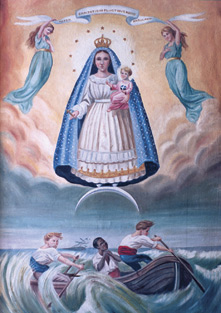
you in this Basilica-Cathedral of León, dedicated to our Lady of Light. In the
lovely painting venerated in this basilica, the Blessed Virgin holds her Son in
one hand with immense tenderness while extending her other hand to succour
sinners. This is how the Church in every age sees Mary. We praise her for
giving us the Redeemer and we put our trust in her as the Mother whom her
divine Son bequeathed to us from the Cross. For this reason, we invoke her
frequently as “our hope” because she has shown us Jesus and passed down to us
the great things which God constantly does for humanity. She does so simply, as
a mother teaches her children at home.
A decisive sign of these great things is
given to us in the reading just proclaimed at these Vespers. The people of
Jerusalem and their leaders did not acknowledge Christ, yet, by condemning him
to death, they fulfilled the words of the prophets (cf. Acts 13:27). Human evil
and ignorance simply cannot thwart the divine plan of salvation and redemption.
Evil is simply incapable of that.
Continue reading The authentic Church is an extension of Good Samaritan today
Christ alone can give life in its fullness; what is needed is a pure heart, Pope tells us
An excerpt of the Pope’s homily delivered early today in Mexico. What does it mean to be pure of heart? Why do I want a purity of heart?
God” (Ps 50:12) during the responsorial psalm. This exclamation shows us
how profoundly we must prepare to celebrate next week the great mystery of the
passion, death and resurrection of the Lord. It also helps us to look deeply
into the human heart, especially in times of sorrow as well as hope, as are the
present times for the people of Mexico and of Latin America.
heart that would be pure, sincere, humble, acceptable to God was very much felt
by Israel as it became aware of the persistence in its midst of evil and sin as
a power, practically implacable and impossible to overcome. There was nothing
left but to trust in God’s mercy and in the hope that he would change from
within, from the heart, an unbearable, dark and hopeless situation. In this way
recourse gained ground to the infinite mercy of the Lord who does not wish the
sinner to die but to convert and live (cf. Ez 33:11). A pure heart, a new
heart, is one which recognizes that, of itself, it is impotent and places
itself in God’s hands so as to continue hoping in his promises. Then the
psalmist can say to the Lord with conviction: “Sinners will return to
you” (Ps 50:15). And towards the end of the psalm he will give an
explanation which is at the same time a firm conviction of faith: “A
humble, contrite heart you will not spurn” (v. 19).
Annunciation of the Lord
Mary would never see the world in the same way again because she had conceived beneath her heart, The Word, the Son of God made flesh within her. The Word from the mind of God now in her being…She would now have to see everything through the eyes of that Word and everything would change. “Nothing would again be causal and small, but everything with light invested,” (J. Duffy, “The Annunciation”). Christ, the Light of the World.
The Papal cane
Walter Ciszek’s advances incrementally to sainthood
Moving around the circles of the Catholic press is the noteworthy acceptance as valid of the cause of beatification and canonization of Father Walter J. Ciszek, SJ, (1904-84) by the Holy See’s Congregation for the Causes of Saints.
Continue reading Walter Ciszek’s advances incrementally to sainthood
Saint Benedict
Stir up in your Church, O Lord, the spirit that animated our Father Saint Benedict, that filled with this spirit we may learn to love what he loved and practice what he taught.
Today is the commemoration of the passing of Saint Benedict (known also as the Transitus of Saint Benedict). The monks of Montecassino noted the serenity of his death making him a patron, an advocate for the dying. We attribute something similar to Saint Joseph, whom we celebrated on the 19th.
Those who wear the “St Benedict Medal” will notice on the margin encircling the image of Benedict the Latin words: Eius in obitu nostro præsentia muniamur (May we be strengthened by his presence in the hour of our death)!
I might note, the Medal of Saint Benedict is THE most indulgenced medal the church has and the proper blessing of the medal contains an exorcism. Because of the Saint’s love of the Cross and his fighting of Satan, the medal has been known to protect against evil.
Tradition holds,
Six days before he died, Benedict gave orders for his tomb to be opened. Almost immediately he was seized with a violent fever that rapidly wasted his remaining energy. Each day his condition grew worse until finally, on the sixth day, he had his disciples carry him into the chapel where he received the Body and Blood of our Lord to gain strength for his approaching end.
Then, supporting his weakened body on the arms of his brethren, he stood with his hands raised to heaven and, as he prayed, breathed his last.
Pope Saint Gregory the Great, Dialogues, book 2, c. 37.
The feast celebrate today is not so much a feast about the advocacy of a good death –an important aspect of our Christian life life– as much as it is to hold before our eyes an authentic witness to Jesus Christ and His Gospel. No other saint of the Church as affected the world as Saint Benedict has.
Most holy confessor of the Lord, Saint Benedict, Father of monks and nuns, guide and intercede for the salvation of us all.
Compunction awakens our soul
Compunction involves a moment of awakening, the first
glimmer of enlightenment, the dawning of a new day lived against a different
horizon. St. John Cassian, one of Benedict’s principal sources, defines
compunction as whatever can by God’s grace waken our lukewarm and sleepy souls
(Conferences 9:26)
lives in a slumberous state of half-wakefulness. The grace of compunction is
the transition to a state of fuller awareness.
saints and the rest of us is that they were spiritually awake more of the time
than we are; they were alert to possibilities. It is because they went through
life in a state of greater consciousness that they were more conscientious in
doing good and avoiding evil.
and omissions admire their saintly deeds but without necessarily realizing that
perhaps we could imitate them more closely if our spiritual senses were not so
drowsy
Stand up for religious freedom: Connecticut takes a stand against HHS
Rallies will be
taking place all over the country this Friday, March 23rd, to voice concerns
over the HHS mandate. Visit online: Stand Up for Religious Freedom.
Thousands of Americans of all faiths will be
participating in these peaceful rallies, organized by the Pro-Life Action League and Citizens for a Pro-Life Society to oppose
the new mandate from the U.S. Department of Health and Human Services (HHS) which
is requiring all employers provide free contraceptives, sterilization and
abortion-inducing drugs through their health plans, even in violation of their
consciences.
Locally, Connecticut as two notable rallies: New Haven and
Hartford beginning at noon and will last approximately one hour.
Women are
invited to voice their concern and support for freedom at Women Speak for Themselves.