A new CFR priest! Father John Paul

Fr John Paul CFR bestows blessing.jpg

The newly ordained (19 May 2012) Franciscan Friar of the Renewal Father John Paul offers a blessing. Brother Luke Mary is assisting. Father John Paul’s ordination happened at Saint Patrick’s Cathedral (NYC). Father John Paul will serve his community as the vocation director. Saint Francis pray for us.
Photo: Fr Sweeney

A blessing of a priest

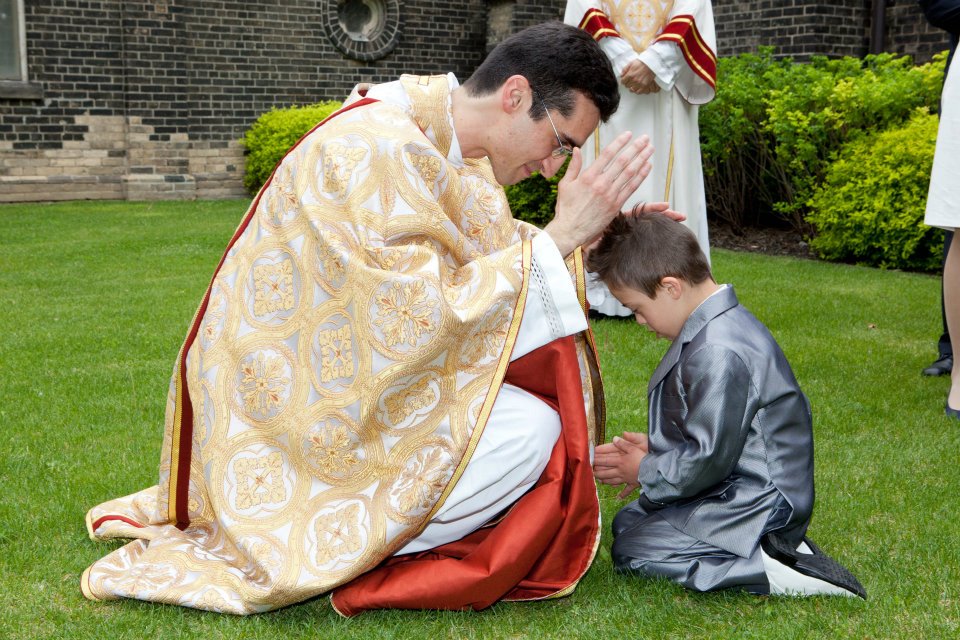
New Toronto priest blesses child May 2012.jpgThe late spring months have a few notable celebrations: the continuation of the Easter Mysteries like the Ascension and Pentecost, Corpus Christi, Mother’s and Father’s Day, and priesthood celebrations. Nothing moves the heart spiritually, that is, than witnessing the blessing of a newly ordained priest. Here a newly ordained priest of Toronto bestows God’s blessing on a little one…

Pray for Mary’s intercession for priests….

The Lord waits to be gracious

God’s providence means that wherever we have got to, whatever we have done, that is precisely where the road to heaven begins. However many clues we have missed, however many wrong turnings we have taken, however unnecessarily we may have complicated our journey, the road still beckons, and the Lord still ‘waits to be gracious’ to us.

Father Simon Tugwell, OP

Saint Pachomius


St Pachomius.jpegThe Church gives us Saint Pachomius (+346), the Egyptian monk and abbot famous for being the “founder” of community-focussed monasticism (cenobitic) thus offering an new pattern of following Christ as a monk that up until Pachomius, one did alone. 200 years later Saint Benedict brought this version of monastic life in general acceptance in the west, drawing on what this sainted abbot first done. He’s known, too,  for his writings titled “Koinonia” (in Latin, Communio).  He wrote: 


“Brothers, as long as you have breath
in your bodies, strive for your salvation. Before the hour comes in which we
shall weep for ourselves, let us practice virtue eagerly.”

The Church prays…

O God, Who didst raise
the blessed abbot Pachomius to the heights of doctrine and of virtue, grant that
we, by following his example, may seek before all else the bread of Thy Word: light
for our minds, and stillness for our hearts.

Blessing of a Child in the Womb

Virgin and Child.jpg

The US Bishops composed and received approval of a ritual that invokes God’s blessing upon the child in the womb. The idea came from Archbishop Joseph Kurtz when he was the bishop of Knoxville several years ago. What better way to observe Mother’s Day in the USA than for us to be in prayerful solidarity with expectant mothers!

As the Introduction to this rite, the Bishops write that 

“The Church welcomes with joy and compassion the mothers who, recognizing that all life is a gift from God, come to the Church seeking a blessing for their unborn child. Such a blessing sustains the parents by imparting grace and comfort in time of concern and need, unites the parish in prayer for the unborn child, and fosters respect for human life within society.”

Here’s the key prayer: 


Continue reading Blessing of a Child in the Womb

Hildegard of Bingen: the reliable witness

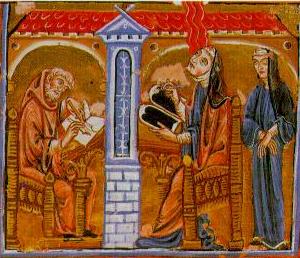
hildegard.jpgSaint Hildegard of Bingen is getting some press these days. Many are very curious to know how and why the Pope did such an unusual thing in making her cult as concrete as possible. Being inscribed as a saint in the album of the saints is pretty concrete, I’d say.

The Church’s official teaching is seen by the use of concepts like “extension of Hildegard of Bingen’s cult to the entire Church,” meaning that she is proposed as a model of holiness with moral certainty to the faithful. Remember, only the Blessed Trinity is worshiped at the Liturgy. Saints and Blesseds are venerated, honored. Not the same. Hence, the definition of “cult” in Catholic theology is that the veneration saints particularly at the sacred Liturgy (i.e., the worship of God at Holy Mass, Lauds and Vespers) is made possible by the Church recognizing that this person is with God in heaven and is a reliable witness for Christian living.

For a long time Hildegard’s been called “saint.” And, so, some may say, “It’s about time” the Church made this fact official. Perhaps it wouldn’t make a difference if she was officially added to the canon of saints, but there is a certain relief that the Church has settled the cause. It has to be acknowledged that in the 800+ years since Hildegard’s death, her cause for canonization must be one of the higher profile ones around. And for whatever reason Hildegard’s cause wasn’t completed until recently. What we’ve been given by the Tradition is that Hildegard has been known as a saint, her writings, and her many ecclesial contributions are well-regarded. It is also well-known that the Pope has spoken eloquently of Hildegard a few times in the past years; hence he decided to end the ambiguity of her ecclesial status, writing her name “in the album of the saints.” Some would say that Benedict’s gesture rehabilitates Hildegard’s place in Church and state. While that may be an overstatement, he did “do good by her.”

Our newest saint is revered by the Anglo-Catholics, so this is another point of connection with those who hold the Anglican patrimony in high esteem.

You may want to read Nathaniel M. Campbell essay on his blog Fides Quaerens Intellectum.

Some things to read:

Augustine Thompson, OP, “Hildegard of Bingen on Gender and the Priesthood”

Dr. Leroy Huizenga’s First Things essay published, Hildegard of Bingen: “Saint of the Universal Church“.

On the image above: Hildegard von Bingen with Richardis von Stade (right) and Volmar (left). Miniature painting, c. 1230; Lucca, Biblioteca Statale

The Holy Spirit… the most precious gift, that personal love

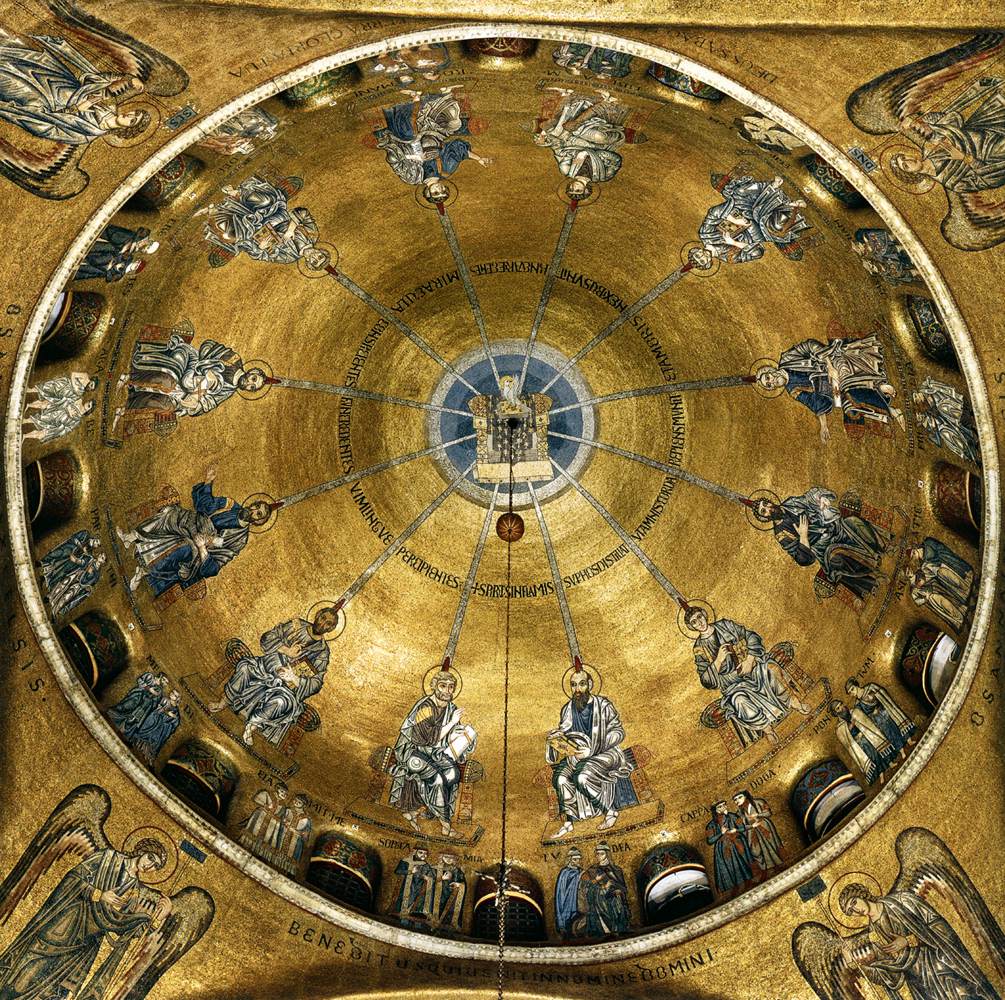
We are fast approaching the great feast of the Pentecost, the outpouring of the Holy Spirit upon those who follow Christ. This feast, like all others we observe in the liturgical life of the Church, is not about an event of 2000+ years ago but an experience of great proportions evidenced today. Yes, we remember liturgically the first event (anamnesis) but it is a remembrance that spills into today’s context. Attentive to our sacred Liturgy, we see that one piece of Scripture interprets another, one liturgical observance of Sunday (or daily) sheds light on another. Pentecost is coming  in two weeks and last Sunday the Church gave us a foreshadowing of a future gift. Below is an excerpt of a homily delivered by an American Benedictine monk in Italy giving us “taste” of what’s coming. These paragraphs are presented for our lectio.
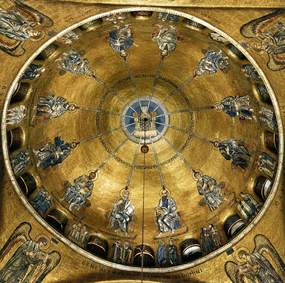

Basilica San Marco.jpg

The departure of Jesus in terms of his bodily presence, therefore, is not a reason to be sad; instead, it is a cause of great joy.  And this is exactly what the Lord promises when he says: “I tell you the truth; it is to your advantage that I go away, for if I do not go away, the Counselor will not come to you; but if I go, I will send him to you” (Jn 16:7).


Christ sends us the Counselor, that is the Holy Spirit, in union with his Father.  In fact, the Holy Spirit is the special promise of the Father (cf. Acts 2:33; Eph 1:13; Lk 24:49), the gift which allows us to know him more intimately, “for the Spirit searches everything, even the depths of God” (1 Cor 2:10).  The good fathers of this world show their goodness towards their children giving them the most precious gift, that of personal love.  The Lord says to earthly fathers: “If you then, who are evil, know how to give good gifts to your children, how much more will the heavenly Father give the Holy Spirit to those who ask him!” (Lk 11:13).  Given that “every good gift and every perfect gift is from above, coming down from the Father of lights” (Jas 1:17), as we heard in today’s epistle [May 9, 2012], it is clear that the best gift that the Father can bestow is that of his Holy Spirit, through whom the Father and the Son are able to dwell in us (cf. Jn 14:23).

How eager, therefore, should we be to receive this Spirit! O how we should implore the Father for this perfect gift!  We should say, therefore: Come, Holy Spirit!  Fill the hearts of thy faithful and kindle in them the fire of your love. Send forth thy Spirit and they shall be created, and you shall renew the face of the earth. Amen.

Father Basil Nixen, OSB

9 May 2012
Monastery of Saint Benedict

Norcia, Italy