The monks of Saint Meinrad Archabbey are gaining traction in the use of social media to promote prayer, the monastic life and ecclesial service.
Discretion keeps the practice of virtue between extremes
The daily grind of living is only made more fruitful when we take time to use the gifts of the Holy Spirit. While not technically not one of the Seven Gifts of the Holy Spirit, Prudence (a cardinal virtue) is perfected by the Spirit’s energy. How often do we move through our day without giving time to self-awareness, reflection on our “I” in action? The lack of a Trinity-diven examination of conscience in one’s spiritual life is a pitfall many post-moderns fall into. Any person wanting to know more about him or herself needs to spend time, if only 10 minutes a day, in reviewing points of grace and sin in life up to that point of the day while asking for the grace of root-and-branch conversion. For example, it is has been said that a measure of the person today is how he or she uses free time. Discretion is a fruit of the virtue of prudence; ask yourself if you have been sufficiently discrete in your undertakings.

Spiritual infirmities such as tepidity are caused, not only by chills but also by fevers, that is, by excessive zeal. Saint Paul says, let your service be a reasonable service [Rom. 12:1], because he knew the truth of the words of the Psalmist, the king in his might loves justice [99:4], that is, discretion; and what was prefigured in Leviticus, whatsoever sacrifice you offer, you shall season it with salt [2:13]. In the same vein does Saint Bernard speak: the enemy has no more successful ruse for depriving the heart of real charity than to get him to act rashly and not in keeping with spiritual reasonableness. “Nothing in excess,” said the philosopher. And this principle should be our guide even in a matter pertaining to justice itself, as we read in Ecclesiastes, be not over just [7:16]. If one fails to observe this moderation, he will find that good is turned into evil and virtue into vice. He will also learn that many inconveniences follow which are quite contrary to the purpose of the one who so acts.
The first is that God is not really served in the long run, as the horse worn out in the first days does not as a rule finish the journey, and thus it happens that someone must be found to care for it.
Second, gains that are made through such excessive eagerness do not usually endure, as Scripture says, wealth gathered in haste will dwindle [Prov. 13:11]. Not only dwindle, but it may be the cause of a fall: and he that is hasty with his feet shall stumble [Prov. 19:2]; and if he stumbles, the further he falls, the greater the danger for he will not stop until he has reached the bottom of the ladder.
Third, there is the danger of being careless in overloading the vessel. There is danger, of course, in sailing it empty, as it can then be tossed about on the waves of temptation; but there is also danger of so overloading it that it sinks.
Fourth, it can happen that, in crucifying the old man, the new man is also crucified and thus made unable through weakness to practice virtue. Saint Bernard tells us that because of this excess we lose four things: “The body loses the effect of the good work, the soul its devotion, our neighbor good example, and God His honor.” From this we infer that whosoever thus mistreats the living temple of God is guilty of sacrilege. Saint Bernard says that the neighbor is deprived of good example, because the fall of one and the ensuing scandal are a source of scandal to others; and he calls them, in cause at least, disturbers of unity and enemies of peace. The example of such a fall frightens many and makes them tepid in their spiritual progress. In the fallen there is danger of pride and vainglory, since they prefer their own judgment to the judgment of everyone else, usurping what is not their own by setting themselves up as judges in their own cause when the rightful judge is their superior.
Besides these, there are also other disadvantages, such as overloading themselves with weapons which they cannot use, like David with the armor of Saul [1 Sam. 17:38-39]. They apply spurs to a spirited horse rather than the rein. Therefore there is need of discretion on this point to keep the practice of virtue between both extremes. Saint Bernard gives this advice: “Good will is not always to be trusted, but it must be bridled, regulated, especially in beginners,” if one wishes to benefit others without any disadvantage to himself, for he that is evil to himself, to whom will he be good? [Sir. 14:5].
Saint Ignatius of Loyola
Letter to the Fathers and Brothers studying in Coimbra, Portugal
May 7, 1547
The obligation to love
other, but also to make ourselves as lovable as possible so that it is easy for
others to love us.”
Prime Minister Cameron’s former girlfriend became a Benedictine nun
One of the US’s monasteries of Benedictine nuns is getting a lot media attention lately. Regina Laudis Abbey (Bethlehem, CT) is now recognized by the European Catholic press for a story written by Mauro Pianta for the Vatican Insider, “U.S.: Cameron’s former lover becomes cloistered nun.” Mr. Pianta tells of the UK’s Prime Minister David Cameron’s former very beautiful girlfriend who found her vocation in the American abbey after a conversion in her life. Sister John Mary known in history as Laura Adshead left the world to follow Christ. Let’s note, however, Sister John Mary has been at the Abbey for four years, now. So this story is not exactly new, but it is good to know that smart women still follow the Lord’s call.
St Scholastica Priory Petersham, MA announce a vocation weekend
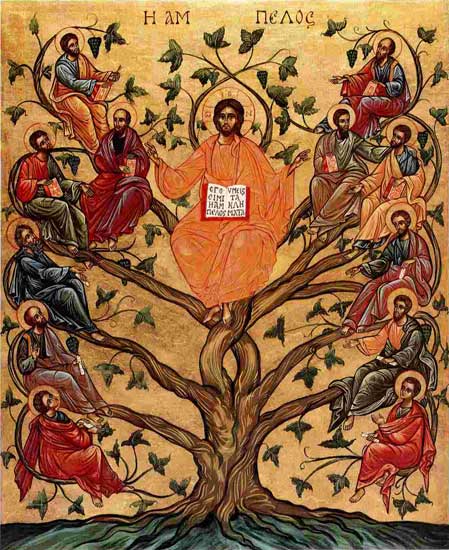
Jesus is the true vine
Saint John’s gospel uses the agricultural image of vine and a vine dresser to express a relationship that is unique. Quite singular when you think that neither the Jews nor the Muslims would admit in terms of intimacy between the Creator and creature, Father and Son, God and me. So, why is Christ called the ‘true vine‘ and why are we his ‘branches’? The short answer is because it is our Christian belief, our Christology, that God is waiting for humanity to bear fruit, sin notwithstanding. The Incarnation, and the proclamation of the Good News tells us of the wine of love, obedience and prayer with the goal of uniting God and humanity in a truer way.
That we are expected to “bear much fruit”
and to rely on the Lord for all things there is a hope that we
remain in Him and that His “words remain in you“. There is a dependence on God in a radical manner that is unheard of in most of relationships. To remain, to abide, to stay close to Jesus is the key of the spiritual life. Not to remain in Christ is reject the offer of Grace. The question of what it means to remain in Christ is given by the second reading: keep the commandments, of both Testaments of sacred Scripture and the teaching of the Church. Concretely, we are nourished by Christ Himself in the sacraments of the Church, notably in the Holy Eucharist.
Portsmouth Abbey monks dedicate Lourdes Grotto
Continue reading Portsmouth Abbey monks dedicate Lourdes Grotto
Dominican Tertiaries professed, new members admitted
Many of the religious orders have what is called a Third Order Laity, or some such name for the laity who are closely connected spiritually and morally to an Order and continue to live their lives according to the vocation they’ve been given: the single life, married life or secular priesthood.
Recognizing Christ’s Presence in healthcare in New York City
As I mentioned on Monday, we celebrated the feast of Saint Catherine of Siena at the New York City parish under her patronage with a solemn Mass offered by His Eminence, Donald Cardinal Wuerl, STD, archbishop of Washington. The Saint Catherine of Siena Award was bestowed on the Cardinal honoring him for his lifetime work for Catholic health care as was Sister Elaine Goodell, PBVM, for her 27 years as a Catholic chaplain at Memorial Sloan-Kettering Hospital. It is noteworthy that Sister Elaine began her ministry as a hospital chaplain at the age of 60 following a sabbatical from teaching music. This liturgical and professional observance was the Sixth Annual ceremony established by the Dominican Friars Healthcare Ministry of New York.
God so desires her (our) salvation
In these days following the feast of Saint Catherine of Siena, I thought I would post this rather beautiful extract from one of the saint’s Dialogues. It shows the depth of love that Catherine knew she had with her Savior, her lover.
“O eternal, infinite Good! O mad lover! And you have need of your creature? It seems so to me, for you act as if you could not live without her, in spite of the fact that you are Life itself, and everything has life from you and nothing can have life without you. Why then are you so mad? Because you have fallen in love with what you have made! You are pleased and delighted over her within yourself, as if you were drunk with desire for her salvation. She runs away from you and you go looking for her. She strays and you draw closer to her. You clothed yourself in our humanity, and nearer than that you could not have come.”
Catherine of Siena, The Dialogue, tr. Suzanne Noffke (New York: Paulist Press 1980) 325.