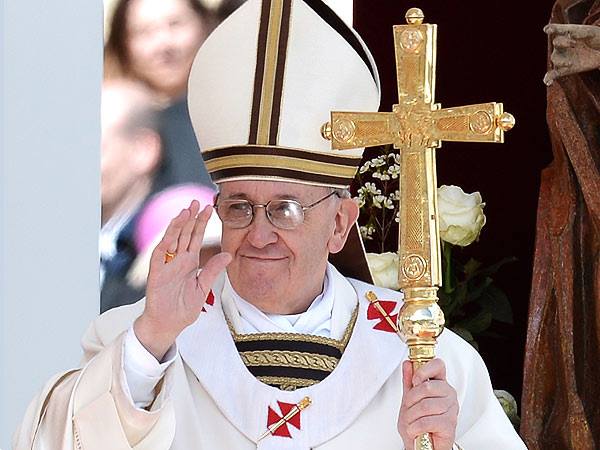
Pope Francis gives interview to Corriere della Sera

(CNS photo:Paul HarinOn March 5, 2014, Ferruccio de Bortoli conducted an interview published in Corriere della Sera, with Pope Francis about his first year at the head of the Church.

Papal interviews are helpful because they further explicate the petrine ministry. Plenty of people, however, on both sides of the theological fence, who are nervous about the way the Holy Father makes decisions. I think it is fair to say that Pope Francis does not engage the “issues” at hand in the same way as Pope Benedict and Pope John Paul before him. It is obvious to say this because of the differences in the way each person engages the mind and heart. Pope Francis takes a few more risks in speaking to the public in his off-the-cuff process, he’s going to the periphery of thinking. There are distinct times that what the Holy Father said is clearly twisted by the opponents of the Church. Several politicians and public intellectuals come to mind; and there is a number of clergymen who have done so.

On the issue of the way Pope Francis aims at making decisions can be seen in what Jesuit Father Antonio Spadaro, an interviewer of the Pope back in August 2013. Edward Pentin of the National Catholic Register brings out that the Holy Father makes decisions by discernment. Father Spadaro said,

Pope Francis’ way of making decisions, because it’s very Jesuitical. He speaks in a very Jesuitical language, so we have to explain it. He doesn’t make decisions balancing reasons. He makes decisions by discernment, so praying and trying to feel the Spirit, trying to be inspired, balancing the emotions of the spirit, not reason or logic. It’s a completely different way of proceeding, a different way of thinking. So I explain what this means in the book.

Also, Pope Francis talks briefly about his decision-making manner. Keeping in mind what Spadaro said, here is an English translation of the Corriere della Sera:

One year has gone by since that simple “good evening” that moved the world. The lapse of 12 very intense months is not able to contain the great mass of Francis’ novelties and profound signs of pastoral innovation. We are in a small room in Saint Martha’s. The only window looks out onto a courtyard that opens a minuscule angle of blue sky. The Pope appears suddenly through a door, with a relaxed and smiling face. He is amused by the various recording devices that the senile anxiety of the journalist placed on the table. “Do they all work? Yes? Thank goodness.” The assessment of this year? No, he doesn’t like assessments. “I only do an assessment every 15 days, with my confessor.”

Holy Father, every now and then you call on the telephone those who ask you for help. And sometimes, do they not believe it’s you?

Holy Father: Yes, it’s happened to me. When someone calls it’s because he wants to talk, has a question to ask, advice to request. When I was a priest in Buenos Aires it was easier. And I have kept that custom. It’s a service, it is expressed like that. But it’s true that now it’s not so easy to do, given the quantity of people who write to me.

Do you remember any one of those contacts with particular affection?

Holy Father: An 80-year-old widow who had lost her son wrote to me. And now I give her a call once a month. She is delighted. I do the [role of a] priest. I like it.

In regard to your relations with your predecessor, Benedict XVI, have you ever asked him for advice?

Holy Father: Yes, the Pope Emeritus isn’t a museum statue. It’s an institution we’re not used to. Sixty or seventy years ago, the figure of the Bishop Emeritus didn’t exist. That came after Vatican Council II and now it’s an institution. The same has to happen with the Pope Emeritus. Benedict is the first and perhaps there will be others. We don’t know that. He is discreet, humble, he doesn’t want to bother. We spoke about it and together we came to the conclusion that it would be better if he saw people, that he come out and participate in the life of the Church. Once he came here on the occasion of the blessing of the statue of Saint Michael the Archangel, then for a lunch in Saint Martha’s and, after Christmas, I returned the invitation to participate in the Consistory and he accepted. His wisdom is a gift of God. Some would have liked him to retire to a Benedictine Abbey far from the Vatican. And then I thought of grandparents, who with their wisdom and advice give strength to the family and do not deserve to end in a retirement home.

We think that your way of governing the Church is like this: you listen to everyone and then you decide alone – somewhat like the Father General of the Jesuits. Is the Pope a man who is alone?

Holy Father: Yes and no, but I understand what you wish to say to me. The Pope is not alone in his work because he is supported by the advice of many. And he would be a man alone if he decided not to listen to anyone or to pretend that he listened. However, there is a moment when one must decide, when one must sign, in which he remains alone with his sense of responsibility.

You have innovated, criticized some attitudes of the clergy. You have revolutionized the Curia, with some resistance and opposition. Has the Church already changed as you wished a year ago?

Holy Father: Last March I had no plan to change the Church. I was not expecting, let’s put it this way, this transfer of diocese. I began to govern, trying to put into practice everything that had emerged in the debate among the Cardinals of the different Congregations. And in my actions I hope to count on the Lord’s inspiration. I’ll give you an example: there has been talk of the spiritual situation of people who work in the Curia, and then they started to make spiritual retreats. More importance should be given to annual Spiritual Exercises. All have a right to spend five days in silence and meditation, whereas before in the Curia they listened to three homilies a day and then some continued working.

Are tenderness and mercy the essence of your pastoral message?

Holy Father: And of the Gospel. They are the heart of the Gospel. Otherwise, one doesn’t understand Jesus Christ, or the tenderness of the Father who sends Him to listen to us, to cure us, to save us.

But was this message understood? You said that the “Francis mania” wouldn’t last long. Is there something of your public image that you don’t like?

Holy Father: I like to be among the people, with those who suffer, and to go to the parishes. I don’t like ideological interpretations, a certain mythology of Pope Francis. When it is said, for instance, that I go out from the Vatican at night to feed beggars on Via Ottaviano – I would never even think of it. Sigmund Freud said, if I’m not mistaken, that in all idealization there is an aggression. To paint the Pope as if he is a sort of Superman, a sort of star, I find offensive. The Pope is a man who laughs, cries, sleeps peacefully and has friends like everyone else. He is a normal person.

Do you have nostalgia for your Argentina?

Holy Father: The truth is that I have no nostalgia. I would go to visit my sister, who is sick, the last of five of us. I’d love to see her, but this does not justify a trip to Argentina: to call by phone, that is enough. I do not think I’ll go before 2016, because I have already been to Latin America, to Rio. Now I have to go to the Holy Land, to Asia, and then to Africa.

You have just renewed your Argentine passport. You are still a head of state.

Holy Father: I renewed it because it had expired.

Were you annoyed that they accused you of being Marxist, especially in the United States, after the publication of “Evangelii Gaudium”?

Holy Father: Not at all. I never shared the Marxist ideology because it’s false, but I knew many good persons who professed Marxism.

The scandals that perturbed the life of the Church fortunately are now in the past. On the delicate topic of the abuse of minors, philosophers Besancon and Scruton among others, asked you to raise your voice against fanaticism and the bad faith of the secularized world that doesn’t respect childhood much.

Holy Father: I wish to say two things. The cases of abuse are terrible because they leave very profound wounds. Benedict XVI was very courageous and opened the way. And, following that way, the Church advanced a lot, perhaps more than anyone. The statistics on the phenomenon of violence against children are shocking, but they also show clearly that the great majority of the abuses come from the family environment and from people who are close. The Catholic Church is perhaps the only public institution that moved with transparency and responsibility. No one else did as much. And yet, the Church is the only one being attacked.

You say that “the poor evangelize us.” The attention given to poverty, the strongest mark of your message, is taken by some observers as a profession of pauperism. The Gospel doesn’t condemn wealth. And Zacchaeus was rich and charitable.

Holy Father: The Gospel condemns the worship of wealth. Pauperism is one of the critical interpretations. In the Medieval Age there were many pauperist currents. St. Francis [of Assisi] had the genius of placing the subject of poverty in the evangelical journey. Jesus says that one cannot serve two masters, God and money. And when we are judged at the end of time (Matthew, 25), we will be asked about our closeness to poverty. Poverty removes us from idolatry and opens the doors to Providence. Zacchaeus gives half of his wealth to the poor. And those whose barns are full of their own egoism, the Lord, at the end, will call to account. I think I expressed well my thought on poverty in “Evangelii Gaudium.”

You identify in globalization, especially financial, some of the evils that humanity suffers. However, globalization brought millions of people out of poverty. It brought hope, a rare sentiment that must not be confused with optimism.

Holy Father: It’s true, globalization saved many people from misery, but it condemned many others to die of hunger, because with this economic system it becomes selective. The globalization that the Church thinks of does not look like a sphere in which every point is equidistant from the center and in which, therefore, the particularity of peoples is lost. It is, rather, a polyhedron, with its different facets, in which each nation keeps its own culture, language, religion, identity. The present “spherical” economic globalization, especially the financial, produces one thought, a weak thought. And the human person is no longer at its center but only money.

The subject of the family is central for the activity of the Council of Eight Cardinals. Since John Paul II’s Exhortation “Familiaris Consortio”, many things have changed. Great novelties are expected. And you said that divorced persons must not be condemned – that they must be helped.

Holy Father: It is a long path that the Church must complete, a process that the Lord wants. Three months after my election, I was submitted the topics for the Synod, and we decided to discuss what Jesus’ contribution is to contemporary man. However, at the end – which for me is a sign of the will of God — we decided to discuss the family, which is going through a very serious crisis. It’s difficult to form a family. Young people no longer get married. There are many separated families, whose common life plan failed. The children suffer a lot. And we have to give an answer. However, we have to reflect a lot on this, and in depth. This is what the Consistory and the Synod are doing. We must avoid staying on the surface of the topic. The temptation to resolve each problem with casuistry is an error, a simplification of profound things. It’s what the Pharisees did: a very superficial theology. And it is in the light of this profound reflection that particular situations will be able to be addressed seriously, also that of the divorced.

Why did Cardinal Walter Kasper’s report in the last Consistory (an abyss between the doctrine on marriage and the family and the real life of many Christians) generate so much division among the Cardinals? Do you think that the Church will be able to go through these two years of toilsome journey to come to a broad and serene consensus?

Holy Father: Cardinal Kasper made a beautiful and profound presentation, which will soon be published in German, in which he addresses five points, the fifth of which is that of second marriages. I would have been more worried if there hadn’t been an intense discussion in the Consistory, because it would have been useless. The Cardinals knew that they could say what they wanted, and they presented different points of view, which are always enriching. Open and fraternal debate makes theological and pastoral thought grow. That doesn’t frighten me. What’s more, I look for it.

In the recent past, it was customary to refer to “non-negotiable values,” especially on questions of bioethics and sexual morality. You haven’t used that formula. Is that choice a sign of a less prescriptive style, more respectful of individual conscience?

Holy Father: I never understood the expression “non-negotiable values.” Values are values and that’s that. I can’t say which of the fingers of the hand is more useful than the rest, so I don’t understand in what sense there could be negotiable values. What I had to say on the topic of life I have put in writing in “Evangelii Gaudium.”

Many countries have regulated civil unions. Is it a path that the Church can understand? But up to what point?

Holy Father: Marriage is between one man and one woman. The secular States want to justify civil unions to regulate different situations of coexistence, spurred by the need to regulate economic aspects between persons as, for instance, to ensure healthcare. Each case must be looked at and evaluated in its diversity.

How will the role of women be promoted within the Church?

Holy Father: Casuistry doesn’t help in this case either. It’s true that women can and must be more present in decision-making posts of the Church. But I would call this a promotion of a functional type. And with that alone, one doesn’t advance much. Rather, we must think that the Church has the feminine article, “la”: it is feminine by origin. Theologian Urs von Balthasar worked a lot on this topic: the Marian principle guides the Church by the hand of the Petrine principle. The Virgin is more important than any Bishop and any of the Apostles. The theological reflection is already underway. Cardinal [Stanislaw] Rylko [president of the Pontifical Council for the Laity], together with the Council of the Laity, is working in this direction with many expert women.

Half a century after Paul VI’s encyclical “Humanae Vitae,” can the Church take up again the topic of birth control? Your confrere, Cardinal [Carlo Maria] Martini [the late Archbishop of Milan] believed it was now time.

Holy Father: It all depends on how the text of “Humanae Vitae”is interpreted. Paul VI himself, towards the end, recommended to confessors much mercy and attention to concrete situations. But his genius was prophetic, as he had the courage to go against the majority, to defend moral discipline, to apply a cultural brake, to oppose present and future neo-Malthusianism. The object is not to change the doctrine, but it is a matter of going into the issue in depth and to ensure that the pastoral ministry takes into account the situations of each person and what that person can do. This will also be discussed on the path to the Synod.

Science evolves and redraws the ends of life. Does it make sense to prolong life in a vegetative state?

Holy Father: I’m not a specialist on bioethical arguments, and I’m afraid of being mistaken in my words. The Church’s traditional doctrine states that no one is obliged to use extraordinary methods when someone is in his terminal phase. Pastorally, in these cases I have always advised palliative care. On more specific cases, should it be necessary, it’s appropriate to seek the advice of specialists.

Will your trip to the Holy Land lead to an agreement of intercommunion with the Orthodox that Paul VI, fifty years ago, almost signed with [Patriarch] Athenagoras?

Holy Father: We are all impatient about achieving “sealed” results. But the path of unity with the Orthodox means above all walking and working together. In Buenos Aires, several Orthodox came to the catechetical courses. I usually spent Christmas and 6 January together with their bishops, who sometimes even asked the advice of our diocesan offices. I do not know if the story is true that Athenagoras told Pope Paul VI that he proposed that they walk together and send all the theologians to an island to discuss among themselves. It’s a joke, but it is important that we walk together. Orthodox theology is very rich. And I believe that they have, at this time, great theologians. Their vision of the Church and collegiality is marvelous.

In a few years the greatest world power will be China with which the Vatican has no relations. Matteo Ricci was a Jesuit like you.

Holy Father: We are close to China. I sent a letter to President Xi Jinping when he was elected, three days after me. And he answered me. The relationships are there. They are a great people whom I love.

Why, Holy Father, do you never speak about Europe? What is it about the European project that does not convince you?

Holy Father: Do you remember the day when I spoke of Asia? What did I say? (Here the reporter ventures to give some explanation, collecting vague memories only to realize that he had fallen for a nice trick). I have not spoken about Asia, or Africa, or Europe. Only about Latin America when I was in Brazil, and when I had to receive the Commission for Latin America. There hasn’t yet been a chance to talk about Europe. It will come.

What book are you reading these days?

Holy Father: ‘Peter and Magdalene’ by Damiano Marzotto on the feminine dimension of the Church. A beautiful book.

And you’re not able to see any good films, another of your passions? “La Grande Bellezza” won an Oscar. Will you see it?

Holy Father: I don’t know. The last movie I saw was Benigni’s ‘Life is Beautiful’. And before I had seen Fellini’s ‘La Strada’. A masterpiece. I also liked Wajda…

St. Francis had a carefree youth. I ask you: have you ever been in love?

Holy Father: In the book The Jesuit, I recount when I had a girlfriend at the age of 17. And I mention it also Heaven and Earth, the volume that I wrote with Abraham Skorka. In the seminary, a girl made my head spin for a week.

And if you do not mind me asking, how did it end?

Holy Father: They were things of youth. I spoke with my confessor about it [a big smile].

Thank you Holy Father.

Holy Father: Thank you.

NB: A CNS image by Paul Harring
Blessed First Anniversary to Pope Francis

Francis with B16 crosierV. Let us pray for Francis, the Pope.
R. May the Lord preserve him, give him a long life, make him blessed upon the earth, and may the Lord not hand him over to the power of his enemies.

V. May your hand be upon your holy servant.
R. And upon your son whom you have anointed.

Let us pray. O God, the Pastor and Ruler of all the faithful, look down, in your mercy, upon your servant, Francis, whom you have appointed to preside over your Church; and grant, we beseech you, that both by word and example, he may edify all those under his charge; so that, with the flock entrusted to him, he may arrive at length unto life everlasting.

Through Christ our Lord.

R. Amen.

Pope and the curia on retreat

Francis and curia on lenten retreatThe annual lenten retreat for the Pope and the curia is not at the Apostolic Palace. This year, the Spiritual Exercises are being given at a retreat house of the Pauline Family, in Ariccia [site of the composition of the Pastoral Constitution of the Church in the Modern World of Vatican II], a town about 20 miles southeast of Rome. Msgr. Angelo De Donatis, a popular spiritual director and Roman pastor in the city center of Rome. The retreat runs March 9-14.

Like Pope Francis and others, we need to sit and listen to the Word of God. Are you spending time in prayer?

“Those who live a retreat in an authentic way,” the pope recently said, “experience the attraction and fascination of God and return renewed and transfigured in their daily lives, their ministry and their relationships.”

Francis met March 3 with an Italian federation of spiritual directors and those who run retreat houses throughout the country, offering Christians “space and time to listen intensely to the word of God in silence and in prayer.”

May the Holy Spirit be with those making the Exercises.

Saint Frances of Rome

S Francesca RomanaThe Church gives us the liturgical memorial of Saint Frances Rome (1384-1440) today. However, her feast is obscured by the fact that it is the First Sunday of Lent. Yet, we cannot move from today without a mentioned of such a terrific witness to the Lord.

Saint Frances is the patroness of Benedictine Oblates and car drivers; and as one of the patrons of Rome along with Saints Peter and Paul and Philip Neri. She is proposed by Mother Church as a clear model of the tenderness of married life and motherhood, but also as a person who devoted her life to the poor and the sick (works of Mercy). Hence, her saintly example is much in need today.

In 1433, Frances founded the Benedictine Oblates of Mary as part of the Olivetan Benedictines. The Mass Collect for Saint Frances of Rome  gives us the lex credendi:

O God, Who in Saint Frances of Rome, has given us a model of holiness in married life and of monastic conversion, make us serve You perseveringly, so that in all circumstances we may set our gaze upon You and follow You.

Saint Frances’ congregation of Oblate sisters exist today in Rome, Le Bec-Hellouin, France, and at Abu-Gosh in Israel. In addition to the characteristic devotion to the Divine Office and the fraternal life, is the devotion to the Blessed Virgin Mary and the Guardian Angels which gives rise to the service of the Church in Rome. Their habit remains the same as their Mother Foundress of a black habit and long white veil. The Roman monastery is open to the public once a year for Mass and interaction with the sisters. I was privileged to be in the monastery with two friends a few years ago.

It is interesting to see how God works in the lives of the unsuspecting. In the period in which Frances lived and in movement of her heart, the Holy Spirit identified a new form of life with some of the Roman widows. Frances discerned a new form of Benedictine life never previously proposed before: women living under the Rule of Saint Benedict, not as enclosed nuns, but as Oblate Sisters of the Roman monastery of the Olivetans at Santa Maria Nuova.

Frances’ followers left the monastery following prayer to serve the poor and sick; the foundress, though, did not limit the sisters to this form of ministry allowing for other skills and talents to give glory to God. Nevertheless, Frances was clearly inspired by Chapter Four of Benedict’s Rule, the Instruments of Good Works:

To relieve the poor, to clothe the naked, to visit the sick, to bury the dead, to give help in trouble, to console the sorrowful, to avoid worldly behavior, and to set nothing before the love of Christ (RB 4:14-21).

The beauty of the vocation attracted the attention of the Roman people that  Frances, a widow, a servant of the poor, a mother to the sick, a spiritual daughter of Saint Benedict, and a mystic was an attractive witness. Frances has also been a favorite saint of Popes John Paul II and Benedict XVI.

Her practical approach to the spiritual and apostolic life has been noted in her saying that “Devotion in a married woman is most praiseworthy, but she must never forget that she is a housewife. Sometimes she must leave God at the altar, to serve Him in her housekeeping.” Perhaps we all can find inspiration here.

Don’t dialogue with Satan, Pope exhorts

Today’s Angelus Address of the Pope gave a wonderful reminder of how you live your spiritual life –or not. This Pope is good for telling us that the devil is lurking, tempting humanity and trying to compromise our faithfulness to God. In my experience I am happy that Francis is pointing out that we need to be careful not try to overpower the enticements of the Evil One. He’s not to be fooled with; pay attention to the Holy Father.

The Gospel of the first Sunday of Lent each year presents the story of Jesus’ temptations, when the Holy Spirit, having descended upon Him after His baptism in the Jordan, urged Him to openly confront Satan in the wilderness for forty days, before beginning His public mission.

The tempter tries to divert Jesus from the Father’s plan, that is, from the path of sacrifice, of love that offers itself in expiation; to make Him take an easy road, [a road] of success and power. The duel between Jesus and Satan is takes place with quotations from the Holy Scriptures. The devil, in fact, to divert Jesus from the way of the Cross, makes present to him the false messianic hopes: economic well-being, indicated by the ability to turn stones into bread; a spectacular and miraculous style, with the idea of casting Himself down from the highest point of the Temple of Jerusalem and being saved by angels; and finally the shortcut of power and domination, in exchange for an act of worship to Satan. There are three groups of temptations. We also know them well.

Jesus decisively rejects all these temptations and reaffirms [His] firm intention to follow the path established by the Father, without any compromise with sin or with the logic of the world. Note well how Jesus responds: He doesn’t dialogue with Satan, as Eve did in the terrestrial Paradise. Jesus knows well that one can’t dialogue with Satan, because he is so cunning. For this reason, instead of dialoguing, as Eve did, Jesus chooses to take refuge in the Word of God and to respond with the power of this Word. Let us remind ourselves of this in the moment of temptation, of our temptation: not arguing with Satan, but defending ourselves with the Word of God. And this will save us. In His responses to Satan, the Lord — using the Word of God — reminds us, first, that “one does not live on bread alone, but on every word that comes forth from the mouth of God” (Mt 4:4; cf. Dt 8:3), and this gives us strength, sustains us in the fight against the worldly mentality that lowers human beings to the level of their basic needs, causing them to lose the hunger for what is true, good, and beautiful, the hunger for God and His love. He also recalls, “Again it is written, ‘You shall not put the Lord, your God, to the test.’” ( v. 7) , because the road of faith also passes through darkness, doubt, and is nourished by patience and persevering expectation. Jesus notes, finally, that “it is written: ‘The Lord, your God, shall you worship and him alone shall you serve,’” that is, we must get rid of idols, of vanities, and build our lives on the essentials.

These words of Jesus will then find concrete responses in His actions. His absolute fidelity to the Father’s plan of love will lead Him, after about three years, to the final confrontation with the “prince of this world” (Jn 16:11), in the hour of the Passion and of the Cross, and there Jesus will achieve His final victory, the victory of love!

Dear brothers and sisters, Lent is a favorable opportunity for all of us to make a journey of conversion, sincerely confronting ourselves with this page of the Gospel. We renew the promises of our Baptism: we renounce Satan and all his works and seductions — because he is a seducer, right? — in order to walk the paths of God and “to arrive at Easter in the joy of the Holy Spirit” (cf. Collect of the First Sunday of Lent, Year A).

Carmelite Spirituality attractive in Asia

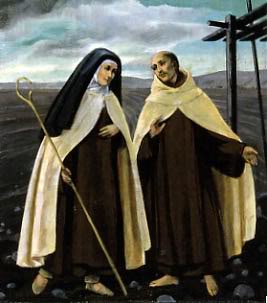
Sts. John of the Cross and Teresa of AvilaI’ve been spying on what the Discalced Carmelites are doing to honor a great figure as Saint Teresa of Jesus (Avila) for the Fifth Centenary of her birth. Last evening I read a brief piece on Pope John Paul’s “Carmelite leanings” with his intense emphasis on love. The writer of the essay argued John Paul was captivated by the work and witness of Teresa and John of the Cross. In recent years I have been interested in the Carmelite approach to the spiritual life primarily because I’ve seen others radically changed by it. I have to admit, though, my soul is not Carmelite at the level of radical substance yet I am draw to what Teresa and John had to say.

The Discalced Carmelites report that in Asia interest in Teresa of Jesus and John of the Cross is increasing.  A recent title at a conference reveals interest in Asia, “A dialogue between the spiritualities of Ignatius of Loyola and of John of the Cross.”

So, it is reported that hundreds of registrants in Asia are participating in courses designed to introduce inquirers of Carmelite spirituality through the eyes of two great Carmelite saints; there’s been collaboration even with the Presbyterian Church of Taiwan. Taiwan, Hong Kong, and Japan have sponsored similar Teresian courses. More work is scheduled for Israel later in 2014.

Temptation of the Lord, and ours

Francis baptizing 2014Today in the Ordinary Form and the Extraordinary Form of the Mass we hear the gospel narrative of Jesus being tempted by Satan. Even Satan tries to lure the Son of God away from the center. The fact that Satan attempts to make another offer to the Lord whom he knows of his origin ought to indicate to us that we are also under attack. The preparation of Lent for Easter exactly poses for us a renewal of faith in the One to whom we owe everything. At the Easter Vigil we will renew our baptismal vows rejecting sin and the temptations of Satan.

The First Sunday of Lent poses for us the same question Jesus was confronted: to whom do you belong? Obviously, Jesus knew to whom He belonged, but do we?

When faced with personal temptation can we say with Jesus, “Get away, Satan! It is written: The Lord, your God, shall you worship and him alone shall you serve.”

A reflection by Saint Gregory Nazianzen reminds us of a central aspect of our baptism:

We must not expect baptism to free us from the temptations of our persecutor. The body that concealed him made even the Word of God a target for the enemy; his assumption of a visible form made even the invisible light an object of attack. Nevertheless, since we have at hand the means of overcoming our enemy, we must have no fear of the struggle. Flaunt in his face the water and the Spirit… Strong in our baptism each of us can say ‘I too am made in the image of God, but unlike you, I have not yet become an outcast from heaven through my pride. I have put on Christ; by my baptism I have become one with him. It is you that should fall prostrate before me!’

Anglican Ordinariates meet, encouraged by Cardinal Müller

Gerhard Ludwig Cardinal Müller, Prefect of the Congregation for the Doctrine of the Faith spoke with the three leaders of the Anglican Ordinariates in February in Rome. The Ordinariates were established by Pope Benedict with the motu proprio of Anglicanorum coetibus for those Anglicans who want to be in full communion with the Church and retain some of their liturgical patrimony. These jurisdictions are similar to dioceses though the leaders are not bishops. The presence of the Ordinariates is controversial in some quarters and therefore they come under greater suspicion and scrutiny but the mercy of the Church ought to be recalled. The Ordinariates, in my opinion, are a clear gesture of the Good Shepherd for communion, that is, ecclesial unity. The Ordinaries were in Rome for the Consistory.

The heads of the three Ordinariates, in case you want to follow their work: Msgr Keith Newton of the Personal Ordinariate of Our Lady of Walsingham in the UK, Msgr Jeffrey Steenson, Ordinary of the Personal Ordinariate of the Chair of Saint Peter in the United States and Msgr Harry Entwistle, Ordinary of the Personal Ordinariate of Our Lady of the Southern Cross in Australia.

In the US we have The Personal Ordinariate of the Chair of Saint Peter.

His Eminence also said, “I want you to know that I have spoken to our Holy Father, Pope Francis, about the ordinariates and the particular gift they are to the Church. The Holy Father is following the development of the ordinariates with great interest.” It may be said that he Holy Father was not at first too understanding of creating the Ordinariates when he was still in Argentina.

Cardinal Müller said: “Anglicans will be interested in how well you are able to make a home in the Catholic Church that is more than just assimilation, while Catholics will want to know that you are here to stay, strengthening our ecclesial cohesion rather than setting yourselves apart as another divisive grouping within the Church…It is your delicate, but all-important task both to preserve the integrity and distinctiveness of your parish communities and, at the same time, help your people integrate into the larger Catholic community.”

The Cardinal noted that it is crucial the Ordinariates keep in mind the importance of the sacred liturgy as the expression of communion. There is no other way to be Catholic. “By ensuring that the sacred liturgy is celebrated worthily and well, you further the communion of the Church by drawing people into the worship of God who is communio.” “In this sense, the celebration according to the approved Divine Worship [or Ordinariate Use] texts is both essential to the formation of the identity of the ordinariate as well as being a tool for evangelization.” Hence, he echoes the timeless teaching that the sacred Liturgy is the privileged place to meet Jesus Christ.

More information is here.

Approved miracle attributed to the intercession of Venerable Servant of God Fulton Sheen

fulton (2)March 6, 2014
FOR IMMEDIATE RELEASE

Peoria, IL — The Most Reverend Daniel R. Jenky, CSC, Bishop of Peoria and President of the Archbishop Fulton Sheen Foundation, received word early Thursday morning that the 7-member board of medical experts who advise the Congregation for the Causes of the Saints at the Vatican unanimously approved a reported miracle attributed to the intercession of the Venerable Servant of God Archbishop Fulton Sheen.

The case involved a still born baby born in September 2010. For over an hour the child demonstrated no signs of life as medical professionals attempted every possible life saving procedure, while the child’s parents and loved ones began immediately to seek the intercession of Fulton Sheen. After 61 minutes the baby was restored to full life and three years later demonstrates a full recovery.

Today’s decision affirms that the team of Vatican medical experts can find no natural explanation for the child’s healing. The case will next be reviewed by a board of theologians. With their approval the case could move on to the cardinals and bishops who advise the Pope on these matters. Finally, the miracle would be presented to Pope Francis who would then officially affirm that God performed a miracle through the intercession of Fulton Sheen. There is no timeline as to when these next steps might move forward.

“Today is a significant step in the Cause for the Beatification and Canonization of our beloved Fulton Sheen, a priest of Peoria and a Son of the Heartland who went on to change the world. There are many more steps ahead and more prayers are needed. But today is a good reason to rejoice,” commented Bishop Jenky.

Fulton Sheen was born May 8, 1895 in El Paso, IL outside of Peoria. His family moved to Peoria so that Fulton and his brothers could attend Catholic school. He grew up in the parish of the Cathedral of St. Mary where he was an altar server and later ordained a priest of the Diocese of Peoria. After advanced studies and service as a parish priest in the city of Peoria, Fulton Sheen was a professor of philosophy and religion at the Catholic University of America in Washington, DC. In the 1930s he became a popular radio personality and later a TV pioneer. His weekly TV program, “Life is Worth Living” eventually reached 30 million viewers and won an Emmy award for outstanding TV program.

From 1950-1966, Bishop Sheen was the national director of the Society for the Propagation of the Faith in the United States, the Church’s primary missionary apostolate. In 1966, he was named Bishop of Rochester of New York where he served until his retirement in 1969, when he was named honorary Archbishop by Pope Paul VI. Fulton Sheen died at the entrance to his private chapel in his New York City apartment on December 9, 1979.

In September 2002, Bishop Jenky officially opened the cause for the beatification and canonization of Fulton Sheen. For six years, the Sheen Foundation, the official promoter of the Cause, gathered testimony from around the world and reviewed all of Sheen’s writings, before sending their conclusions to the Vatican. In June 2012, Pope Benedict affirmed the investigation that Sheen had lived a life of heroic virtue and holiness. Sheen was then titled “Venerable.”

Pending further review by the theologians and the cardinals who advise the Pope through the Congregation for the Causes of the Saints, should Pope Francis validate this proposed miracle, Sheen could then be declared “Blessed” in a ceremony that could be celebrated in Peoria, Sheen’s hometown. Upon the Holy Father signing the decree for the beatification, an additional miracle would lead to the Canonization of Archbishop Sheen, in which he would be declared a “Saint.”

For more information about Fulton Sheen and the Cause for his canonization, visit: ArchbishopSheenCause.org.

Fasting was instituted by Our Lord

Yesterday for Ash Wednesday, I proposed that we listen to the words of Saint John Chrysostom on the subject of fasting. Perhaps a more modern person, Saint Francis de Sales, is in order for fasting as a key discipline of Lent. De Sales preached the following. Thanks to Dom Hugh for bringing this excerpt to light which bears a little reflection form us all:

To treat of fasting and of what is required to fast well, we must, at the start, understand that of itself fasting is not a virtue. The good and the bad, as well as Christians and pagans, observe it. The ancient philosophers observed it and recommended it. They were not virtuous for that reason, nor did they practice virtue in fasting. Oh, no, fasting is a virtue only when it is accompanied by conditions which render it pleasing to God. Thus it happens that it profits some and not others, because it is not undertaken by all in the same manner… We know very well that it is not enough to fast exteriorly if we do not also fast interiorly and if we do not accompany the fast of the body with that of the spirit

We must fast with our whole heart, that is to say, willingly, wholeheartedly, universally and entirely. If I recount to you St. Bernard’s words regarding fasting, you will know not only why it is instituted but also how it ought to be kept.

He says that fasting was instituted by Our Lord as a remedy for our mouth, for our gourmandizing, and for our gluttony. Since sin entered the world through the mouth, the mouth must do penance by being deprived of foods prohibited and forbidden by the Church, abstaining from them for the space of forty days. But this glorious saint adds that, as it is not our mouth alone which has sinned, but also all our other senses, our fast must be general and entire, that is, all the members of our body must fast. For if we have offended God through the eyes, through the ears, through the tongue, and through our other senses, why should we not make them fast as well? And not only must we make the bodily senses fast, but also the soul’s powers and passions — yes, even the understanding, the memory, and the will, since we have sinned through both body and spirit.

Ash Wednesday, 1622