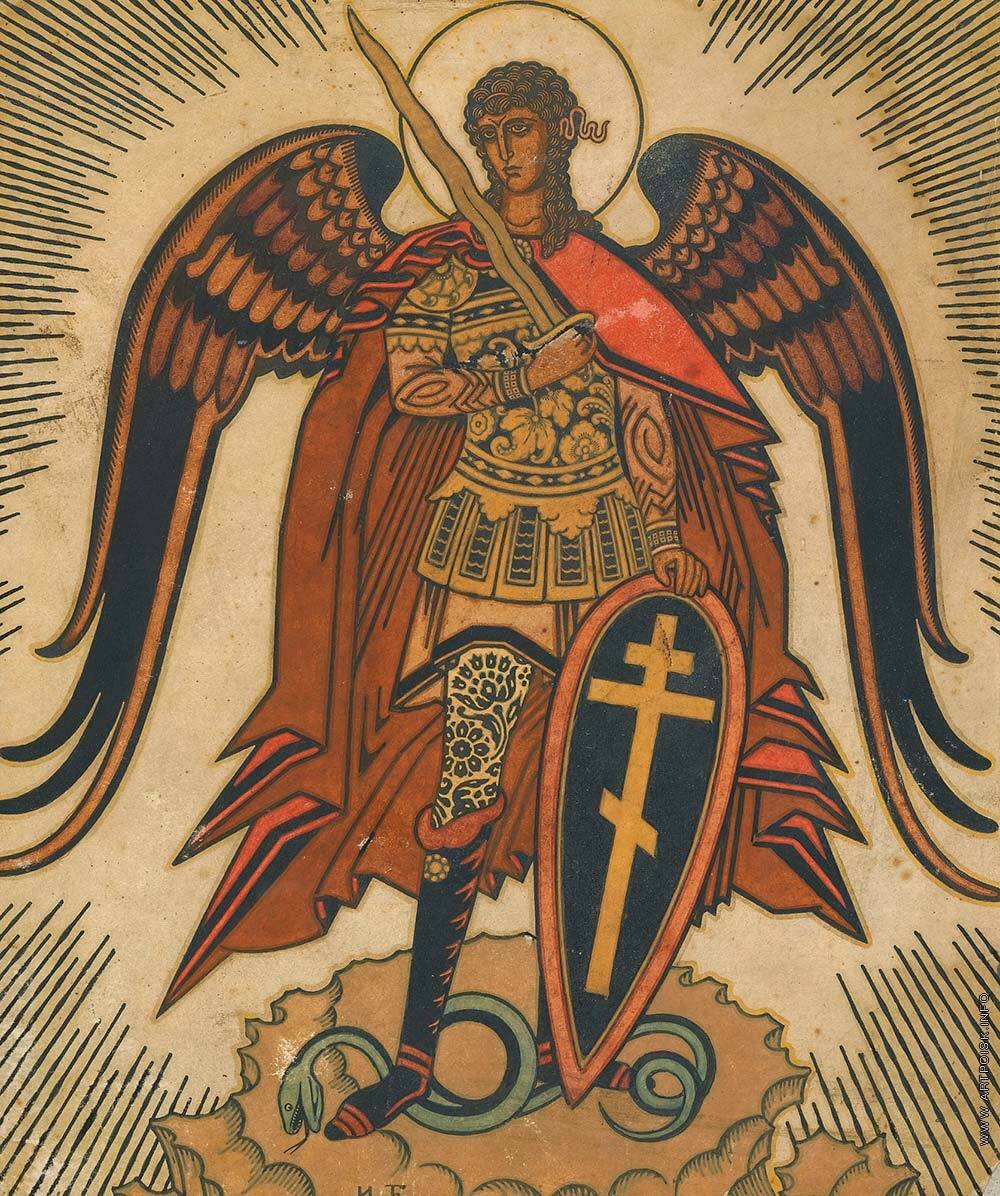
Saint Michael the Archangel

Archangel Michael Ivan BilibinThe feast of the Archangel Michael brings to table a certain wrinkle in the spiritual life that we don’t frequently acknowledge, or truly address as real. Recognizing the place evil has in the lives of many people due to the lure of sin and division, and noting that the true desire of man’s heart is really for God, Saint John Paul II in his ministry as a priest asked the faithful pray to Saint Michael the Archangel for divine assistance in the long and difficult work of spiritual warfare. He wanted us to make room in our devotional life for the intention when he said,

May prayer strengthen us for the spiritual battle we are told about in the Letter to the Ephesians, “Draw strength from the Lord and from his mighty power” (Eph 6 10). The Book of Revelation refers to this same battle recalling before our eyes the image of St. Michael the Archangel (Rev. 12:7). Pope Leo XIII certainly had a very vivid recollection of this scene when, at the end of the last century, he introduced a special prayer to St Michael throughout the Church.”

“St Michael the Archangel defend us in battle, be our safeguard against the wickedness and snares of the devil.” Although today this prayer is no longer recited at the end of Mass, I ask everyone not to forget it, and to recite it to obtain help in the battle against the forces of darkness and against the spirit of this world. (Pope John Paul II, Regina Caeli, 24 April 1994)”

Michael, whose name means “who is like unto God” (Quis ut Deus?), does indeed protect us.

Will you take up the challenge and call to holiness of John Paul?

Alvaro Del Portillo declared “Blessed” in Madrid

Bl Alvaro del PortilloShortly after the elected of Francis to the Throne of Peter, he approved of the miracle that would lead to his beatification. His first miracle, if you are interested, concerned a case in 2003 where a Chilean baby boy’s heart started beating despite doctors’ failed 30-minute efforts to resuscitate him. The boy’s parents prayed to Del Portillo for his intercession from God to save their child. From all reports the child lives a normal life, going to school and playing soccer.

In the car last evening I was listening to various news services and NPR had a story –none of the other international services did– of the beatification of Del Portillo. But the real story seemed not the beatification of a man known for holiness but his connection to Opus Dei famously derided in Dan Brown’s The DaVinci Code. I fail to see what one thing really has to do with another.

Saint Josemaría Escrivá’s original vision for Opus Dei has nothing to do with the political monikers of being liberal or conservative. Many will frame the group in these terms out ignorance. Opus Dei –a Latin concept meaning “The Work of God”– is about encouraging Catholics to know their ordinary, everyday work and life as a path to holiness. In other words, we are all called in whatever our work is, to the universal call to holiness; a strong emphasis of the Second Vatican Council and many saints. Religion is NOT just for 47 minutes on a Sunday morning where you put your money in the parking meter.

So, what ought to be admired about Opus Dei is the group’s emphasis and witness on the dignity of the laity. This same emphasis is also seen in two other ecclesial movements in the Church: Communion and Liberation and Focolare. But, The Work of God since its founding in 1928 has a significant challenge to the ultra-clerical attitudes of our Church while raising up the beauty of being a lay Christian and building up the Mystical Body of the Church.

Blessed Alvaro Del Portillo’s style was humble and faithful to the charism he was given by God to fulfill in history. His reputable for holiness is well-regarded and and substantiated. Del Portillo worked with Saint Josemaría Escrivá, the founder of Opus Dei for more than 40 years, and later his successor as the group’s leader until 1994.

Opus Dei is a lay organization in the Church with more than 90K members; only 2,073 are priests.

Blessed Alvaro, pray for us.

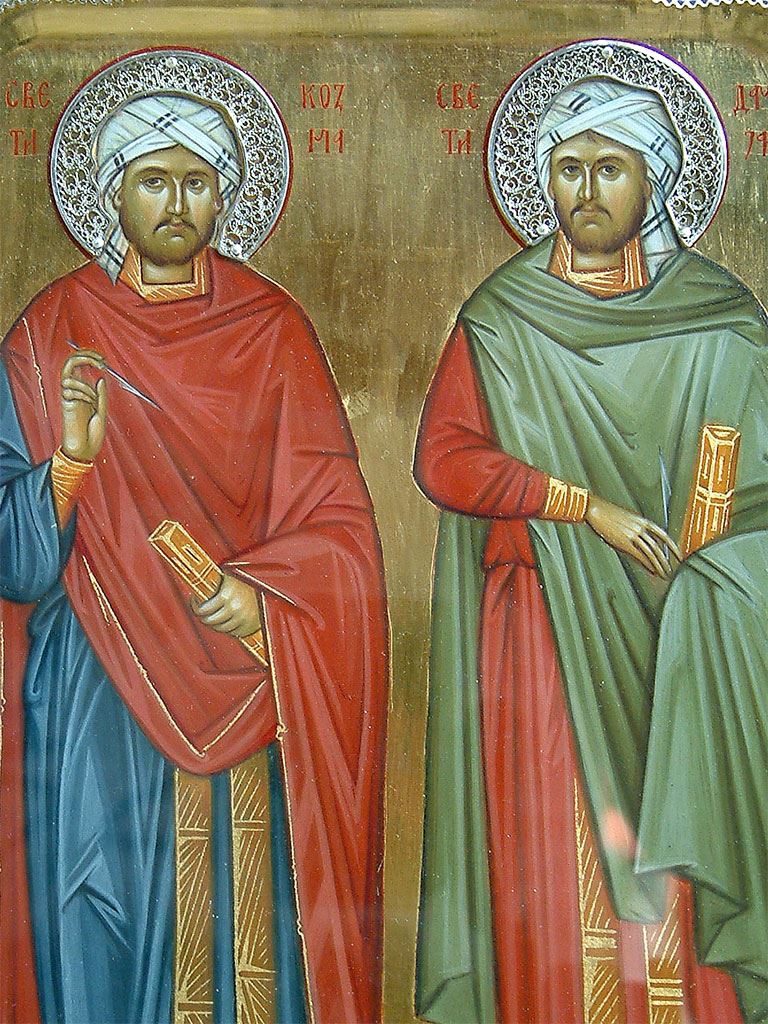
Saints Cosmas and Damian

Cosmas and DamianWith the Church we pray:

May you be magnified, O Lord, by the revered memory of your saints Cosmas and Damian,for with providence beyond words, you have conferred on them everlasting glory and on us, your unfailing help.

Mother Church commemorates twin brothers, Saints Cosmas and Damian born in Arabia.  Eminent for their practice of medicine and reputation for giving free medical care; hence being known as the “moneyless ones.” The practice of charity and service to their neighbor exemplified that it is possible to live the gospel, especially Matthew 25. They attracted many converts to the faith. The holy brothers were arrested and beheaded during the Diocletian persecution in 303.

Saints Cosmas and Damian are patron saints of physicians and pharmacists. By the 6th century, their names were placed in the canon of the Mass (Eucharistic Prayer I).

Church history keeps their memory alive by the fact that we observe a feast day for them and that the faithful  erected church on the site of their burial place — later enlarged by the emperor Justinian; likewise a famous basilica was erected in their honor in Constantinople. Recall that Saint Francis of Assisi rebuilt the dilapidated San Damiano chapel outside Assisi.

Blessed Teresa of Calcutta

Blessed Teresa

One of the most recognizable faces on the planet: a woman who pointed to Jesus even when her own questions surfaced. Blessed Teresa’s faithfulness and complete self-sacrifice for Christ and His people is what I follow.

“Go before the Blessed Sacrament- He is there. When we look at the Cross we know how much He loved us; when we look at the tabernacle, we know how much He loves us now. “Loved,” past tense; “Loves,” present tense. Not only past tense, He loves us now. He loves me tenderly.”


–Blessed Mother Teresa, Where There is Love, There is God, page 60)

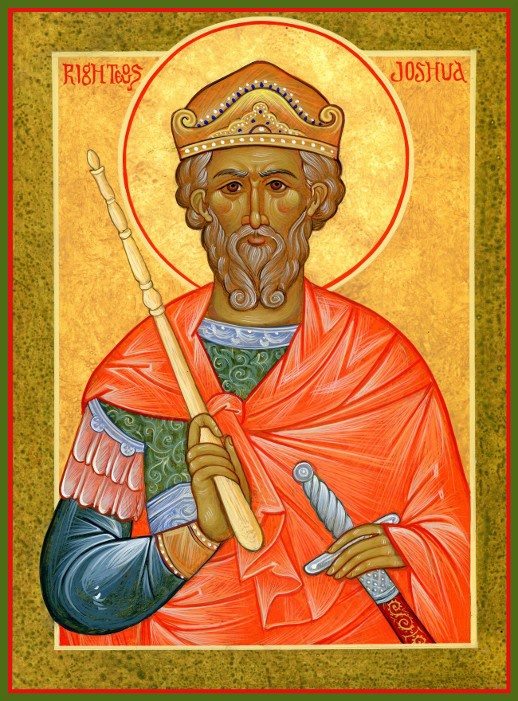
Saint Joshua

St JoshuaThe Roman Martyrology offers us the commemoration of the holy Joshua (Jesus), son of Nun, servant of the Lord. It is he who, having had hands laid on him by Moses, became full of the spirit of wisdom. After the death of Moses, he led the people of Israel across the Jordan River, accompanied by many miracles, into the Promised Land.

Even though the Roman Martyrology has OT holy men and women noted for liturgical remembrance, the current liturgical calendar does not have them listed. Hence, I like to draw our attention to these types of commemorations.

Blessed feast!

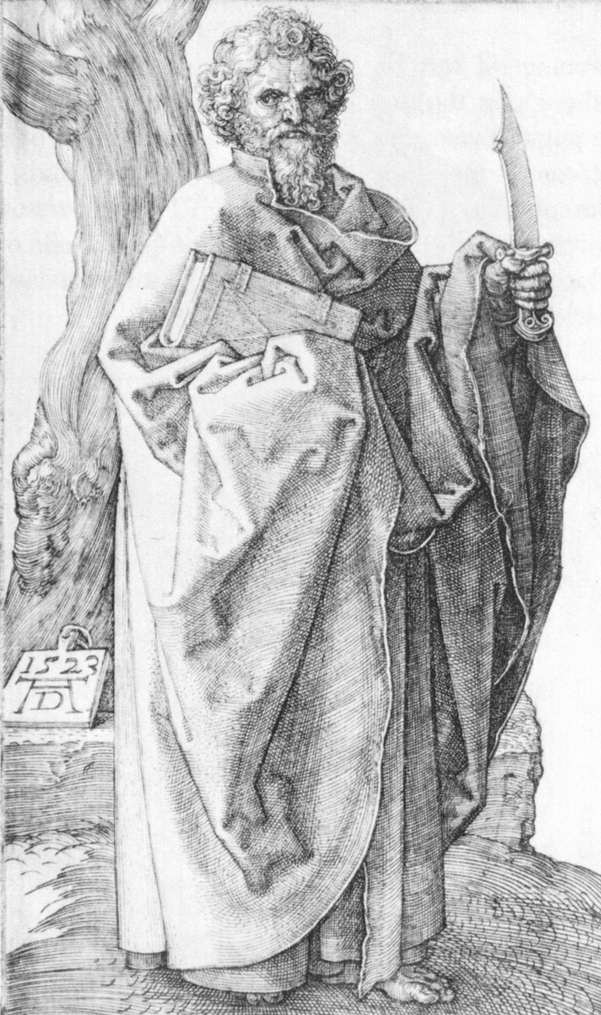
Saint Bartholomew

St Batholomew DurerSaint Bartholomew, known also as Nathanael, apostle and martyr, died in AD 71, is liturgically recalled today. However, his feast comes after the Sunday’s precedence. Nonetheless, we need to closely attend to the life and ministry of the 12, those who personally and dramatically lived with the Lord for three years. Why? Because we follow their experience and we continually ask ourselves the key question of the Christian life: “Who are you, Jesus?”

Saint Bartholomew, Bar-Tolmai or son of Tolmai, was one of the twelve Apostles called to the apostolate by our Blessed Lord Himself. His name is more adequately rendered by his given name, Nathanael. If one wonders why the synoptic Gospels always call him Bartholomew, it would be because the name Nathanael in Hebrew is equivalent to that of Matthew, since both in Hebrew signify gift of God; in this way the Evangelists avoided all confusion between the two Apostles. He was a native of Cana in Galilee, a doctor of the Jewish law, and a friend of Philip.

Philip, advised by Peter and Andrew, hastened to communicate to his friend the good news of his discovery of Christ: We have found Him whom Moses in the Law, and the Prophets, wrote! Come and see. Jesus saw Nathanael coming to Him, and said of him, Behold a true Israelite, in whom there is no guile. (Cf. John 1:45-49) His innocence and simplicity of heart deserved to be celebrated with this high praise in the divine mouth of Our Redeemer. And Nathanael, when Jesus told him He had already seen him in a certain place, confessed his faith at once: Rabbi, Thou art the Son of God, Thou art the King of Israel!

Being eminently qualified by divine grace to discharge the functions of an Apostle, he carried the Gospel through the most barbarous countries of the East, penetrating into the remoter Indies, baptizing neophytes and casting out demons. A copy of the Gospel of Saint Matthew was found in India by Saint Pantænus in the third century, taken there, according to local tradition, by Saint Bartholomew. Saint John Chrysostom said the Apostle also preached in Asia Minor and, with Saint Philip, suffered there, though not mortally, for the faith. Saint Bartholomew’s last mission was in Greater Armenia, where, preaching in a place obstinately addicted to the worship of idols, he was crowned with a glorious martyrdom. The modern Greek historians say that he was condemned by the governor of Albanopolis to be crucified. Others affirm that he was flayed alive, which treatment might well have accompanied his crucifixion, this double punishment being in use not only in Egypt, but also among the Persians.

Reflection: The characteristic virtue of the Holy Apostles was zeal for the divine glory. A soldier is always ready to defend the honor of his prince, and a son that of his father; can a Christian say he loves God if he is indifferent to His honor?

Dictionnaire de la Bible, Ed. F. Vigouroux (Letouzey et Ané: Paris, 1912), Vol. 5, Philippe, Apôtre; Little Pictorial Lives of the Saints, a compilation based on Butler’s Lives of the Saints and other sources by John Gilmary Shea (Benziger Brothers: New York, 1894).

Saint Pius X

Pius XToday, we celebrate the liturgical memorial Saint Pius X and the centenary of his death. He was the 257th pope. The Eucharist, in part because of Pius, is far more central to our lives as Catholics than before him. His intuition and boldness of teaching open new doors to radical gift of the Holy Eucharist. Rome Reports has a brief presentation on Pius.

From the Discourse of Pope Pius XII at the Canonization of Pius X

Sanctity, which was the guide and inspiration of the undertakings of Pius X, shines forth even more clearly in the daily acts of his personal life. Before applying it to others, he put into practice in himself his program of returning all things to unity in Christ. As a humble parish priest, as bishop, as the Supreme Pontiff, he believed that the sanctity to which God called destined him was that of a priest. What sanctity is more pleasing to God in a priest of the New Law than that which belongs to a representative of the Eternal High Priest, Jesus Christ, Who left to His Church in the holy Mass the perennial memorial, the perpetual renovation of the Sacrifice of the Cross, until He shall come for the last judgment; and Who with this Sacrament of the Blessed Eucharist has given Himself as the food of our souls: “He that eateth this bread shall live forever.”

A priest above all in the Eucharistic ministry: this is the most faithful portrait of St. Pius X. To serve the mystery of the Blessed Eucharist as a priest, and to fulfill the command of Our Savior “Do this in memory of me” (Luke 22:19), was his way. From the day of his sacred ordination until his death as Pope, he knew no other possible way to reach such an heroic love of God, and to make a such generous return to that Redeemer of the world, Who by means of the Eucharist “poured out the riches of His divine Love for men” (Council of Trent, Session 13, chapter 2). One of the most significant proofs of his priestly sensibility was his ardent concern for the renewal of the dignity of worship, and his concern to overcome the prejudices of an erroneous practice, by resolutely promoting the frequent, and even daily, Communion of the faithful at the table of the Lord, without hesitation, leading children thereto, lifting them up, as it were, in his own arms, and offering them to the embrace of God hidden on the altars. From this, sprang up a new springtime of the Eucharistic life of the Bride of Christ.

In the profound vision which he had of the Church as a society, Pius X recognized in the Eucharist the power to nourish substantially its interior life, and to raise it high above all other human associations. Only the Eucharist, in which God gives Himself to man, can lay the foundations of a social life worthy of its members, cemented by love more than by authority, rich in its works and aimed at the perfection of individuals: a life, that is, “hidden with Christ in God.”

A providential example for today’s world, where earthly society is becoming more and more a mystery to itself, and anxiously searches for a way give itself a soul! Let it look, then, for its model at the Church, gathered around its altars. There in the sacrament of the Eucharist mankind truly discovers and recognizes its past, present, and future as a unity in Christ. Conscious of, and strong in his solidarity with Christ and his fellow men, each member of either Society, the earthly and the supernatural one, will be able to draw from the altar an interior life of personal dignity and personal worth, such as today is almost lost through insistence on technology and by excessive organization of the whole of existence, of work and even leisure. Only in the Church, the holy Pontiff seems to repeat, and though Her, in the Eucharist which is ‘‘life hidden with Christ in God,” is to be found the secret and source of the renewal of society’s life.

Hence follows the grave responsibility of those who, as ministers of the altar, have the duty of it is to open up to souls the saving treasure of the Eucharist. There are indeed many forms of activity which a priest can exercise for the salvation of the modern world; but only one of them is without a doubt the most worthy, the most efficacious, and the most lasting in its effects: to act as dispenser of the Holy Eucharist, after first nourishing himself thereof abundantly. His work would not be that of a priest, if, even through zeal for souls, he were to put his Eucharistic vocation in second place. Let priests conform their outlook to the inspired wisdom of Pius X, and orient every activity of their life and apostolate by the sun of the Eucharist.

Saint John Eudes

St John EudesSaint John Eudes is a saint’s name really unknown to many. But when you read what he did, you realize his importance for the life of the Church and for our personal devotion to the sacred Hearts of Jesus and Mary, the priesthood and preaching on the them of mercy.

“How culpable are we, if, instead of honoring the sacerdotal dignity, we degrade it; if instead of behaving worthily in the holy surroundings and becomingly handling holy things, we sully them with sacrileges; and if, instead of seeking only the glory of our master and the salvation of souls, we run after the glory of the world and our own particular interests.” (St. John Eudes)

Influenced by the teaching of the French school and the teaching of Saint Francis de Sales, as we see in his  Treatise on the Love of God, with distinct revelations of the Benedictines Saint Gertrude and Saint Mechtilde, John Eudes was completely dedicated to the Divine Heart because it is keenly an acceptance of the Incarnation. 

The French devotion to the SacredHeart of Jesus through Bérulle’s devotion to the Incarnate Word, Eudes saw the value of being a witness to the gentleness and warmth of Saint Francis de Sales. Eudes’ intuition was correct because an emphasis on the humanity of Lord’s heart is a fact taught through the centuries but overlooked as unimportant by some. How did he manage this? Eudes was able to move the individual and private character of the devotion into a devotion for the whole Church by locating the Sacred Heart’s devotion into the sacred Liturgy. In the Liturgy of the Church you realize that Catholics dovetail the community in prayer (Holy Mass and the Divine Office) and the personal prayer of an adherent. Writing the prayer texts first for his own religious communities which were approved by several local bishops before spreading throughout the Church. Pope Leo XIII spoke of John Eudes’ heroic virtues in 1903, gave him the title of “Author of the Liturgical Worship of the Sacred Heart of Jesus and Holy Heart of Mary“.

John Eudes taught the mystical unity of the hearts of Jesus and Mary and wrote: “You must never separate what God has so perfectly united. So closely are Jesus and Mary bound up with each other that whoever beholds Jesus sees Mary; whoever loves Jesus, loves Mary; whoever has devotion to Jesus, has devotion to Mary.”

The most striking characteristic of the teaching of St. John Eudes on Devotion to the Sacred Heart-as indeed of his whole teaching on the spiritual life—is that Christ is always its centre.

Saint Lawrence

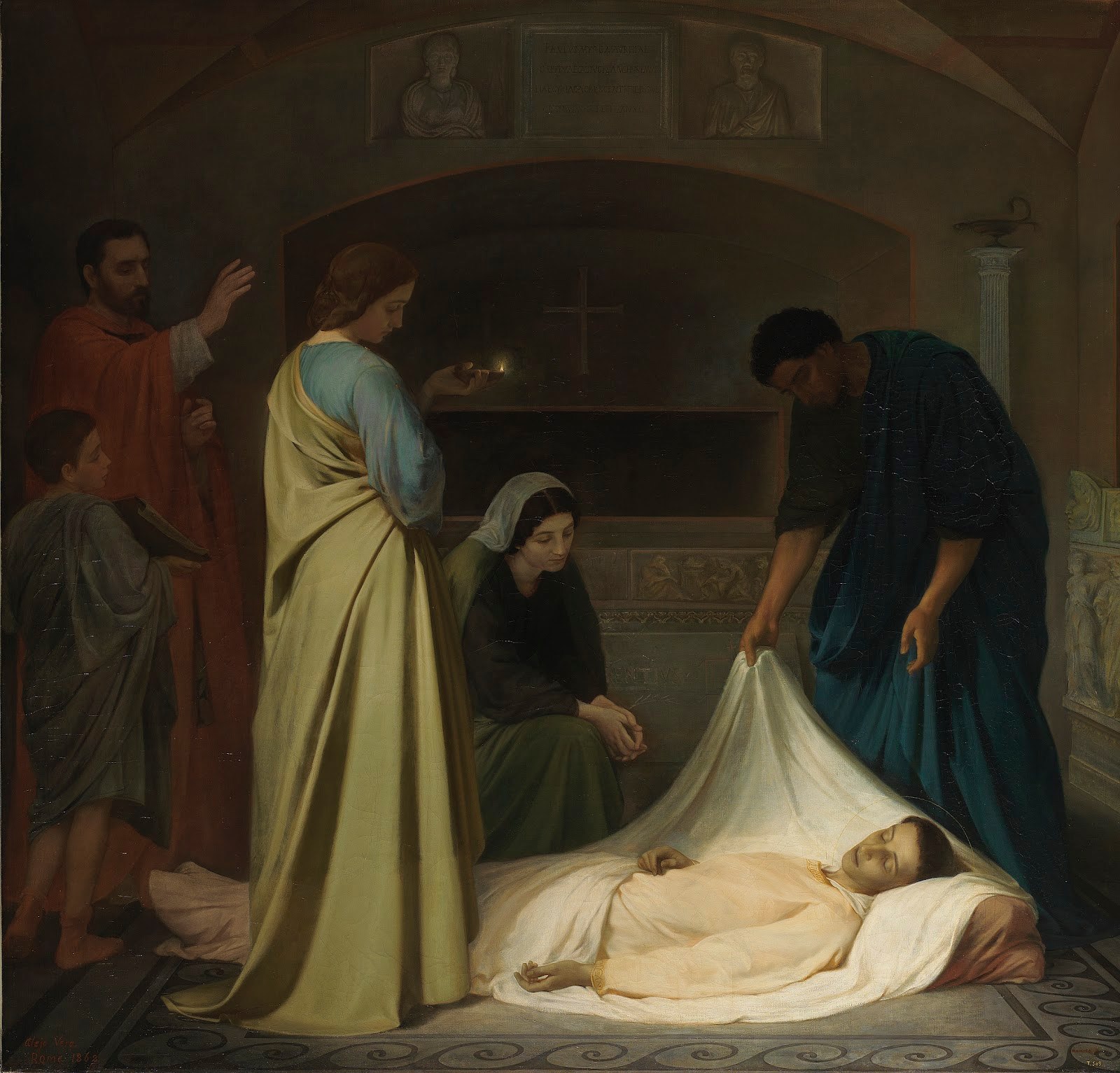
St LawrenceSaint Lawrence, deacon and martyr, is clearly a disciple of Christ that we need to follow. He prayed and worked; he never reduced his ministry to mere activism.

Saint Lawrence was Chief of the seven deacons of Rome. In the year 258 Pope Sixtus was led out to die, and Saint Lawrence followed beside him, weeping because unable to share his fate. Where are you going, my father, without your son? Where are you going, holy pontiff, without your deacon? Never did you offer a sacrifice without my serving you at the altar. In what way have I displeased you? The holy Pope comforted him with the words, I am not abandoning you, my son; a more difficult trial and a more glorious victory are reserved for you; in three days you will follow me.

This prophecy was fulfilled. After the Pope’s martyrdom the prefect of the city, knowing the rich offerings which the Christians put into the hands of the clergy, demanded the treasures of the Roman Church from Lawrence, their guardian. The Saint promised to show him, at the end of three days, riches exceeding all the wealth of the empire. He was granted the time of delay. The Archdeacon of Rome went about assembling the poor, the infirm, and the religious who lived by the alms of the faithful, and he brought them to the prefect on the appointed day. Behold the treasures I promised you; I add pearls and precious stones — these virgins and widows consecrated to God; the Church has no other riches. The prefect replied: How dare you play games with me, miserable one? Is this how you show your contempt for the imperial power?

Christ, whom Lawrence had served in His poor, gave him strength in the conflict which ensued. After being placed on the rack, he was stretched on a grill over a slow fire. He joked about his pains. I am roasted enough on this side, he said, perhaps you should turn me over. Soon, his gaze towards heaven, he gave up his soul to God. He was buried in the catacomb near the Tiburtine Way, called the Verano Field, a little over a mile from the city walls. The faithful watched there for three days to mourn their holy Archdeacon who had been so good to them. God, by the glory of this holy martyr, demonstrates the value He sets upon love for the poor. Innumerable prayers were offered at his tomb. Saint Lawrence continued from his throne in heaven his charity to those in need, granting them, as Saint Augustine says, the smaller graces which they sought, and leading them to the desire of better gifts.

Reflection: Our Lord appears before us in the persons of the poor. Charity to them is a great sign of predestination. It is almost impossible, the holy Fathers assure us, for any one who is charitable to the poor, above all for Christ’s sake, to perish.

Les Petits Bollandistes: Vies des Saints, by Msgr. Paul Guérin (Bloud et Barral: Paris, 1882), Vol. 9; Little Pictorial Lives of the Saints, a compilation based on Butler’s Lives of the Saints and other sources by John Gilmary Shea (Benziger Brothers: New York, 1894).

Saint John Mary Vianney

St John VianneyToday is the Feast day of Saint John Mary Vianney, the Curé d’Ars. He died on 4 August 1859, and was canonized and declared the patron of priests in 1929 by Pope Pius XI.

The Curé taught his parishioners primarily by the witness of his life. We recognize that from his example his people learned to pray, to visit Jesus frequently in the Tabernacle.

“One need not say much to pray well”, he explained to them, “we know that Jesus is there in the Tabernacle. Let us open our hearts to him, let us rejoice in his sacred presence. That is the best prayer”. And he would urge them: “Come to communion, my brothers and sisters, come to Jesus. Come to live from him in order to live with him… Of course you are not worthy of him, but you need him!”

Pope Benedict XVI wrote in his letter proclaiming the Year of the Priest, “In his time the Curé of Ars was able to transform the hearts and the lives of so many people because he enabled them to experience the Lord’s merciful love. Our own time urgently needs a similar proclamation and witness to the truth of Love: for God is Love (I John 4:8).”

Let us pray for our parish priests today.