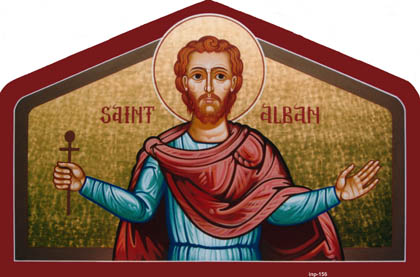
St. Alban, protomartyr of England

Today the Church in England honors its first martyr early in the 4th century, St Alban. In some missals, St Alban is commemorated on June 20. The saint’s biographer writes,

“St. Alban was the first martyr of England, his own country (homeland). During a persecution of Christians, Alban, though a pagan, hid a priest in his house. The priest made such a great impression on him that Alban received instructions and became a Christian himself.

“In the meantime, the governor had been told that the priest was hiding in Alban’s house, and he sent his soldiers to capture him. But Alban changed clothes with his guest, and gave himself up in his stead. The judge was furious when he found out that the priest had escaped and he said to Alban, “You shall get the punishment he was to get unless you worship the gods.” The Saint answered that he would never worship those false gods again. “To what family do you belong?” demanded the judge. “That does not concern you,” said Alban. “If you want to know my religion, I am a Christian.” Angrily the judge commanded him again to sacrifice to the gods at once. “Your sacrifices are offered to devils,” answered the Saint. “They cannot help you or answer your requests. The reward for such sacrifices is the everlasting punishment of Hell.”

“Since he was getting nowhere, the judge had Alban whipped. Then he commanded him to be beheaded. On the way to the place of execution, the soldier who was to kill the Saint was converted himself, and he too, became a martyr. 304 A.D.

Let us pray with the Church:

O God, by whose grace Saint Alban gave himself up for his friend and received the martyr’s crown as the first in this land to shed his blood for Christ: Grant, we pray, that, following his example and supported by his prayers, we may worship you, the living God, and give true witness to Christ our Lord. Who lives and reigns with you in the unity of the Holy Spirit, God, for ever and ever. Amen.
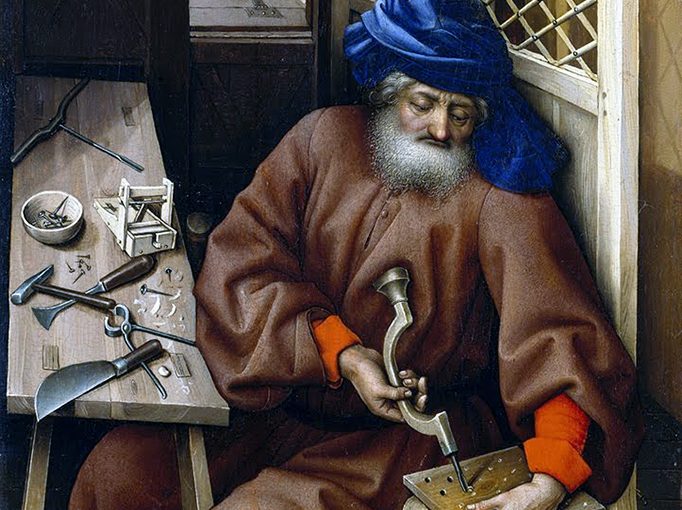
St Joseph the Worker

Pope Benedict XVI once commemorated the Feast of St. Joseph the Worker, he spoke of the fruitful tension (the generativity) that emerges for the Christian meaning of work:

“Work is of fundamental importance to the fulfillment of the human being and to the development of society. Thus, it must always be organized and carried out with full respect for human dignity and must always serve the common good.

At the same time, it is indispensable that people not allow themselves to been slaved by work or idolize it, claiming to find in it the ultimate and definitive meaning of life…”

The Pope continues:

“Work must serve the true good of humanity, permitting “men as individuals and as members of society to pursue and fulfill their total vocation” (Gaudium et Spes, n. 35). For this to happen, technical and professional qualifications, although necessary, do not suffice; nor does the creation of a just social order, attentive to the common good.

It is necessary to live a spirituality that helps believers to sanctify themselves through their work, imitating St Joseph, who had to provide with his own hands for the daily needs of the Holy Family and whom, consequently, the Church holds up as Patron of workers.”

Thus, as Catholics we don’t see meaningful work as trivial, a drudgery, a four lettered word –something to be avoided. We understand work as contributing to our sanctification and it demonstrates our ability to collaborate with God in building up the Kingdom of God. Following the example of St. Benedict who points to Joseph quietly, as one example, our goal is to integrate work and prayer, by pursuing the model of holiness as a beautiful work.

The Savior and the honey bees

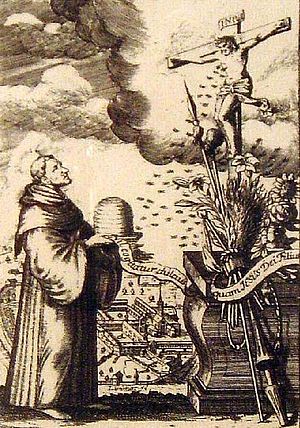
Great and Holy Friday seems like a day to post this intriguing picture of the crucified Lord, St Bernard and honey bees. Surely you can connect the dots. The Passion of the Lord –a supreme act of love, is called to mind and hence by the Cross we are saved. Particular thanks to Aurelius Belz, a researcher in the cultural history of musical instruments, for publishing this “find” on his blog.

From the Liturgy of St. Basil the Great we are educated: “… He [Jesus] surrendered himself as a ransom to death by which we were held captive, sold into slavery under sin. Descending by the cross into Hades to fulfill all things in himself, he freed us from Death’s despair, and rose on the third day, preparing the way for the resurrection of all flesh from the dead…”

Honey bees ascend to the side wound of Jesus.

Mr. Belz writes: “It should be noted here in relation to the medal that the encounter of a bee colony with the Savior has a significant precursor. Both on an altar sheet (private property, Germany) and in Josef Meglinger’s Cistercineser Year, published in 1700 in print, we see Bernard of Clairvaux –who received the epithet doctor mellifluus due to his honey-flowing sermons– with a beehive in front of an altar with the crucified. The bees ascend to the side wound of Jesus and on a banner we find the text. “Nil cogitatur dulcius quam JESUS Dei Filius”, nothing sweeter can be thought of than Jesus, the Son of God. The flowers on the altar are symbolic bearers of meaning, so the lily stands for innocence, the rose for love and the sunflower, which always turns to the light, for permanence in faith. (Josef Meglinger, Cistercienser Year, 1700)

St. Bernard is the famous abbot of the Cistercian Benedictine reform. He’s the patron saint of beekeepers as well as the patron saint of bees and candlemakers. The image connected with this post is Bernard of Clairvaux, circa 1090 – 20.8.1153, French monk, saint, full length, copper engraving, Germany, circa 1700, Marienthal Abbey library.

On a personal note, St. Bernard has been invoked as one of the patron saints of my apiary.

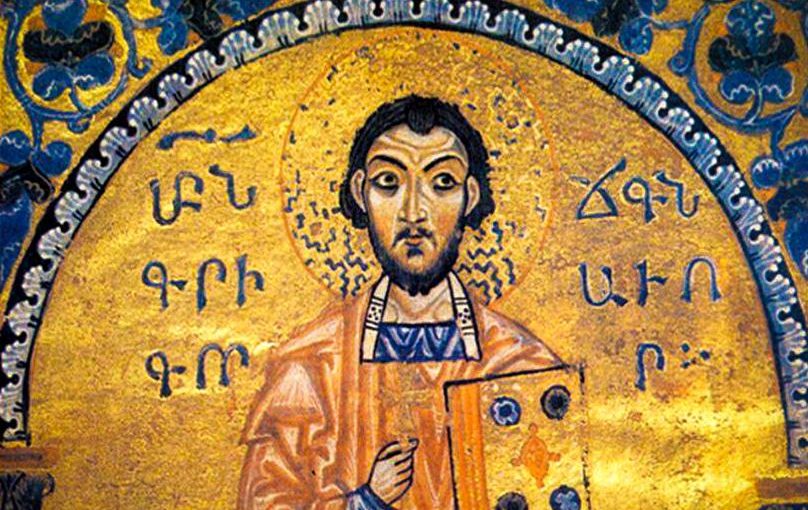
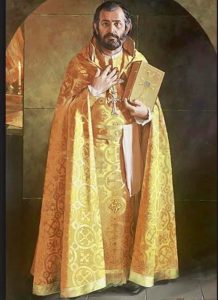
St Gregory of Narek

Doubtful that most Catholics will note who the Doctors of the Church are among the saints, but perhaps we ought to attend to the small group much more than we do. Today, St. Gregory of Narek is liturgically remembered by the Church. Gregory is revered as a saint, a man who served as a priest, gifted by the Spirit as a mystic, and shared his talents as a composer, astronomer, theologian and poet; he is honored as the first poet of Armenia and revered by Armenians as a “watchful angel in human form.” He is also the 36th Doctor of the Church and, one of very small group of Eastern Fathers with the title.
Matthew Bunson wrote a good biography of St Gregory of Narek that will give you a wider perspective.

St Lucy

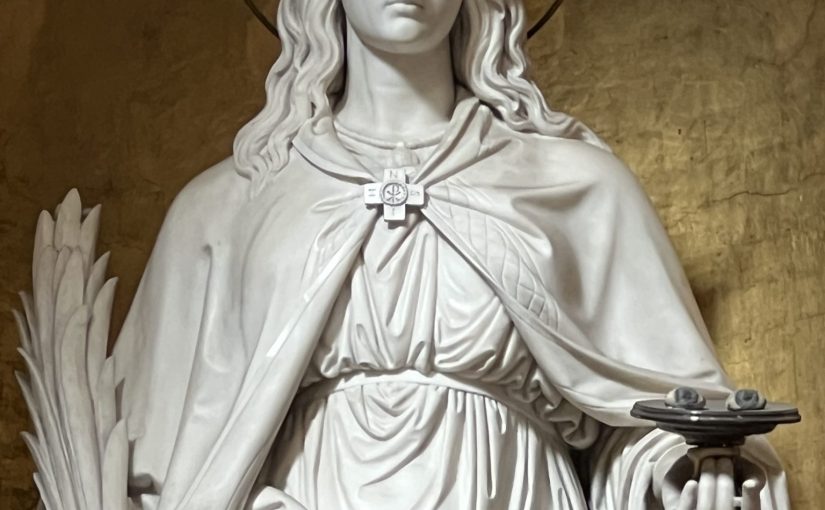
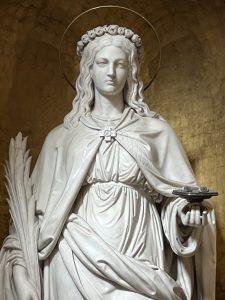
Today we pray for the gift to see. Not only seeing light, color and people/things, but seeing deeply things of God –in the spiritual life — through the intercession of Saint Lucy of Syracuse (283–304). It is a fervent pray of mine that Saint Lucy will open the eyes of us all to see truth, beauty and goodness; I also pray for my friend Ken whose birthday is celebrated today, and for those who live eye problems.
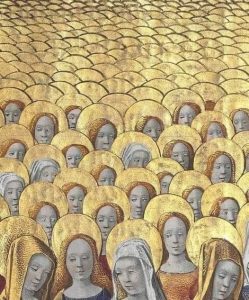
The feast of St. Lucy whose name from the Latin lux, for “light”, reminds us who dwell in the still darkening northern hemisphere that our days will soon be getting longer again.

One her biographers say “Some accounts have Lucy slain by having her throat thrust through with sword.

“Other accounts say that to protect her virginity she disfigured herself by cutting her own eyes out and sending them to her suitor, a plot likely to discourage him.

“St. Lucy is therefore the patroness of sight.

“St. Lucy shows up fairly often in Dante’s great Divine Comedy. She is first in the Inferno. It is Lucy who asked Beatrice to help Dante. In Purgatory the eagle that bears Dante upward in a dream is actually Lucy who is bearing him to the gate of Purgatory. Eagles, of course, are “eagle-eyed” and see very well. In the Paradiso she is placed directly across from Adam in the Heaven of the Rose. She can gaze directly at God.

The photo, above, is from the Church of St. Lucy in Rome taken by Fr JZ.

All Saints


“Therefore, since we are surrounded by so great a cloud of witnesses, let us also lay aside every weight and the sin that clings so closely, and let us run with perseverance the race that is set before us,” Hebrews 12:1.

“It is a great good to think that if we try we can become saints with God’s help. And have no fear that He will fail if we don’t fail. Since we have not come here for any other thing, let us put our hands to the task.”

St. Teresa of Avila, Doctor of the Church

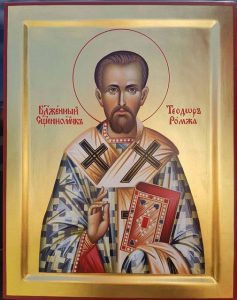
Blessed Theodore Romzha

“If the world hates you, realize that it hated me first. … No slave is greater than his master.’ If they persecuted me, they will also persecute you. If they kept my word, they will also keep yours.” (John 15:18.20)
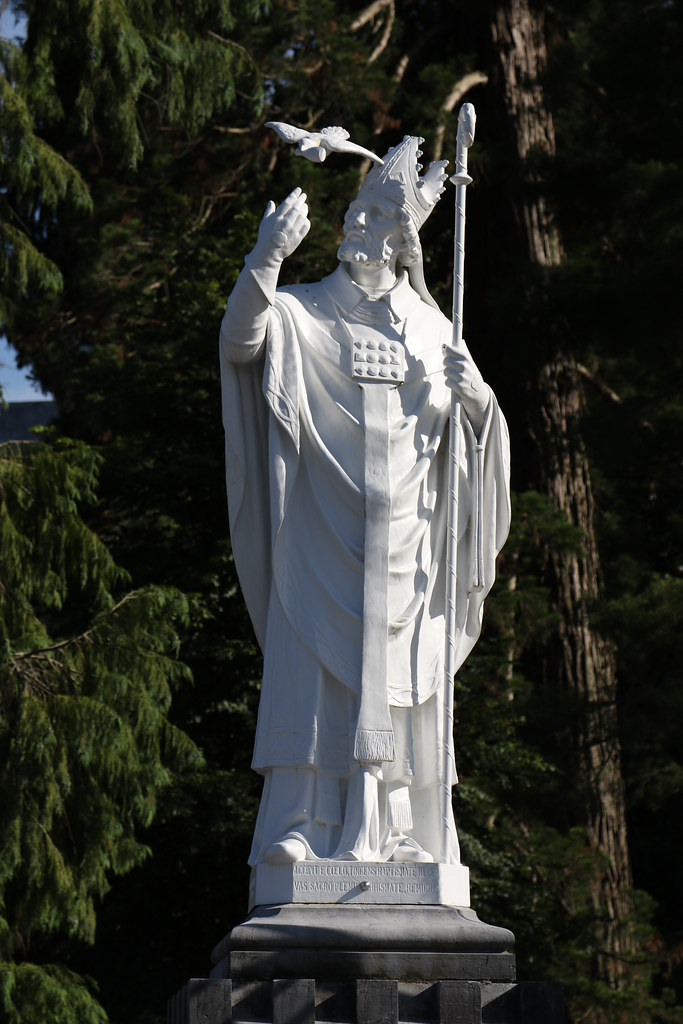
Bishop Kallistos Ware [+2022] said that today is truly the age of martyrs. More people are giving witness to Christ than ever before.

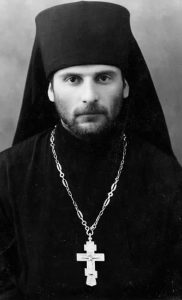
Today, the Byzantine Catholic Church remembers Blessed Theodore Romzha, who was killed by the Communists as he performed his pastoral duties. In the epistle read today, St. Paul reflects on what Christians have always had to do to follow Christ, “Now I rejoice in my sufferings for your sake, and in my flesh I am filling up what is lacking in the afflictions of Christ on behalf of his body, which is the church. (Colossians 1:24)” This, St. Paul, comes from the great mystery of the Church: Christ in us, our hope of glory. (Colossians 1:27) We do not give up our lives for our own purposes, but because we know that our life is in Christ. We die not only for some ideal, but in witness to a person -the Jesus Christ, our Lord, “light from light, true God from true God.” This is why in history Christians have been persecuted by all kinds of organizations and ideologies and economic systems which perceive Jesus, the Giver of Life, as a threat.

Sadly, even in our history, Christians have persecuted other Christians. However, today we proclaim the glory of all those who proclaim Jesus as Lord. Indeed, the feast is ecumenical, celebrating the Byzantine Catholic bishop who died for Christ in 1947, Theodore Romzha, and the Russian Orthodox priest, John Kochurev, who had served as a pastor in Chicago, but was the first Orthodox priest to be martyred by the Communists in Russia in 1917. Both Catholic and Orthodox therefore bear united witness to the one Lord Jesus Christ in the face of his enemies.

Meditation by Archpriest David Petras

Saint Remi

The Church recalls the French saint who very evangelical in the face of pagan belief arguing for the worship of the One, Triune God. He was a persuasive preacher and teacher.

ST REMI

Remi was elected bishop of Rheims in 459 when he was only 22 years old, and guided his flock for more than 70 years. Clovis ruled northern Gaul in those days and despite the constant urgings of his wife, St Clotilde, whose father was the Christian king of Burgundy, he refused to abandon his tribal gods. When bishop Remi joined his power of argument to the efforts of the queen, and after an impressive military victory, the king finally agreed to be baptized. But as St Remi led Clovis into the font, he warned him to be humble and “worship what you have burned and burn what you have worshipped!” Following this event Remi was quick to spread the good news among the Franks, and tradition relates many miracles that accompanied his preaching.

St Remi was also a supporter of Nicaean Orthodoxy and was vigorous in opposing Arianism. France honors this saint on October 1. (NS)

IMAGE BY FR LAWRENCE LEW, OP

Saint Helen, Empress, Mother, Pilgrim

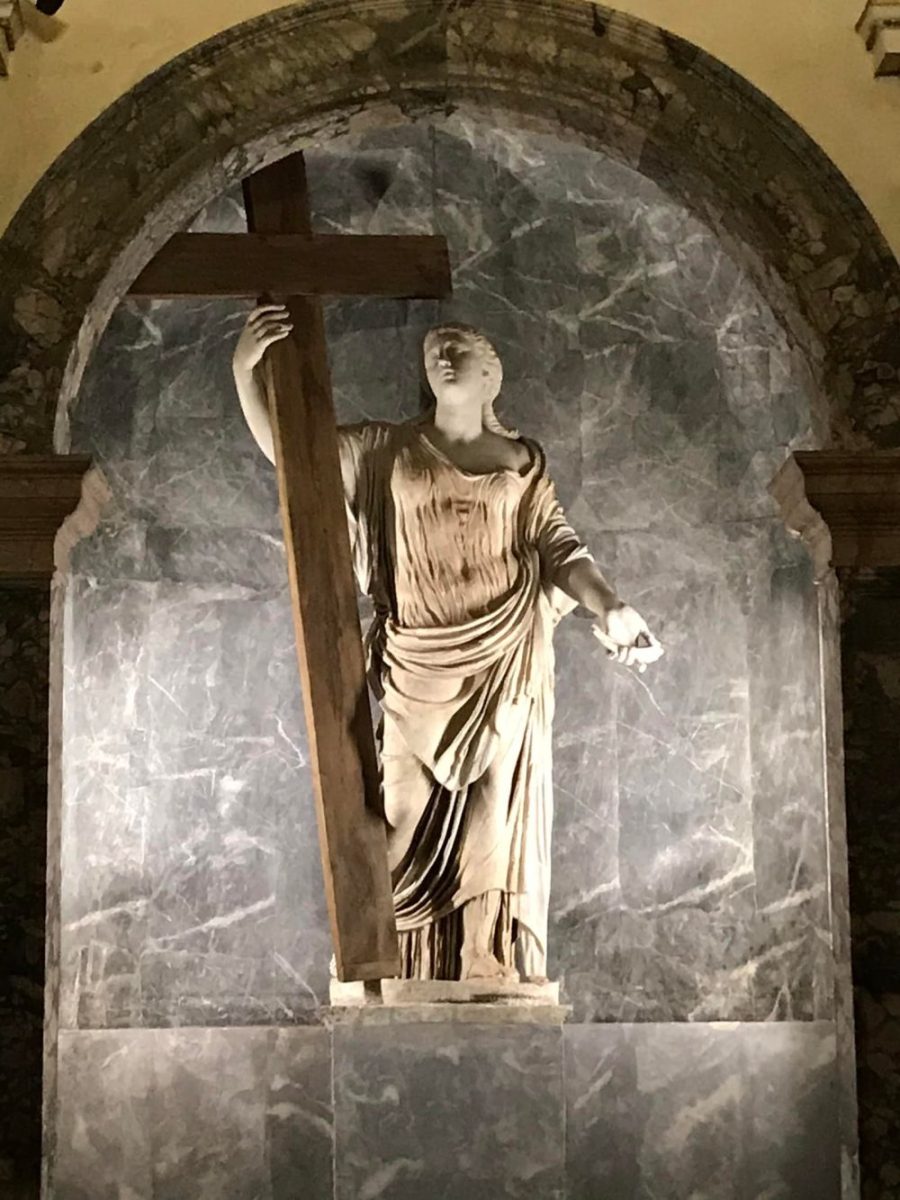
In Rome and Jerusalem especially, and especially for me in the Equestrian Order of the Holy Sepulchre of Jerusalem, we celebrate today Saint Helen (d. 327 A.D.), empress, mother, pilgrim of the Holy Land, who made worship places and relics of the history, the mystery of salvation.

Several years ago I was privileged to live at the Basilica of Santa Croce in Rome where the relics of the Lord’s passion reside. It was a beautiful thing to have some daily prayer in this holy place.

Let us pray for the Church and the Order of the Holy Sepulchre.

Image of St Helena at the Basilica of Santa Croce in Rome.