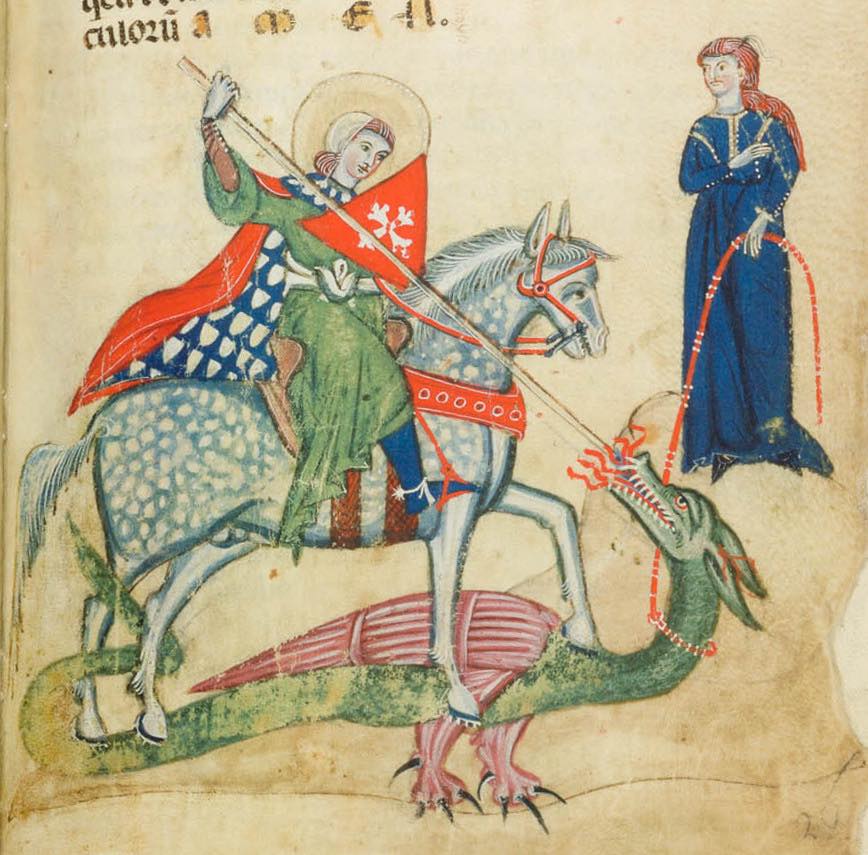
St George, pray for us.
St George, pray for us.
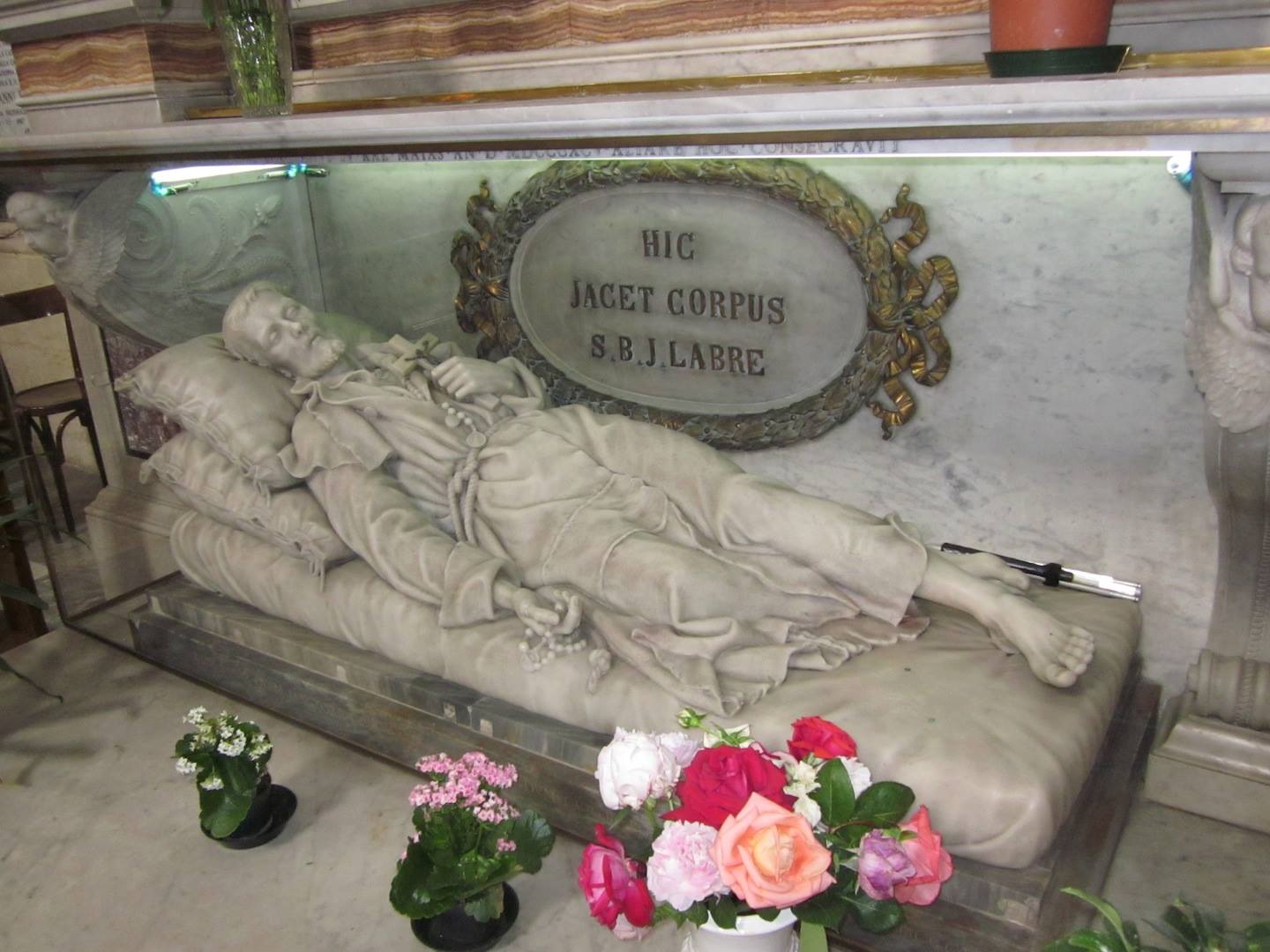 Today’s saint, Saint Benedict-Joseph Labre, was a homeless street person. His home, it is reported, used to be in a hole in the Colosseum. Probably a rarity, other street persons gave testimony for Labre’s canonization process.
For many, the Labre is a great witness to the Gospel and therefore frequently visit the Church near the Colosseum and the Angelicum, Santa Maria ai Monti, where he is entombed.
Saint Benedict-Joseph thought his vocation was to the contemplative life and therefore tried to join the Trappists, the Common Observance Cistercians, and the Carthusians; but was denied profession of vows. In many ways his cloister was the world. Wandering Europe, especially Rome, in complete poverty, spending his days in perpetual adoration of the Blessed Sacrament. He begged in the streets, and if he was given more than he needed for the day, he would give the remainder to a person he considered more in need. Benedict-Joseph healed some of his fellow homeless, and was reported to have multiplied bread for them; he was also the spiritual director for many. Given to religious ecstacies when contemplating the crown of thorns; reputed to float, soar, and bilocate when in these swoons. He died in a hospice, exhausted from his life of austerity.
Father Marconi, Labre’s confessor and biographer, describes 136 miraculous cures attributed to him within three months of his death.
May Saint Benedict-Joseph Labre show us the face of Christ today.
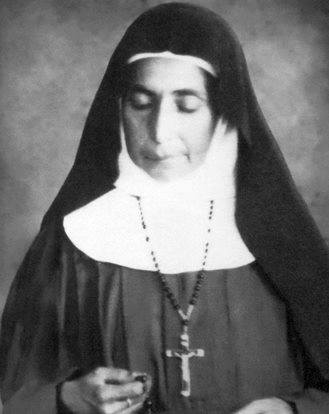 St Mariam Sultaneh Danil Ghattas (4 October 1843-25 March 1927), was a Dominican tertiary. She first joined the Sisters of Joseph but following a vision of the Blessed Virgin Mary she received in Bethlehem, she co-founded the Rosary Sisters (Sisters of the Holy Rosary of Jerusalem of the Latins; Congregation of the Sisters of the Most Holy Rosary of Jerusalem). The visions were kept a secret for 53 years, and her journals read only post mortem. People recognized the virtues of humility and meekness in Mother Mariam, similar to those of the Mother of God.
Ghattas promoted the Confraternity of the Immaculate Conception (later known as, “Daughters of Mary”) and also the Confraternity of the Christian Mothers.
Mother Mariam spent her life working for the poor and the education of Palestinian Christians, and her Sisters continue that work today.
St Mariam Sultaneh Danil Ghattas was beatified on 22 November 2009, in the Basilica of the Annunciation, Nazareth; she was the second Palestinian nun to be beatified. She was canonized by Pope Francis on 17 May 2017.
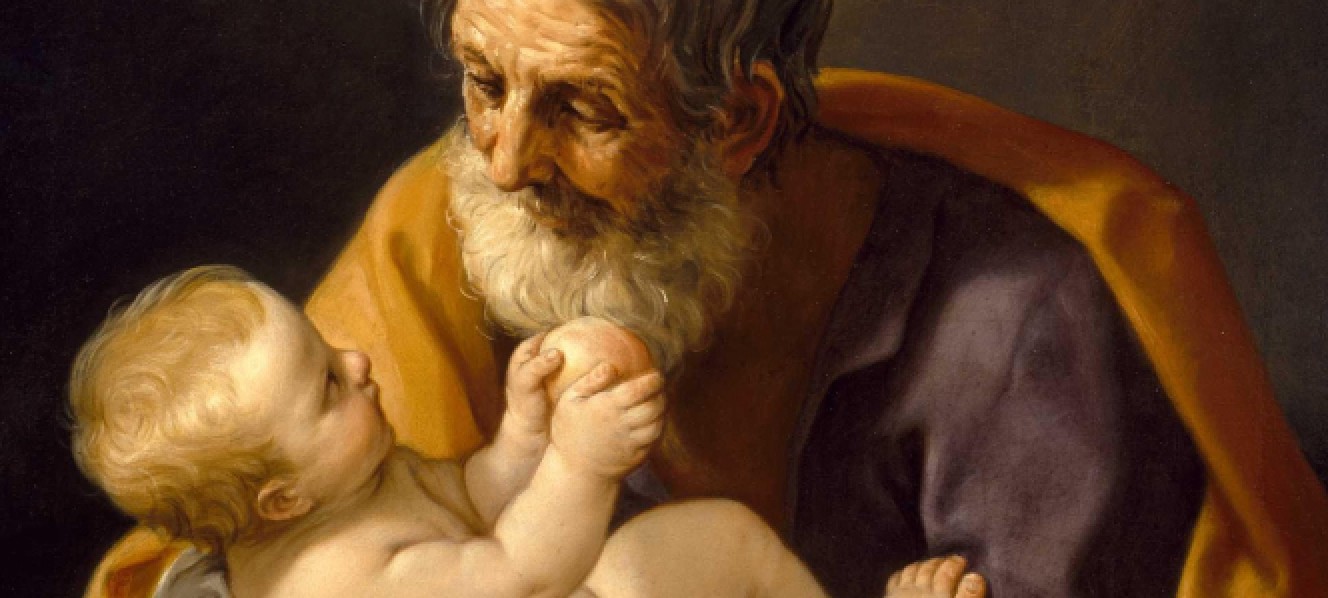 St. Joseph was chosen among all men, to be the protector and guardian of the Virgin Mother of God; the defender and foster-father of the Infant-God, and the only co-operator upon earth, the one confidant of the secret of God in the work of the redemption of mankind.
~St. Bernard of Clairvaux
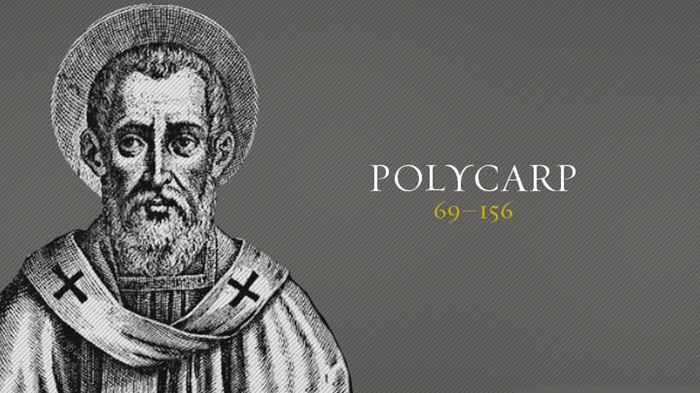
Today we liturgically honor St Polycarp. We have a letter from St Ignatius of Antioch to Polycarp written around AD 110, when he was a young bishop in Smyrna. Ignatius himself going to Rome in chains to face martyrdom. Ignatius wrote:
Stand firm, like an anvil being struck with a hammer. It is the mark of a great athlete to be bruised, yet still conquer. But especially we must, for God’s sake, patiently bear all things, so that he may also bear with us. Be more diligent than you are. Understand the times. Wait expectantly for the one who is above time: the Eternal, the Invisible, who for our sake became visible; the Intangible, the Unsuffering, who for our sake suffered, who for our sake endured in every way. (Letter of Ignatius to Polycarp, 3)
Polycarp stood firm; he was a great athlete; he was patient; he was diligent. Are we? Do we have these traits in in following Christ, and dealing with adversity? Today, let us ask for the same grace Polycarp did so as to fight evil?
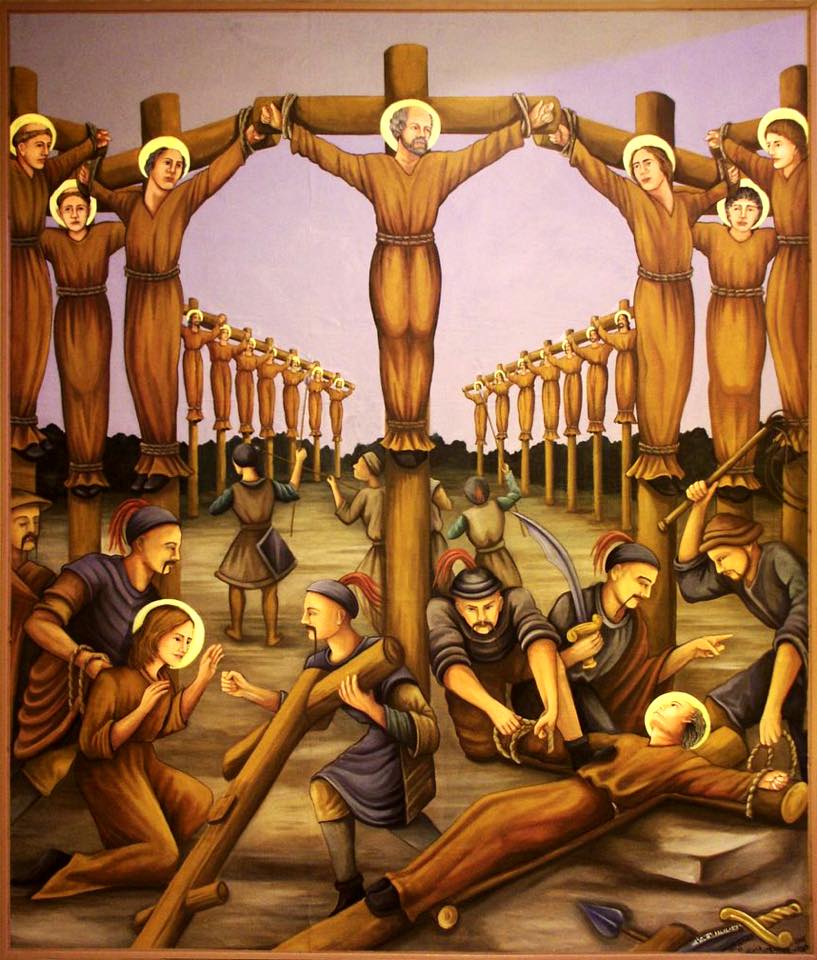 The Martyrs of Nagasaki, St. Paul Miki (1562–1597) and his twenty-five companions are liturgically honored today. As you note from the image he was crucified for the faith in Nagasaki, Japan, in 1597.
Historians tell us that Miki was Japanese layman of great nobility and wealth, who converted to Christ by the great missionary, St. Francis Xavier. The Church, initially, was not in opposition to the Emperor and his princes but as time went on Christians were felt to be a threat to Japanese culture. Paul Miki and his companions were tortured and made to walk 600 miles to Nagasaki before they died. Given the option for personal freedom if they denied Christ and the Church, Paul remained steadfast to the Faith. I wonder how many of us would do the same today?
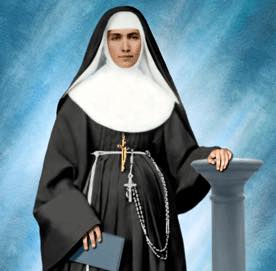 The Church in America liturgically remembers St. Marianne Cope (1838–1918), also known as St. Marianne of Molokai, today.
A German immigrant to the USA, Marianne worked in a New York factory before entering the Sisters of the Third Order of Saint Francis in Syracuse. Her superiors missioned Sister Marianne to a ministry in health care and education where she excelled. Called to serve the poor, and by Divine Providence, Hawaii opened the door for Mother Marianne and six sisters to go on mission in 1883. There she gave 35 years to caring for those afflicted with Hansen’s disease (leprosy) in Molokai, Hawaii, establishing a hospital and a school for girls on the island of Maui. She is remembered for introducing cleanliness, dignity, and fun into the colony. Despite her direct contact with leprosy patients over many years, she was not afflicted by the disease, which some consider miraculous. A gift for Sister Marianne was collaborating with St. Damien of Molokai. Benedict XVI canonized Marianne Cope in 2012.
Are we open to the promptings of Divine Providence?
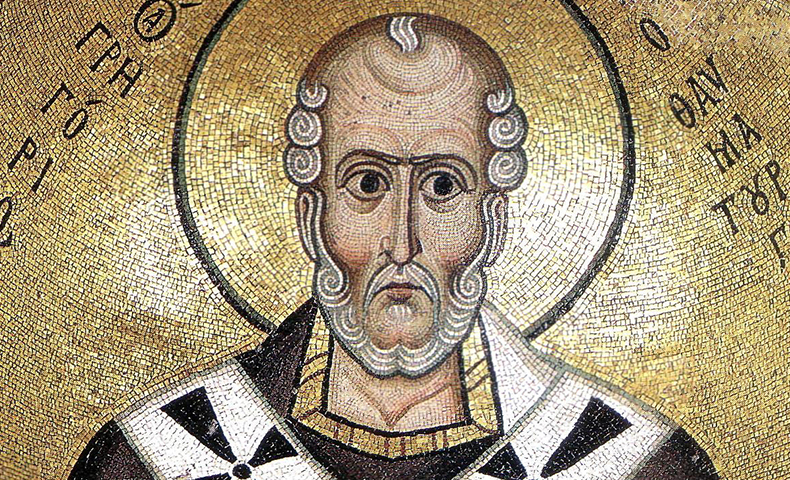 After his education, Gregory married and became a teacher of rhetoric. We do not know what happened to his wife, but the influence of his older brother Basil was strong enough to draw Gregory to monastic life. In 371, Basil arranged for his election as bishop of Nyssa, a town in Basil’s province. It was a political move intended by Basil to stem the influence of the Arians. Gregory was not happy with this sudden thrust into the fray, and he was not a very effective ally, and his brother criticized him for his lack of firmness. In the following decade he was deposed by the Arians, and later restored. His brother died, and Gregory came into his own. he was a prominent participant in the 2nd Ecumenical Council. He wrote scriptural commentaries and spoke of the concept of theosis, or deification as a luminous darkness, the ultimate paradox of union with God. His mystical theology is an early expression of the apophatic method which places more certainty in what we cannot say or know about divine truths. (NS)
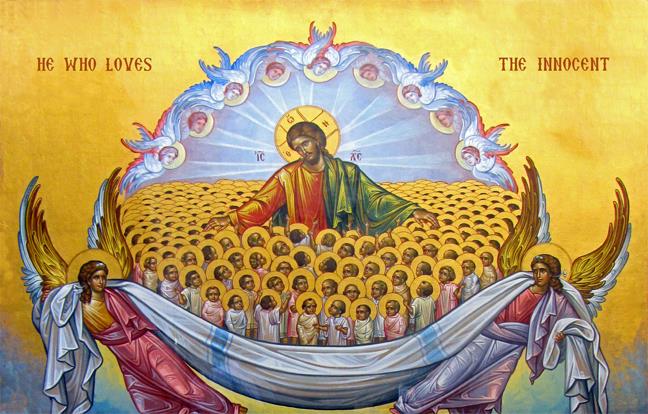 Today, in the days following the feast of the Incarnation, we honor the memory those who were among the first to die as martyrs for faith in Jesus Christ. It is amazing that 2000 years ago we had very young people, innocents, killed due to sin and hardness of heart. The feast day for the Holy Innocents marks the martyrdom of an unnumbered group of boys aged 2 and under during the reign of King Herod. The murder of these young boys fulfills the prophecy of St Jeremiah:
Then was fulfilled that which was spoken through Jeremiah the prophet, saying, ‘A voice is heard in Ramah, mourning and great weeping, Rachel weeping for her children and refusing to be comforted, because her children are no more.’ (Jer 31:15)
They did not die on account of their own personal misdeeds; a confession of faith was not required of them. Why did they die? We don’t know; that answer is known to God alone; but we trust that their eternal life is better than any life they had on earth; happiness, and beatitude. We know that they died in retaliation in Herod searching out competition. And Jesus was that competitor. As the Latin hymn says, Crudelis Herodes, Deum Regem venire quid times? Non eripit mortalia, Qui regna dat caelestia (Cruel Herod what do you fear in the King and God to come? He seizes not earthly things who gives heavenly kingdoms). Indeed, it IS his fear that drives Herod.
In our own era we have similar deaths of innocents –while not laying their lives down for Jesus in the same way, but violent and egregious nonetheless with the victims of abortion. Plus, we can’t forget the children plagued with human trafficking and domestic violence. Some young people are trafficked for sex, forced labor, immigration and war. Nonetheless, the killing of babies and the very young is unbelievable.
What does this all mean for our prayer and mission? Pope Francis said last year on this feast day: “To contemplate the manger also means to contemplate this cry of pain, to open our eyes and ears to what is going on around us, and to let our hearts be attentive and open to the pain of our neighbors, especially where children are involved.”
Archpriest David Petras wrote, “The holy innocents are only the first of thousands upon thousands who will have to die for the spiritual kingdom of God. God does not oppose the violence of this world with weapons or an army, but he calls upon all to hear the truth and to love and not hate. This part of the Christmas gospel may make us extremely uncomfortable – almost by definition, but it reminds us of the struggle faith will have in this world, and that every Christian must be prepared to offer his or her life for God.”
On this feast of the Holy Innocents during the Octave of the Nativity, the Christ Child and the innocents have something definite to teach us: that we are to protect human life at this very tender stage. In honoring these little ones we also reflect upon the need for our atoning for forgetting about the deaths of these youths. May the intercession of the Holy Innocents be with those in need, with all of us.