Holy Innocents

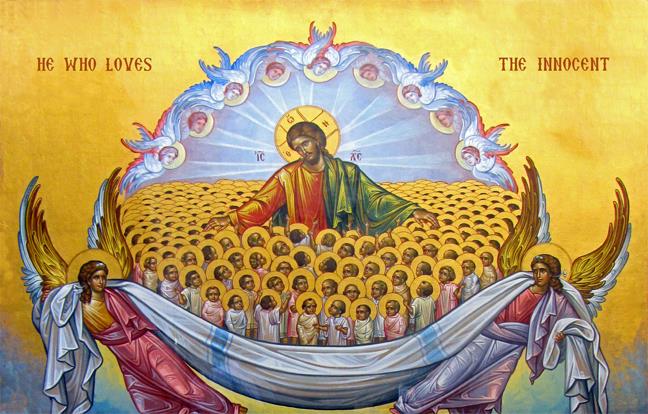
Today, in the days following the feast of the Incarnation, we honor the memory those who were among the first to die as martyrs for faith in Jesus Christ. It is amazing that 2000 years ago we had very young people, innocents, killed due to sin and hardness of heart. The feast day for the Holy Innocents marks the martyrdom of an unnumbered group of boys aged 2 and under during the reign of King Herod. The murder of these young boys fulfills the prophecy of St Jeremiah:

Then was fulfilled that which was spoken through Jeremiah the prophet, saying, ‘A voice is heard in Ramah, mourning and great weeping, Rachel weeping for her children and refusing to be comforted, because her children are no more.’ (Jer 31:15)

They did not die on account of their own personal misdeeds; a confession of faith was not required of them. Why did they die? We don’t know; that answer is known to God alone; but we trust that their eternal life is better than any life they had on earth; happiness, and beatitude. We know that they died in retaliation in Herod searching out competition. And Jesus was that competitor. As the Latin hymn says, Crudelis Herodes, Deum Regem venire quid times? Non eripit mortalia, Qui regna dat caelestia (Cruel Herod what do you fear in the King and God to come? He seizes not earthly things who gives heavenly kingdoms). Indeed, it IS his fear that drives Herod.

In our own era we have similar deaths of innocents –while not laying their lives down for Jesus in the same way, but violent and egregious nonetheless with the victims of abortion. Plus, we can’t forget the children plagued with human trafficking and domestic violence. Some young people are trafficked for sex, forced labor, immigration and war. Nonetheless, the killing of babies and the very young is unbelievable.

What does this all mean for our prayer and mission? Pope Francis said last year on this feast day: “To contemplate the manger also means to contemplate this cry of pain, to open our eyes and ears to what is going on around us, and to let our hearts be attentive and open to the pain of our neighbors, especially where children are involved.”

Archpriest David Petras wrote, “The holy innocents are only the first of thousands upon thousands who will have to die for the spiritual kingdom of God. God does not oppose the violence of this world with weapons or an army, but he calls upon all to hear the truth and to love and not hate. This part of the Christmas gospel may make us extremely uncomfortable – almost by definition, but it reminds us of the struggle faith will have in this world, and that every Christian must be prepared to offer his or her life for God.”

On this feast of the Holy Innocents during the Octave of the Nativity, the Christ Child and the innocents have something definite to teach us: that we are to protect human life at this very tender stage. In honoring these little ones we also reflect upon the need for our atoning for forgetting about the deaths of these youths. May the intercession of the Holy Innocents be with those in need, with all of us.
St Nicholas

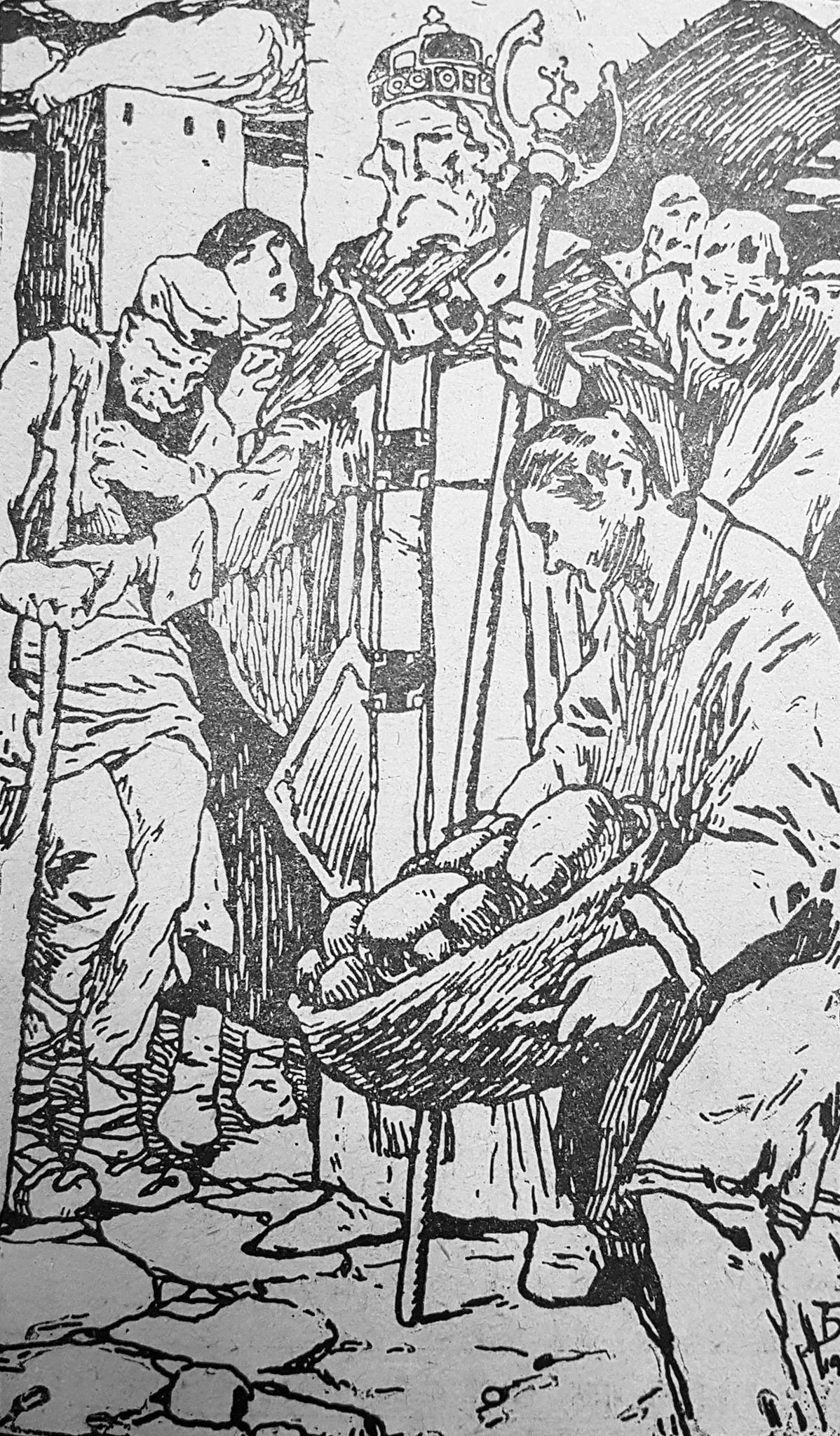
An illustration of St. Nicholas, the Wonderworker, Archbishop of Myra in Lycia whose feast we celebrate today.

St. Nicholas is the patron saint of the Ruthenian Greek Catholic Church in the United States, and protector of our children. Traditionally, before bed the prior night, children would leave their shoes out and upon waking on December 6th they would find them filled with treats left by the saint from the night before. This is a custom observed by many East Slavs throughout the world.

In the illustration St. Nicholas is depicted feeding the poor while wearing the vestments of a Byzantine bishop, notably the omophorion, epigonation, and mitre. The mitre which is topped by a cross, and resembling an imperial crown, was not worn by bishops until after the fall of Constantinople; however, this is how the saint is traditionally depicted in Byzantine iconography.

(Artwork by Yosyf Bokshai, 1922; h/t MW)

St Andrew

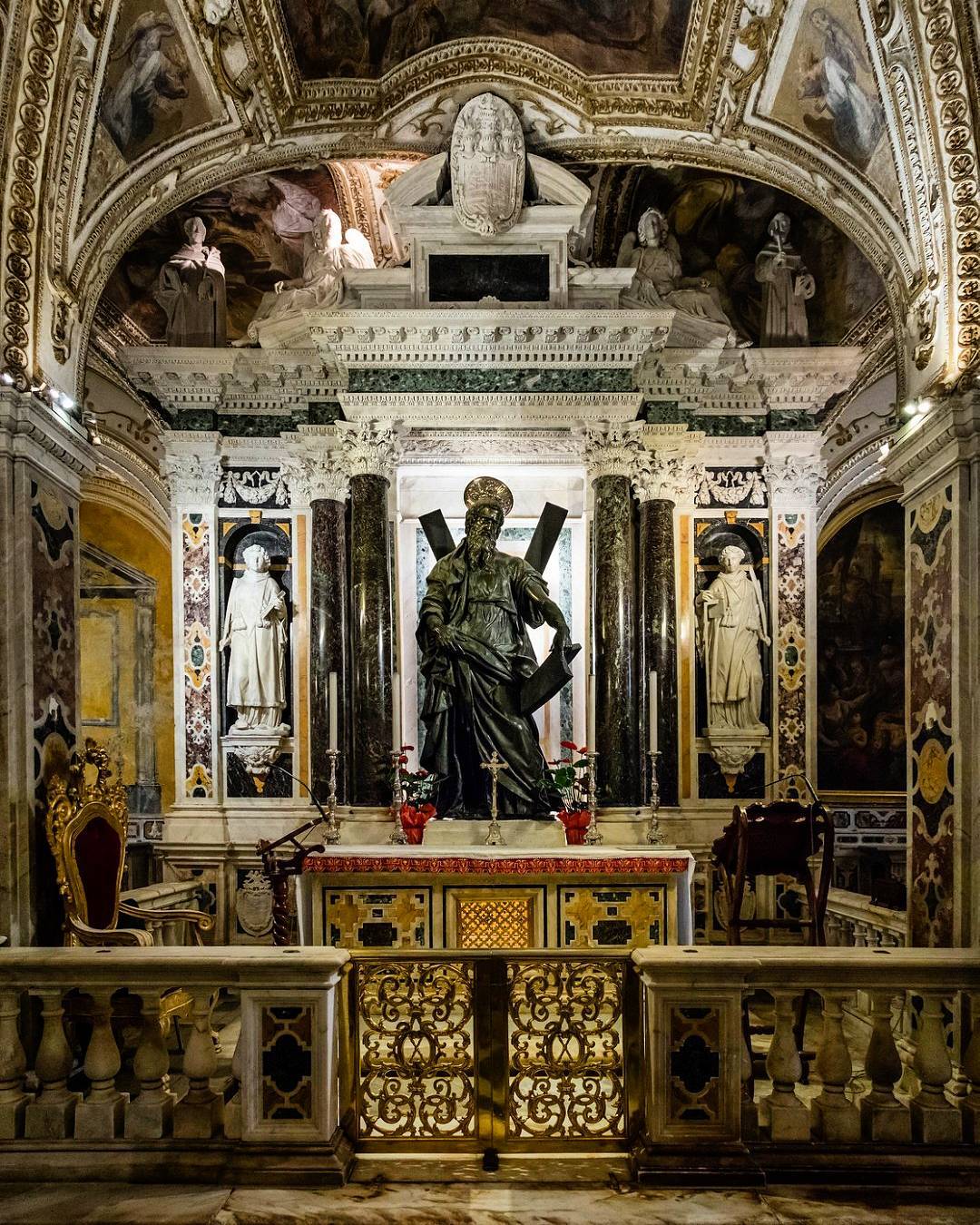
A later tradition … tells of Andrew’s death at Patras, where he too suffered the torture of crucifixion. At that supreme moment, however, like his brother Peter, he asked to be nailed to a cross different from the Cross of Jesus. In his case it was a diagonal or X-shaped cross, which has thus come to be known as “St Andrew’s cross”.

This is what the Apostle is claimed to have said on that occasion, according to an ancient story (which dates back to the beginning of the sixth century), entitled The Passion of Andrew:

“Hail, O Cross, inaugurated by the Body of Christ and adorned with his limbs as though they were precious pearls. Before the Lord mounted you, you inspired an earthly fear. Now, instead, endowed with heavenly love, you are accepted as a gift.

“Believers know of the great joy that you possess, and of the multitude of gifts you have prepared. I come to you, therefore, confident and joyful, so that you too may receive me exultant as a disciple of the One who was hung upon you…. O blessed Cross, clothed in the majesty and beauty of the Lord’s limbs!… Take me, carry me far from men, and restore me to my Teacher, so that, through you, the one who redeemed me by you, may receive me. Hail, O Cross; yes, hail indeed!”.

Here, as can be seen, is a very profound Christian spirituality. It does not view the Cross as an instrument of torture but rather as the incomparable means for perfect configuration to the Redeemer, to the grain of wheat that fell into the earth.

Here we have a very important lesson to learn:  our own crosses acquire value if we consider them and accept them as a part of the Cross of Christ, if a reflection of his light illuminates them.

It is by that Cross alone that our sufferings too are ennobled and acquire their true meaning.

The Apostle Andrew, therefore, teaches us to follow Jesus with promptness (cf. Mt 4: 20; Mk 1: 18), to speak enthusiastically about him to those we meet, and especially, to cultivate a relationship of true familiarity with him, acutely aware that in him alone can we find the ultimate meaning of our life and death.

Benedict XVI
Audience, June 14, 2006

Image: Fr. Kevin Kim’s

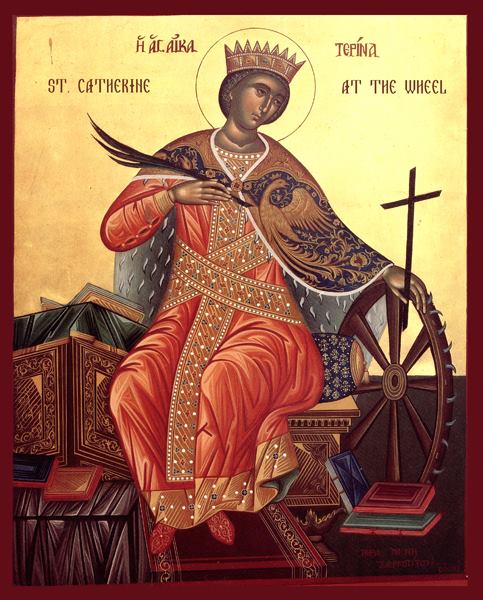
St Catherine of Alexandria


“Let all of us who love to honor the martyrs form a great choir and praise the most wise Catherine, for she preached Christ in the stadium and trampled the serpent, despising the art of orators.”

-Kontakion for the feast of Great-Martyr Catherine of Alexandria


Are we preaching Christ Jesus everywhere we go?

St Clement of Rome

Clement was a disciple of Ss. Peter and Paul from whom he learned about Jesus and the new Way. Much of what we know about Clement comes from his epistle to the Church at Corinth (an example of pastoral concern and paternal prudence). Yet, our knowledge of Clement comes through the witness of St. Irenaeus spent significant time with the Church at Rome, before serving as bishop of Lyon from approximately AD 177. Irenaeus was a pupil of Polycarp. The Roman Christians chose him as their bishop to succeed Linus and Cletus who briefly held that office before being martyred.

Its antiquity ranks Clement as the first of the great Apostolic Fathers. Tradition holds that after being tried for his faith Clement was exiled to hard labor in the Crimea, where he was believed to have been martyred. His relics were returned to Rome by St. Cyril, who reportedly discovered them on one of his early missionary journeys to the region. The relics were placed in what is now called St. Clement’s church in Rome (now under the direction of the Order of Preachers), where Cyril himself was buried when he died while he and Methodius were in Rome preparing for their mission among the Slavs.

The importance of St. Clement is his understanding of ecclesial authority and the life of the Christian in the face of said authority. As St. Irenaeus says, Clement had “the preaching of the apostles … echoing [in his ears], and their traditions before his eyes.” Is this true for us today? Do we have the preaching of the apostles echoing in my ears, and the traditions of the apostles before my eyes?

St Cecilia

St. Cecilia, one of the venerated Virgin Martyrs of the early Church. Known as the patron saint of church musicians, she is the object of many a poet and has the affection of many even today.

Orpheus could lead the savage race;
And trees unrooted left their place;
Sequacious of the lyre:
But bright Cecilia rais’d the wonder high’r;
When to her organ, vocal breath was giv’n,
An angel heard, and straight appear’d
Mistaking earth for Heav’n. (John Dryden)

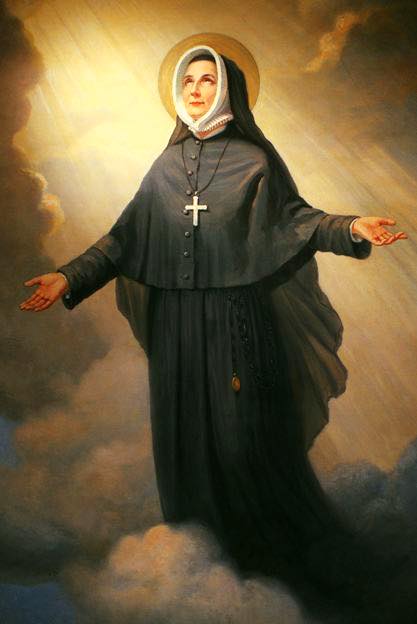
St. Rose Philippine Duchesne

St. Rose Philippine Duchesne (1769–1852) was born in Grenoble, France, to a wealthy and prominent family. At the age of 18 she joined the Visitation nuns against the wishes of her family, taking her religious name after St. Rose of Lima and St. Philip Neri. During the anti-religious fervor of French Revolution, the “Reign of Terror,” her convent was shut down. She then took up the work of providing care for the sick, hiding priests from the revolutionaries, and educating homeless children.

When the tensions of the revolution subsided, she rented out her old convent in an attempt to revive her religious order, but the spirit was gone. She and the few remaining nuns of her convent then joined the Society of the Sacred Heart of Jesus (founded in 1800). Since childhood St. Rose Philippine had had a strong desire to be a missionary in the New World, and encouraged by her spiritual father, she wanted to work especially among the Native Americans. Like the Apostles sent by the Lord, she was sent by the Society to go on mission in 1818; she and four nuns traveled across the Atlantic, up the Mississipi river to serve in one of the remotest outposts in the region in St. Charles, Missouri.

The vocation St. Rose had was for a blend of the contemplative life and the missionary life: a contemplative in action, like that of the Society of Jesus. St. Rose Philippine was a hardy pioneer woman ministering in the Midwest during its difficult frontier days. She opened several schools and served the Potawatomi Indians who gave her the name “Quah-kah-ka-num-ad,” meaning, “Woman-who-prays-always.”

St. Rose Philippine followed the example the foundress of the Sacred Heart Society, trusting completely in God with boldness and completeness that would saturate her whole life and mission. Her mission, like that of St Paul, was realized in “the power now at work in us can do immeasurably more than we can ask or imagine.” (Ephesians 3:20)

At the age of 83 St. Rose Philippine on this date. She was canonized on July 3, 1988 by St. John Paul II. (edited DG)

St. Francis Xavier Cabrini

I have, for many years, admired Mother Cabrini for reasons known and unknown. Today’s feast gives us the space of time to consider the vocation and mission of a great woman called by Jesus to serve Him. The following prayer should keep us focussed.

Prayer of St. Cabrini after Confession

My dearest Jesus, I have told all my sins as well as I could. I tried hard to make a good confession. I feel sure that you have forgiven me. I thank You. It is only because of all Your sufferings that I can go to confession and free myself from my sins. Your Heart is full of love and mercy for poor sinners. I love You because You are so good to me. My loving Saviour, I shall try to keep from sin and to love You more each day. My dear Mother Mary, pray for me and help me to keep my promises. Protect me and do not let me fall back into sin. Almighty God, kneeling before Your Divine Majesty, I adore You and because You command me, I dare approach Your divine Heart. But what shall I say if You do not enlighten me with a ray of Your divine light?

Speak to my soul, O Lord, and command me to listen to Your voice. Enlighten my will to put Your words into practice. Pour Your grace into my heart; lift up my soul weighed down by my sins; raise my mind to heavenly things, so that earthly desires may no longer appeal to me. Speak to my soul with Your divine omnipotence, for You are my salvation, my life, and my peace, in time and in eternity. Strengthen me with the grace of Your Holy Spirit and give Your peace to my soul that I may be free from all needless worry and care. Help me to desire always that which is pleasing and acceptable to You so that Your Will may be my will, Grant that I may rid myself of all unholy desires, and that for Your love I may remain unknown in this world, and be known only to You.

Do not permit me to attribute to myself the good that You perform in me and through me, but rather, referring all honor to Your majesty, may I glory only in my weakness, so that renouncing sincerely all vain glory which comes from the world, I may aspire to the true and lasting glory which comes from you. Amen.

St Luke

“Luke’s Gospel is marked by a special concern for the poor, the marginalized, women, and social outcasts. His account of the nativity, with its stress on the faith of Mary, emphasizes the humbleness of Jesus’ birth and its significance in fulfilling the hopes of the poor. It is in Luke’s Gospel that Jesus preaches, “Blessed are the poor” and where we find the parable of the rich man and the poor beggar Lazarus, offering such a striking image of the relation between mercy and justice in this life and in the life to come.”
Blessed Among Us, by Roger Ellsberg, p. 600.

St. John XXIII, pope

Today is the liturgical memorial of St. John XXIII. This is the first time the universal Church is permitted to observe this feast. He was the beloved Servant of the Servants of God.

Here is the opening prayer for the Novus Ordo Liturgy.

Almighty and eternal God, who in the Pope, Saint John XXIII, gave to the whole world the shining example of a good shepherd, grant that, through his intercession, we may with joy spread abroad the fullness of Christian charity.

Through our Lord Jesus Christ, your Son, who lives and reigns with you in the unity of the Holy Spirit, one God, for ever and ever.