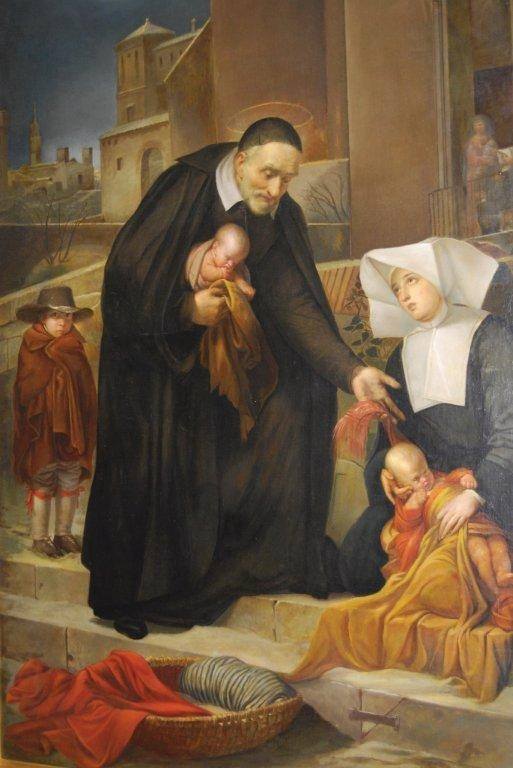
St Vincent de Paul

st-vicent-de-paul


“The Church teaches us that mercy belongs to God. Let us implore Him to bestow on us the spirit of mercy and compassion, so that we are filled with it and may never lose it. Only consider how much we ourselves are in need of mercy.”

Saint Vincent de Paul

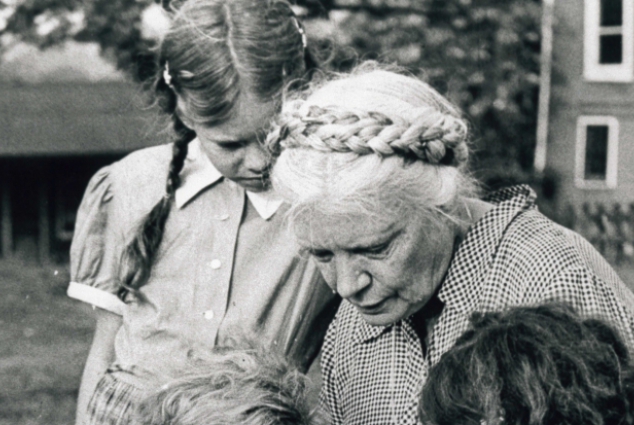
Dorothy Day’s teaching on Justice

dorothy-day“If you find the life of Dorothy Day inspiring, if you want to understand what gave her direction and courage and strength to persevere, her deep attentiveness to others, consider her spiritual and sacramental life.”

These are the words of Jim Forest published in an article, “What I learned about justice from Dorothy Day,” that originally appeared in the July/August 1995 issue of Salt of the Earth magazine. This article is really good and I highly recommend it. One reason being you really do locate the source of Day’s thinking and spirituality in the Eucharistic Heart of Our Savior, Jesus.  Is there really anything more to be taught/learned by way of praying before the Blessed Sacrament?

Jim Forest began his association with Dorothy Day in 1961, when he moved to New York City to join the Catholic Worker community there. Jim is the author of an excellent introduction on the life and work of Dorothy Day called All Is Grace.

Dorothy Day’s caused for sainthood has been introduced. It would be good to learn from Day on how to be an authentic Catholic and not some secularist: Go to Jesus through the example of Dorothy!

Meet the Monk Who Makes NY’s Best Vinegar

Watch this terrific video on the work of a Benedictine monk, Brother Victor Antoine d’Avila Latourrette, and the vinegars made at Our Lady of the Resurrection Monastery in Langrangeville, NY. What Brother Victor has is a very lovely ministry –a definite way of life–connected at the matrix of the spiritual life, the land and the work of human hands.

https://youtu.be/WPojukzZrek

Guillermo Arboleda Tamayo new Abbot President of Subiaco Cassinese Congregation

guillermo-a-tamayoThe General Chapter of the Subiaco Cassinese Congregation elected today (22 Sept 2016) Father Guillermo Arboleda Tamayo, abbot of the Abbey of Santa Maria of Medellin and Administrator of Guatapè (Colombia) to be the new Abbot President. He succeeds Abbot Bruno who has served as praeses since 2004.

Abbot Guillermo was born in 1956, ordained priest in 1980, professed as a monk of Guatapé in 1986. In 1991, Father was elected the Conventual Prior of Santa María de la Epifanía (Guatapè), Rionegro-Antioquia, Colombia, and then elected community’s first abbot in 1999. Then, in 2014, he took on the administration of the Abbey of Santa Maria of Medellin, before being postulated the abbot of the community.

Abbot Guillermo becomes the first Abbot President of the Subiaco Cassinese Congregation from the Americas.

Sts. Andrew Kim Tae-gŏn, Paul Chŏng Ha-sang, and Companions

sts-andrew-kim-and-companionsSt. Andrew Kim was the first native Korean priest and the son of Korean converts. His father, Ignatius Kim, was martyred during the persecution of 1839 and beatified in 1925. After Baptism at the age of 15, Andrew traveled 1,300 miles to seminary in Macao, China. After six years of study, he returned to Korea and was ordained a priest. He was eventually arrested, tortured and beheaded near Seoul. 

Paul Chong Hasang, 45, was a lay man and married, also martyred.

Pope John Paul II canonized Kim and the companions in 1984 when he visited Korea. The 98 Koreans and three French missionaries were martyred between 1839 and 1867. Among them were bishops and priests, but for the most part they were lay persons: 47 women, 45 men.

Sts. Andrew Kim Tae-gŏn, Paul Chŏng Ha-sang, and Companions, pray for us!

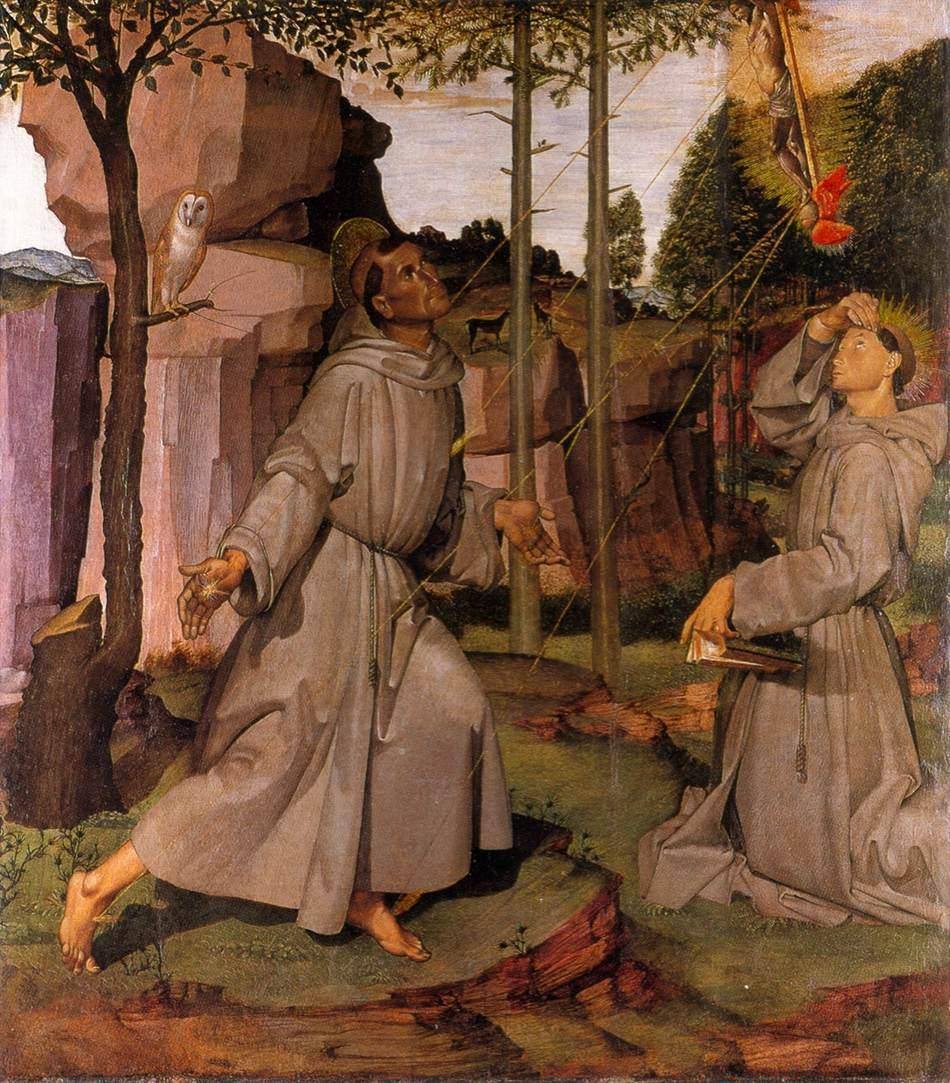
The Stigmata of St. Francis of Assisi

stigmata-of-francisThe Franciscans mostly observe this event in the life of Saint Francis turned into a feast day of the Stigmata. It is recalled that Francis, in meditation on Mount Alvernia in the Apennines, in September 1224, received a vision of a six winged angel. Francis recalls that he was visited by angel and the Life-saving wounds of the crucified Lord. That is, he was left with wounds in his hands, feet, and side as though he had been crucified. The wound in his side often seeped blood.

Saint Francis and his conversion story, from the beginning, included a very great devotion and veneration for Jesus Christ crucified. He was constant in this aspect of the Paschal Mystery until he died.

Pope Benedict XI gave permission for the Friars to have an annual liturgical commemoration on this day the memory of this extraordinary event attested by reliable witnesses.

St Hildegard of Bingen

st-hildegard

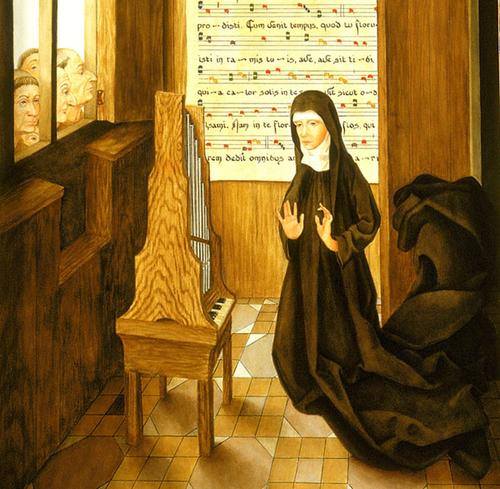
Saint Hildegard of Bingen (1098-1179) is a most attractive person with a personal relationship with Jesus Christ, a keen intellect and good zeal of a Benedictine nun. Knowing her history you would say she is a polymath. She said once, “There is the Music of Heaven in all things, and we have forgotten how to hear it until we sing.”

For many years it was hoped that Hildegard would be officially raised to the altar and be declared a Doctor of the Church. In deed, it was Pope Benedict who gave the Church this supreme gift of this saintly woman a witness to the new evangelization. Benedict stated:

In Saint Hildegard of Bingen there is a wonderful harmony between teaching and daily life. In her, the search for God’s will in the imitation of Christ was expressed in the constant practice of virtue, which she exercised with supreme generosity and which she nourished from biblical, liturgical and patristic roots in the light of the Rule of Saint Benedict. Her persevering practice of obedience, simplicity, charity and hospitality was especially visible. In her desire to belong completely to the Lord, this Benedictine Abbess was able to bring together rare human gifts, keen intelligence and an ability to penetrate heavenly realities.

Hildegard’s eminent doctrine echoes the teaching of the Apostles, the Fathers and writings of her own day, while it finds a constant point of reference in the Rule of Saint Benedict. The monastic liturgy and the interiorization of sacred Scripture are central to her thought which, focusing on the mystery of the Incarnation, is expressed in a profound unity of style and inner content that runs through all her writings.

The teaching of the holy Benedictine nun stands as a beacon for homo viator. Her message appears extraordinarily timely in today’s world, which is especially sensitive to the values that she proposed and lived. For example, we think of Hildegard’s charismatic and speculative capacity, which offers a lively incentive to theological research; her reflection on the mystery of Christ, considered in its beauty; the dialogue of the Church and theology with culture, science and contemporary art; the ideal of the consecrated life as a possibility for human fulfilment; her appreciation of the liturgy as a celebration of life; her understanding of the reform of the Church, not as an empty change of structure but as conversion of heart; her sensitivity to nature, whose laws are to be safeguarded and not violated.

For these reasons the attribution of the title of Doctor of the Universal Church to Hildegard of Bingen has great significance for today’s world and an extraordinary importance for women. In Hildegard are expressed the most noble values of womanhood: hence the presence of women in the Church and in society is also illumined by her presence, both from the perspective of scientific research and that of pastoral activity. Her ability to speak to those who were far from the faith and from the Church make Hildegard a credible witness of the new evangelization.

(Pope Benedict XVI, 7 October 2012)