Challenging the well-manicured: Archbishop Chaput takes a look at our cultural engagement

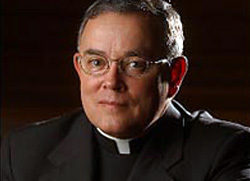
Someone who “gets it” is Capuchin Franciscan Archbishop Charles Chaput, archbishop of Denver. Whether it be culture, beauty, healthcare, abortion, immigrant rights, education, politics, preaching, I think the archbishop is a clear thinker and renders a fine and helpful assessment of Christian life and a Christians involvement in the world. Recently, Archbishop Chaput was in Rome to give a talk he titled, “The Prince of This World and the Evangelization of Culture” at the Fifth Symposium Rome: Priests and Laity on Mission. In this address the archbishop addresses questions of culture, beauty, anthropology, faith, evangelization and sin and grace.

What follows is only an excerpt of a longer talk that you can read at the link above. AND I recommend you read the entire text!

Charles Chaput.jpg

In 1929, as the great totalitarian murder-regimes began to rise up in Europe, the philosopher Raissa Maritain wrote a forgotten little essay called “The Prince of This World.” It is worth reading. We need to remember her words today and into the future.  With no trace of irony or metaphor, Maritain argued:

“Lucifer has cast the strong though invisible net of illusion upon us. He makes one love the passing moment above eternity, uncertainty above truth. He persuades us that we can only love creatures by making Gods of them. He lulls us to sleep (and he interprets our dreams); he makes us work. Then does the spirit of man brood over stagnant waters. Not the least of the devil’s victories is to have convinced artists and poets that he is their necessary, inevitable collaborator and the guardian of their greatness. Grant him that, and soon you will grant him that Christianity is unpracticable. Thus does he reign in this world.”

If we do not believe in the devil, sooner or later we will not believe in God.  We cannot cut Lucifer out of the ecology of salvation. Satan is not God’s equal. He is a created being subject to God and already, by the measure of eternity, defeated.  Nonetheless, he is the first author of pride and rebellion, and the great seducer of man. Without him the Incarnation and Redemption do not make sense, and the cross is meaningless. Satan is real. There is no way around this simple truth.

Let me underline that even more strongly. Leszek Kolakowski, the former Marxist philosopher who died just last year, was one of the great minds of the last century.  He was never a religious person in the traditional sense.  But Kolakowski had few doubts about the reality of the devil.  In his essay Short Transcript of a Metaphysical Press Conference Given by the Demon in Warsaw, on 20th December 1963, Kolakowski’s devil indicts all of us who call ourselves “modern” Christians with the following words:

“Where is there a place [in your thinking] for the fallen angel? … Is Satan only a rhetorical figure? . . . Or else, gentlemen, is he a reality, undeniable, recognized by tradition, revealed in the Scriptures, commented upon by the Church for two millennia, tangible and acute?  Why do you avoid me, gentlemen?  Are you afraid that the skeptics will mock you, that you will be laughed at in satirical late night reviews?  Since when is the faith affected by the jeers of heathens and heretics?  What road are you taking?  If you forsake the foundations of the faith for fear of mockery, where will you end?  If the devil falls victim to your fear [of embarrassment] today, God’s turn must inevitably come tomorrow.  Gentlemen, you have been ensnared by the idol of modernity, which fears ultimate matters and hides from you their importance.  I don’t mention it for my own benefit – it is nothing to me – I am talking about you and for you, forgetting for a moment my own vocation, and even my duty to propagate error.”

We live in an age that imagines itself as post-modern and post-Christian.  It is a time defined by noise, urgency, action, utility and a hunger for practical results.  But there is nothing really new about any of this. I think St. Paul would find our age rather familiar.  For all of the rhetoric about “hope and change” in our politics, our urgencies hide a deep unease about the future; a kind of well-manicured selfishness and despair. The world around us has a hole in its heart, and the emptiness hurts.  Only God can fill it.  In our baptism, God called each of us in this room today to be his agents in that work. Like St. Paul, we need to be “doers of the word, and not hearers only” (Jas 1:22). We prove what we really believe by our willingness, or our refusal, to act on what we claim to believe.

But when we talk about a theme like today’s topic – “Priests and laity together, changing and challenging the culture” – we need to remember that what we do, proceeds from who we are. Nothing is more dead than faith without works (Jas 2:17); except maybe one thing: works without faith.  I do not think Paul had management issues in his head when he preached at the Areopagus.  Management and resources are important – but the really essential questions, the questions that determine everything else in our life as Christians, are these:  Do I really know God?  Do I really love him?  Do I seek him out?  Do I study his word?  Do I listen for his voice?  Do I give my heart to him?  Do I really believe he’s there?

For more than 30 years, first as a bishop and now as the successor to St. Peter, Benedict XVI has spoken often and very forcefully about the “culture of relativism” that guides today’s developed world, breaks down human community and intimacy, and drains the meaning out of human activity. That culture flows out of the “new Areopagus” John Paul II described in Redemptoris Missio – a culture formed by radically new technologies and methods of communication; a culture with a power that reshapes how we think, what we think about, and how we organize our personal and social lives.

We have an obligation as Catholics to study and understand the world around us.  We have a duty not just to penetrate and engage it, but to convert it to Jesus Christ. That work belongs to all of us equally: clergy, laity and religious. We are missionaries. That is our primary vocation; it is hardwired into our identity as Christians. God calls each of us to different forms of service in his Church.  But we are all equal in baptism. And we all share the same mission of bringing the Gospel to the world, and bringing the world to the Gospel.

Rehabilitating our friends in Haiti: the work of CRUDEM

Crudem vol Haiti.jpgI’ve been getting daily updates from the CRUDEM folks in Haiti. I am sure many are keeping current on the efforts of those trying to help the earthquake victims. The stories of the tragedy and the human efforts sustained by God, I am convinced, move the heart.

Financial gifts to an agency is a good thing AND so is prayer. Please consider making a contribution to AVSI, CRS and the Order of Malta is recommended and asking the Sacred Hearts of Jesus and Mary to guide this human process of aiding our Haitian sisters and brothers is crucial. When the earthquake was announced I mentioned asking for the divine mediation of Venerable Servant of God Pierre Toussaint: I renew that request. When you visit the Blessed Sacrament today make a prayer for Haiti!

The crisis continues and so does the humanitarian efforts in the areas of medicine and food outreach to help the citizens of Haiti recover their lives. Human resources, budgets and food supplies are stretched thin, for obvious reasons. Many, many acts of kindnesses have be demonstrated. Keep yourself engaged by visiting CRUDEM.

Saint Scholastica

Thumbnail image for St Scholastica with crosier.jpg

The Church uses biblical imagery to center our worship of the Blessed Trinity. On this feast of Saint Scholastica, virgin, the Church prays the Office and Mass of Virgins and a recurring theme is taken from Psalm 44, a nuptial hymn. There we meet Christ as the bridegroom and the Church, with Saint Scholastica as the model of bride. Baptized and adopted sons and daughters of God, we walk as brides to the altar of our salvation in the proclamation of the Word and Eucharist. As Scholastica is the virgin bride of Christ, we too enter into the mystery of our salvation as Christ’s brides according to the grace given to us and are addressed as such by the sacred Liturgy of the Church.

Today the Church observes Saint Scholastica’s liturgical memorial, the twin sister of the Patriarch of Western Monasticism, Saint Benedict. Not often can we say that in the canon of saints that one’s twin is also enrolled. Tradition has her being born in Norcia c. 480 and dying in 543. The bodies of Saint Scholastica and Saint Benedict share a common tomb at Monte Cassino, a fitting place of rest for twins. Monte Cassino is a beautiful place of pilgrimage if you get a chance: I’ve done it twice.

Saint Scholastica is the patron saint against rain, storms, convulsive children, and nuns. And so, we ask Saint Scholastica to look after these things today. Of course, we in NY are engaged in a snow storm which I hope counts in the general idea of being against storms. Pray for us!
The 2009 post is noted here with the liturgical prayer for Saint Scholastica and a link to the Saint Gregory’s Dialogues.

Understanding Adoration of the Blessed Sacrament

B16 & Eucharist 2009.jpgPeriodically people ask about the practice of Adoration of the Blessed Sacrament. I typically find the questions interesting because it seems like we have forgotten the reasons why we adore the eucharistic Presence of Jesus Christ and this experience of eucharistic adoration is key for every Catholic and for every parish, school, hospital, convent, abbey, etc. 


When questions arise about the character of Adoration
of the Blessed Sacrament we should go to the liturgical book called Holy
Communion and Worship of the Eucharist Outside Mass
. While it does not provide
details about what ought or ought not be done at Adoration, it does provide a
liturgical theology by which we follow. There it says that 


Exposition of
the Holy Eucharist is intended to acknowledge Christ’s marvelous presence in
the sacrament. Exposition invites us to the spiritual union with him that
culminates in sacramental communion. Thus it fosters very well the worship
which is due to Christ in spirit and in truth. This kind of exposition
must clearly express the cult of the blessed sacrament in its relationship to
the Mass.  The plan of the exposition should carefully avoid anything
which might somehow obscure the principal desire of Christ in instituting the
Eucharist, namely, to be with us as food, medicine, and comfort” (n.82).

Therefore,
we can reason that devotions, songs, prayers, etc., ought to be consistent
with what is given in this book. 


The Directory on Popular Piety and the
Liturgy: Principles and Guidelines
 does offer examples of what is
consistent with the purposes of Eucharistic adoration. It says: 

The
faithful should be encouraged to read the Scriptures during these periods of
adoration, since they afford an unrivalled source of prayer.  Suitable
hymns and canticles based on those of the Liturgy of the Hours and the
liturgical seasons could also be encouraged, as well as periods of silent
prayer and reflection.  Gradually, the faithful should be encouraged not
to do other devotional exercises during exposition of the Blessed Sacrament.
 Given the close relationship between Christ and Our Lady, the rosary can
always be of assistance in giving prayer a Christological orientation, since it
contains meditation of the Incarnation and the Redemption (n.165).

This list of practices is not exhaustive, and it is not meant to be but it does give a useful sense of how to
evaluate our devotional practices during Adoration of the Blessed Sacrament.

Saint Josephine Bakhita

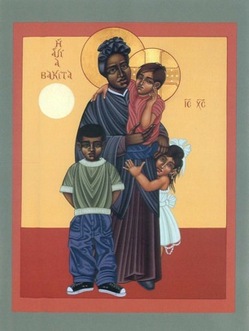
Thumbnail image for St. Josephine Bakhita.jpg

With the Church we pray:

God, who drew blessed Josephine from abject servitude to
the dignity of being your daughter and a spouse of Christ, grant to us, we ask, that by her example, we may follow the crucified Jesus with constant love, and be lovingly ready to persevere in mercy. 

The young Miss Bakhita (1869-1947) was entrusted to the Canossian Sisters of the Institute of the Catechumens in Venice and it was there that she came to know about God whom “she had experienced in her heart without knowing who He was” ever since she was a child. “Seeing the sun, the moon and the stars, I said to myself: Who could be the Master of these beautiful things? And I felt a great desire to see him, to know Him and to pay Him homage…”

After several months in the catechumenate, Bakhita received the sacraments of Christian initiation (Baptism, Confirmation and Holy Eucharist) and was given the new name, Josephine on January 9, 1890. With expressive eyes that sparkled, revealing intense emotions, she radiated joy. Josephine was often observed kissing the baptismal font and saying: “Here, I became a daughter of God!”

The Arabic word “Bakhita” means fortunate one. Indeed, Saint Josephine was fortunate. The Vatican biography written at the time of her canonization can be found here. When Pope John Paul II canonized Josephine she was the first Sudanese saint and she is the patron of evangelical reconciliation and freedom.

Would that we all kissed the baptismal font!!!

Paul Wattson: RIP 70 years

Fr Paul Wattson.jpg

Today is Father Paul Wattson’s 70th anniversary of death– the great Catholic ecumenist and convert. I pray that he lives with the Lord: May his memory be eternal.
O God, Who did raise Thy servant to the dignity of priest in the apostolic priesthood, grant, we beseech Thee, that he may be joined in fellowship with Thine Apostles forevermore.
This essay on Father Paul Wattson, “Father Paul of Graymoor: Founder of the Society of the Atonement and Father of the Church Unity Octave” written by Eleanore Villarrubia, is a great overview of Father Paul’s life. 

Some words by Father Paul Wattson


Now that which fosters this love and causes it to burn
up and kindle within us, is the gift of our Lord himself to us in the Blessed
Sacrament. That is the very heart and center of the religious life. It is our
exceedingly  great privilege to
have come out of the world and assemble ourselves in the religious houses,
where we practically live under the same roof with our heavenly bridegroom. 


In
a most intimate manner we receive Him every morning in Holy Communion. When we
receive our Lord in Holy Communion, we receive God’s body, blood, soul and divinity,
the whole Christ, entering our lips and penetrating the inmost recesses of our heart
even as he said, “He that eats my flesh and drinks my blood, abides in me
and I in him.” [John 6:56] Consequently our life is a life of most intimate
union. Our divine Savior would not only have us live under the same roof with
him and dwell in our chapels, which are for the time being a part of the court
of Heaven, but he enters into our interior and penetrates our whole being and
lives in us in this wonderful union. And all this is the fruit and the result
of the Blessed Sacrament. Therefore, we should have a most wonderful devotion
to the Holy Eucharist. (Father Paul Wattson, SA, Retreat Conference August 19, 1926)


A brief
remembrance of Father Paul Wattson from a 2009 Communio
blog entry
.

Saint Giles Mary of Saint Joseph

St Giles Mary of St Joseph.jpgCome, you whom my Father has blessed; I was ill and you consoled me. Anything you did for one of my brothers, you did for me, says the Lord.

God our Father, You kept Brother Giles Mary of Saint Joseph faithful to Christ’s pattern of poverty and humility. With his prayers to give us courage help us to move forward in unselfish charity.
Saint Giles Mary (1729-1812) lived while Napolean Bonaparte was in-charge. He served his friary as the community beggar  for 53 years in humility and peace, in contradistinction to the way power was exercised in Naples at this time. The work of “community beggar” is little known today; the holder of this job was to walk the streets begging for the needs of the poor and then friars, in that order. He was known by the people as the “Consoler of Naples.” He would constantly tell the people, “Love God, Love, God.”
Pope Leo XIII beatified Brother Giles Mary in 1888. The Venerable Servant of God Pope John Paul canonized Blessed Giles Mary of Saint Joseph in 1996. At that time he told the Church that Brother Giles Mary represented “the humility of the Incarnation and the gratuituousness of the Eucharist.”
Not a bad message….

Saint Colette

St Colette.jpg

Let us rejoice
and shout for joy, because the Lord of all things has favored this holy and
glorious virgin with his love.

God, our Father, You set Saint Colette as an
example and leader of evangelical perfection for many virgins. Grant that the
spirit of Saint Francis which she wisely taught and wondrously confirmed by her
holy example may ever abide in us.


Following the death of her parents, Colette,
with permission of the ecclesial authorities remained hidden from the world in
a room next a church where a window allowed her to adore the Blessed Sacrament.
Essentially she adopted an ancient form of religious life as an anchoress.
Colette embraced the rule of the Third Order of St. Francis, desiring to live
in perfect poverty, severe mortification, and constant prayer in order to become
like the Seraphic Father. The life she was graced to live had bountiful
consolations but she faced severe temptations and even corporal abuse from
Satan. Who, by the way, is clearly instrumental in trying to bring the Church to her knees.

Because her life as a Third Order Franciscan an interest developed to
know more about the life of Saint Clare and the early Poor Clare rule where the
ideal was to live in strict observance of the rule of Saint Clare. By this time,
history indicates that even the Poor Clares were a bit economical in living the
life Clare envisioned. Discerning that her call in life was not to take an
active role in re-forming the Poor Clare observance, Colette dismissed the
desires she had entertained. The problem was that these desires resurfaced
time-and-again to the extent that she discovered that God, not the devil, placed
the desire of reform in her heart. Rather boldly God got Colette’s attention by
striking her dumb and blind, until she finally resigned herself to the will of
God, like some notable biblical figures. Acknowledging the will of God, her
speech and her sight were restored.

You know the scenario: God never asks you
to do something without giving the grace to accomplish the task. A spiritual
father given to Colette to guide her spiritual life so that she could what the
Lord required. As preparation, Colette spent four years on before receiving the
blessing of the pope to establish one convent of Poor Clares. In time the
charism Colette proposed was corresponding to women’s desires that in her
lifetime Colette seventeen monasteries were founded under her inspiration. In the USA, the Colettine Poor Clares have a number of monasteries. One foundation that I would like to highlight is the Bethlehem Monastery of the Poor Clares, Barhamsville, VA.

Grace
upon grace was given to Colette for saving souls for Christ that in a vision
she saw souls falling into hell more swiftly than the snowflakes in a winter’s
storm. At once she knew her mission.

Saint Colettes’s devotion to the Passion
of Our Lord was evident which enabled her to make sacrifices to do what the
Lord wanted. With her friend, the Dominican, Saint Vincent Ferrer,  she is
considered most responsible for the end of the Great Western Schism when the
Popes resided at Avignon, France between 1378 and 1417. Some Dominicans will likely dispute this claim, but as history is written on this period in Church history, Colette and Vincent seem to more key in papal correction than Saint Catherine of Siena is, but the latter’s influence is no doubt significant. The unity of the Church
was a stake when Colette and Vincent wrote to the Fathers in council at
Constance guiding them on how to deal with John XXIII, Benedict XIII, and
Gregory XII. They proposed the deposing of Benedict XIII in order for a new
election.

Saints Peter Baptist, Paul Miki and companions –the Nagasaki Martyrs

26 Japanese martyrs.JPG.jpegGod, our Father, source of strength for all Your
saints, You led Peter Baptist, Paul Miki, and their companions through the
sufferings of the cross to the joy eternal life. May their prayers give us the
courage to be loyal until death in professing our faith.


Today the Church commemorates
twenty-six martyrs, three  Jesuits
and six Franciscans, crucified in Nagasaki, Japan, on February 5, 1597. Most
were Japanese and most were laypersons and they were among the first martyrs of
a young Church. The names of the martyrs are:

The Franciscans

Fathers Peter Baptist, Martin of the Ascension, Francis Blanco; Seminarian Philip of Jesus; Brothers Gonsalvo Garzia, Francis of St Michael with seventeen native Franciscan Tertiaries

The Jesuits

Seminarians Paul Miki, John Goto, and Brother James Kisai

They were beatified by Pope Urban VIII on September 14, 1627 and canonized by Pope Pius IX on June 8, 1862.

One historical note, to date the Catholic Church in Japan has 410 beatified and/or canonized martyrs.