Apostolic Exhortation “Verbum Domini”

The Pope released his post-synodal Apostolic Exhortation, Verbum Domini, following the 2008 Synod of Bishops on the Word of God. It’s available in eight languages in at least 200 pages. 

Verbum Domini – English

Verbum Domini – Italiano

Verbum Domini – Español

The press conference:

Word of God.jpg

At midday today
in the Holy See Press Office, the presentation took place of the Post-Synodal
Apostolic Exhortation “Verbum Domini” of Benedict XVI, on the Word of
God in the life and mission of the Church.

Today’s press conference was
presented by Cardinal Marc Ouellet P.S.S., prefect of the Congregation for
Bishops; Archbishop Gianfranco Ravasi, president of the Pontifical Council for
Culture, and Archbishop Nikola Eterovic and Msgr. Fortunato Frizza,
respectively secretary general and under secretary of the Synod of Bishops.

The
Apostolic Exhortation, which is dated 30 September, Memorial of St. Jerome, is
the fruit of the Twelfth Ordinary General Assembly of the Synod of Bishops,
which was held in Rome from 5 to 26 October 2008. The document, which has been
published in Latin, Italian, English, French, Spanish, German, Portuguese and
Polish, is made up of an introduction, three parts and a conclusion.

Achbishop
Eterovic explained how in part one, entitled “Verbum Dei”, the Pope
highlights both “the fundamental role of God the Father, source and origin
of the Word”, and “the Trinitarian dimension of revelation”.
Chapter one – “The God Who Speaks” – underscores “God’s will to
open and maintain a dialogue with man, in which God takes the initiative and
reveals Himself in various ways”. It also dwells on “the
Christological aspect of the Word, while at the same time underlining the
pneumatological dimension”. This section of the document also focuses on
the relationship between the Eucharist and Tradition, and on the theme of the
inspiration and truth of the Bible.

“Our Response to the God Who
Speaks” is the title of chapter two of part one. “Man is called to
enter into the Alliance with his God, Who listens to him and responds to his
questions. To God Who speaks, man responds with the faith. The most suitable
prayer is that made using the words which were revealed by God and are
conserved and written in the Bible”, said Archbishop Eterovic.

Chapter
three has as its title “The Interpretation of Sacred Scripture in the
Church”. The secretary general of the Synod of Bishops explained how
“Sacred Scripture should be, as the Dogmatic Constitution ‘Dei Verbum’
says, ‘the soul of sacred theology’. … The biblical hermeneutics of Vatican
Council II must be rediscovered, also in order to avoid a certain dualism
evident in secularised interpretations which could give rise to a
fundamentalist and spiritualist interpretation of Holy Scripture. Correct
interpretation requires complementarity in a literal and spiritual sense, a
harmony between faith and reason”. This chapter also examines relations
between Christians and Jews, noting that they enjoy “a very special
relationship … because they share a large part of the Scriptures”.

Part
two of the document is entitled “Verbum in Ecclesia”. Chapter one –
“The Word of God and the Church” – underlines how it is thanks to the
Word of God and the effect of the Sacraments “that Jesus remains
contemporary to mankind in the life of the Church”, said the archbishop.

“The
Liturgy, Privileged Setting for the Word of God” is the title of chapter
two, in which the focus turns to “the vital link between Sacred Scripture
and the Sacraments, especially the Eucharist”. The importance of the
Lectionary is mentioned, as is that of the proclamation of the Word and the
ministry of reader, with particular emphasis being laid on the preparation of
the homily, a theme of great importance in this Post-Synodal Apostolic
Exhortation.

Chapter three of part two concerns “The Word of God in the
Life of the Church” and highlights “the importance of biblical inspiration
for pastoral activity, the biblical dimension of catechesis, the biblical
formation of Christians, the use of Sacred Scripture in great ecclesial
gahterings, and the Word of God in relation to vocations”. Attention is
also given to “lectio divina and Marian prayer”, said the
archbishop.

Part three of the document published today has as its title
“Verbum Mundo”. It draws attention to “the duty of Christians to
announce the Word of God in the world in which they live and work”.
Chapter one – “The Church’s Mission to Proclaim the Word of God to the
World” – explains how the Church “is oriented towards the
announcement ‘ad gentes’, to people who do not yet know the Word, … but also
to those who have already been baptised … but need new evangelisation in
order to rediscover the Word of God”.

“The Word of God and Commitment
to the World” is the title of chapter two, which recalls how
“Christians are called to serve the Word of God in their most needy
brothers and sisters and, hence, to commit themselves in society for
reconciliation, justice and peace among peoples”.

Chapter three of part
three is dedicated to “The Word of God and Culture”. It expresses the
hope “that the Bible may become better known in schools and universities
and that better use may be made of the social communications media, exploiting
all the modern possibilities of technology. The theme of the inculturation of
Sacred Scripture is also linked to the translation and diffusion of the Bible,
which must be increased”, said Archbishop Eterovic.

“The Word of God
and Inter-religious Dialogue” is the title of chapter four. “Having
established the value and topicality of inter-religious dialogue, ‘Verbum
Domini’ … supplies some important guidelines concerning dialogue between
Christians and Muslims, and with members of other non-Christian religions,
within the framework of a religious liberty which involves not only the freedom
to profess one’s faith in private and in public, but also freedom of
conscience; in other words, of choosing one’s religion”.

In the
conclusion, Archbishop Eterovic concluded his explanations, the Holy Father
reiterates his exhortation to all Christians “to become increasingly
familiar with Sacred Scripture”.

Veterans Day 2010

Let’s pray for the women and men who have died in service of the United States of America and for those now serving in the military services and those retired military persons. In thanksgiving we commend these people to the Lord for his mercy and his love. Saints Martin of Tours, Michael and George, pray for us.

Veterans Day 2010.jpg

Fulton J. Sheen’s cause for canonization halted

A distressing development has occurred with the canonization process for the Servant of God Archbishop Fulton J. Sheen has been suspended by the Bishop of Peoria, Daniel Jenky, CSC. The issue seems to be the refusal of the Archdiocese of New York to return the mortal remains of Sheen to his home diocese of Peoria; the archbishop died in 1979 at the age of 84, and was entombed in the crypt of the famed Cathedral of Saint Patrick. Earlier that year he met Pope John Paul II in Saint Patrick’s Cathedral in a terrific embrace of brothers. The life and work of Archbishop Sheen might be likened to being a 20th century Saint Dominic of Guzman. After serving for three years (1966-69) as the Bishop of Rochester (NY), Fulton returned to New York City. The diocesan phase of the process was concluded in 2008.

Bishop Jenky’s statement follows:

FJ Sheen with girl.jpgIt is with great sadness and disappointment, Bishop Jenky announces that after nine years of effort and sacrifice, the Diocese of Peoria is suspending its efforts on behalf of the Beatification of Fulton J. Sheen.  The Archdiocese of New York has made it clear that it is not likely that they will ever transfer the remains of Fulton J. Sheen to his home diocese of Peoria.  The Bishop hopes that the Archdiocese of New York, in whose Cathedral crypt the earthly remains of the Servant of God are still entombed, might now assume this responsibility.  In this endeavor he would pledge the cooperation of his diocese.  The bishop urges the clergy, faithful and religious of Peoria to continue to pray for the Cause of Archbishop Sheen whose heroic virtues in announcing the Gospel and serving the poor were an extraordinary blessing in the life of the Catholic Church.  The bishop would also like to remind all in his diocese and all those throughout the world who have so enthusiastically supported the Sheen Cause that finally it is only God who makes saints, not men.

The Diocese of Peoria remains committed to promote the message of the great priest, Fulton J. Sheen within our Diocese and to continue to develop our museum and research center devoted to his life.

Pope Saint Leo the Great

Pope St Leo the Great.jpgThe Church offers us today the life of someone salvation history has determined to be a significant figure in the proclamation of the Gospel. Pope Saint Leo the Great, a doctor of the Church helped the Church of his era develop orthodox thinking on the person of Jesus Christ that is standard theology today. He defended the two natures of Jesus Christ at the Council of Chalcedon. The Fathers of Chalcedon said, “Peter has spoken through Leo!”

Saint Leo is one of three popes to be given the title “the Great” acknowledging his work as a father of the faithful. 

This text is a hymn based on a text taken from the Office of Readings for Matins for Christmas. This text captures Leo and his keeping belief in Christ correct.
God truly is come down from heaven,
begotten of the Father,
and has entered into the womb of the Virgin
and has appeared visibly to us,
clothed in human flesh
received from our first parent:
and He who is both God and man,
Light and Life,
the Creator of the world,
has passed through the closed portal.
Glory to the Father and to the Son and to the Holy Spirit.

Melkite Patriarch calls for unified talk & acting to build better future

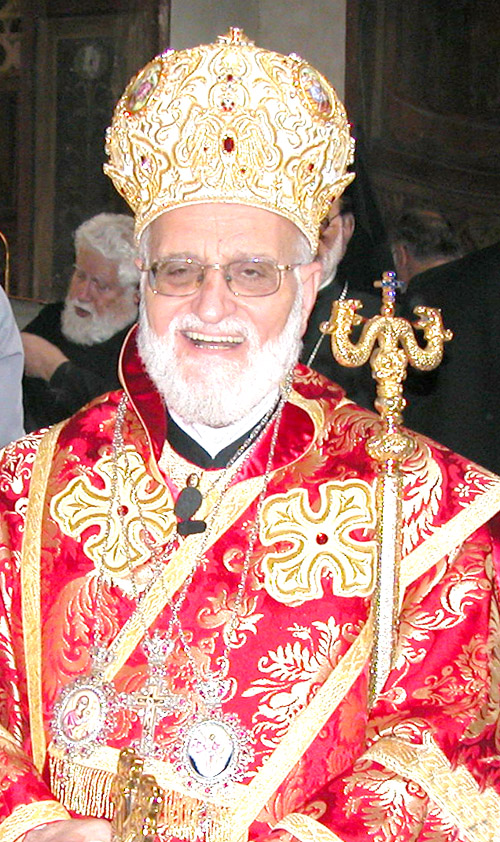
A friend sent me this letter of His Beatitude, Patriarch Gregory III addressing the killing and violence inflicted on the Syrian Christian community on October 31 (there’s discrepancy in the letter). His Beatitude is known for straight-talking and this letter indicates that sensibility. Let’s pray for peace in all of our hearts and minds as we pray for our enemies.

Patriarch Gregory III .JPG

Rabweh, 8 November 2010

Christian bloodbath in the Cathedral
of Our Lady of Deliverance, Baghdad

The carnage which took place on Sunday,
November 1, 2010 in the Syrian Catholic Cathedral of our Lady of Deliverance in
Baghdad was of an unprecedented cruelty and barbarity. It was an attack capable
of undermining the good will of genuine bridge-builders between cultures, brave
heroes of inter-religious dialogue, as well as the optimism of the Special
Assembly of the Synod of Bishops for the Middle East.

I offer my sincere
condolences and the assurance of my prayers and those of our Church to His Beatitude
Patriarch Ignace-Joseph III (Younan), to His Eminence Cardinal Emmanuel III
(Delly) and to all those who are broken-hearted at this crime.

We know that
this criminal act is not the work of authentic Islam, and cannot be based on
it. Despite that, we hold Muslims in Iraq and in all Arab countries to be
responsible for Christian security, since they have power, and control the army
and police force.

We urge Arab countries to study the reality of fundamentalist
terrorism and the trends that feed on it. This is a global Islamic
responsibility, because showing Islam under that guise is a disfigurement of
authentic Islam. The real enemies of Islam and Muslims are neither
“Islamophobia” nor “Christian Europe,” but rather these fundamentalist organisations
and trends.

They are also the enemies of Christianity and of every Christian
and Muslim social and human value, whether Arab or not.

Christians are
peaceable, patriotic, loyal, faithful to their homeland and countries, tolerant
and naturally inclined to forgiveness. But they are not passive, cowardly,
timid, any more than they are inclined to be humiliated. They are not sheep,
designed to be slaughtered by fundamentalists. Christians are builders of
values, nations and cultures, including Islamic culture itself.

If Muslims do
nothing to safeguard this creative strain represented by Arab Christians in
Iraq and throughout the Middle East, the prosperity and drive of Islamic
culture will be in danger of collapse, and Muslims will then be their own worst
enemies, enemies of their faith and of their countries.

Dear Muslim and
Christian Arab brothers, let us adopt a unifying way of talking and act
together to build a better future for all our children and compatriots!

Gregorios
III

Patriarch of Antioch and All the East of Alexandria and of Jerusalem

Dedication of the Basilica of Saint John Lateran

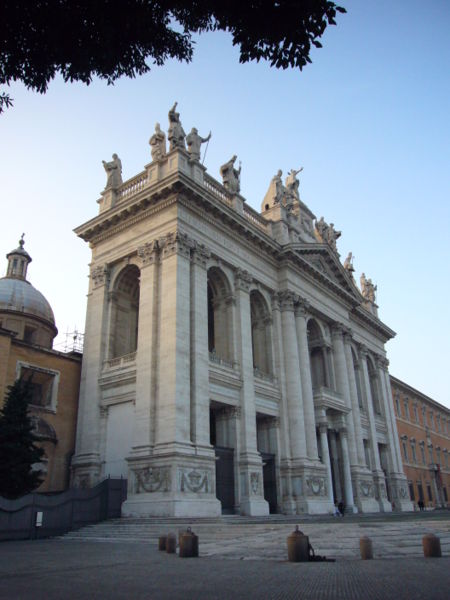
Lateran Basilica.JPGJerusalem, city of God, you will shine with the light of God’s splendor; all people on earth will pay you homage. Nations will come from afar, bearing gifts for the King of Heaven; in you they will worship the Lord. (the lamp-lighting antiphon from the Dedication of a Church)

At first blush some people will ask, why is the Church celebrating the dedication of a church building. The answer is, she’s not. Some history is crucial in understanding today’s liturgical observance.

The cathedral church of the Bishop of Rome, the Pope, is Saint John Lateran, not Saint Peter’s Basilica. And by extension, the Lateran basilica is the head of all churches in the world. The confusion between the Lateran and Vatican basilicas is a common and understandable mistake since Saint Peter’s is the place where the bones of Saint Peter are buried and it’s the place where the Pope most often celebrates ecclesial events. The Lateran was a church built by the Emperor Constantine and consecrated in AD 324 by Pope Sylvester. Notice that the church was consecrated 12 short years following the Edict of Milan.
The feast honoring the role of the basilica church in Christendom, indeed, the entire world at one time, is understood in the aphorism: omnium urbis et orbis ecclesiarum mater et caput (the mother and head of all churches of Rome and the world). The Lateran is the place that symbolizes the ministry of bishop as teacher, servant and sanctifier; it’s the place where charity is most identifiable.
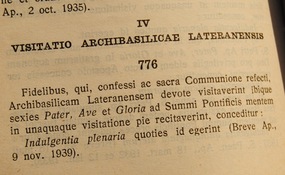
Visitatio jpgPope Benedict said it well in his 2008 Angelus Address for this feast: “Dear Friends, today’s feast celebrates a mystery that is always relevant: God’s desire to build a spiritual temple in the world, a community that worships him in spirit and truth (cf. John 4:23-4). But this observance also reminds us of the importance of the material buildings in which the community gathers to celebrate the praises of God. Every community therefore has the duty to take special care of its own sacred buildings, which are a precious religious and historical patrimony. For this call upon the intercession of Mary Most Holy, that she help us to become, like her, the ‘house of God,’ living temple of love.”

Swiss Capuchins: Help wanted

Capuchin friar logo.jpg

The Capuchin Franciscans in Switzerland are spreading the net far and wide. Their vocation promotion ad reads: 

“Wanted: Bankers, traders or lawyers for full-time, lifelong position. No pay. Unmarried Catholic men between 22 and 35 capable of communal living are encouraged to look into the possibility.

The Washington Post carried the news

Possible parishes in a proposed Ordinariate for Anglicans in the US & Canada

maps logo.jpgYou gotta love Google Maps … proposed parishes of the Anglican Ordinariate

Shane Schaetzel put together a map of proposed parishes that may be in a ecclesiastical jurisdiction for Anglicans entering into full communion with the Catholic Church. A lot of work went into developing this fine resource and we’re grateful.