Writing letters of solidarity with the Christians in Iraq


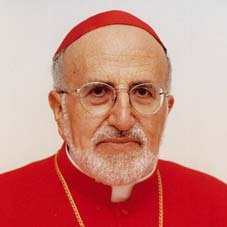
Emmanuel III Delly.jpgAs a way of
showing solidarity with our Christian brothers and sisters in Iraq who faced
such horrible circumstances because of their faith Jesus Christ, I am extendiing
an invitation to all of us: writing letter(s) of fraternal solidarity with our
brothers and sisters through the Chaldean Catholic Patriarch, His Beatitude, Patriarch Emmanuel III Delly. He’s the head of the Conference of Catholic Bishops in Iraq.

An initiative of solidarity is proposed by members of Communion and Liberation

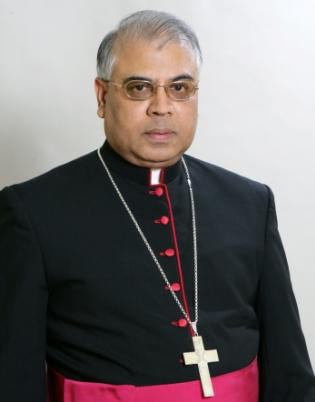
Abp Chullikatt.jpg

Our many friends
in the lay Catholic movement, Communion and Liberation have also moved by the
plight of Iraqi Christians has organized a gesture of solidarity with the Iraqi
Christians in the form of a letter campaign. One of our friends spoke with the Apostolic
Nuncio (the Pope’s ambassador) at the UN, Archbishop Francis Assisi Chullikatt who
said he’d be very happy for our initiative and offered his diplomatic pouch
(direct mail) to reach the Nunciature in Iraq.

So, if you are inclined to write an email in solidarity, you
may send it to tonuncio@gmail.com
and the email will be printed and hand-delivered to Archbishop
Chullikatt on Tuesday, November 16.

Messages ought to be addressed to His Beatitude, Patriarch Emmanuel
III Delly, Patriarch of Babylon of the Chaldeans
.


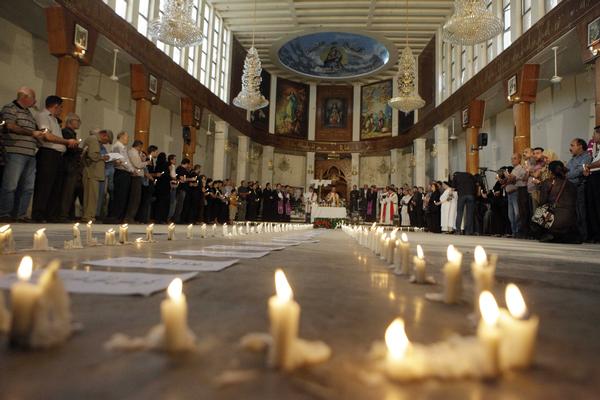
Iraqi Christians pray Mass in assaulted Church for victims and the attackers

candle memorial Syrian Church.JPGThe pain and suffering endured but not consumed by some people is an extraordinary testimony to Grace. The AP news stories about the Mass prayed in the church assaulted by the slayings of Syrian Christians on October 31 brings tears to my eyes especially when I read that the walls retained the blood and flesh of the victims. No doubt poignant relics of the witnesses of humanity and Christ. I bet you no one entered Our Lady of Salvation Church expecting to lay down their life in such a dramatic manner.

Our Lady of Salvation Church has become the School of the Cross and Resurrection in which new life is being formed and born. The Christian response is exactly what Jesus taught his followers: pray for your enemies and those persecute you for love of Me. The priest who celebrated the Divine Liturgy the other day told his congregants that “We will perform a strange kind of prayer because Christ tells us: ‘Love your enemies.'”  Father Mukhlis also said that “We will pray for those who assaulted our church and shed the blood of our martyrs.”
Father Mukhlis recalled for his people that one of the murdered priests, Father Thair, said to his attackers: “Kill me, not the families and children.”
Have the Syrian Catholics become 21st century icons of love? How have we changed since hearing of these brutal deaths? What does Christ want us to learn from these events?

Saint Frances Xavier Cabrini, a great American saint

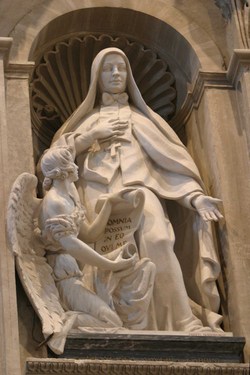
St Frances Xavier Cabrini at Vatican Basilica.jpgO Lord and Bridegroom of your Church,

We praise you for this virgin wise

Who, lighted lamp in hand, went forth

To preach her Groom and win his prize!


From early youth she heard your voice

And longed to work in Asian lands;

But “in the west you’ll find your east,”

The pope said, firm in his commands.

So from her home, Francesca came

That she might care for those who left

Italian homes to seek for work,

But in the New World were bereft.

She founded schools and hospitals

And orphan homes, and traveled wide;

Despite ill health and stature small

Her works became our Church’s pride.


She labored long with sisters brave,

And soon her congregation spread

From North to Southern hemisphere,

Although she sailed the seas with dread.


In labors long and hard, she worked

That Christ her Lord might be well served

In poor and sick and ignorant,

That they might feel God’s love deserved.

O Trinity of love most great,

O Father, Son, and Spirit blest,

With Frances and with all your saints

Bring us, at length, to heaven’s rest.


J. Michael Thompson

Copyright © 2009, World Library Publications

LM; DUKE STREET, ROCKINGHAM NEW, HAMBURG

Training Exorcists

Make no joke about it: the devil exists, people do evil things. Of course, the existence of the devil is not at all the same as we seen in the movies. We know this is a fact from our personal experience and from the Gospels: the devil works on believers to get them away from adhering to Jesus Christ. We don’t fool around with the devil and his temptations, nor his ability to possess a person. So, ridicule would not be the correct approach to understanding the nature of the devil and demonic possession. While believers say that evil is real, it is our unqualified belief that evil and the devil are powerless to the power of Jesus Christ, the eternal Son of God, the Second Person of the Blessed Trinity. It is Jesus who expels the devil, not the priest. Evil is terminated only through prayer, fasting, the sacraments; when it is discerned by competent authority, the praying of the Rite of Exorcism may be done. The Rite is performed only by a validly ordained Catholic priest who is deputed by the bishop of the diocese in which the priest lives, and who is known to live a life of virtue and sanctity.

Rite of Exorcism.jpgThe Church protects the exercise of the Rite of Exorcism in the Code of Canon Law (1983) by saying, “No one can perform exorcisms legitimately upon the possessed unless he has obtained special and express permission from the local ordinary. The local ordinary is to give this permission only to a prebyter who has piety, knowledge, prudence and intergrity of life (1172).

The awareness of evil in the world is increasing with the desire of the Church to find competent priests and bishops –not every priest and bishop have the qualifications to do an exorcism– i.e., some are incapable of doing the Rite of Exorcism.

“Anyone who does not believe in the Devil does not believe in the Gospel,” Pope John Paul II.  Catholics hold that the Lord gave the power to cast out demons to the Church (cf. Mark 16:17).

A recent story dealing with the training of exorcists today. The Catholic bishop of Sprinfiield in Illinois and canonist, Bishop Thomas Paprocki organized a meeting of priests and bishops to orient them with the 1999 revision De Exorcismis et Supplicationibus Quibusdam (On Exorcism and Certain Supplications). The purpose is to gain the proper skills to correctly discern the need to use the Rite of Exorcism. Its use is infrequent but sometimes necessary.

Some critics suggest this type of meeting is playing into a “reversion” to prior times, playing on the fears of the weak. What Bishop Paprocki did is to provide some members of the clergy the tools, theology and expertise, training and insight into knowing more about matters transcendent.

I have heard from priest friends that the old rites of baptism and exorcism are stronger in getting rid of the devil than the newer ones. You may want to read this article, “The New Rite of Exorcism, The Influence of the Evil One.”

Henryk Mikolaj Górecki RIP

Henryk Gorecki.jpgThe NY Times reports this afternoon that Henryk Mikolaj Górecki died today after a period of illness. Gorecki was 76.

Henryk Górecki was one of my favorite modern sacred music composers. His music enriched me and countless others. He had the strong sensibility for the past and for the present. Listening to his music you the distinct sense that he worked within the dialogue with God, one that is at once profound, provoking, transcendent and yet simple and accessible. When I listen to Henryk Górecki’s music I know with certitude that faith, hope and charity exist. Especially present in his compositions is the virtue and feeling of hope.

Let’s pray for the soul of Henryk Mikolaj Górecki and for God’s mercy upon him. In gratitude we commend him to the Lord through the Our Lady of Czestochowa and Saint Stanislaus, B.M.

Eternal memory!
The Wiki article is here.

Francis Xavier Cardinal Nguyên Van Thuán, a beacon of hope


FXN Van Thuan.jpgThe process of canonization has begun, as many know, of Francis Xavier Cardinal Nguyên Van Thuán. The cardinal’s reputation of holiness was born through his virtue and the crucible of suffering in prison for 13 years, 9 of them in solitary confinement. His is a true to witness to hope for us today.

Pope Benedict twice referred to Cardinal Van Thuán in his 2007 encyclical, Spe Salvi, where spoke about the way the cardinal faced hopelessness. The Pope said of Van Thuán ought to be a challenge to us: “the fact that he could listen and speak to God became for him an increasing power of hope, which enabled him, after his release, to become for people all over the world a witness to hope –to that great hope which does not wane even in the nights of solitude” (32).

Van Thuán was a priest for 49 years, a bishop for 35 and a cardinal of the Roman Church for a year and a half. When he came to Rome Pope John Paul II appointed him the president of the Pontifical Council for Justice and Peace.

Cardinal Francis Xavier Cardinal Nguyên Van Thuán died on September 16, 2002, at 74 years old. The Congregation of Saints allowed the process of canonization to proceed in 2007 and the cause is currently be studied. It is reported that several miracles are claimed or credited to the intercession of Cardinal Francis Xavier Cardinal Nguyên Van Thuán.

When Cardinal Van Thuán is canonized he will be the first Vietnamese saints since the martyrs of Vietnam. A great spiritual honor for the people of Viêt Nam, a beacon of hope.

Books by Francis Xavier Cardinal Nguyên Van Thuán:

Testimony of Hope: The Spiritual Exercises of Pope John Paul II (2000)

The Road of Hope: A Gospel from Prison (2001)

Prayers of Hope, Words of Courage (2002)

Five Loaves & Two Fish (2003)

  • Rome Reports TV News Agency did a video presentation in early November on the cardinal with a brief interview with his sister, Tien Thérèse, giving good insights into the person of His Eminence. See the video here.
  • The official website for the cardinal is located here.
  • Recent news on Cardinal Van Thuán can be read here.

Prayer for the Beatification of Francis Xavier Cardinal Nguyên Van Thuán

Francis Van Thuan.jpg

O mighty and eternal God, Father, Son and Holy Spirit I offer thanks for giving to the Church the heroic testimony of Cardinal Francis Xavier Nguyên Van Thuân. The suffering he experienced in prison, which he united with the crucified Christ and commended to the maternal protection of Mary, is for the Church and the world a shining witness of unity and forgiveness, and of justice and peace. His loving person and his Episcopal ministry radiate the light of faith, the
enthusiasm of hope and the warmth of love. Now, my Lord, through his
intercession and according to your will, grant me the grace I am imploring in the hope that he will soon be elevated to the honour of sainthood.

Imprimatur given in Rome

Giampaolo Crepaldi

Archbishop-Secretary, Pontifical Council for Justice and Peace

September 16, 2007

Saint Josaphat of Polotsk, a martyr for unity

Striving to preserve the unity of the Spirit.


Lord, fill Your Church with the Spirit that gave Saint Josaphat
the courage to lay down his life for his people. By his prayers may Your Spirit
make us strong and willing to offer our lives for our brothers and sisters.


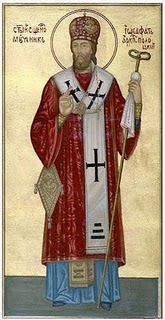
God, you are the martyrs’ crown!St Josaphat of Poltosk.jpg

Hear the hymn we raise in gladness, 

Praising good Saint Josaphat,

Who in midst of earthly sadness

Followed Truth, and Way, and Life,

Braving trouble, scorn, and strife.


Josaphat, a preacher bold,

Was a bishop strong and fearless.

In his love for all his flock

And his ardor, he was peerless:

“That in Christ we one may be”

Was his earnest, heart-felt plea.


Strong defender of his Church,

Lover of the Eastern teaching,          

Faithful priest and leader true

Urged his people through his preaching,

And, by God’s mysterious grace,

Took in heav’n a martyr’s place.


God the Father, God the Son,

God the Spirit, hear our praises

With our hymns on this glad day;

 Which your Church in glory raises.

With Saint Josaphat, in song,

Echoing the ages long!


J. Michael Thompson

Copyright © 2009, World Library Publications

78
78 77; GROSSER GOTT, or JESU MEINE ZUVERSICHT

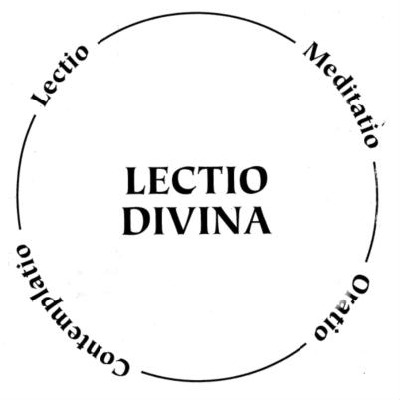
Steps of Lectio Divina

Lectio Divina chart.jpgPope Benedict reviews “… the basic steps of this procedure. It opens with the reading (lectio) of a text, which leads to a desire to understand its true content: what does the biblical text say in itself? Without this, there is always a risk that the text will become a pretext for never moving beyond our own ideas. Next comes meditation (meditatio), which asks: what does the biblical text say to us? Here, each person, individually but also as a member of the community, must let himself or herself be moved and challenged. Following this comes prayer (oratio), which asks the question: what do we say to the Lord in response to his word?

Prayer, as petition, intercession, thanksgiving and praise, is the primary way by which the word transforms us. Finally, lectio divina concludes with contemplation (contemplatio), during which we take up, as a gift from God, his own way of seeing and judging reality, and ask ourselves what conversion of mind, heart and life is the Lord asking of us? In the Letter to the Romans, Saint Paul tells us: “Do not be conformed to this world, but be transformed by the renewal of your mind, that you may prove what is the will of God, what is good and acceptable and perfect” (12:2). Contemplation aims at creating within us a truly wise and discerning vision of reality, as God sees it, and at forming within us “the mind of Christ” (1 Cor 2:16). The word of God appears here as a criterion for discernment: it is “living and active, sharper than any two-edged sword, piercing to the division of soul and spirit, of joints and marrow, and discerning the thoughts and intentions of the heart” (Heb 4:12). We do well also to remember that the process of lectio divina is not concluded until it arrives at action (actio), which moves the believer to make his or her life a gift for others in charity” (Verbum Domini, 87).

Saints in Verbum Domini


communion of saints LA Cathedral.JPGYou may be curious to know the saints and blessed Pope Benedict references in Verbum Domini, or whose work he used.

The Pope said, “The interpretation of sacred Scripture would remain incomplete were it not to include listening to those who have truly lived the word of God: namely, the saints” (48). 

And, “No sooner do I glance at the Gospel, but immediately I breathe in the fragrance of the life of Jesus and I know where to run. Every saint is like a ray of light streaming forth from the word of God…” (49).

Who are the saints in Verbum Domini?

Mary, the Mother of God

Saint Peter
Saint John the Evangelist
Saint Paul
Saint Bernard of Clairvaux
Saint Bonaventure
Saint Thomas Aquinas

Saint John of the Cross
Saint Irenaeus of Lyons
Saint John Chysostom
Saint Maximus the Confessor
Saint Jerome
Saint Gregory the Great

Saint Ambrose
Saint Augustine
Saint Anthony, Abbot
Saint Basil the Great
Saint Benedict
Saint Athanasius

Saint Francis of Assisi
Saint Clare of Assisi
Saint Dominic
Saint Teresa of Avila
Saint Thérèse of the Child Jesus
Saint Ignatius of Loyola
Saint John Bosco

Saint John Mary Vianney
Saint Pius of Pietrelcina
Saint Josemaría Escrivá
Saint Teresa Benedicta of the Cross
Saint Gaetano Errico
Saint Maria Bernarda Bütler
Saint Alphonsa of the Immaculate Conception

Saint Narcisa de Jesús Martillo Morán
Saint Ignatius of Antioch
Saint Elizabeth
Blessed Jordan of Saxony
Blessed Teresa of Calcutta
Blessed Aloysius Stepinac
Blessed John XXIII

Plus, the Pope uses the works of Origen, Richard of Saint Victor and Hugh of Saint Victor, the last two are notable scholars and saintly men; Richard and Hugh are not saints but may be we can push their cause.

“Read the divine Scriptures frequently; indeed, the sacred book should never be out of your hands. Learn there what you must teach.”

Lectio Divina in Verbum Domini

In the Apostolic Exhortation Verbum Domini released today, I immediately started reading the document for what the Pope had to say about lectio divina. You may recall the Pope’s remarks for the 40th anniversary of Dei Verbum in 2005, he said lectio divina will bring about a spiritual springtime in Church. His words were:

“the diligent reading of Sacred Scripture accompanied by prayer brings about that intimate dialogue in which the person reading hears God who is speaking, and in praying, responds to him with trusting openness of heart (cf. Dei Verbum, 25). If it is effectively promoted, this practice will bring to the Church –I am convinced of it– a new spiritual springtime.”

No less than 16 times does His Holiness use the words lectio divina.

Here are some points of interest in Verbum Domini regarding lectio:

St Dominic with Scripture.jpg

46. Listening together to the word of God, engaging in biblical lectio divina, letting ourselves be struck by the inexhaustible freshness of God’s word which never grows old, overcoming our deafness to those words that do not fit our own opinions or prejudices, listening and studying within the communion of the believers of every age: all these things represent a way of coming to unity in faith as a response to hearing the word of God.

48. The interpretation of sacred Scripture would remain incomplete were it not to include listening to those who have truly lived the word of God: namely, the saints. Indeed, “viva lectio est vita bonorum.” The most profound interpretation of Scripture comes precisely from those who let themselves be shaped by the word of God through listening, reading and assiduous meditation. It is certainly not by chance that the great currents of spirituality in the Church’s history originated with an explicit reference to Scripture.

82. Those aspiring to the ministerial priesthood are called to a profound personal relationship with God’s word, particularly in lectio divina, so that this relationship will in turn nurture their vocation: it is in the light and strength of God’s word that one’s specific vocation can be discerned and appreciated, loved and followed, and one’s proper mission carried out, by nourishing the heart with thoughts of God, so that faith, as our response to the word, may become a new criterion for judging and evaluating persons and things, events and issues. Such attention to the prayerful reading of Scripture must not in any way lead to a dichotomy with regard to the exegetical studies which are a part of formation. The Synod recommended that seminarians be concretely helped to see the relationship between biblical studies and scriptural prayer.

student does lectio.jpg

86. The Synod frequently insisted on the need for a prayerful approach to the sacred text as a fundamental element in the spiritual life of every believer, in the various ministries and states in life, with particular reference to lectio divina.

Devote yourself to the lectio of the divine Scriptures; apply yourself to this with perseverance. Do your reading with the intent of believing in and pleasing God. If during the lectio you encounter a closed door, knock and it will be opened to you by that guardian of whom Jesus said, ‘The gatekeeper will open it for him.’ By applying yourself in this way to lectio divina, search diligently and with unshakable trust in God for the meaning of the divine Scriptures, which is hidden in great fullness within.

For this reason, the privileged place for the prayerful reading of sacred Scripture is the liturgy, and particularly the Eucharist, in which, as we celebrate the Body and Blood of Christ in the sacrament, the word itself is present and at work in our midst. In some sense the prayerful reading of the Bible, personal and communal, must always be related to the Eucharistic celebration. Just as the adoration of the Eucharist prepares for, accompanies and follows the liturgy of the Eucharist, so too prayerful reading, personal and communal, prepares for, accompanies and deepens what the Church celebrates when she proclaims the word in a liturgical setting. By so closely relating lectio and liturgy, we can better grasp the criteria which should guide this practice in the area of pastoral care and in the spiritual life of the People of God.

87. The documents produced before and during the Synod mentioned a number of methods for a faith-filled and fruitful approach to sacred Scripture. Yet the greatest attention was paid to lectio divina, which is truly “capable of opening up to the faithful the treasures of God’s word, but also of bringing about an encounter with Christ, the living word of God.”