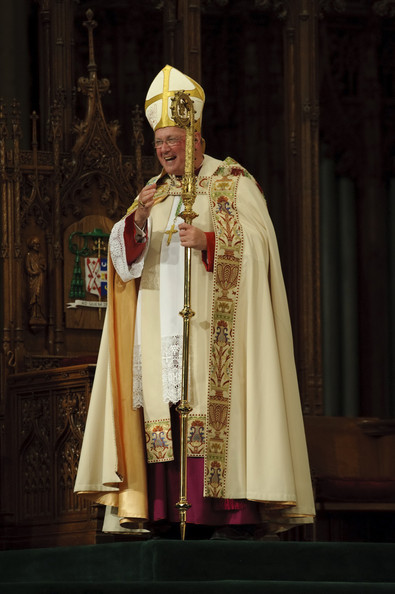
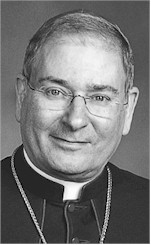
 The out-going chairman of the bishops’ Committee on Divine Worship, Bishop Arthur Serratelli of Paterson, gave the following update to the USCCB today. Bishop Serratelli is now succeeded by the Archbishop of New Orleans, the Most Reverend Gregory M. Aymond. The USCCB press release is here.
There has been some discussion recently about a report
surfaced through some segments of the Catholic Press regarding the present
state of the text of the Roman Missal, Third Edition. A number of facts will
hopefully clarify the situation and, in so doing, give us the calm needed to
welcome and implement the new text.
surfaced through some segments of the Catholic Press regarding the present
state of the text of the Roman Missal, Third Edition. A number of facts will
hopefully clarify the situation and, in so doing, give us the calm needed to
welcome and implement the new text.
First, it is helpful to keep in mind the
genesis of the final text that is now being prepared for publication. The International
Commission on English in the Liturgy (ICEL) prepared for the English-speaking
Conferences of Bishops preliminary drafts (“green books”) of the 12 sections of
the Roman Missal. After incorporating the feedback and responses of the
individual Conferences of Bishops and the Vatican Congregation for Divine
Worship and the Discipline of the Sacraments, ICEL then prepared the final
drafts (“gray books”). These were approved by canonical vote by each of the
member Conferences. In approving the gray books, each conference also had the
opportunity to make further suggestions to the Congregation, as was done in
particular by our Conference. We submitted many amendments to the texts. The
Congregation, working with the Vox Clara Committee, carefully listened to what
the bishops said. The Congregation incorporated many of the suggestions of the
various Conferences (including our own), combined with their own review and
changes, and put forth the final text. The Congregation followed the principles
of Liturgiam Authenticam faithfully but not slavishly.
genesis of the final text that is now being prepared for publication. The International
Commission on English in the Liturgy (ICEL) prepared for the English-speaking
Conferences of Bishops preliminary drafts (“green books”) of the 12 sections of
the Roman Missal. After incorporating the feedback and responses of the
individual Conferences of Bishops and the Vatican Congregation for Divine
Worship and the Discipline of the Sacraments, ICEL then prepared the final
drafts (“gray books”). These were approved by canonical vote by each of the
member Conferences. In approving the gray books, each conference also had the
opportunity to make further suggestions to the Congregation, as was done in
particular by our Conference. We submitted many amendments to the texts. The
Congregation, working with the Vox Clara Committee, carefully listened to what
the bishops said. The Congregation incorporated many of the suggestions of the
various Conferences (including our own), combined with their own review and
changes, and put forth the final text. The Congregation followed the principles
of Liturgiam Authenticam faithfully but not slavishly.
This is the final text
now being readied for publication. This process includes a final review and
copy edit which, given the size of the text, uncovers some minor questions of
consistency, typographical errors, and layout. Those questions are being
addressed by the Congregation for Divine Worship. This review has not dealt
with the translation itself. The critique that has circulated has necessarily
failed to take into account the final version of the text, which incorporates
some corrections issued by the Congregation since the transmittal of the full
text to the English-speaking Conferences of Bishops in August 2010.
now being readied for publication. This process includes a final review and
copy edit which, given the size of the text, uncovers some minor questions of
consistency, typographical errors, and layout. Those questions are being
addressed by the Congregation for Divine Worship. This review has not dealt
with the translation itself. The critique that has circulated has necessarily
failed to take into account the final version of the text, which incorporates
some corrections issued by the Congregation since the transmittal of the full
text to the English-speaking Conferences of Bishops in August 2010.
To sum up,
there is a final text. It has received a recognitio. As the work of editing and
assembling nears completion, there is assurance that the published text will be
available in more than ample time for implementation in Advent 2011. It is good
to note also that the catechetical preparation for implementation is already
underway and has proceeded with much enthusiasm and wide acceptance by both
clergy and laity. It is clear at this point in time that there is an attitude
of openness and readiness to receive the new text. Let us pray in this time of
transition and change that the Roman Missal, Third Edition, will enable all to
understand more deeply the mysteries we celebrate.
there is a final text. It has received a recognitio. As the work of editing and
assembling nears completion, there is assurance that the published text will be
available in more than ample time for implementation in Advent 2011. It is good
to note also that the catechetical preparation for implementation is already
underway and has proceeded with much enthusiasm and wide acceptance by both
clergy and laity. It is clear at this point in time that there is an attitude
of openness and readiness to receive the new text. Let us pray in this time of
transition and change that the Roman Missal, Third Edition, will enable all to
understand more deeply the mysteries we celebrate.
Bishop Arthur J. Serratelli
Chairman, USCCB Committee on Divine Worship
November 18, 2010


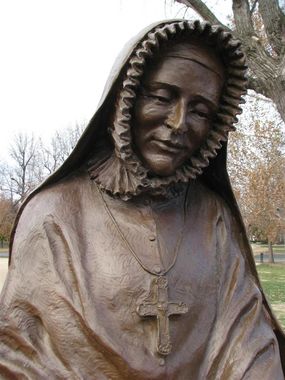 Saint Rose Philippine was called “the woman who is always praying.” Her singular focus on Christ and the mission won her esteem among those who found the Christian Gospel foreign. She is buried in St. Charles, MO, having died there on this date in 1852 at the age of 83. She lived the Lord’s parable of the Pearl of Great Price.