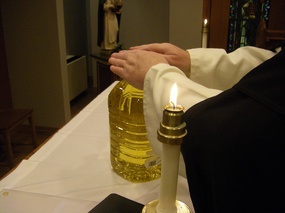
Blessing of St Jude Oil at the St Jude Shrine NYC

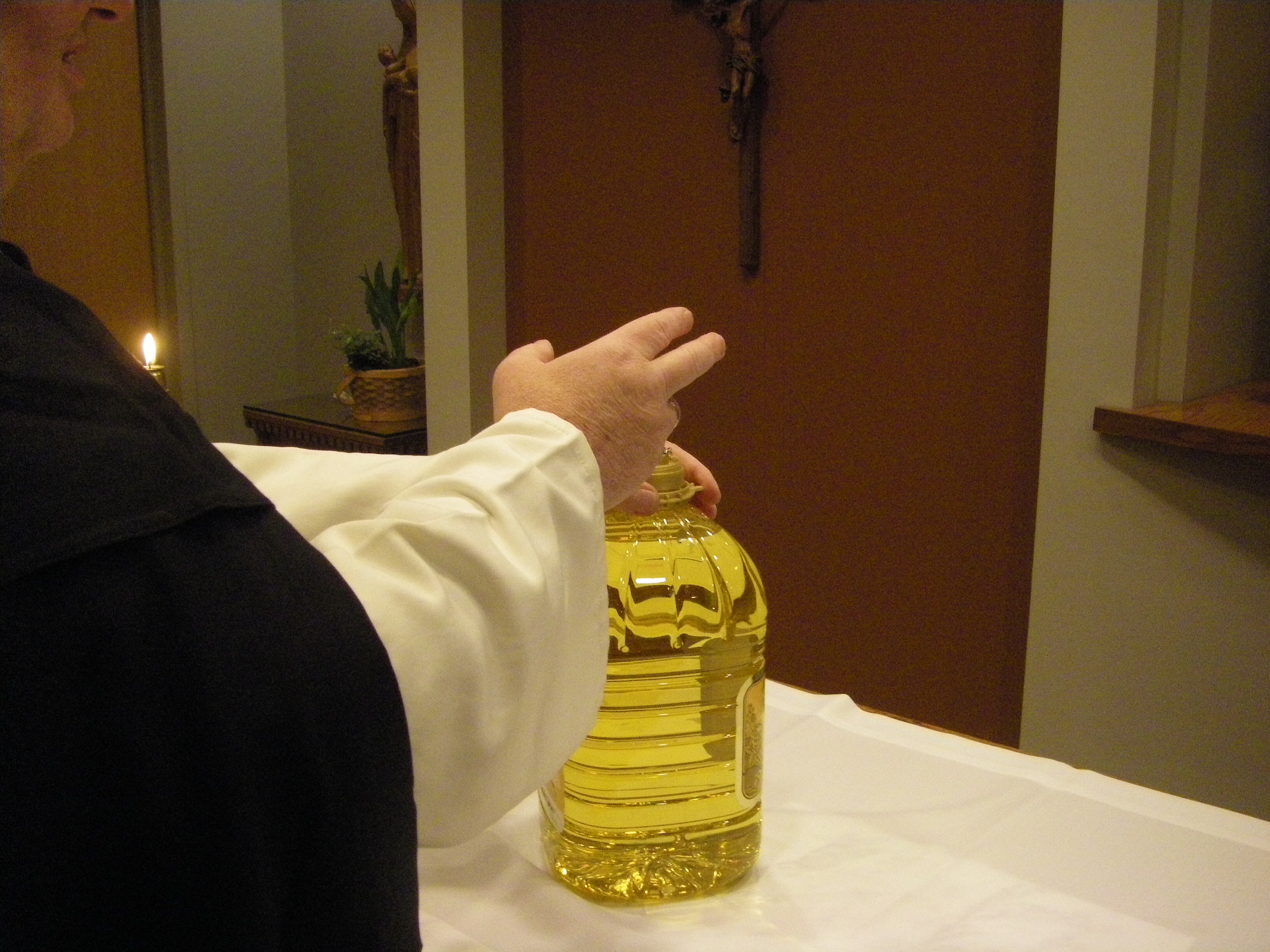
Epiclesis over Oil2.jpg

For centuries the Church has blessed olive oil as a sacramental for healing. Some will have oil blessed for lighting a lamp, bodily healing, and even some will use it in cooking. As a sacramental, oil is used in the same way we’d use Holy Water, Holy Salt, and holy images. The blessing given by the priest beseeches God through the intercession of Saint Jude to heal those who use the Oil protecting them from evil and giving the gift of good health of both mind and body. The Bible also speaks of the healing power of oil and its use also reminds us of our own consecration at the time of Baptism and again at Confirmation. This oil is blessed with the relic of St. Jude but is not to be confused with the Sacrament of Anointing of the Sick.

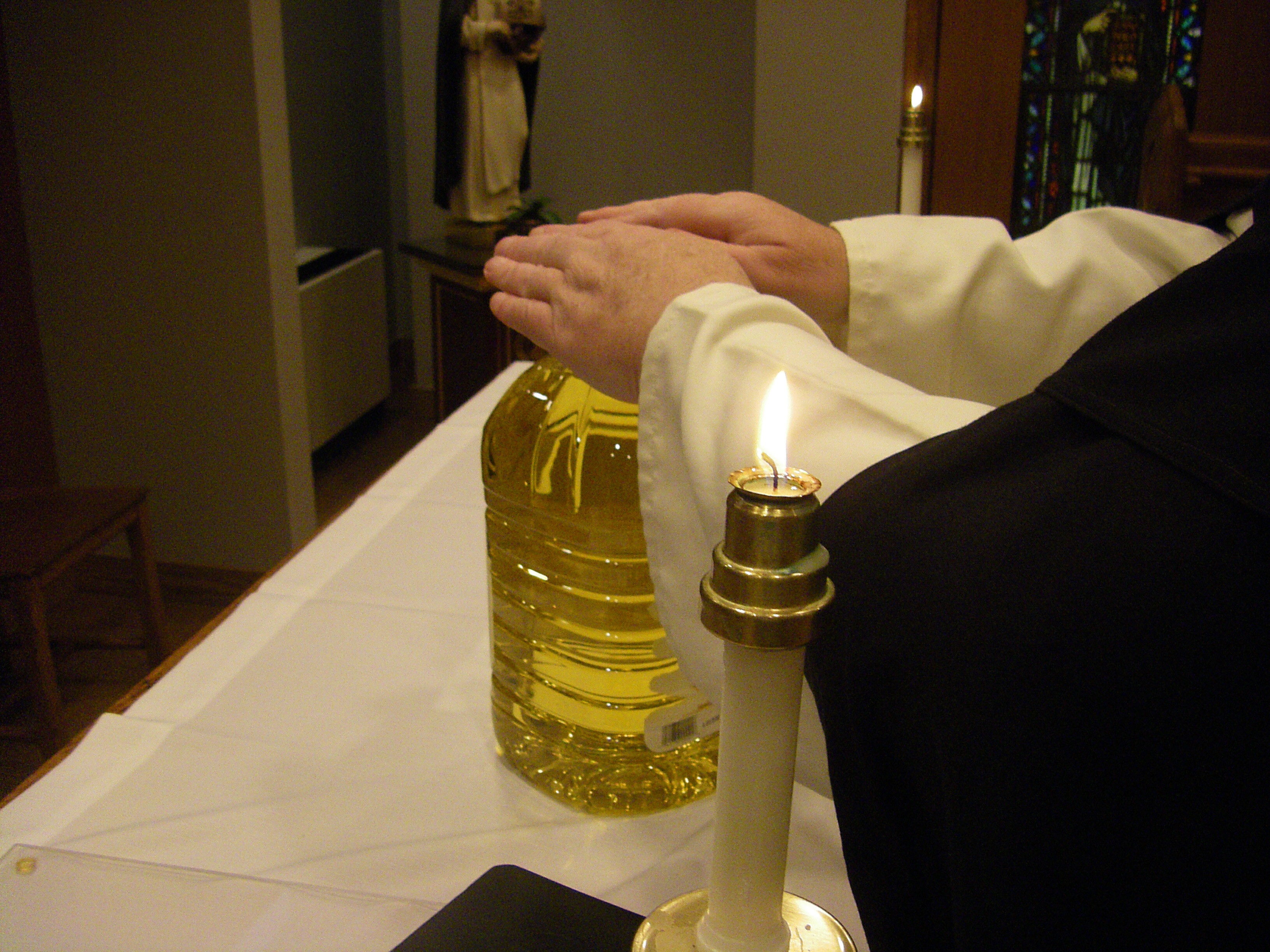
Today, asking for Saint Jude’s intercession and using the relic of Saint Jude, Father Ken blessed Saint Jude Oil for the Dominican Shrine of Saint Jude. The Shrine is a ministry of the Church of Catherine of Siena –NYC.

If you would like to get Saint Jude Oil, write to the Shrine at 411 East 68th Street, New York, NY 10065. A $5.00 donation is requested to cover costs of mailing the Oil.

Blessing of Saint Jude Oil
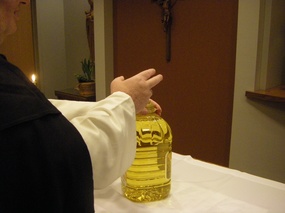
Blessing of Oil.jpg

Priest: Our help is in the name of the Lord.

All: Who made heaven and earth.

God’s creature, oil, I cast out the demon from you by God the Father + almighty, who made heaven and earth and sea, and all that they contain. Let the adversary’s power, the devil’s legions, and all Satan’s attacks and machinations be dispelled and driven afar from this creature, oil. Let it bring health in body and mind to all who use it, in the name of God + the Father almighty, and of our Lord Jesus + Christ, His Son, and of the Holy Spirit, the Advocate, as well as in the love of the same Jesus Christ our Lord, who is coming to judge both the living and  the dead and the world by fire.


Oil in contact with St Jude relic.jpg

Priest: O Lord, heed my prayer.

All: And let my cry come unto you.

Priest: The Lord be with you.

All: And with your spirit.

Let us pray. Lord God almighty, before whom the hosts of angels stand in awe, and whose heavenly service we acknowledge; may it please you to regard favorably and to bless + and hallow + this creature, oil, which by your power has been pressed from the juice of olives. You have ordained it for anointing the sick, so that, when they are made well, they may give thanks to you, the living and true God. Grant, we pray, that those who will use this oil, which we are blessing + in your name, may be delivered from all suffering, all infirmity, and all wiles of the enemy.

Let it be a means of averting any kind of adversity from man, made in your image and redeemed by the precious blood of your Son, so that he may never again suffer the sting of the ancient serpent; through Christ our Lord.

All: Amen.

It is sprinkled with holy water.
Day of Prayer and Penance for Abortion


Angel Gabriel.jpgToday marks the
anniversary of Roe v. Wade, the Supreme Court decision that legalized abortion
in the USA. It is possible according to Law to end a pregnancy throughout all
nine months. A prayerful response to this atrocity the Church has proposed to
us to observe January 22 as the Day of Prayer and Penance making
reparation for the sin the abortion, praying that true freedom would be engaged
in respecting all of human life, from conception to natural death, and that the
Law would be changed.

The rubric for prayer for the day:

In all the dioceses of the United States of America, January 22 (or January 23, when January 22 falls on a Sunday) shall be observed as a particular day of penance for violations to the dignity of the human person committed through acts of abortion, and of prayer for the full restoration of the legal guarantee of the right to life. The Mass “For Peace and Justice” (no. 22 of the “Masses for Various Needs”) should be celebrated with violet vestments as an appropriate liturgical observance for this day. (General Instruction of the Roman Missal, no. 373)


Continue reading Day of Prayer and Penance for Abortion

The Siena Forum for Faith and Culture announced in NYC

Announcing the formation of The Siena Forum for Faith and Culture at The Church of Saint Catherine of Siena (411 East 68th Street, NYC). The Forum’s existence is the result of the leadership of Father Jordan Kelly, OP and myself, who feel deeply that The Siena Forum’s place in the life of the parish and NYC will offer opportunities for the serious engagement of faith and culture, and hopefully and God-willing, in the greater Church. The work of the Forum is rooted in the thinking of Pope Benedict XVI and the soon-to-be beatified Pope John Paul II, along with the intellectual tradition of Catholicism in general and the Order of Friars Preachers (the Dominican Order).
The Forum’s mission

The mission of The Siena Forum for Faith and Culture
seeks to critically examine and promote the rich diversity of the Catholic
faith and its practices that advance authentic human flourishing and its common
good. Our goal is to bridge the gap between faith and reason. The work of the
Forum is rooted in relationships among theology, art, culture, since,
education; the activities of the Forum include pastoral practice, leadership
development, talks, debates courses, seminars, publications, cultural events,
and exhibitions to help people integrate their faith in Jesus Christ as a
dynamic lived experience.


In the coming months and among others, Patrick Madrid and Mike Aquilina will be speaking at the Forum. Currently, the weekly gathering Communion and Liberation’s School of Community meet and organize periodic presentations.

Saint Meinrad, the Martyr of Christ-like Hospitality

St Meinrad.JPGO God, You made glorious in the martyrdom of the hermit Meinrad. Through his intercession, help me to grow in my love for you and in the devotion of the Blessed Virgin Mary. May I follow his example in the Christ-like hospitality and in single-hearted prayer.

There are very few abbeys in the USA that have enduring monastic presence, life, study, music and the like, that the monks of the Archabbey of Saint Meinrad have given to the Church. As I am an oblate of the Archabbey and friends with some of the monks there, I am short on objectivity with the good work and prayer life of the monks. Pray for the monks of Saint Meinrad.

Pope appoints council for Financial Information Authority

Pope Benedict
XVI appointed  Attilio Cardinal Nicora, as president of the newly
created Financial Information Authority (FIA). Until now, the cardinal has been the
head of the Administration of the Patrimony of the Holy See. Also appointed on
Wednesday were the members of the executive council of the FIA: 

  • Claudio
    Bianchi, former professor of accounting at Rome’s La Sapienza University; 
  • Marcello Condemi, associate professor of economic law at Rome’s G. Marconi
    University;
  • Giuseppe Dalla Torre del Tempio di Sanguinetto, rector of Rome’s
    LUMSA University;
  • Cesare Testa, former president of the Central
    Institute for the Sustenance of the Clergy.

Surprisingly, no North
Americans were appointed.

The Financial Information Authority was formed on December
30 as an “autonomous and independent body with the specific task of
preventing and countering the laundering of money and the financing of
terrorism with respect to each subject, both legal and physical, entity and
institution of whatever nature, of Vatican City State, of the Dicasteries of
the Roman Curia and of all the other institutions and entities dependent on the
Holy See.”

Enhanced by Zemanta

Dialogue frozen between the Vatican & Islamic University of Al-Azhar

Controversies never end between the Holy See and Islam. Dialogue between a Vatican group and an Egyptian one is now suspended in a surprising move. From what I can tell, some individuals are easily swayed by sentiment and the immediacy of political power and not by true faith and reason. Not to mention the poor translations of speeches given by the Pope. This is not a new issue and it is a matter of concern. I am inclined to say that the tensions originate not in Pope Benedict’s statements on Islam and Christianity, religious freedom and reciprocity, and faith and reason, but the tensions in Egypt (and other Islamic countries) over secularizing tendencies of some government leaders and the more conservative religious types. Islam, like Christianity, is in a precarious situation with the faith not being able to fruitfully interact in society. They are facing what 1968 was for the West. Islam is losing ground with many people, though it’s hard to prove this on occasion. On the other hand, I am not convinced, from what I read coming from certain religious leaders in Islam, that broadening reason by faith is a priority. They say one thing and do something opposite. Many of them can’t (won’t?) distinguish secularity from secularism. Certainly conflicting statements and reversing previously held “positions” is confusing and leading to heightened anxieties.

Now the Islamic University of Al-Azhar, Egypt’s most prestigious institution of higher learning, is accusing Pope Benedict with propagating a negative attitudes toward Islam and therefore freezing dialogue. Those who hold that idea aren’t reading what the Pope has said. And our consistent approach is openness to dialogue. What does that tell you? And who, really, does the dialogue benefit? The answer: the West according to some Muslims.
This statement comes a month before the meeting of the Joint Committee for Dialogue of the Pontifical Council for Interreligious Dialogue and the Permanent Committee of Al-Azhar for Dialogue among the Monotheistic Religions.

AsiaNews.it provided this story today. I highly recommend it.

Saint Agnes

Let us keep the feast of blessed Agnes, and recall the kind of suffering she endured: in the full flower of her youth she died, and found life. She chose to love the Author of life alone; in the full flower of her youth she died, and found life. (the responsory)

The Church gives us a young woman martyr of the early 4th century. She is thought to be about 12 or 13 (records are sketchy) Agnes was martyred under the Emperor Diocletian.

Pope Benedict XVI blesses lambs to mark the feast of Saint Agnes at the VaticanMore often than not our remembrance of Agnes focuses less on her virginity and martyrdom —the supreme gesture of witness to the Lord– and more on the fact that wool is given to the Pope. Sad but true. Agnes’ witness to a life of virginity, possessing without possession, of a complete love for God. On this feast a tradition reaching back centuries lambs are raised by the Trappist monks of Tre Fountane in Rome bring to the Pope the wool that will be made into the pallia by the Benedictine nuns of the Abbey of Saint Cecelia (in Trastevere). The pallium is a white band of wool with six embroidered black crosses (the Pope’s pallium is slightly different with red crosses and wider). The pallium is worn by the metropolitan archbishop for significant ecclesial events, i.e., Masses of Ordination, consecration of churches, altars, bishops, and on certain feast days. Unfortunately, the pallium is worn too often and without proper distinction of festivity and ecclesial communion with the Pope. The Servant of God Pope Paul VI issued a 1978 document, Inter Eximia, limiting the use of the pallium to the pope and metropolitan archbishops. In 1984, John Paul determined the date of the conferral of the pallia.

Before given to the new metropolitan archbishops on June 29th, the feast of Saints Peter and Paul, the pallia rest for short time on the tomb of Saint Peter (the Confessio). You will recall that Saint Agnes is one of the seven women commemorated in the Roman Canon (the BVM would be the 8th).

When the Pope was invested with the pallium on April 25, 2005 by the cardinal proto-deacon Jorge Cardina Medina Estévez, it was prayed: Praise the Lord, who chose you as herdsman of the whole church and embraces you with the white stole of your office. May you act under its briliance for many years of your earthly life and enter his celestial realm vested in the stole of immortality once He calls you.

A poetic work worth noting for the feast is John Keats’ poem “The Eve of St. Agnes.” Written in 1819, this is an extensive poem with great literary accomplishment but of questionable understanding of Agnes’ witness. Keats was no doubt captivated by the life and martyrdom of Agnes, who wouldn’t be? Her brief life and dramatic death is very intriguing and it captivates  the intellect.

The striking figure that the young Agnes was encouraged Roman Christians to build a the Church of Saint Agnes outside the Walls (i.e., outside the City) over the tomb of Agnes. It is the titular church of Camillo Ruini, the former Vicar of Rome.

Saint Agnes is the patron saint for chastity, gardeners, girls, engaged couples, rape victims and virgins.

Nevertheless, one can’t move away from the feast day without reading Saint Ambrose’s treatise On Virgins given in the Office of Readings:

Detail of St Agnes, Fra AngelicoToday is the birthday of a virgin; let us imitate her purity. It is the birthday of a martyr; let us offer ourselves in sacrifice. It is the birthday of Saint Agnes, who is said to have suffered martyrdom at the age of twelve. The cruelty that did not spare her youth shows all the more clearly the power of faith in finding one so young to bear it witness.

There was little or no room in that small body for a wound. Though she could scarcely receive the blow, she could rise superior to it. Girls of her age cannot bear even their parents’ frowns and, pricked by a needle, weep as for a serious wound. Yet she shows no fear of the blood-stained hands of her executioners. She stands undaunted by heavy, clanking chains. She offers her whole body to be put to the sword by fierce soldiers. She is too young to know of death, yet is ready to face it. Dragged against her will to the altars, she stretches out her hands to the Lord in the midst of the flames, making the triumphant sign of Christ the victor on the altars of sacrilege. She puts her neck and hands in iron chains, but no chain can hold fast her tiny limbs.

A new kind of martyrdom! Too young to be punished, yet old enough for a martyr’s crown; unfitted for the contest, yet effortless in victory, she shows herself a master in valour despite the handicap of youth. As a bride she would not be hastening to join her husband with the same joy she shows as a virgin on her way to punishment, crowned not with flowers but with holiness of life, adorned not with braided hair but with Christ himself.

In the midst of tears, she sheds no tears herself. The crowds marvel at her recklessness in throwing away her life untasted, as if she had already lived life to the full. All are amazed that one not yet of legal age can give her testimony to God. So she succeeds in convincing others of her testimony about God, though her testimony in human affairs could not yet be accepted. What is beyond the power of nature, they argue, must come from its creator.

What menaces there were from the executioner, to frighten her; what promises made, to win her over; what influential people desired her in marriage! She answered: “To hope that any other will please me does wrong to my Spouse. I will be his who first chose me for himself. Executioner, why do you delay? If eyes that I do not want can desire this body, then let it perish.” She stood still, she prayed, she offered her neck.

You could see fear in the eyes of the executioner, as if he were the one condemned; his right hand trembled, his face grew pale as he saw the girl’s peril, while she had no fear for herself. One victim, but a twin martyrdom, to modesty and to religion; Agnes preserved her virginity, and gained a martyr’s crown.

Almighty, ever-living God, you choose what is weak in the world to shame what is strong. Grant that, as we celebrate the martyrdom of Saint Agnes, we may follow her example of steadfastness in faith.

Saint Henry


St Henrik.jpg


Almighty God, your
servant Henry of Uppsala brought the light of the gospel to the people of
Finland and confirmed his preaching by martyrdom: Shine, we pray, in our
hearts, that we, also, in our generation may show forth your praise, who called
us out of darkness into your marvelous light.

Pope talks about Christian Unity this week

This week the Christian Churches around the world are observing the Week of Prayer for Christian Unity. Today, the Pope gave his thoughts on the subject:

1.  “we have listening to the teaching of the Apostles, or
listening to the witness that they give to the mission, life, death and
resurrection of the Lord Jesus. It is what Paul simply calls the Gospel”.
“Even today, the community of believers recognizes in reference to the
teaching of the Apostles the law for their faith; every effort to build unity
among all Christians therefore passes through the deepening of fidelity to the
deposit of faith handed down to us by the apostles.”

Continue reading Pope talks about Christian Unity this week