Cybertheology

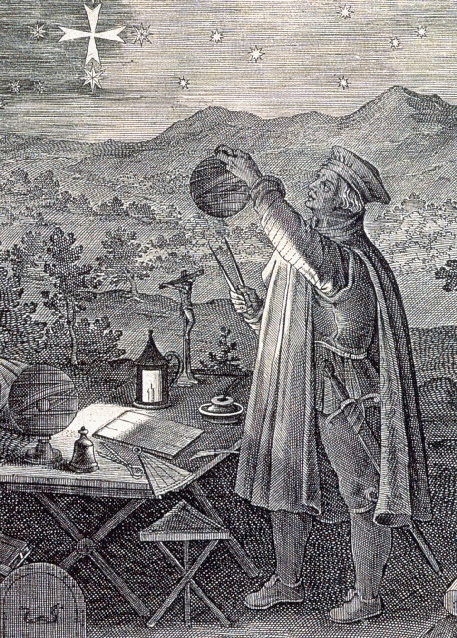
medieval astronomer.jpg

Cybertheology is not one of the sub-sections of systematic theology. At least not yet. But it is a promising idea that will likely have a positive influence in the lives of those who surf the web religiously and for those searching for God and who are not ready (willing?) to be personally involved in the Sunday celebration of the Mass or any other organized religious program that requires one to be physically present.
The originator of the Cybertheology project, Jesuit Father Antonio Spadaro, one of the editors at La Civiltà Cattolica, started a blog to investigate the new, dynamic and complex influence of the Net and the challenages it poses to our relationships with others, language, thinking and the Divinity. I take Father Spadaro’s interest and work in this subject on the impact of the digital world to be wholly consistent with what Pope Benedict talked about in his January 2011 letter on social communications where he said “new technologies must be placed at the service of the integral good of the individual  and of the whole of humanity. If used wisely, they can contribute to the satisfaction of the desire for meaning, truth and unity which remain the most profound aspirations of each human being.” And, “This dynamic [the digital world] has contributed to a new appreciation of communication itself, which is seen first of all as dialogue, exchange, solidarity and creation of positive relations.”

Continue reading Cybertheology

Reno new editor of First Things

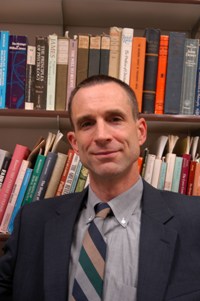
RR Reno.jpgThe Chairman of the Board of First Things, Robert Louis Wilken, announced that Russell R. Reno is the new editor of First Things.

RR Reno is the sometime professor of theological ethics at Creighton University. He earned a doctorate from Yale University.
Reno recently published Fighting the Noonday Devil and Other Essays Personal and Theological (Eerdmans, 2011).

The appointment is effective April 1. 

RR Reno’s the second successor to Father Richard John Neuhaus. Jody Bottum left the editorship a few months ago.

Enhanced by Zemanta

Pope ordains 5 new bishops


placing mitre on new bishop.jpg

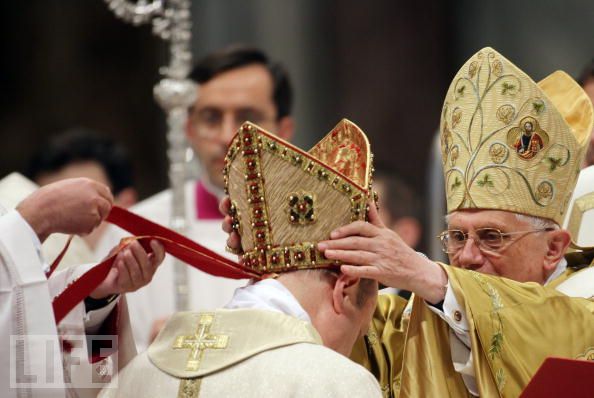
The Holy Father ordained 5 priests to the episcopacy today on the liturgical memorial of Saint
Agatha at the Vatican Basilica. The priests are:

Father Savio Hon Tai-Fai, 61,
a Salesian of Saint John Bosco, elected titular archbishop of Sila and
nominated Secretary of the Congregation of the Evangelization of Peoples.

Father
Marcello Bartolucci, 67, a priest of the Diocese of Assisi-Nocera Umbria-Gualdo
Tadino, elected titular archbishop of Bevagna and nominated Secretary of the
Congregation of the Causes of Saints.

Father Celso Morga Iruzubieta, 63,  a priest of the Diocese of Calahorra y
La Calzada-Logroño, elected titular archbishop of Alba Marittima and nominated
Secretary of the Congregation of the Clergy.

Father Antonio Guido Filipazzi,
48, a priest of the Diocese of Ventimiglia-San Remo, elected titular archbishop
of Sutri and nominated Apostolic Nuncio.

Father Edgar Peña Parra, 51, a priest
of the Archdiocese of Maracaibo, elected titular archbishop of Telepte and
nominated Apostolic Nuncio in Pakistan.

May the saints intercede for these men.

Pope no longer organ donor

Pope at Vespers Feb 2 2011.jpgWord’s been received that Pope Benedict’s organ donor card is void. It’s been so since his election to the papacy in 2005. Since the 1970’s it is said that he’s been an organ donor.

He fully supports organ donation but now that he’s the Pope, his thinking has not changed –he still believes in the virtue of donating one’s organs to another– but now as it was said, his body belongs to the whole Church. In fact, the Pope has criticized the selling of human organs versus the free gift of self in making a donation of an organ. The Pope said on November 7, 2008 at the international congress, “A Gift for Life: Considerations on Organ Donation”: 
The act of love, which is expressed with the gift of one’s own vital organs, is a genuine testament of charity that knows how to look beyond death so that life always wins. The recipient should be aware of the value of this gesture that one receives, of a gift that goes beyond the therapeutic benefit. What they receive is a testament of love, and it should give rise to a response equally generous, and in this way grows the culture of gift and gratitude.
Archbishop Zygmunt Zimowski, head of the healthcare office at the Holy See, said the Pope’s body will remain intact at the time of his death.

Read what Pope Benedict XVI thinks about beauty of organ donation: Pope Benedict on organ donation.pdf

If you understand German, you can listen to Pope Benedict’s personal secretary Monsignor Georg Gänswein brief on the matter.

First Dulles Chair at Fordham inaugurated

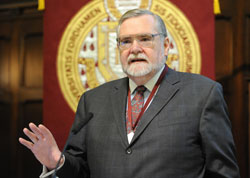
Terrence Tilley.jpgTerrence W. Tilley, Ph.D., chair of the Department of
Theology at Fordham University, was formally installed as the first occupant of
the Avery Cardinal Dulles, S.J., Chair of Catholic Theology. The benefactors of
the Dulles Chair are Vincent and Teresa Viola.


Typical in academic settings
like this one the Chair delivers an address of his choosing. Tilley gave
audience his opinion on Saint Ignatius of Loyola’s famous Rule 13 in  Rules for Thinking with the Church as
found in the Spiritual Exercises. His address: “Sentire cum Ecclesia:
Thinking With and for the Church.” Tilley’s claim was based on his reading
the of Rule 13 in light of Cardinal Dulles’ 1974 and later republished in 2002 with a
new introduction and an essay on Pope John Paul II’s ecclesiology, Models of the Church. Models is Dulles’ exposition of the 5 ways of knowing the Church.

Continue reading First Dulles Chair at Fordham inaugurated

Mass of Thanksgiving for the Beatification of Pope John Paul II set for St Catherine of Siena Church, NYC on May 1

The NY Community Communion and Liberation has been invited by Dominican Father Jordan Kelly to attend a Mass of Thanksgiving for the Beatification of Pope John Paul II which will be celebrated at The Church of Saint Catherine of Siena (411 East 68th Street, NYCon Sunday, May 1, at 12 Noon. Father Jordan will be the main celebrant and homilest.

Monsignor Lorenzo Alabacete will be concelebrating and giving his personal recollections of Pope John Paul II and what the beatification means for us following the Mass.

If you already read the recent letter by Father Carrón, you would know that on the same day the entire Movement in Italy will be present for the beatification ceremony in Rome. If you have not read the letter yet, I strongly encourage you to do so. Father Carrón’s letter to the Movement can be read here

Please save the date for this moment of gratitude and unity.

Giussani’s “The Religious Sense”: a variety of points of view

The Religious Sense.jpgThis coming year the Schools of Community throughout the world will be working on Monsignor Luigi Giussani’s seminal text, The Religious Sense (in English in 1997).

In The Religious Sense, Monsignor Giussani explores man’s search for meaning in the given-ness of life. He demonstrates that reason is known in understanding and recognition of truth, goodness and beauty. Regardless of faith tradition, all people are in search for these elements and we can know the meaning of truth, goodness and beauty by the criteria of the heart, that is, discovery of these element is found in the person himself by an openness to existence which has the capacity to affirm reality as it is –from experience– (reason) and not from what the lack of self-aware world says reason is, that is, from outside factors.
Several essays open up Giussani’s work:
Father Julián Carrón’s Milan presentation of “The Religious Sense, Verification of the Faith”, a version of which was given at the 2011 NY Encounter: The Religious Sense, Verification of the Faith.pdf
Father Luigi Giussani’s “The Religious Sense and Faith”: The Religious Sense and Faith.pdf
John Waters’ “The Religious Sense and myself”

Focolare saved a vocation and formed a man of God

Carol Glatz of CNS wrote a fascinating article –at least fascinating to me because I can identify with what the new Prefect of the Congregation of Religious said of his own experience with Liberation Theology. To say that liberation theology terrorized vocations is likely an understatement. I believe the Archbishop is correct in saying that elements of liberation theology are credible, Pope Benedict has said as much, too, but the Marxist methodology is not fitting for the salvation of souls, at least how the Church conceives of salvation of souls. Liberation theology deconstructed religious and priestly life to social work, reduced essential theological concepts to ideology and rejected the authority as non-essential, among many things. Why would anyone devote their lives to a religious vocation under the rubric of liberation theology? Clearly this method of theological reflection needs to be scrutinized even more.

A very telling line in Glatz’s article is the Archbishop saying: “‘The lack of a theological and mystical experience of the Holy Trinity as the source of communion has brought negative statements about community life,’ such as when some religious say the biggest penance they face is communal living.” His other statements on one’s experience of God viz. autonomy and obedience and love are interesting, too.

Archbishop Joāo Bráz de Aviz credits his relationship with the lay movement Focolare in saving his vocation from being aborted. Focolare, like other lay ecclesial movement focused on vertical and horizontal communion with the Trinity and others, and stressed the virtue of unity built on the Trinitarian life. I follow Communion and Liberation and I say that CL has kept me together in ways that other things did not or could not. Focolare is also a very worthy vocation to follow.
Enhanced by Zemanta

Saint Rabanus Maurus

St Rabanus Maurus.jpgSaint Rabanus (c. 780-4 Feb. 856), a Benedictine monk, theologian, exegete, poet, abbot and archbishop of Mainz, called the “teacher of Germany.” Rabanus studied under Alcuin who gave him the name of “Maurus.” He authored De rerurm naturis (On the Nature of Things), De laudibus sanctae Crucis but he’s most known for his composition of “Veni Creator Spiritus,” the beautiful hymn we sing at Pentecost and any time we pray to the Holy Spirit.

As Pope Benedict XVI reminded us when thinking about Saint Rabanus, he is “an extraordinary awareness of the need to involve not only the mind and heart in the experience of faith, but also the senses.” Rabanus was instructive in showing us how to use the “aesthetic taste and human sensitivity which bring man to benefit from the truth with all of himself: spirit, soul and body.”
For Benedict said, “I believe that Rabanus Maurus also speaks to us today. Whether immersed in the frenetic rhythms of work or on holiday, we must reserve time for God. We must not forget Sunday as the day of the Lord and the day of the liturgy, in order to see –in the beauty of our churches, of sacred music, and of the Word of God– the beauty of God Himself, and allow it to enter own being. Thus our lives become great, they become true life.
Ultimately from Saint Rabanus we learn that “We must search for God in all the dimensions of our being.”
The 2001 Roman Martyrology lists Rabanus as a saint while other sources list him as a blessed. Saint Rabanus is recognized as a holy bishop and scholar, and a confessor of the faith.
Pope Benedict XVI’s General Audience of 3 June 2009 was dedicated to Saint Rabanus.

St Agatha’s Mass and Anointing of the Sick for those living with breast cancer, East Haven

agatha.jpg


We will be gathering to pray the Holy Mass for those living with breast cancer in honor of Saint Agatha, the patron saint of those living with breast cancer.

Saint Agatha’s feast day is February 5 but for pastoral reasons, the liturgical observance will be held on the day before and the after the feast.

No one is without a family member or a friend who has breast cancer.
This is an opportunity to join together in prayer and friendship with those living with ongoing trial –you could say cross– of breast
cancer.

On Friday, February 4, 2011, at the 5:30 pm Mass at Our Lady of Pompeii Church (355 Foxon Road, Route 80, East Haven, CT), Father John Lavorgna will administer the Sacrament of the Anointing of the Sick invoking the intercession of Saint Agatha.

Let your friends know of this special Mass and anointing service. All are invited and most welcome.