Preparing for (real) Christian life

Good question: how does one prepare one self for Christian living? I’d suggest 

  • look for ways to grow in virtue by practice and asking for the grace from Jesus;
  • reduce time sitting in front of the TV, vedging-out; drinking, and eating bad food;
  • be aware of the ways in which self-ish behavior is the norm and make changes;
  • spend time doing lectio divina, praying the rosary and praying for enemies one’s conversion;
  • seek ways to be generous, self-sacrificing by offer a sincere gift of self, self mastery relationship with the Lord.
Many come to a conversion of life from within marriage (and some through religious vows and priesthood) but how we live our life right now is the question; it is also a matter of formation that will bear fruit later in life. Ask for the grace to live a real Christian life.

Court of the Gentiles –next step

Success is not a word that is appropriate for matters pertaining to faith, even if it’s dealing those hearing the message of the Gospel for the first time or fancy programs. But I think it’s fair to say that from the reports that are coming from the Court of the Gentiles last weekend, this event was extraordinarily successful. Cardinal Gianfranco Ravasi, his staff and collaborators have the makings of very significant work for culture, humanity and theology which will, no doubt, bear much fruit.

What’s at stake is not theology but humanity, not God but man and woman. If we don’t deal with our humanity, our human need, our desire for the infinite, then we will be less than what we are made for: happiness and greatness.

Sandro Magister’s follow-up can be read here.
Chicago is on the list of possible events like the Court of the Gentiles. AND not New York?
BTW, read this blog post on the origin of the “Court of the Gentiles.”

Patriarch’s title for the Ukrainians?

For many moons now, some estimate 50 years in the asking, the question to the pope has been: when will the Ukrainian Greek Catholic Church be given the title of Patriarch?

Currently, there are some people who use the title unofficially –even provocatively– because they know better than the pope. Somehow the thinking is that if we just use that which is due to us then the rest of the world –and the Holy See– will see they we’re right and they are wrong. The head of the Ukrainian Greek Catholic Church holds the title of “Major Archbishop.” There are three other Major Archbishops in the Catholic Church: Romanian Greek Catholic Church, Syro-Malabar and Syro-Malakar Churches (both in India).
This attitude is unhelpful, incorrect and obnoxius. It is acutally an attitude of entitlement AND no one is entitled to anything in the Catholic Church. While the title of patriarch may, in fact, be fitting and proper to the head of the Ukrainian Greek Church, it is a title and privilege that is given. It is bestowed, not taken.
You’ll recall that Pope Paul VI made the designation of “Major Archbishop” in 1963 and gave it to the Ukrainian Greek Church. and his successors have said the Byzantine Ukrainian Church that it is an open question and that the Church has work toward getting the title of Patriarch. You see, this Church has been persecuted and “run out town” by the government and other ecclesial bodies and really only since the early 1990s has the Church gotten its proverbial sea-legs back. For a time, which may be current, there’s been a fear jeopardizing ecumenical relations with the Orthodox sister-churches.
Archbishop Sviatoslav Shevchuk is in Rome to pray at the tombs of Saints Peter and Paul and to meet with Pope Benedict and the Roman Curia. It is the sharing of Communio between brothers in the Lord. He’s travelling with the Metropolitan Archbishops and members of his staff.
So, while it may be important to have the title of “patriarch” it is not the first of the priorities of the new head of the Ukrainian Greek Catholic Church.
The brief story is here.

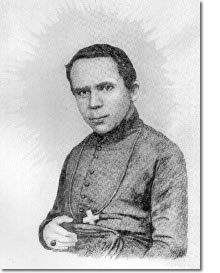
Saint John Neumann: “he laid his life down”


St John N Neumann.jpg

His love for
people was authentic brotherly love. It was real charity: missionary and
pastoral charity. It meant that he gave himself to others. Like Jesus the Good
Shepherd, he lay down his life for the sheep, for Christ’s flock: to provide
for their needs, to lead them to salvation. And today, with the Evangelist, we
solemnly proclaim: “There is no greater love than this: to lay down one’s life
for one’s friends” (John 15, 13).

Servant of God Pope Paul VI

excerpt, canonization homily

19 June 1977

Learn more about Saint John Neumann during this holy year, the 200th anniversary of his birth.

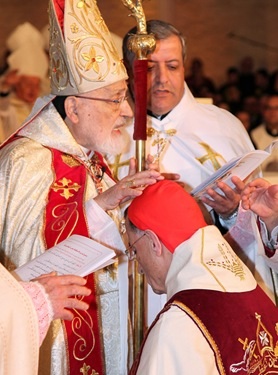
Patriarch Béshara Raï begins new ministry as the Maronite head and father working on unity

Sfeir & Rai March 25 2011.jpg

In his letter to the new Patriarch, granting “ecclesiastica communio”, Pope Benedict prayed that Patriarch Béchara Peter would be assisted by the Lord in the proclamation of the Gospel of Jesus Christ and the fervent in his teaching of the faith; the Pope also said “It is a motive of pride for your Church to be united from the beginning to the Successor of Peter. Peter was called by Jesus to preserver the unity of his one Church in truth and in love. Following a beautiful and ancient tradition, Peter’s name is added to the patriarch’s”
Pope Benedict’s fraternal support was echoed in his hope that the Patriarch had “all the ardor, illumined by wisdom and tempered by prudence, to guide the Maronite Church.”
The Maronite Church was established by Saint Maron having lived in the 4th and 5th centuries. Patriarch Béchara Peter is the 77th father of a Church of 3 million people worldwide. Besides the Middle East, Maronites are present in Western Europe, Argentina, Mexico, Australia, the United States of America, and Canada.

The video of Patriarch Béchara Peter Raï’s enthronement Liturgy on March 25, 2011.

Digging back into TV history, Jesuit Father Mitch Pacwa of EWTN talks with the US Maronite Bishops Gregory Mansour and Robert Shaheen about the role of the Maronite Church in the overall unity of the Catholic Church. Father Pacwa gives a sense of Maronite spirituality. Watch the show.

80 years of monastic profession: the witness of a lifetime

Permanent commitment is an awesome gesture. It is, however, becoming a thing of the past these days. I remember a few years ago
when my parents were celebrating their 40th wedding anniversary and one of my
mother’s clients said to her: “I can’t believe you’ve been married to the same
man for this long.” I was taken aback by the statement. In my mind what else would you do but be faithful to your vows. Of course this woman is on her second marriage and from all
reports pretty self-absorbed. There was a time when you entered into a “life
commitment” by vows and you did what they indicated: live them forever, unto death is there parting. Times have changed: prenuptials are “in” and convenience has replaced permanency. Have we become too fickle? Just
recently an event in Rome gave me hope: Father Angelo’s 80 years as a Trappist
monk of the Abbey of Tre Fontane. Imagine 80 years do anything! Imagine living your monastic profession in the place where Saint Paul was martyred! Saint Paul’s head bounced three times. Hence three fountains of water sprung up.


Tre fontane di S. Paolo.jpg

Father Angelo (Archangelo Buccitti in
history), just celebrated his 94th birthday on March 3. Bishop Paolo
Schiavon, a long-time friend of the community offered Mass for Father Angelo’s
intentions. 

Father Angelo’s monastic journey included entry at Frattochie abbey at 14 years of age, his journey to solemn profession, ordination to the
priesthood, time as chaplain for the Trappistine nuns at Vitorchiano, his election
as abbot of Tre Fontane and his ten years in that capacity. All of Father
Angelo’s life can be seen as a homage, a testament to grace and grace’s living through his deep humanity known through fraternal
charity, humility and faithfulness to God’s call. 

Father Angelo said: “The
Lord does not count the number of one’s years, but weighs their quality” and “A
man is never taller than when he is on his knees before his Lord.”

Is the Pope’s Irish proposal reasonable?

Haven’t been thinking of the Pope’s letter to the Church in Ireland regarding the sexual abuse problems in a while? Let’s start thinking anew: the year of prayer that the Pope asked for is coming to an with Easter. I’d like to know what’s different.


No one I know takes issue with what the Pope has been doing with the sexual abuse matters. That may be a point of criticism of me and my friends, but I don’t have all the answers to such a complex issue such as pedodphilia and ephebophilia and I tend to lean toward diagnosing the problem not merely from psychological and sociological criteria but most importantly from spiritual criteria. What does one do with sin in one’s spiritual life? My experience with secular and religious clergy, religious sisters and brothers, and of course the laity, is that there is lots of mediocre spiritual lives in the Catholic; I might even argue for an acceptance that there are a lot of spiritually dead men of the cloth pastoring souls today. Since the Pope’s March letter to Ireland of a year ago I have been thinking and praying about the matter, as you have you some concrete initiatives to address the situation, in addition to a special investigation into the way certain dioceses took responsibility for the crimes.


Continue reading Is the Pope’s Irish proposal reasonable?

Reaching Muslims: A one-stop guide for Christians

Reaching Muslims.jpg

A recent book on Muslim Christian relations is Reaching Muslims: A one-step guide for Christians gives a perspective, albeit from a Protestant perspective, is worth noting. Much of what is said therein would recall for interested readers the kinds of things Pope Benedict XVI has already said. The author is reasonably positive when he speaks about Muslim culture being “culturally rich and often wonderfully passionate
about life and faith.” There is a lot of useful information given here: he covers lots of ground: politics, sociology, belief, justice matters, history and demographics.

This book attempts to help the read to bridge the gap of divisions, real or fictional, between Christians and Muslims. Fear of the other keeps us from speaking the truth in love and in peace with someone who does not think or act like we do. Chatrath holds up the role of friendship in knowing the other. Friendship bears the heat of the day!

Continue reading Reaching Muslims: A one-stop guide for Christians

Saint Stephen Harding

St Stephen Harding.jpg

Today the Church –though localized to the Cistercian Order– celebrates the liturgical memorial of Saint Stephen Harding, one of the 3 founders of the Cistercian reform of Benedictine monastic life. Most of the faithful would not know of Saint Stephen unless they had contact with the Cistercians or remember their church history class.

Several things distinguish Saint Stephen Harding: he was English, he was the third abbot of Cîteaux, he was a man of great pragmatism, he was the author of the Charter of Charity (the foundational document of the Cistercian life), and was responsible for the liturgical formulations for this way of life, cleaning up the corruptions inserted into the Divine Office over the years.

On Saint Stephen’s deathbed he said, I assure you that I go to God in fear and trembling. If my baseness should be found to have ever done any good, even in this I fear, lest I should not have preserved that grace with the humility and care I ought.

For more on Saint Stephen Harding read this entry and this one.