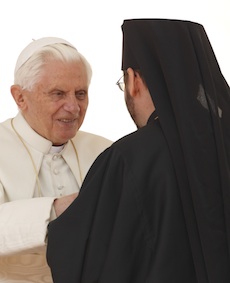
Shevchuk talks about his election, chosen to lead a Church

Shevchuk & Pope Benedict Mar 31 2011.jpg

Cindy Wooden’s CNS article, “Ukrainian archbishop says he was chosen ‘despite age to promote unity” on Archbishop Sviatoslav Shevchuk gives a clearer sense of the man and some of priorities. Wooden and Shevchuk met in Rome this week on the latter’s visit to Pope Benedict.

Archbishop Sviatoslav described the nature of his church in this way: “We are an Eastern Church with its tradition and inheritance, … a synodal Church is governed by the synod of bishops together with the major archbishop. But, we are also a Catholic Church that lives its identity in a full, visible and real communion with the Holy Father.”

What are Archbishop Sviatoslav’s priorities?
  • to strengthen the proclamation of the Gospel (kērgma) and the teaching of the faith (didachē)
  • to work on the Church’s liturgical theology and praxis; to make the liturgical patrimony intelligible in all the countries where the Ukrainian Catholic Church exists
  • to develop programs that attack secularism and engages the positive secularity
  • to strengthen the service of justice (diakonia)
  • to promote unity in the Church and among the other churches
  • to develop better social communications strategies for the Church
  • to identify ways in which to inculturate the Gospel and Byzantine tradition
  • to work with the Ukrainian people to heal from past injuries viz. the Russian Orthodox Church; to work on the fears that are paralyzing some members of the Church
  • to dialogue and work with the Orthodox Churches in the Ukraine (and where the Church is present) on matters of theology and mutual human interest
  • to promote healthy celibate and married vocations to religious life and priesthood.
Read the CNA story on the archbishop.
The Archeparchy of Philadelphia’s newsletter The Way also gives another sense of the recent events in the Church: The Way March 2011.pdf

“Reality holds a signature from God … we must seek to decipher”

The transcript for the talk on whether a scientist can be a believer that was given at a lecture hosted by the New York Encounter in January has just been released by the Crossroads Cultural Center. Faith and reason is being explored here. It is a great question to ask if a believer in Christ –or perhaps a Jew or Muslim adherent– can be credible, true to his or her being given a certain intellectual formation. Does belief in God forfeit our true search for the Divine? Monsignor Lorenzo Albacete’s portion of the discussion is the most interesting to me and it is noted below (emphasis mine). A believer sometime has to work overtime to convince him or herself that faith and science are compatible. The other day my attention was drawn to what a little girl said about Lent: her view of life and the simplicity by which we have to look everything realizing that we don’t make ourselves; everything is given. Albacete answers the question of the compatibility of faith and science: The answer, I propose, is not only yes he can, but, in fact, it is faith that will sustain his or her passion for investigating nature, and prevent the process itself and its results from becoming enslaved to political, economic, and religious ideology.Let me know what you think.

In such a case, is awe, wonder, and joy at scientific
discoveries possible? When I was thinking about this, a friend sent me the text
of a speech given by Msgr. Luigi Giussani about the “love of being” that is
remarkably appropriate to this reflection.  Giussani’s argument is that the truth of Christianity can be
verified by a proper consideration of the evidence
for it. Evidence, he says,
is the correct word, even if the evidence for the Christian claim is given to
us through signs
. Signs are things that can be touched, seen, and experienced. The Apostles had Jesus in front of them and this presence was a sign of His
victory over death, and therefore of His mysterious identity. But what about
us? What happens with the passage of time? What signs are there for us as
evidence of the truth of the Christian claim, of the reasonableness of the
Christian claim?


The interpretation of the signs available to us engages our
liberty, he says. In this drama, our liberty is a manifestation of our love for
being. Without this love for being we are not truly free and we will never
grasp the evidence of the signs given to us. At this point, as an example of
this love for being, Giussani invokes the Magi.

Continue reading “Reality holds a signature from God … we must seek to decipher”
Byran Kemper reverts to Catholicism…why?

Bryan Kemper.jpgComing to Christ –that’s what I am calling it when some comes into full communion with the Catholic Church (or Orthodoxy)– is not an easy thing for some people. Family, friends, employment, fear, and second-guessing the discernment can make “converting” all the more a royal pain. Only grace can sustain one’s move from one ecclesial body to another. A case in point has been those of the Anglican Communion coming to Catholic Church and now Byran Kemper, a baptized Catholic turn Presbyterian who founded the Stand True Ministries, among other things. Kemper is also the author of Social Justice Begins in the Womb (2010).

Why is Byran Kemper coming into full communion with the Catholic Church (he’s reverting to the Church in which he was baptized and through whom he received the pledge of future glory)?

He mentions a few factors that cradle Catholics often dismiss as important: the Liturgy, the Seven Sacraments, church authority, pro-life theology and activity, and friendship.
In the coming weeks as we move closer to the great feast of our faith, the Resurrection of Jesus from the dead, and where our brothers and sisters come home to Christ, add Bryan and the others in the RCIA programs around the world who will receive the Easter Sacraments at the Easter Vigil to your prayer list. Beg the Holy Spirit for the grace of fortitude.

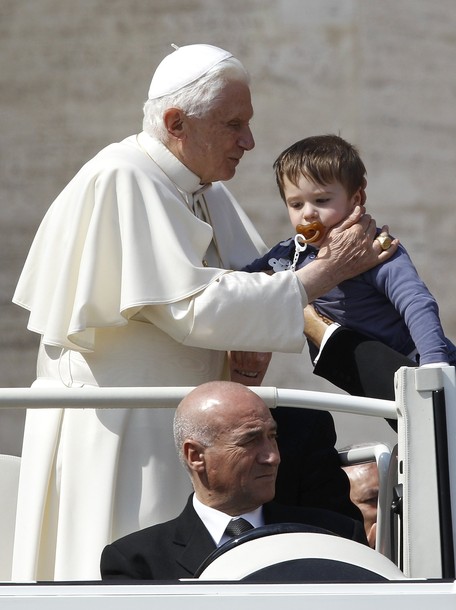
Pope Benedict XVI’s monthly prayer intentions for April 2011


Pope and a kid Mar 30 2011.jpg

Prayer is
consenting to unite our desire to God’s passion for our salvation. And, that’s what we’ll do…

The general
intention

That through its compelling preaching of the Gospel, the Church may
give young people new reasons for life and hope.

The missionary intention

That
by proclamation of the Gospel and the witness of their lives, missionaries may
bring Christ to those who do not yet know him.


Acquiring the Mind of the Church

Misa Mosaico San Marco.jpgPère [Cardinal] Yves Congar, OP, in 1963 quoted by Geoffrey Hull in The Banished Heart (2010): 


Nothing is more educative for man in his
totality than the liturgy
. The Bible is certainly a marvelous teacher of
prayer, of the sense of God and of the adult convictions of conscience. Used
alone, the Bible might produce a Christian of the Puritan tradition, an
individualist and even a visionary. The liturgy, however, is the
“authentic method instituted by the Church to unite souls to Jesus”

(Dom Maurice Festugière). The sort of Christian produced by an enlightened and
docile participation in the liturgy is a man of peace and unified in every
fibre of his human nature by the secret and powerful penetration of faith and
love in his life, throughout a period of prayer and worship, during which he
learned, at his mothers knee and without effort, the Church’s language: her
language of faith, love, hope, and fidelity. There is no better way of
acquiring “the mind of the Church” in the widest and most interior
interpretation of this expression.

My friend, Father Mark posted this paragraph quoting Cardinal Congar from a recently published book, The Banished Heart (Continuum, 2010 – the link above takes you to the book) on his blog and I am shamelessly posting it here because I think it fully captures what this blog is about, and more importantly, what the Christian life is exactly about.

Lent asks us to live in simplicity

We can’t live in abstractions.  Reality as it is, God in Himself, is revealed in the concrete. The temptation is to let ourselves be consumed by what is non-essential, with things that burdensome or just plainly a pain. God is not known in the abstract; God is only revealed in the concreteness of life: in love, goodness, beautiful things, friendship, prayer, the sacred Liturgy, the proclamation of the Word, the sacred Tradition of the Church, and the like. Lent for some people is an abstract time of the Church’s calendar because they don’t necessarily know the aim, the goal, the necessity and the personal. What we all should bear in mind is that Lent is a simple time for getting back to basics so that these basics become virtue and virtue becomes a permanent way of looking at things in front of us. A little girl who does religious education following the method of the Catechesis of the Good Shepherd (CGS) focusses our attention in how she experiences this period of conversion. “What is Lent? Lent is a time of reflection, of preparing ourselves for the resurrection of Our Lord… by doing something that takes a great effort… a time of sharing and giving ourselves, body and soul to God and the Holy Spirit”  (Jessica, 9 years old, Chihuahua Mexico, Journals of the Catechesis of the Good Shepherd, 1984 – 1997, p.149).


Jessica’s rather simple declaration hopefully gives you pause during the day to give heart and the mind the space to do something other than work. Lent, like Advent, is a fitting to time of the liturgical year to reflect on the meaning of the Cross and the our Lord’s resurrection (this is what we call the Paschal Mystery). In what concrete ways does God the Father, God the Son and God the Holy Spirit capture our imagination –our heart? The founder of the CGS movement Sofia Cavalletti writes: “Simplicity also imposes a kind of asceticism, but it is an asceticism that is joyful, happy, dynamic, and opens out to spaces that are always becoming wider. It is an asceticism that is invigorating, filling the lungs with fresh air that empowers us to keep climbing toward the summit, where the space we will stand on might have become smaller, but the space before us, the panorama we view, will have opened out on the infinite” (“Holy Simplicity,” Journals of the Catechesis of the Good Shepherd, 2003 – 2008, p. 4).

Thinking about the sacrament

There is no such thing as pure spirituality because there is no such thing as spirituality without reality. One needs a body to have a healing, water is required for holy water.

As Chesteron reminds us, the sacraments are both certain and incredible, both ideas are true and yet a paradox. The sacraments of the Church are solidly physical and wonderfully spiritual. The sacraments, as known by the Church, are ways of seeing (faith) the invisible. Any of the seven sacraments are philosophically the same as knowing the paradox of God: Spirit becoming flesh. Look at the greatest sacrament, the Eucharist, it is spirit and substance together, it is the Presence of the One who was crucified and risen, it’s healing and food and a pledge. And all these things are true we can never exhaust the meaning of the sacrament because of its divine reality.
Sacraments coming face to face with God, and face to face with ourselves. They reveal God’s face of love and mercy, and they also pull back the veils that cover our face. God comes and finds us through the sacraments.

Where Shahbaz Bhatti leading us now?

A few times in the last month I’ve mentioned the the tragic death of a brother in the Lord, Shahbaz Bhatti, a Catholic in Pakistan, a voice against oppression. His death should signal for us that religious freedom is not operative around the world as well as out-and-out persecution of Christians is a too frequent occurrence. Just read the end of the year stats on the deaths of people just because they are Christian published by the Vatican office of Evangelization of Peoples. We can’t under-estimate the our brothers and sisters in other parts of the world face just because they utter Jesus’ name as Lord and Savior: they face death and oppression daily.


In a recently published essay, “The Assassination of Shahbaz Bhatti, Jesuit Father Luciano Larivera, explores the details of a  Christian’s murder by Islamic extremists. He writes in his summary, “On March 2, a commando of an Islamic terrorist group assassinated Shahbaz Bhatti, 42, the minister of Religious Minorities in Pakistan. He was a Catholic, and is already considered a martyr for the faith and interreligious dialogue. Let us quote the spiritual testament. As with the governor of the province of the Punjab, Salmaan Taseer, who was killed Jan. 4, Bhatti had fought for the abolition, or at least for the reform, of the law against blasphemy and the liberation of Asia Bibi, who was sentenced to be hung for insulting Muhammad. Pakistan is torn apart by numerous tensions and an internal power struggle. Religious violence and intimidation have weakened the Government’s action. The country needs the restoration of an effective criminal justice system, which also prevents and sanctions crimes against religious minorities. La Civiltà Cattolica (3859, 2011, II, pp. 81-90) carries the essay.


The UK’s Guardian carried this obit for Shahbaz Bhatti.