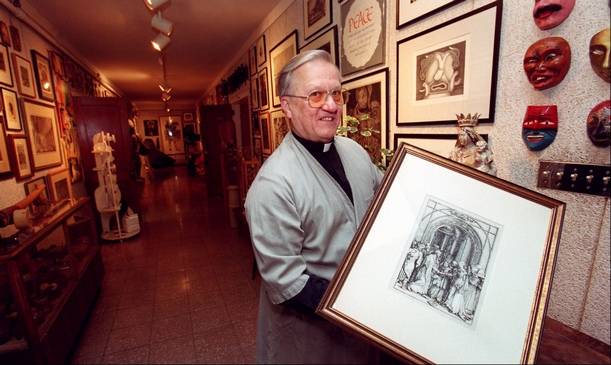
 Benedictine culture is very interesting. I find this to be true for 2 reasons: after 1500 years of Benedictine monasticism a refined style of humanity and relationship with God is constitutive and monasteries have interesting people as monks and nuns. The famous Rule of Saint Benedict encourages the monk to praise and worship God through a proper ordering of life and interest. Few Benedictines I know are not proficient in works of culture (in the true meaning of the word) like music, vestment making, bee keeping, keeping the library, preparing good lessons for the classroom, cooking, music writing, preaching, study and the like.
Author: Paul Zalonski
Saint Benedict and his friend the raven
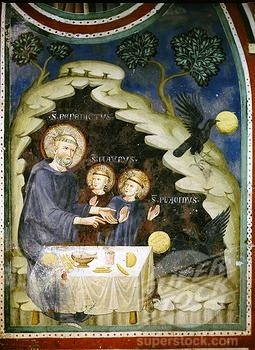
One of my favorite parts of the Saint Benedict’s hagiography (iconography) is the narrative of the “man of God” (Benedict) and the raven. It is related by Saint Gregory the Great (+603) that in the wilderness Benedict fed a raven with some a portion of his bread. When a jealous and wicked priest tried to kill Benedict with poisoned bread, Benedict coached the raven to take the deadly bread to place where it couldn’t harm another. The raven complied.
In his Dialogues Gregory writes, “Then the raven, opening its beak wide and spreading its wings, began to run around the bread, cawing, as if to indicate that it wanted to obey but was unable to carry out the order. Again and again the man of God told him to do it, saying, ‘Pick it up, pick it up. Do not be afraid. Just drop it where it cannot be found.’ After hesitating a long time, the raven took the bread in its beak, picked it up and flew away. Three hours later it came back, after having thrown the bread away, and received its usual ration from the hands of the man of God.”
Aidan Kavanagh, monk, priest, liturgical scholar: 5th anniversary of death
 Students of the sacred Liturgy are familiar with the scholarship and some would say “pioneering work” in the realm of adult baptism and the new (in 1972) Rite of Christian Initiation of Adults (RCIA) by Father Aidan Kavanagh, a Benedictine monk and priest of the Archabbey of Saint Meinrad.
Most of Father Aidan’s professional teaching life was spent away from Saint Meinrad having only taught a few years in his monastery’s seminary. In discernment with his abbot, Father Aidan devoted his energies to teaching at the University of Notre Dame and then for many years Yale Divinity School (New Haven, CT).
Why mention this? Well, today is the fifth anniversary of Father Aidan‘s death. The necrology is always an occasion to express our gratitude to God for graces bestowed on his through his children. I am grateful for the books written by Father Aidan (he is required reading in the study of the Liturgy) and the countless peoples he taught and guided in the Christian life.
May God be merciful to Father Aidan and may his memory be eternal.
Why Bill Keller misses the mark with Catholicism
In the NY Times yesterday the editors published a few paragraphs on Bill Keller and his coverage of Catholicism for the 8 last years. It was really a screed on being the priests of truth. However, the article indicates that he has gratitude for his Catholic education, noting his the fervent faith of his parents, especially his mother. But the rub for me is that now Keller identifies himself as a “collapsed Catholic” meaning “beyond lapsed.” Of course, he doesn’t explain how or what concrete events led him to arrive at being a collapsed Catholic.
Essentially Bill Keller’s understanding of Catholic faith is reduced to a set of rigid moralisms that have no vitality, no freedom, no desire. I can only surmise that Keller’s skeptical attitude toward the beauty of Catholic faith rests in his inability to see Jesus Christ as the answer to his human need now due to an absence of wonder, gratitude and true charity. I think he blames his skepticism on the “institution” of the Church on incidental things versus on things of depth. On one level who could disagree with Keller and those like him who walk away from the Church when the desire of the heart is played down.
I’d like to know what Bill Keller’s experience of Jesus is, and what his experience of receiving the sacraments is. Perhaps his problem of a lack of satisfaction in the Faith is a true lack of gratitude for what is given by the newness of the Risen Lord and that Christ is not a thing but a person.
But is there really such a thing as a collapsed Catholic? Or, a Catholic who needs a reawakening by meeting Christ personally?
Father Carrón clarifies The Meaning of Charitable Work
Today, I had the opportunity to speak to Father Julián Carrón so as to clarify an aspect of what the Movement of Communion and Liberation understands its founder, Father Luigi Giussani to mean by doing charitable work. One of the central characteristics in the life of the Fraternity of Communion and Liberation is doing charitable work, where I see “the final powerlessness of my love” and the presence of Christ now.
Father Giussani’s text on the meaning of charitable work is a very document that speaks of the reasons why we charitable work but doesn’t tell us how to do it. The mechanics, if you will, are not given because they have to be given flesh in a local, concrete experience. Hence, there’s a bit confusion on what it means for the members of CL do works of charity.
Continue reading Father Carrón clarifies The Meaning of Charitable Work
Thomas Frerking, Abbot, re-elected at St Louis Abbey
 Today, the monks of Saint Louis Abbey elected for the third time, Abbot Thomas Frerking.
Abbot Thomas, 69, was first elected in 1995; he will serve for an 8-year term. The abbots of the English Benedictine Congregation have term limits: you can be elected indefinitely for 8 years each terms.
Abbot Thomas is a St Louis native. Harvard and Oxford University educated, Frerking studied Philosophy; he’s also a Rhodes Scholar. The Abbot is a noted Thomist.
Saint Louis Abbey operates the Priory School, Saint Anselm Church and the Oratory of Saints Gregory and Augustine. Abbot Thomas is the father of a monastic community which numbers 30 monks.
May God grant, through the intercession of Saints Benedict, Scholastica and all the Benedictine saints and blesseds, the graces needed to lead the monastic community of Saint Louis Abbey.
John Corapi leads a double life, SOLT explains
The past few weeks have proved to be a most confusing time trying to figure out the assertions made against the “former Father John Corapi” now taking a leave from ministry. Today, a “Press Release
Concerning Fr John Corapi from SOLT Regional Priest Servant” was released. It is a disturbing piece of information but something that deserves our time, patience and prayer. Someone accused me of misjudging Corapi when the allegations surfaced; my only response is that it is possible that a former addict could have a relapse. We need to exhibit Christian forgiveness and beg God for His Mercy. We need to beg the Holy Spirit to warm John Corapi’s heart to return to the regular observance of his vowed religious life. Here’s the text:
From: Rev.
Gerard Sheehan, SOLT Regional Priest Servant Society of Our Lady of the Most
Holy Trinity Robstown, Texas
Fr. John A. Corapi
submitted his resignation from the Society of Our Lady of the Most Holy Trinity
(“SOLT”) early in June. SOLT is a Society of Apostolic Life of
Diocesan Right with its regional office in Robstown, Texas.
While SOLT does
not typically comment publicly on personnel matters, it recognizes that Fr.
John Corapi, through his ministry, has inspired thousands of faithful
Catholics, many of whom continue to express their support of him. SOLT also
recognizes that Fr. Corapi is now misleading these individuals through his
false statements and characterizations. It is for these Catholics that SOLT, by
means of this announcement, seeks to set the record straight.
Continue reading John Corapi leads a double life, SOLT explains
Examination of Conscience for priests
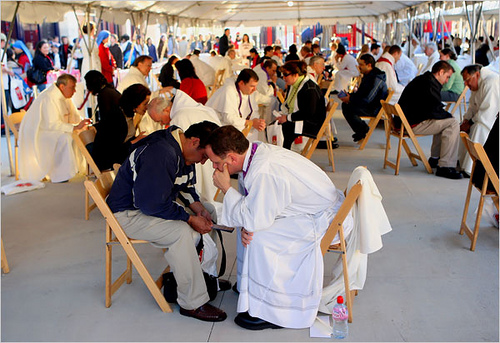 The Congregation for Clergy published an examination of conscience entitled “The Priest, Minister of Divine Mercy: An Aid for Confessors and Spiritual Directors” which hopes to reinvigorate the priest’s spiritual paternity by a recovery of the sacrament of Confession by penitent and confessor. Here is yet another aspect of the new evangelization called for by Blessed John Paul II and now Pope Benedict: the renewal of priests and people through Reconciliation.
“The Priest, Minister of Divine Mercy” is the fruit of Pope Benedict’s Year for Priests. As Cardinal Piacenza notes, this “is a measure of authentic faith in the saving action of God which shows itself more clearly in the power of grace than in human strategic or pastoral initiatives which sometimes overlook this essential truth.” A sobering statement for one who works in a parish.
On the surface it seems that this text is exclusively for the clergy. Don’t be fooled into putting it aside. I would recommend it to the laity as well. Be acquainted to the sacrament of Confession, the theology and practice of the Church and what the Church expects of her clergy. We have to help each other see Christ’s work among through concrete manifestation of Divine Mercy.
Consider the ideas found in the introduction (the link to the full text is at the end):
“It is necessary to return to the confessional as a place in which to celebrate the Sacrament of Reconciliation, but also as a place in which “to dwell” more often, so that the faithful may and compassion, advice and comfort, feel that they are loved and understood by God and experience the presence of Divine Mercy beside the Real Presence in the Eucharist”.
With these words, the Holy Father Pope Benedict XVI addressed confessors during the recent Year for Priests, indicating to each one present the importance and therefore the apostolic urgency of rediscovering the Sacrament of Reconciliation, both from their viewpoint of penitents as well as that of ministers. Along with the daily celebration of the Eucharist, the availability of the priest to hear sacramental confessions, to welcome penitents, and to accompany them spiritually when they so request, is the real measure of a priest’s pastoral charity. By their availability, priests give joyful witness and in a certain sense take upon themselves their true identity, redefined in the Sacrament of Holy Orders and not reducible to a mere functionality. The priest is a minister, which is to say that he is at the same time both a servant and a prudent dispenser of Divine Mercy. To him is entrusted the serious responsibility “to forgive or to retain sins” (cf. John 20: 23).

Through him, and through the power of the Spirit who is the Lord and Giver of Life, the faithful are able to experience today in the Church the joy of the Prodigal Son, who after a life of sin returned to his father’s house in the manner of a servant but was welcomed with the dignity of a son. Whenever a confessor is available, sooner or later a penitent will arrive. And if the confessor continues to make himself available, even stubbornly so, sooner or later many penitents will arrive! Our rediscovery of the Sacrament of Reconciliation, both as penitents and as ministers, is a measure of authentic faith in the saving action of God which shows itself more clearly in the power of grace than in human strategic or pastoral initiatives which sometimes overlook this essential truth.
Responding to the appeal of the Holy Father and expressing his profound intent, this aid is intended as yet another fruit of the Year for Priests, to be a helpful instrument for the ongoing formation of the Clergy and an aid in rediscovering the indispensible value of the Sacrament of Reconciliation and of Spiritual Direction. The new evangelization and the ongoing renewal of the Church, semper reformanda, draw their life blood from the true sanctification of each member of the Church. It is clear that sanctifi cation must precede both evangelization and renewal, for it lays claim to and forms the necessary precondition for every effective apostolic effort, as well as for the reform of the Clergy.
In the generous celebration of the Sacrament of Divine Mercy, each priest is called to experience for himself the uniqueness and the indispensability of the ministry entrusted to him. Such an experience will help him to avoid the “ever-changing sense of identity” which so often marks the existence of some priests. Instead, his experience will cultivate within himself that sense of wonder which fi lls his heart, for through no merit of his own he is called by God, in the Church, to break the Eucharistic Bread and to forgive the sins of others.
Here’s “The Priest, Minister of Divine Mercy: An Aid for Confessors and spiritual Directors”: Examination of Conscience for confessors and spiritual directors.pdf
Otto von Habsburg, 98, Archduke, RIP
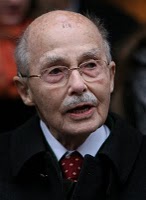 Archduke Franz Joseph Otto Robert Maria Anton Karl Max Heinrich Sixtus Xavier Felix Renatus Ludwig Gaetan Pius Ignatius von Hapsburg, 98, died July 4, in his sleep at his home. His Imperial Highness was the eldest son of the last Austian-Hungarian emperor, Charles I. The Empire, ruled by the Habsburg family since the 13th century disintegrated following World War I.
Archduke Otto was well-regarded as a statesman of modern Europe, particularly supporting the notion of the European Union.
By tradition, the Archduke’s body will be buried, next to his wife, Regina, in the Capuchin Church in Austria and his heart will be buried in Hungary at the Benedictine Royal Abbey of Pannonhalma.
Archduke Otto is survived by his seven children
A blessed 4th of July

“America, you are beautiful and blessed. The ultimate
test of your greatness is the way you treat every human being, but especially
the weakest and most defenseless. If you want equal justice for all and true
freedom and lasting peace, then America, defend life.” Blessed John Paul II
test of your greatness is the way you treat every human being, but especially
the weakest and most defenseless. If you want equal justice for all and true
freedom and lasting peace, then America, defend life.” Blessed John Paul II