Examination of Conscience for priests


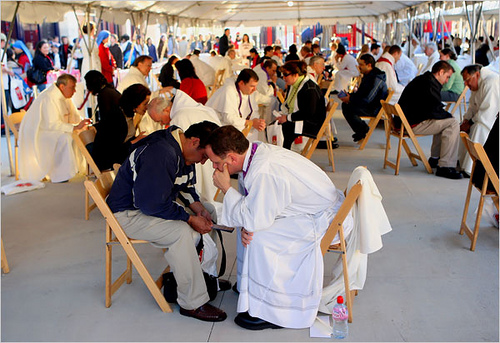
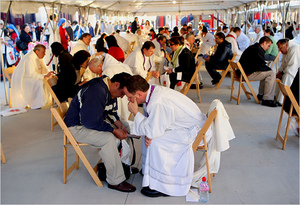
confession-6.jpgThe Congregation for Clergy published an examination of conscience entitled “The Priest, Minister of Divine Mercy: An Aid for Confessors and Spiritual Directors” which hopes to reinvigorate the priest’s spiritual paternity by a recovery of the sacrament of Confession by penitent and confessor. Here is yet another aspect of the new evangelization called for by Blessed John Paul II and now Pope Benedict: the renewal of priests and people through Reconciliation.

“The Priest, Minister of Divine Mercy” is the fruit of Pope Benedict’s Year for Priests. As Cardinal Piacenza notes, this “is a measure of authentic faith in the saving action of God which shows itself more clearly in the power of grace than in human strategic or pastoral initiatives which sometimes overlook this essential truth.” A sobering statement for one who works in a parish.

On the surface it seems that this text is exclusively for the clergy. Don’t be fooled into putting it aside.  I would recommend it to the laity as well. Be acquainted to the sacrament of Confession, the theology and practice of the Church and what the Church expects of her clergy. We have to help each other see Christ’s work among through concrete manifestation of Divine Mercy.

Consider the ideas found in the introduction (the link to the full text is at the end):

“It is necessary to return to the confessional as a place in which to celebrate the Sacrament of Reconciliation, but also as a place in which “to dwell” more often, so that the faithful may  and compassion, advice and comfort, feel that they are loved and understood by God and experience the presence of Divine Mercy beside the Real Presence in the Eucharist”.

With these words, the Holy Father Pope Benedict XVI addressed confessors during the recent Year for Priests, indicating to each one present the importance and therefore the apostolic urgency of rediscovering the Sacrament of Reconciliation, both from their viewpoint of penitents as well as that of ministers. Along with the daily celebration of the Eucharist, the availability of the priest to hear sacramental confessions, to welcome penitents, and to accompany them spiritually when they so request, is the real measure of a priest’s pastoral charity. By their availability, priests give joyful witness and in a certain sense take upon themselves their true identity, redefined in the Sacrament of Holy Orders and not reducible to a mere functionality. The priest is a minister, which is to say that he is at the same time both a servant and a prudent dispenser of Divine Mercy. To him is entrusted the serious responsibility “to forgive or to retain sins” (cf. John 20: 23).
Rembrandt The Return Of The Prodigal Son.jpg

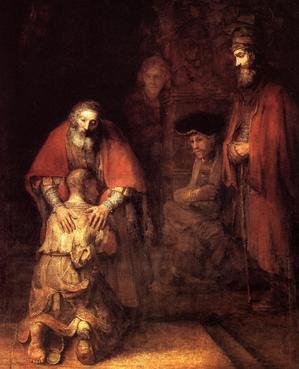
Through him, and through the power of the Spirit who is the Lord and Giver of Life, the faithful are able to experience today in the Church the joy of the Prodigal Son, who after a life of sin returned to his father’s house in the manner of a servant but was welcomed with the dignity of a son. Whenever a confessor is available, sooner or later a penitent will arrive. And if the confessor continues to make himself available, even stubbornly so, sooner or later many penitents will arrive! Our rediscovery of the Sacrament of Reconciliation, both as penitents and as ministers, is a measure of authentic faith in the saving action of God which shows itself more clearly in the power of grace than in human strategic or pastoral initiatives which sometimes overlook this essential truth.

Responding to the appeal of the Holy Father and expressing his profound intent, this aid is intended as yet another fruit of the Year for Priests, to be a helpful instrument for the ongoing formation of the Clergy and an aid in rediscovering the indispensible value of the Sacrament of Reconciliation and of Spiritual Direction. The new evangelization and the ongoing renewal of the Church, semper reformanda, draw their life blood from the true sanctification of each member of the Church. It is clear that sanctifi cation must precede both evangelization and renewal, for it lays claim to and forms the necessary precondition for every effective apostolic effort, as well as for the reform of the Clergy.

In the generous celebration of the Sacrament of Divine Mercy, each priest is called to experience for himself the uniqueness and the indispensability of the ministry entrusted to him. Such an experience will help him to avoid the “ever-changing sense of identity” which so often marks the existence of some priests. Instead, his experience will cultivate within himself that sense of wonder which fi lls his heart, for through no merit of his own he is called by God, in the Church, to break the Eucharistic Bread and to forgive the sins of others.

Here’s “The Priest, Minister of Divine Mercy: An Aid for Confessors and spiritual Directors”: Examination of Conscience for confessors and spiritual directors.pdf

Otto von Habsburg, 98, Archduke, RIP

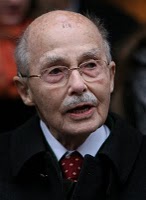
Otto von Habsburg.jpgArchduke Franz Joseph Otto Robert Maria Anton Karl Max Heinrich Sixtus Xavier Felix Renatus Ludwig Gaetan Pius Ignatius von Hapsburg, 98, died July 4, in his sleep at his home. His Imperial Highness was the eldest son of the last Austian-Hungarian emperor, Charles I. The Empire, ruled by the Habsburg family since the 13th century disintegrated following World War I.

Archduke Otto was well-regarded as a statesman of modern Europe, particularly supporting the notion of the European Union.

By tradition, the Archduke’s body will be buried, next to his wife, Regina, in the Capuchin Church in Austria and his heart will be buried in Hungary at the Benedictine Royal Abbey of Pannonhalma.
Archduke Otto is survived by his seven children

A blessed 4th of July

US flag3.jpg


“America, you are beautiful and blessed. The ultimate
test of your greatness is the way you treat every human being, but especially
the weakest and most defenseless. If you want equal justice for all and true
freedom and lasting peace, then America, defend life.” Blessed John Paul II

Congregation of Holy Cross merge two US provinces

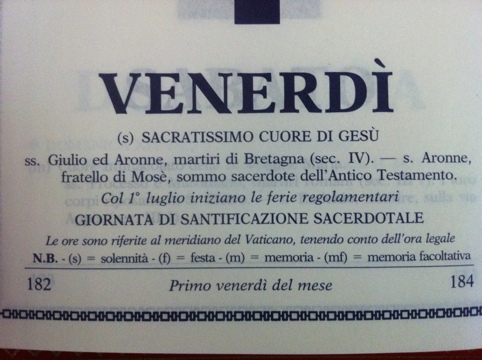
Spes Unica.jpgToday marks the beginning of new life within the Congregation of Holy Cross in the USA: the merging of the Eastern and Indiana Provinces. The coming together  on this date in 2011 is noteworthy because today is the solemnity of the Sacred Heart of Jesus, a feast near and dear to the Congregation. The merger follows upon the decision taken by the 2010 General Chapter. The new province now has more than 100 seminarians numbers more than 500 priests and brothers. Around the world there are about 1500 CSCs.

Founded in 1837 by Blessed Basil Anthony Moreau, the Congregation of Holy Cross filled the many gaps in ecclesial life following the French Revolution. The “auxiliary priests” were parish priests, educators, missionaries, scholars with no single work so as to be available like the apostles were in spreading the Gospel of Jesus Christ. In the USA operates 4 colleges and universities, including my alma mater, UND. There is one CSC bishop in the USA: The Most Reverend Daniel Jenky, CSC of Peoria, IL.
Some of the activities of the CSC can be seen in an online photo album.
May the Sacred Heart of Jesus richly bless the Congregation of Holy Cross!

Pope Benedict XVI’s monthly prayer intentions for July 2011

Benedict on Corpus Christi 2011.jpg

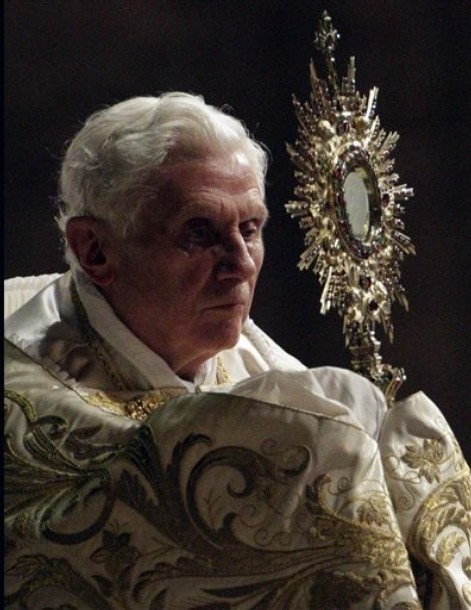
The month of July has us praying the following intentions with Pope Benedict:
The general intention
That Christians may ease the physical and spiritual suffering of those who are sick with AIDS, especially in the poorest countries.
The missionary intention
That religious women in missionary territories may be witnesses of the joy in the Gospel and living signs of the love of Christ.

L’Osservatore Romano lauded by Pope for 150 years of service

Giovanni Maria Vian.jpeg

The Pope met with “The Most Distinguished Prof. Giovanni Maria Vian, Editor-in-Chief of L’Osservatore Romano” today observing the paper’s 150th anniversary to what is called “A service to truth and to justice.” Hearty congrats to Prof. Vian and to his staff for the insight, planning, and good journalism for the world-wide Catholic communion. The paper is often said the “pope’s newspaper” and that it’s the official newspaper of the pope. In reality L’Osservatore Romano is not that controlled by neither the Pope nor the Secretary of State, though the latter is the supervisor of the paper. Recall that the LOR was not founded by a pope or a member of the Roman Curia; it was a personal initative of the laity with support of the papal government of 1870. As Benedict recalls for us in his address to Vian and staff, the principle of justice based on Christ’s promise that evil would not triumph is what oriented the work of LOR. The only official part of the paper is the list of papal appointments. It would be simple to dismiss the paper or to look at LOR as mere parrotting of papal ideology. On the contrary, LOR does excellent work with matters to faith, reason, culture, and politics and related interests Prof. Vian has taken the LOR to a new level. LOR is “a paper of ideas, an organ of formation, not only of information.”


The papal address is posted here and the concluding paragraphs are noted below.


Thumbnail image for Ratzinger's arms.jpg

In our day — frequently marked by the lack of reference points and the removal of God from the horizon of many societies, even of those with an ancient Christian tradition — the Holy See’s daily stands as a “paper of ideas”, an organ of formation and not only of information. It must therefore be able to stick faithfully to the task it has carried out in this past century and a half, paying attention in addition to the Christian East, to the irreversible ecumenical commitment of the different Churches and Ecclesial Communities, to the constant quest for friendship and collaboration with Judaism and with the other religions, to discussion and to cultural exchanges, to the voice of women and to bioethical topics that give rise to questions crucial to us all.

By pursuing its open policy towards new signatures, and an increasing number of contributors — and highlighting the internet dimension and breadth of readership, present since the daily newspaper’s very beginning,  after 150 years of a history of which it may well be proud, L’Osservatore Romano knows how to express the Holy See’s cordial friendship for the humanity of our time, in defence of the human person created in the image and likeness of God and redeemed by Christ. 

For all these reasons I wish to address my grateful thoughts to all those have worked on the newspaper of the Holy See from 1861 to this day: to the Director, to the editorial staff and all the personnel. To you, the Editor-in-Chief,  and to all who cooperate today in this exciting, demanding and praiseworthy service to truth and justice, as well as to the benefactors and supporters, I assure my constant spiritual closeness and warmly impart a special Apostolic Blessing.

1,400 year old fresco of St Paul found

new fresco of St paul.jpgThe religious and art worlds are abuzz with the latest find: an early 6th century image of the Apostle Paul in Naples. The discovery happened in the Catacombs of San Gennaro.

Gianfranco Cardinal Ravasi said “The image of Saint Paul has an intense expression, philosophical and its discovery enriches our image of one of the principal apostles.”
The story of the new image is found in the culture section of L’Osservatore Romano.

Watch the video story from Rome Reports.
Enhanced by Zemanta

Saints Peter and Paul: “I no longer call you servants, but friends”

Benedict XVI coat of arms MFoppoli.jpg

The Church celebrates today great solemn feast of Saints Peter and Paul, it is also the 60th anniversary of Pope Benedict’s priestly ordination as well as the day the See of Constantinople sends a delegation to Rome to pray at the tombs of the two great saints and to meet with the Pope. Plus, it is the day in which the metropolitan archbishops who have been appointed in the last calendar year come to Rome to receive the palium (see below). The USA has for archbishops receiving their pallium today: San Antonio, Oklahoma City, Seattle and Los Angelos. All four of these archbishops are under 60. Watch the video clip.

Non iam dicam servos, sed amicos” – “I no longer call you servants, but friends” (cf. Jn 15:15).

Sixty years on from the day of my priestly ordination, I hear once again deep within me these words of Jesus that were addressed to us new priests at the end of the ordination ceremony by the Archbishop, Cardinal Faulhaber, in his slightly frail yet firm voice. According to the liturgical practice of that time, these words conferred on the newly-ordained priests the authority to forgive sins. “No longer servants, but friends”: at that moment I knew deep down that these words were no mere formality, nor were they simply a quotation from Scripture. I knew that, at that moment, the Lord himself was speaking to me in a very personal way. In baptism and confirmation he had already drawn us close to him, he had already received us into God’s family. But what was taking place now was something greater still. He calls me his friend. He welcomes me into the circle of those he had spoken to in the Upper Room, into the circle of those whom he knows in a very special way, and who thereby come to know him in a very special way. He grants me the almost frightening faculty to do what only he, the Son of God, can legitimately say and do: I forgive you your sins. He wants me – with his authority – to be able to speak, in his name (“I” forgive), words that are not merely words, but an action, changing something at the deepest level of being. I know that behind these words lies his suffering for us and on account of us. I know that forgiveness comes at a price: in his Passion he went deep down into the sordid darkness of our sins. He went down into the night of our guilt, for only thus can it be transformed. And by giving me authority to forgive sins, he lets me look down into the abyss of man, into the immensity of his suffering for us men, and this enables me to sense the immensity of his love. He confides in me: “No longer servants, but friends”. He entrusts to me the words of consecration in the Eucharist. He trusts me to proclaim his word, to explain it aright and to bring it to the people of today. He entrusts himself to me. “You are no longer servants, but friends”: these words bring great inner joy, but at the same time, they are so awe-inspiring that one can feel daunted as the decades go by amid so many experiences of one’s own frailty and his inexhaustible goodness.

“No longer servants, but friends”: this saying contains within itself the entire programme of a priestly life. What is friendship? Idem velle, idem nolle – wanting the same things, rejecting the same things: this was how it was expressed in antiquity. Friendship is a communion of thinking and willing. The Lord says the same thing to us most insistently: “I know my own and my own know me” (Jn 10:14). The Shepherd calls his own by name (cf. Jn 10:3). He knows me by name. I am not just some nameless being in the infinity of the universe. He knows me personally. Do I know him? The friendship that he bestows upon me can only mean that I too try to know him better; that in the Scriptures, in the Sacraments, in prayer, in the communion of saints, in the people who come to me, sent by him, I try to come to know the Lord himself more and more. Friendship is not just about knowing someone, it is above all a communion of the will. It means that my will grows into ever greater conformity with his will. For his will is not something external and foreign to me, something to which I more or less willingly submit or else refuse to submit. No, in friendship, my will grows together with his will, and his will becomes mine: this is how I become truly myself. Over and above communion of thinking and willing, the Lord mentions a third, new element: he gives his life for us (cf. Jn 15:13; 10:15). Lord, help me to come to know you more and more. Help me to be ever more at one with your will. Help me to live my life not for myself, but in union with you to live it for others. Help me to become ever more your friend.

Jesus’ words on friendship should be seen in the context of the discourse on the vine. The Lord associates the image of the vine with a commission to the disciples: “I appointed you that you should go out and bear fruit, and that your fruit should abide” (Jn 15:16). The first commission to the disciples, to his friends, is that of setting out – appointed to go out -, stepping outside oneself and towards others. Here we hear an echo of the words of the risen Lord to his disciples at the end of Matthew’s Gospel: “Go therefore and make disciples of all nations …” (cf. Mt 28:19f.) The Lord challenges us to move beyond the boundaries of our own world and to bring the Gospel to the world of others, so that it pervades everything and hence the world is opened up for God’s kingdom. We are reminded that even God stepped outside himself, he set his glory aside in order to seek us, in order to bring us his light and his love. We want to follow the God who sets out in this way, we want to move beyond the inertia of self-centredness, so that he himself can enter our world.

After the reference to setting out, Jesus continues: bear fruit, fruit that abides. What fruit does he expect from us? What is this fruit that abides? Now, the fruit of the vine is the grape, and it is from the grape that wine is made. Let us reflect for a moment on this image. For good grapes to ripen, sun is needed, but so too is rain, by day and by night. For noble wine to mature, the grapes need to be pressed, patience is needed while the juice ferments, watchful care is needed to assist the processes of maturation. Noble wine is marked not only by sweetness, but by rich and subtle flavours, the manifold aroma that develops during the processes of maturation and fermentation. Is this not already an image of human life, and especially of our lives as priests? We need both sun and rain, festivity and adversity, times of purification and testing, as well as times of joyful journeying with the Gospel. In hindsight we can thank God for both: for the challenges and the joys, for the dark times and the glad times. In both, we can recognize the constant presence of his love, which unfailingly supports and sustains us.

Yet now we must ask: what sort of fruit does the Lord expect from us? Wine is an image of love: this is the true fruit that abides, the fruit that God wants from us. But let us not forget that in the Old Testament the wine expected from noble grapes is above all an image of justice, which arises from a life lived in accordance with God’s law. And this is not to be dismissed as an Old Testament view that has been surpassed – no, it still remains true. The true content of the Law, its summais love for God and for one’s neighbour. But this twofold love is not simply saccharine. It bears within itself the precious cargo of patience, humility, and growth in the conforming of our will to God’s will, to the will of Jesus Christ, our friend. Only in this way, as the whole of our being takes on the qualities of truth and righteousness, is love also true, only thus is it ripe fruit. Its inner demand – faithfulness to Christ and to his Church —seeks a fulfilment that always includes suffering. This is the way that true joy grows. At a deep level, the essence of love, the essence of genuine fruit, coincides with the idea of setting out, going towards: it means self-abandonment, self-giving, it bears within itself the sign of the cross. Gregory the Great once said in this regard: if you are striving for God, take care not to go to him by yourselves alone — a saying that we priests need to keep before us every day (H Ev 1:6:6 PL 76, 1097f.).

Dear friends, perhaps I have dwelt for too long on my inner recollections of sixty years of priestly ministry. Now it is time to turn our attention to the particular task that is to be performed today.

Constantinople's delegation June 28 2011.jpg

On the feast of Saints Peter and Paul my most cordial greeting goes first of all to the Ecumenical Patriarch Bartholomaios I and to the Delegation he has sent, to whom I express sincere thanks for their most welcome visit on the happy occasion of this feast of the holy Apostles who are Rome’s patrons. I also greet the Cardinals, my brother bishops, the ambassadors and civil authorities as well as the priests, the confrères of my first Mass, religious and lay faithful. I thank all of you for your presence and your prayers.


John Paul II's pallium.JPG

The metropolitan archbishops appointed since the feast of Saints Peter and Paul last year are now going to receive the pallium. What does this mean? It may remind us in the first instance of Christ’s easy yoke that is laid upon us (cf. Mt 11:29f.). Christ’s yoke is identical with his friendship. It is a yoke of friendship and therefore “a sweet yoke”, but as such it is also a demanding yoke, one that forms us. It is the yoke of his will, which is a will of truth and love. For us, then, it is first and foremost the yoke of leading others to friendship with Christ and being available to others, caring for them as shepherds. This brings us to a further meaning of the pallium: it is woven from the wool of lambs blessed on the feast of Saint Agnes. Thus it reminds us of the Shepherd who himself became a lamb, out of love for us. It reminds us of Christ, who set out through the mountains and the deserts, in which his lamb, humanity, had strayed. It reminds us of him who took the lamb – humanity – me – upon his shoulders, in order to carry me home. It thus reminds us that we too, as shepherds in his service, are to carry others with us, taking them as it were upon our shoulders and bringing them to Christ. It reminds us that we are called to be shepherds of his flock, which always remains his and does not become ours. Finally the pallium also means quite concretely the communion of the shepherds of the Church with Peter and with his successors – it means that we must be shepherds for unity and in unity, and that it is only in the unity represented by Peter that we truly lead people to Christ.

Sixty years of priestly ministry – dear friends, perhaps I have spoken for too long about this. But I felt prompted at this moment to look back upon the things that have left their mark on the last six decades. I felt prompted to address to you, to all priests and bishops and to the faithful of the Church, a word of hope and encouragement; a word that has matured in long experience of how good the Lord is. Above all, though, it is a time of thanksgiving: thanks to the Lord for the friendship that he has bestowed upon me and that he wishes to bestow upon us all. Thanks to the people who have formed and accompanied me. And all this includes the prayer that the Lord will one day welcome us in his goodness and invite us to contemplate his joy. Amen.