Lectio Divina as the springtime of the Church

Here are Pope Benedict’s 5 reasons for Christians doing lectio divina, because as he sees it, lectio is the new springtime of the Church.

Lectio Divina is of course central to Benedictine spirituality –but not limited to those who are “professional religious people–  with several hours a day of prayerful reading of Scripture and other spiritual texts required of monks in the Rule.

And it is also one of the central themes of Pope Benedict XVI’s Apostolic Exhortation Verbum Domini.  Scattered through the document are the reasons why lectio is so crucial.  Here is my summation of the reasons he sets out for why we should do lectio divina.

1.  To please God by listening to him. Pope quotes Origen: “Do your reading with the intent of believing in and pleasing God.”

2.  To build the Church as a community.  “While it is a word addressed to each of us personally, it is also a word which builds community, which builds the Church…The reading of the word of God… enables us to deepen our sense of belonging to the Church, and helps us to grow in familiarity with God.”

3.  To nourish and sustain us ‘on our journey of penance and conversion’: through it, we grow in love and truth.

4.  In order to discern God’s will for us, and convert us: “Contemplation aims at creating within us a truly wise and discerning vision of reality, as God sees it, and at forming within us “the mind of Christ” (1 Cor 2:16).

The Pope particularly recommends lectio divina to seminarians because: “It is in the light and strength of God’s word that one’s specific vocation can be discerned and appreciated, loved and followed, and one’s proper mission carried out…”  Lay people to should be trained, he urges, “to discern God’s will through a familiarity with his word, read and studied in the Church under the guidance of her legitimate pastors.”

He goes on: “Saint Paul tells us: “Do not be conformed to this world, but be transformed by the renewal of your mind, that you may prove what is the will of God, what is good and acceptable and perfect ” (12:2). The word of God appears here as a criterion for discernment: it is “living and active, sharper than any two-edged sword, piercing to the division of soul and spirit, of joints and marrow, and discerning the thoughts and intentions of the heart” (Heb 4:12).”, and “….by nourishing the heart with thoughts of God, so that faith, as our response to the word, may become a new criterion for judging and evaluation persons and things, events and issues”….”

5.  For the spiritual benefit of others. First, to equip us to fulfill the duty of all Christians to evangelize, contributing to the Churches mission to convert the whole world to Christ. And secondly to aid the souls in purgatory through the Church’s offer of indulgences for Scripture reading and certain Scripturally based prayers (such as the Office), which teach us that “to whatever degree we are united in Christ, we are united to one another, and the supernatural life of each one can be useful for the others.”
Archbishop Wenski: Protect rights of conscience, Mr. President

Thomas Wenski.jpg

In today’s editorial piece, Miami Archbishop Thomas Wenski personally addressed the US President Barack Obama on matters pertaining to conscience and religious freedom. Conscience is more than a policy; conscience is a basic human right given by God Himself. It is good piece for all to read –especially Catholics– as it outlines recent history lest we forget. Wenski is right to bring to light the transgressions on conscience by this Administration. Our thanks to the Archbishop for teaching the faith. Thoughts?


In May 2009, President Obama gave the commencement address at Notre Dame University and received an honorary degree. That Notre Dame would confer an honorary degree on an elected official who advances abortion rights in contradiction to Catholic teaching caused no small controversy among many Catholics throughout the United States.

Those who supported Notre Dame felt vindicated, however, when in his speech the President promised tohonor the conscience of those who disagree with abortion,” stating that his Administration would provide “sensible” protections for those who wanted no involvement in the procedure. This would presumably include health-care providers, social-service providers, and consumers who might otherwise have to pay through their health-care plans for other people’s abortions. Obama later reiterated this position to Catholic newspaper editors, stating that he would make such protections “robust.”

Continue reading Archbishop Wenski: Protect rights of conscience, Mr. President

Male religious life revives

A recent article in the National Catholic Register by Trent Beattie, “Surprising Revival for Men in Religious Life” notes that tide may be turning for some religious orders of men, especially those who remain faithful to prayer, orthodox theological reflection as proposed by the Church, a common life and work and the wearing of a religious habit. Beattie highlights the Texas Carmelites, Connecticut’s Franciscan Brothers of the Eucharist and the Oklahoma Benedictines of the Creak Creek abbey. All of the groups are beautiful expressions of the work of the Holy Spirit today.

Our Lady of the Way, pray for us.

Benedict on music and Liturgy


Two central interests in the ministry of Pope Benedict are music and the sacred Liturgy; other interests you might say are evangelization, theology and culture. At recent gatherings with the Pope he spoke about music as a concert given by a group of Spanish musicians and then to the bishops of New York State making their pilgrimage to Rome to pray and speak with the Pope about their work. Below are two interesting sets of ideas worthy of reflection:

On music

“…the magic
worked by music, the universal language which can overcome all barriers and
allow us to enter the world of others, of a nation or a culture, at the same
time enabling us to turn our mind and hearts … to the world of God.”

Pope
Benedict XVI to musicians

November 26, 2011

On the sacred Liturgy

“A weakened sense of the meaning and importance of Christian
worship can only lead to a weakened sense of the specific and essential
vocation of the laity to imbue the temporal order with the spirit of the
Gospel. America has a proud tradition of respect for the Sabbath; this legacy
needs to be consolidated as a summons to the service of God’s Kingdom and the
renewal of the social fabric in accordance with its unchanging truth.”


First Sunday of Advent

Advent wreath 2011 St Catherine of Siena Church NYC.JPG

Therefore we are called to be vigilant because we do not know the ‘precise moment’ when the master will return to the house. The ‘house’ can be seen as an image of the Christian community which prepares itself with vigilance through prayer and works, to welcome the master. The ‘house’ can also be thought of as the spiritual dwelling of each of us that needs to be built daily.

Everyone must also take care to complete the work that God has entrusted to them, watching that they will not find themselves unprepared for the Lord when he comes. The season of Advent calls us to strengthen our spirit of prayer, carefully fighting the negligence and the weakness that makes us yield to sin.

Blessed John Henry Newman wrote in his spiritual diary that to be vigilant with Christ is to look ahead without forgetting the past. It is not to forget that He has suffered for us, it is to lose ourselves in contemplation of the grandeur of redemption. It is to continually renew the passion and agony of Christ – to cover with joy that mantle of affliction that Christ wore first and then left behind when he ascended into heaven. It is separation from this sensible world to join the life beyond the senses. This is how Christ will come, and come in the way he has said. (J. H. Newman, Diario spirituale e meditazione, 93).

Excerpts of a Letter for the First Sunday of Advent from the Congregation of Clergy

Enhanced by Zemanta

Our Lady of the Miraculous Medal

OL of the Miraculous Medal.gif


Today we celebrate the Feast Day of Our Lady of the Miraculous Medal.  On this day, November 27th, in 1830, the Immaculate Virgin Mary appeared to Saint Catherine Laboure in the chapel of the motherhouse of the Daughters of Charity in Paris. 


At one point during the apparition Catherine saw Our Lady standing on a globe, with dazzling rays of light streaming from her outstretched hands. Framing the figure was an inscription: O Mary, conceived without sin, pray for us who have recourse to thee


Mary spoke to Catherine: “Have a medal struck upon this model. Those who wear it will receive great graces.”  The Medal of the Blessed Virgin Mary, popularly known as the Miraculous Medal, was approved by Pope Leo XIII on July 23, 1894.


For more info, visit

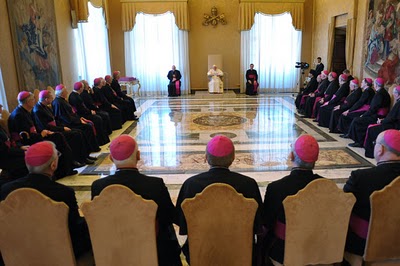
Pope speaks to New York Bishops: we ourselves are the first to need re-evangelization,

As you know, the Pope is meeting for next several months with all the bishops of the United States. Two weeks ago I noted the Ad Limina Apostolorum of the New England bishops; this week the Pope meets with the New York bishops and next week he’ll be meeting with the New Jersey and Pennsylvania bishops. His reflections and leadership on key areas are crucial for all of us to pay attention to right now for the good of the Church. The text of his address to the bishops of these three regions is given below.


Pope with NY bishops.jpg

I greet you all with affection in the Lord and, through you, the Bishops from the United States who in the course of the coming year will make their visits ad limina Apostolorum.

Our meetings are the first since my 2008 Pastoral Visit to your country, which was intended to encourage the Catholics of America in the wake of the scandal and disorientation caused by the sexual abuse crisis of recent decades. I wished to acknowledge personally the suffering inflicted on the victims and the honest efforts made both to ensure the safety of our children and to deal appropriately and transparently with allegations as they arise. It is my hope that the Church’s conscientious efforts to confront this reality will help the broader community to recognize the causes, true extent and devastating consequences of sexual abuse, and to respond effectively to this scourge which affects every level of society. By the same token, just as the Church is rightly held to exacting standards in this regard, all other institutions, without exception, should be held to the same standards.

Continue reading Pope speaks to New York Bishops: we ourselves are the first to need re-evangelization,

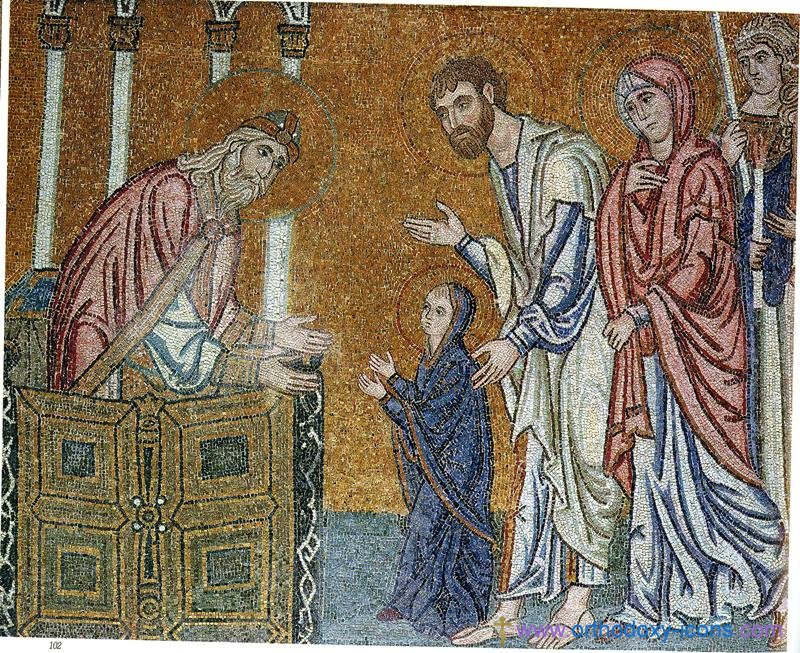
Presentation of the Blessed Virgin Mary and Benedictine Oblation

Presentation of the Blessed Virign Mary3.jpgAs we Venerate the glorious memory of the most holy Virgin Mary, grant, we pray, O Lord, through her intercession, that we, too, may merit to receive from the fullness of your grace.

PAX
In the Name of Our Lord Jesus Christ. Amen.
On this Feast of the Presentation in the Temple of the Blessed Virgin Mary, I, too, offer myself to God through this renewal of my oblation. I commit myself anew to Stability of Heart, Fidelity to the Spirit of the Monastic Life, and Obedience to the Will of God as a Benedictine Oblate of the venerable monastery of Saint Meinrad.