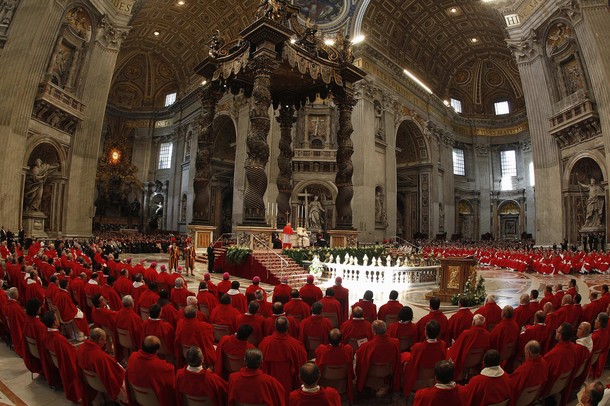
Generally once a year the Pope calls together all those involved in the work of each of the Pontifical councils for a plenary session, usually addressing some key item. Today was the Plenary Assembly of the Pontifical Council for the Family
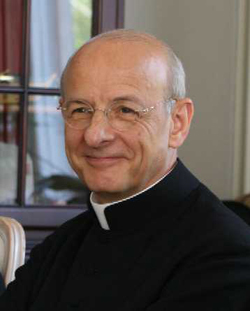
I am pleased to welcome you on the occasion of the Plenary Assembly of the Pontifical Council for the Family, on the occasion of a double XXX anniversary: that of the Apostolic Exhortation Familiaris Consortio, published November 22, 1981 by Blessed John Paul II and the Congregation itself, which he established on May 9 with the Motu Proprio Familia a Deo instituta, as a sign of the importance to be attributed to family ministry in the world and at the same time, as an effective tool to help promote it at every level (cf. John Paul II, Familiaris Consortio, 73). I cordially greet Cardinal Ennio Antonelli, thanking him for the words with which he introduced our meeting, as well as the Bishop Secretary, other employees and all of you gathered here.
The new evangelization depends largely on the domestic Church (cf. ibid., 65). In our time, as in times past, the eclipse of God, the spread of ideologies contrary to the family and the degradation of sexual ethics are intertwined. And just as the eclipse of God and the crisis of the family are linked, so the new evangelization is inseparable from the Christian family. The family is indeed the way of the Church because it is the “human space” of our encounter with Christ. Spouses, ” not only receive the love of Christ and become a saved community, but they are also called upon to communicate Christ’s love to their brethren, thus becoming a saving community ” (ibid., 49). The family founded on the Sacrament of Matrimony is a particular realization of the Church, saved and saving, evangelized and evangelizing community. Just like the Church, it is called to welcome, radiate and show the world the love and the presence of Christ. The reception and transmission of divine love are realized in the mutual commitment of spouses, generous and responsible procreation, in the care and education of children, work and social relationships, with attention to the needy, in participation in church activities, in commitment to civil society. The Christian Family to the extent it succeeds in living love as communion and service as a reciprocal gift open to all, through a process of ongoing conversion supported by the grace of God, reflects the splendor of Christ in the world and the beauty of the divine Trinity. Saint Augustine has a famous quote: “immo vero vides Trinitatem, si caritatem vides “, “If you see charity, yes indeed you see the Trinity ” (De Trinitate, VIII, 8). And the family is one of the fundamental places where you live and are educated to love and charity.
In the wake of my predecessors, I too have repeatedly urged Christians spouses to evangelize both with the witness of life and with involvement in the pastoral activities. I did so recently at Ancona, at the end of the Italian National Eucharistic Congress. There I wanted to meet with couples and priests. In fact, the two sacraments, “at the service of communion” (CCC, n. 1534), Holy Orders and Matrimony, are traced to the sole source of the Eucharist. ” both these states of life share the same root in the love of Christ who gives himself for humanity’s salvation. They are called to a common mission: to witness to and make present this love at the service of the community in order to build up the People of God. This perspective makes it possible to overcome a reductive vision of the family, which sees it merely as the object of pastoral action. […] The family is a source of wealth for married couples, an irreplaceable good for children, an indispensable foundation of society and a vital community for the journey of the Church“. (Homily at Ancona, September 11, 2011). By virtue of this ” family is the privileged place of human and Christian education and remains, for this end, as the closest ally of the priestly ministry. […] No vocation is a private matter, and even less so is the vocation to marriage”(ibid.).
There are some areas where the prominence of Christian families in collaboration with priests, and under the guidance of Bishops is particularly urgent: the education of children, adolescents and young people to love, understood as self-giving and communion, and the preparation of engaged couples to married life with a journey of faith, and the formation of married couples, especially young couples, the experiences associated with charitable purposes, education and civic engagement, and the pastoral care of families for families, towards life-long commitment, giving due value to time dedicated to work and that of rest.
Dear friends, we are preparing for the VII World Meeting of Families to be held in Milan from May 30 to June 3, 2012. It will be a great joy for me and for us all to come together, to pray and to celebrate with families who come from around the world, accompanied by their pastors. I thank the Ambrosian Church for the great efforts made thus far and for those of the coming months. I invite the families of Milan and Lombardy to open the doors of their houses to accommodate the pilgrims who come from all over the world. In hospitality we experience joy and enthusiasm: it’s nice to make acquaintances and friendships, recounting the experience of family life and the faith experience associated with it. In my letter convoking the Meeting in Milan I asked for “an adequate process of ecclesial and cultural preparation“, so the event will be successful and able to actively involve the Christian communities around the world. I thank those who have already taken steps in that direction and call on those who have not yet done so to take advantage of the next few months. Your Council has already provided valuable help in drawing up a catechism with the theme “The Family: Work and Rest“; it has also proposed a “family week” for the parishes, associations and movements, and other laudable initiatives.