Wisdom … our life … in Christ

It was brought to my attention that we need to ask the Holy Spirit for wisdom. We need help. So ask for it. Let’s look at what the Church said at the Second Vatican Council about our own times in Gaudium et Spes:

To carry out such a task, the Church has always had the duty of scrutinizing the signs of the times and of interpreting them in the light of the Gospel. Thus, in language intelligible to each generation, she can respond to the perennial questions which men ask about this present life and the life to come, and about the relationship of the one to the other. We must therefore recognize and understand the world in which we live, its explanations, its longings, and its often dramatic characteristics. Some of the main features of the modern world can be sketched as follows.

Today, the human race is involved in a new stage of history. Profound and rapid changes are spreading by degrees around the whole world. Triggered by the intelligence and creative energies of man, these changes recoil upon him, upon his decisions and desires, both individual and collective, and upon his manner of thinking and acting with respect to things and to people. Hence we can already speak of a true cultural and social transformation, one which has repercussions on man’s religious life as well.


Continue reading Wisdom … our life … in Christ

Lectio Divina not an intellectual exercise

In monastic theology, lectio divina is not simply an intellectual exercise, but a communing with the living God who reveals himself to us through his Word. It is the occasion of a visit from the Lord, a reading with God, in his company, with his help, a reading that involves two.

This spiritual exercise is accompanied by a relish which, surpassing a mere notional knowledge, leads to a true religious experience suited to each individual. This light which comes from the inspired text or – it is important to note – on the occasion of the lectio, is received by the soul as a personal message, which is meant for it and serves to build up its faith.

The monk of the Middle Ages was not primarily interested in the letter of the text, as is the exegete of today, but in the profit he could draw from it for his spiritual life. The purpose of the lectio was to stimulate devotion.

The Monastic Theology of Aelred of Rievaulx

Amedee Hallier, OCSO

Nun hits Hollywood, again: Mother Dolores Hart turns heads

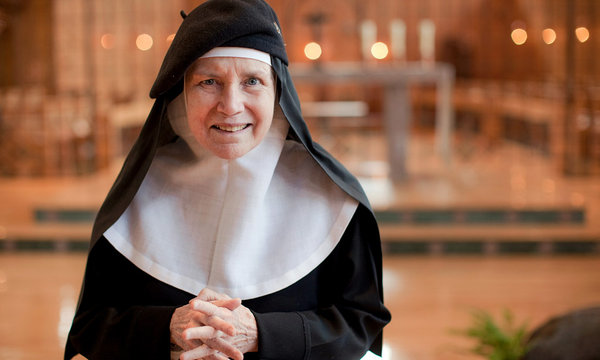
Mother Dolores Wendy Carlson.jpgBenedictine nuns typically don’t go to the Oscars. For that matter, high profile actresses don’t consecrate themselves as Benedictine nuns. Dolores Hart did both. 

Dressed in the traditional Benedictine habit of the Abbey of Regina Laudis of Bethlehem, Connecticut, Mother Dolores Hart was being considered for a short film Oscar for “God Is The Bigger Elvis.” 

The film debuts on April 5 on HBO.
Enhanced by Zemanta

Continue reading Nun hits Hollywood, again: Mother Dolores Hart turns heads

Saint Gabriel Possenti of Mary, the Mother of Sorrows


St Gabriel Possenti of Mary.jpegI’ve always been impressed by the saints and blesseds of the Passionist order. So many have them exemplify what the Christian of today face, Saint Gabriel Possenti and in my opinion help us to strive to be holy.


Lord Jesus, crucified and risen, you taught Saint
Gabriel to cling to you alone as Lord and Savior and to find in your Mother a
refuge and companion along the Gospel Way. Through his prayers and
example, may we too, who honor him, share in the marvelous joys of friendship
with you and the Blessed Virgin and come to the Heavenly Father in eternal
glory, where you live forever and ever. Amen.

Cardinal Francis George preaches Sunday Vespers for Lent I

PAZ & Cardinal Francis George Feb 26 2012.jpgA Christian’s observance of Lent brings with it, I hope, a certain discipline of prayer. At The Church of Saint Catherine of Siena (411 East 68th Street, NYC) the Sundays in Lent Solemn Vespers will be celebrated at 4 pm.

The Church’s prayer is understood as consisting in Lauds, Vespers and Mass. The sacred Liturgy can’t be conceived in any other way. In fact, the Servant of God Pope Paul VI wanted parishes to celebrate the Divine Office with regularity to fill out our worship of the Triune God. And as you know, priests and religious are obligated to pray the Divine Office for the Church on a daily basis; the laity are encouraged to pray the same. At Saint Catherine’s we pray Vespers following the evening Mass (M-F) and with a more solemn character several times a year. Our praying Vespers in Lent in a more substantial way with singing psalms and hymns, preaching, vesture and incense is consistent with the tradition found with Dominicans.
Lent II: Father Jordan Kelly, OP
Lent III: Father Jay Scott Newman
Lent IV: Father Joel Warden, CO
Lent V: Father Allen White, OP
Palm Sunday: Edward Cardinal Egan
Earlier this afternoon, Cardinal George’s homily was absolutely brilliant using Saint Paul’s theme of being free in Christ and viz. freedom today and the current issues we are facing in the USA with the current administration of the United States. The Church’s choirmaster, Daniel B. Sañez, and the Schola Dominicana was perfect for God’s glory.
Enhanced by Zemanta

Arm yourself for the culture war, Peter Kreeft, advocates at the Siena Forum for Faith and Culture

Peter Kreeft.jpegA week ago (February 18, 2012) Dr. Peter J. Kreeft, professor of Philosophy of Boston College and popular Catholic apologist delivered two lectures concerning the conflicts of culture, conscience, freedom and faith in which we find ourselves at these days.

The controlling themes of Dr Kreeft’s were centered on the perspective of winning the culture war and the differing notions of freedom. The Siena Forum for Faith and Culture hosted Dr Kreeft.

NET TV aired this interview with Dr. Peter Kreeft the other day.

Indulgence granted on Friday in Lent….

Christ's Crucifixion.jpg

A plenary indulgence is granted to the Christian faithful who:

on any Friday in the season of Lent piously recite the prayer before an image of the Crucified Jesus Christ after communion; …


Behold, O good and most sweet Jesus, I fall upon my knees before Thee, and with most fervent desire beg and beseech Thee that Thou wouldst impress upon my heart a lively sense of faith, hope and charity, true repentance for my sins, and a firm resolve to make amends. And with deep affection and grief, I reflect upon Thy five wounds, having before my eyes that which Thy prophet David spoke about Thee, o good Jesus: “They have pierced my hands and feet, they have counted all my bones.”

Lent 2012: we, prodigal children, can return

Pope Benedict XVI processed from the Benedictine Church of Saint Anselm to the Dominican Church of Saint Sabina on the Aventine Hill. A long standing tradition of the popes, though it was in abeyance for several years until 1979 when John Paul II revived the tradition. The Benedictine monks welcome the Pope and his entourage for a moment of prayer and reflective before processing to the 5th century church of the Dominican Friars where Holy Mass is celebrated with the distribution of ashes. As usual, Cardinal Tomko, the cardinal titular of Saint Sabina’s gave Benedict his ashes. The following homily of the Pope’s focusses on the origins of this humble sign that assists in our recognition of salvation. Is this our recognition, too?


Benedict 16 getting ashes 2012.jpg

Ash Wednesday is a day of fasting and penance on which we begin a new journey towards the Easter of Resurrection, the journey of Lent. I would like to reflect on the liturgical sign of the ashes, a material sign, a natural element that, in the Liturgy, becomes a sacred symbol, so important on this day that marks the start of our Lenten journey. In ancient times, in the Jewish culture, it was common to sprinkle one’s head with ashes as a sign of penance, and to dress in sack-cloth and rags. For us Christians, there is this one moment which has important symbolic and spiritual relevance.

Ashes are the material sign that brings the cosmos into the Liturgy. The most important signs are those of the Sacraments: water, oil, bread and wine, which become true sacramental elements through which we communicate the Grace of Christ who comes among us. The ashes are not a sacramental sign, but they are linked with prayer and the sanctification of the Christian people. Before the ashes are placed on our heads, they are blessed according to two possible formulae: in the first they are called “austere symbols”, in the second, we invoke a blessing directly upon them, referring to the text in the Book of Genesis which can also accompany the imposition of the ashes: “Remember that you are dust and unto dust you shall return”.

Continue reading Lent 2012: we, prodigal children, can return

Communion and Liberation opens cause for beatification and canonization for Luigi Giussani today

LGiussani.jpgFather Julián Carrón, the President of the Fraternity of Communion and Liberation, the ecclesial movement founded Father Luigi Giussani (who died 7 years ago today) and which was approved by the Church 30 years this past February 11, gave the preliminary research to Angelo Cardinal Scola, Archbishop of Milan, to open the diocesan phase of investigating the eventual beatification and canonization of Father Luigi Giussani.