
What day is it?” asked Pooh.
“It’s today,” squeaked Piglet.
“My favorite day,” said Pooh.
What day is it?” asked Pooh.

A person who attends a bible study I organize asked if indulgences are still possible, in vogue, as it were. “Weren’t they done away with at Vatican II?”, I was asked. I assured this person that indeed indulgences were still a common practice in the Catholic Church and that they have received a renewed sensibility with Benedict XVI. THE thing that catapulted the Church into the protestant revolution is now being talked about with seriousness and sincerity because it is realized that the practice of giving indulgences does help us to know ourselves and the mercy of God better.
In brief, the Catechism teaches that “The doctrine and practice of indulgences in the Church are closely linked to the effects of the sacrament of Penance” (1471ff).
So, what is an indulgence? Why would a Catholic be interested in knowing more about indulgences?
“An indulgence is a remission before God of the temporal punishment due to sins whose guilt has already been forgiven, which the faithful Christian who is duly disposed gains under certain prescribed conditions through the action of the Church which, as the minister of redemption, dispenses and applies with authority the treasury of the satisfactions of Christ and the saints.”
Continue reading Do Catholics believe in the use of indulgences today?

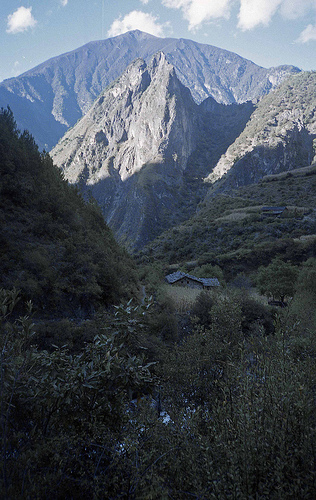
On the feast of the Sacred Heart of Jesus I am reminded of Saint Bernard’s image in Sermon 61 on the Song of Songs. There the sainted Cistercian abbot likens the pierced heart of Jesus Christ, and the wounds in his hand and feet to the clefts in a rock. “The secrets of his heart are laid open through his wounds.” (61:4)
What more can be said of our Lord, our Shepherd and our friend?
A blessed feast of the Sacred Heart of Jesus!
 O God, who in martyrdom have brought true faith to its highest expression, graciously grant that, strengthened through the intercession of Saints John Fisher and Thomas More, we may confirm by the witness of our life the faith we profess with our lips.
 The events of today require us to seek divine assistance. Actually the events of every day require us to seek divine assistance.
 Give me the grace good Lord, to set the world at
naught; to set my mind fast upon Thee and not to hang upon the blast of men’s
mouths. Gladly to be thinking of God, piteously to call for His help, to lean
unto the comfort of God, busily to labor to love Him. Gladly to bear my
purgatory here, to be joyful of tribulations, to walk the narrow way that
leadeth to life.
The Sacrament of Confession (aka Reconciliation or Penance) is a source of a new life for the Christian. It sets the soul ablaze in the love of God. It radically re-orients your life anew.

O God, who through Saint Romuald renewed the manner of life of hermits in your Church, grant that, denying ourselves and following Christ, we may merit to reach the heavenly realms of high.
“Sit in your cell as in paradise. Put the whole world behind you and forget it. Watch your thoughts like a good fisherman watching for fish. The path you must follow is in the Psalms — never leave it…. And if your mind wanders as you read, do not give up; hurry back and apply your mind to the words once more. Realize above all that you are in God’s presence, and stand there with the attitude of one who stands before the emperor…”
Saint Romuald (+1027)
The desire and capacity to linger in joy, beauty and truth is liturgically not easy to do these days with the absence of octaves following a major feasts. Eight days are not too long, not too complicated, not too esoteric to extend our prayer! And I don’t mean to merely lament the ansence of an official 8-day period of liturgical prayer. The Church has retained the octaves of Christmas and Easter but the rest are sadly gone. At least for now. I think it was a colossal mistake of the reform of the Missal by Pope Paul VI to jettison the octave, especially the octave of Pentecost.
How often do we need to slowly meditate on the Gifts and Fruits of the Holy Spirit and beg for the grace to integrate grace into our lives. We need the opportunity to understand concretely the action of the Spirit in our lives and we need to hear the beautify music, poetry and preaching connected with the Pentecost’s octave. The Pope even he wepted when he realized the change he made without thinking the whole thing through; the implications are significant; the absence of the Pentecost octave is diasasterous event for the Church. Why is it problematic? It is so because we are Church, a people of the Way, who rely on the Holy Spirit to guide each-and-every step we take in living the Gospel and seeking the face of God.
I share the opinion with many others that one of the re-reforms of the Missal that still needs to be investigated is the restauration of the Pentecost Octave. However, I would also advocate the implementation of the Assumption and Epiphany octaves. Apparently, I am not alone: the editor of America magazine Jesuit Father Drew Christiansen is saying the same thing and he’s quoting a friend, Benedictine Father Mark Daniel Kirby in his “Of Many Things” article this week.
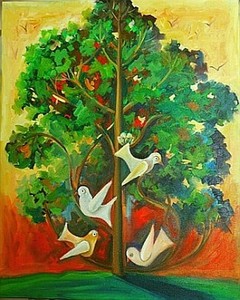 The Lord loves parables. Today’s parable is the one about the mustard seed growing into a big tree for all the birds to make a home. A fitting typology for heaven. But it is only a metaphor but a reality: the small becomes great. As Sofia Cavalletti said, “The person who at a certain point becomes aware of the dynamic nature of the Kingdom of God, which is like a mustard seed, will gradually come to see this dynamism filling the universe and empowering man and his history” (Religious Potential of the Child, 165). Jesus, in today’s gospel, fixes our attention on the place we have in His Father’s Kingdom here on earth and with Him in heave: our growth, transformation and conversaion is slow and purpose-filled. It is a recognition of the Mystery.