The loss of the Pentecost octave

The desire and capacity to linger in joy, beauty and truth is liturgically not easy to do these days with the absence of octaves following a major feasts. Eight days are not too long, not too complicated, not too esoteric to extend our prayer! And I don’t mean to merely lament the ansence of an official 8-day period of liturgical prayer. The Church has retained the octaves of Christmas and Easter but the rest are sadly gone. At least for now. I think it was a colossal mistake of the reform of the Missal by Pope Paul VI to jettison the octave, especially the octave of Pentecost.

How often do we need to slowly meditate on the Gifts and Fruits of the Holy Spirit and beg for the grace to integrate grace into our lives. We need the opportunity to understand concretely the action of the Spirit in our lives and we need to hear the beautify music, poetry and preaching connected with the Pentecost’s octave. The Pope even he wepted when he realized the change he made without thinking the whole thing through; the implications are significant; the absence of the Pentecost octave is diasasterous event for the Church. Why is it problematic? It is so because we are Church, a people of the Way, who rely on the Holy Spirit to guide each-and-every step we take in living the Gospel and seeking the face of God.

I share the opinion with many others that one of the re-reforms of the Missal that still needs to be investigated is the restauration of the Pentecost Octave. However, I would also advocate the implementation of the Assumption and Epiphany octaves. Apparently, I am not alone: the editor of America magazine Jesuit Father Drew Christiansen is saying the same thing and he’s quoting a friend, Benedictine Father Mark Daniel Kirby in his “Of Many Things” article this week.

The Kingdom of God is like the mustard tree

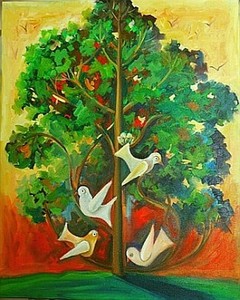
Mustard Tree Bezuidenhout.jpgThe Lord loves parables. Today’s parable is the one about the mustard seed growing into a big tree for all the birds to make a home. A fitting typology for heaven. But it is only a metaphor but a reality: the small becomes great. As Sofia Cavalletti said, “The person who at a certain point becomes aware of the dynamic nature of the Kingdom of God, which is like a mustard seed, will gradually come to see this dynamism filling the universe and empowering man and his history” (Religious Potential of the Child, 165). Jesus, in today’s gospel, fixes our attention on the place we have in His Father’s Kingdom here on earth and with Him in heave: our growth, transformation and conversaion is slow and purpose-filled. It is a recognition of the Mystery.

The child hearing this parable will recognize that they exemplify the growing of the Kingdom in their bodies. As adults, do we believe that the small can become great? Do we believe that all have a place in God’s Kingdom?

Immaculate Heart of the Blessed Virgin Mary

My heart will rejoice in your salvation. I will sing to the Lord, who has been bountiful with me.
(Entrance ant. Ps. 13)

Fridolin Leiber Herz Maria.jpg

With Mother Church we pray, 

O God, who has prepared a fit dwelling place for the Holy Spirit in the Heart of the Blessed Virgin Mary, graciously grant that through her intercession we may be a worthy temple of your glory.


The solemnity of the Sacred Heart of Jesus is directly followed by the memorial of the Immaculate Heart of Mary, the supreme human vessel of the Holy Spirit. In days following the feast of Pentecost the Church offers us an opportunity to dedicate our lives once again to the love and work of Divine Providence today. As we move through summer and then into the autumn we need a focus and the Hearts of Jesus and Mary are just the focus we need.
If you read the Litany to the Immaculate Heart of Mary you notice the characteristics the Church believes are part of Mary’s witness to Divine Providence, and which ought to be a part of our lives, too. The Litany keeps the recognition of the Mystery alive; it awakens within us our destiny in Christ. Therefore, what is said of Mary ought to be said of us (with God’s grace, of course). Let me note a few of the characteristcs that we ought to have: a heart like God’s, a heart united to Jesus’, an instrument of the Holy Spirit, a sanctuary of the Blessed Trinity, a tabernacle of the Incarnation, etc. Find the Litany of the Immaculate Heart and meditate on it today. It will be a invitation to conversion.
In August, the month dedicated to the Immaculate Heart of Mary, we’ll return to a way of living in the purity of intention and love found in Mary.

Not doctrine, but power: recent tensions in the Church

We need perspective, we need a good review of what’s happening in the press regarding the state of Catholicism. At least I do. The ever-well spoken George Weigel takes on us on a brief journey….


The American mainstream media, reflecting deeper currents in American culture, typically treats “religion” as a private lifestyle choice: a personal option one may exercise to make sense out of life (and death) through certain rituals embodied in communities. That the “choice” in question has anything to do with adherence to the truth, as one is grasped and transformed by that truth; that those rituals embody religious truth in a unique way that links the believer to the very life of God; that those communities are formed by, and accountable to, truths that can be rationally explicated in a body of knowledge called “theology” — say what? To treat religion as a lifestyle choice leaves little room for the very concept of “truth,” unless it be the anorexic postmodern notion of “your truth” and “my truth” (which means that Khalid Sheikh Muhammad’s “truth” is just as much “truth” as Pope Benedict XVI’s). In the sandbox of self-absorption that is so much of postmodern culture, there is little or no room for the truth.


Perhaps we should take a hint from a recent Church Council on this matter: 


“Theology relies on the written Word of God, taken together with sacred Tradition, as on a permanent foundation. By this Word it is most firmly strengthened and constantly rejuvenated, as it searches out, under the light of faith, the full truth stored up in the mystery of Christ.” (Dogmatic Constitution on Divine Revelation)


Read the whole article here.


Georeg Weigel

“Don’t Know Much about Theology …”

National Review online

June 12, 2012

A Light from the South illuminating the World?

“…the whole purpose of evangelism is to foster friendship with Jesus Christ, the Son of God who reveals both the face of the merciful Father and the truth about our humanity,”

In a June 13, 2012 column on the First Things website, George Weigel published a few brief reflections on his visit to Argentina and the evangelization work being done that resulted in what is being called the “Aparecida Document” (the full text is below) which is a collation of the documents from the Fifth General Assembly of Bishops of Latin America and the Caribbean (CELAM) of 2007. Weigel is naming the very long Aparecida Document as the master plan of evangelization. We ought to take note.

We in the north need this document; we need to study it and to apply its perspective to our context. But beware: we need to have the same thrust —
+ “everything in the Church must be mission-driven”
+ we need a “permanent catechesis: an ongoing encounter with the Lord Jesus, deepened spiritually through Word and Sacrament, the Bible and the Eucharist.”
+ we need to live the Gospel and the Tradition given to us.

Sacred Heart of Jesus

The designs of his Heart are from age to age, to rescue their souls from death, 


and to keep them alive in famine. (Entrance ant. Ps 33)

Jesus heart.jpg

I am always enthralled with the Church’s solemnity of the Most Sacred Heart of Jesus. The wondrous love poured out for us, Christ’s Heart is the center of our life of love, forgiveness, peace, compunction, and action. It is from the Heart of Christ that the Church is born and sacraments given as a sign and nourishment.

In his chapter “The Heart of Jesus at His Birth in Bethlehem” Blessed Louis Guanella offers this prayer to the Sacred Heart:

O Most Holy
Heart of Jesus, I cannot love you as the Blessed Mother loved you. I feel bad
about it. I would like to love you, as the chaste Joseph did. At least, O Lord,
make me love you with simplicity and affection equal to that of the devout
shepherds. How happy will I be when I will really begin to love you! How
fortunate I will be when, enkindling my accent, I will be able to applaud
around you with the choirs of angels, saying: “Glory to God in the highest, and
peace on earth to men of good will!”

Blessed Louis Guanella

In the Month of
Fervor: Thirty Scriptural Maxims Developed on the Sacred Heart of Jesus for
Christian Souls

May the fire of the Heart of Jesus burn brightly within us!

A different view women of religious today

In the Catholic press this morning there is a story about the Religious Sisters of Mercy of Alma using the language of faith versus the language of politics for life, ministry and vocation. All this clap-trap with the LCWR and who’s on what side or not is a bit over the top for several reasons (which I won’t get into right now). Read what the Sisters of Mercy of Alma have to say –they give a more balanced view.

Vatican works more closely with Sport

JPII Foundation for Sport.jpegThe Church is getting more deeply into sport laity with the John Paul II Foundation for Sport, and the Pontifical Councils for Culture and Laity. It is believed that sport as a privileged place for dialogue among church, culture and youth. Sport is healthy recreation and appropriate challenge. Sport is a point of reference of bettering oneself and the development of virtue.


This is a new approach to following Christ.

(Sadly, the John Paul II Foundation for Sport is only a London based organization; let’s hope something in the USA and Canada gets working.)


From Vatican Radio:


Representatives from the Pontifical Council for Culture and the Pontifical Council for the Laity held a press conference at the Vatican on Thursday, during which they presented the new lines of cultural approach to sport. The new approach is aimed at coming to an understanding of sport as a privileged place for dialogue among Church, culture and youth. The conference also provided an opportunity to present the Pontifical Council for Culture’s new Department dedicated to Culture and Sport, which will work closely with the Church and Sport Section of the Pontifical Council for the Laity, and the John Paul II Foundation for Sport. One of those who participated in the press briefing was Fr. Kevin Lixey, who is Responsible for the Church and Sport Section at the Council for the Laity. He told Vatican Radio recent, highly publicized scandals in major league sports – including betting scandals in Italy – make the announcement extremely timely. “On the one hand,” said Lixey, “we wanted to announce something we’ve been doing for the past year and a half,” adding, “it’s a moment for the Church to show that it is concerned.” Fr. Lixey went on to say, “[The Church] is actively working and interested in trying to stimulate a little bit more the pastoral work with sport,” on all levels, from youth leagues to international and professional compretition. “There is,” said Fr. Lixey, “still a lot of good in sport.” 


Listen to Chris Altieri’s extended interview with Fr. Kevin Lixey of the Pontifical Council for the LaityRealAudioMP3 

Origen attracts new interest with discovery

origen.jpg

Yesterday there was a very brief article in the newspaper from the AP about the discovery of homilies from Origen (AD 185-253/4) Church father (theologian) from Alexandria, Egypt. Later I noticed a friend on Facebook telling us a little more of the discovery the homilies on the Psalms. Few of his texts are extant. The press release (in German) is noted here.
More than being esoteric, this a really important find because Origen is a pivotal Christian thinker because he contributed to the building of our witness to Christ.
The manuscripts of the homilies were found in the Bavarian State Library by Marina Molin Pradel while she was doing some other work. The texts were verified by Lorenzo Perrone of the University of Bologna. These homilies are important since Origen’s work as been until now unknown in Greek.
The 3rd century Origen was condemned by the Ecumenical Council of Constantinople in 553.

Zenit news has an article.

If you are interested in Origen you may be interested in what Pope Benedict XVI said about this theologian in 2007 when he dedicated two of his catechesis sessions on him.
 

Enhanced by Zemanta