Author: Paul Zalonski
Francis: Pope of a New World by Andrea Tornielli
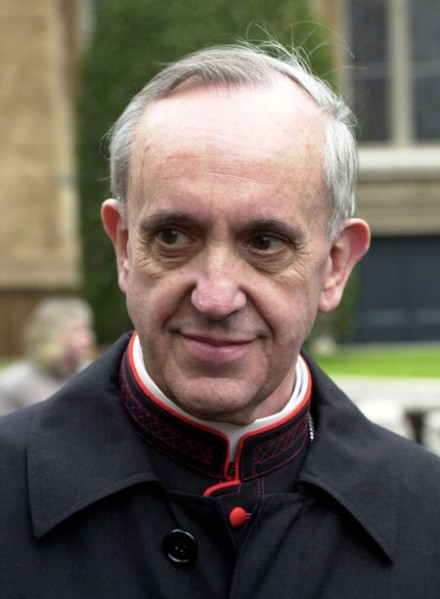
“Francis, rebuild my Church!” That is how St. Francis of Assisi heard the call of Christ. It is also how Jorge Mario Bergoglio, at the age of 76, and a Jesuit, seems to have accepted his election to the papacy with the choice of a name that no other pope has ever chosen.
Who is Pope Francis, elected in one of the shortest conclaves in history? Who is the man chosen to be the first pope from the Americas and the first Jesuit pope?
Continue reading Francis: Pope of a New World by Andrea Tornielli
Novena of Prayer to Saint Benedict, Day 4
Articles on or about Pope Francis
Faithful catechists are “witnesses rather than teachers,” Pope Francis said
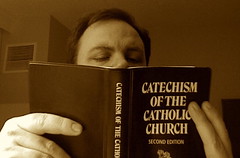
Catechism Clips (Photo credit: thicke)
As the archbishop of Buenos Aires Jorge Mario Bergoglio spoke of the importance of the ministry of catechesis, as a “pillar of the Church.” For him, as you would expect, catechesis is the sowing of seed in soil. No what type of soil, as the parable goes, you sow, cultivate, and pray. In a letter addressed to catechists, the cardinal stated, “In our task of evangelization, God asks us to accompany a people that walks in the faith.”
Cardinal Bergoglio paid attention to the ecclesial and evangelical nature of the catechetical ministry that is often overlooked, mismanaged, and otherwise dismissed by clergy and laity alike. You get a clearer sense of the the scope –successes and failures– in catechetical ministry throughout the last hundred plus years if you read George Weigel’s recent book, Evangelical Catholicism. And this why catechetical methods such as Catechesis of the Good Shepherd aim at doing what is consistent with the long-view of teaching the faith is about, and the emphases Pope Francis made in 2010.
Bergoglio, like Weigel, and other reasonably attentive pastors of the Church speak of the handing on the faith to others (children and adults alike) is a “splendid mission, ministry of the Word that catechists have been carrying out uninterruptedly for almost two thousand years”; it is “an ecclesial service that is expressed in many ways and in different places.”
Continue reading Faithful catechists are “witnesses rather than teachers,” Pope Francis said
Ecumenical and Interfaith leaders respond to the election of Pope Francis
Surveying what the ecumenical crowd has to say about this papal election is mixed at best. Time will tell about our interfaith friends, namely the Jewish and Muslim communities. It is said that Pope Francis has had very strong friendships with the Jewish community of Argentina.
On Wednesday night when Pope Francis was introduced to the world on the loggia he said, “And now let us begin this journey, the bishop and people, this journey of the Church of Rome which presides in charity over all the churches, a journey of brotherhood in love, of mutual trust. Let us always pray for one another. Let us pray for the whole world that there might be a great sense of brotherhood.”
Pope Francis Portrait Painting (Photo credit: faithmouse)
His All Holiness the Ecumenical Patriarch Bartholomew (of Constantinople) will attend the enthronement of the newly-elected Pope of Rome on March 19. This is the first time since 1054 that Orthodox bishops will be in attendance. Bartholomew will be accompanied by the Metropolitan of Pergamum, John (Zizoulas), the Metropolitan of Buenos Aires, Tarasios (a native of San Antonio, Texas) and the Metropolitan of Italy, Gennadios.
The Russian Orthodox Church’s Department for External Relations, Metropolitan Hilarion of Volokolamsk, spoke on Thursday that he thought a meeting between the Pope Francis and Patriarch Kirill of Moscow was “possible but the place and timing will depend on how quickly we will overcome the consequences of the conflicts from the turn of 1980s and 1990s.” Hilarion notes, “on several occasions, Pope Francis has shown spiritual sympathy towards the Orthodox Church and a desire for closer contacts.” The Orthodox still refuse to accept the fact that some Christians in the Byzantine East want, in their own freedom, be in communion with the bishop of Rome. Tensions run high when it comes to thinking about the Ukrainian Byzantine Church using the title of Patriarch for their head and the existence of Latin Catholic dioceses in Russia.
Continue reading Ecumenical and Interfaith leaders respond to the election of Pope Francis
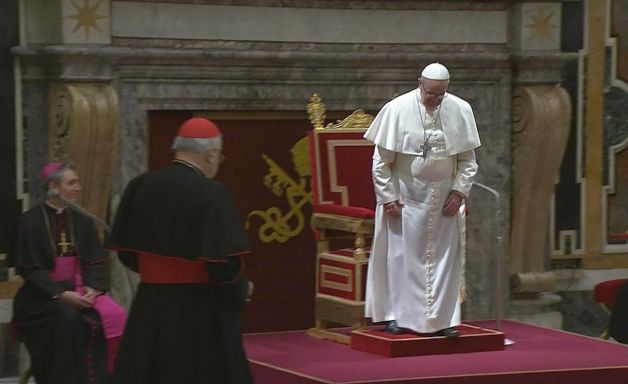
Pope Francis speaks to the cardinals: the Paraclete is the supreme protagonist of every initiative; never give in to pessimism, to bitterness
The Church needs reform, as always, a personal conversion. Turning to Jesus Christ is an act of freedom. What baggage do we have that would prevent change, or hinder me from confessing and living differently as a Christian? Reform starts not with institutional works, but with oneself. Governance is not the only issue that we have to be vigilant of with this new papacy; conversion of life starts locally and spreads. As Francis said yesterday in his first Mass as the Bishop of Rome, we need to walk, to build, to confess with, for and by each and every person so that we see the glory of God. We need to untie the knots that were spoken of by Saint Ireneaus. All this talk of reform includes the Curia, it is not business as usual. The Pope will remind us and lead us by his own life. He now holds office as the Vicar of Christ. He has suffered much close to To that end, today Pope Francis spoke to the gathered cardinals in the Sala Clementina. His address follows.
This period of the Conclave has been filled with meaning not just for the College of Cardinals but also for all the faithful. During these days we have felt almost palpably the affection and solidarity of the universal Church, as well as the attention of many people who, even if not sharing our faith, look upon the Church and the Holy See with respect and admiration.
From every corner of the earth a heart-felt chorus of prayer was raised by Christian peoples for the new Pope, and my first encounter with the crowds filling St. Peter’s Square was an emotional one. With that eloquent image of a praying and joyful populace still fixed in my mind, I would like to manifest my sincere gratitude to the Bishops, priests, consecrated persons, young people, families, and to the aged for their spiritual closeness which is so touching and sincere.
Pope Francis’ first homily as the Bishop of Rome
In these three readings I see that there is something in common: it is movement. In the first reading, movement is the journey [itself]; in the second reading, movement is in the up-building of the Church. In the third, in the Gospel, the movement is in [the act of] profession: walking, building, professing.
Walking: the House of Jacob. “O house of Jacob, Come, let us walk in the light of the Lord.” This is the first thing God said to Abraham: “Walk in my presence and be blameless.” Walking: our life is a journey and when we stop, there is something wrong. Walking always, in the presence of the Lord, in the light of the Lord, seeking to live with that blamelessness, which God asks of Abraham, in his promise.
Continue reading Pope Francis’ first homily as the Bishop of Rome
Pope Francis writes about Fr Luigi Giussani: he “helped me to pray”
Research is running on steroids in the hours since Jorge Mario Bergoglio was elected to be our new Roman Pontiff, Francis. This is especially true with members of Communion and Liberation who are eager to see what connection they can make with the new Pope. Who could blame us?
The First American Pope: Catholicism’s turn into an evangelical future
National Review Online published today George Weigel’s “The First American Pope: Catholicism’s turn into an evangelical future.”