34th Rimini Meeting gathers, Pope sends message

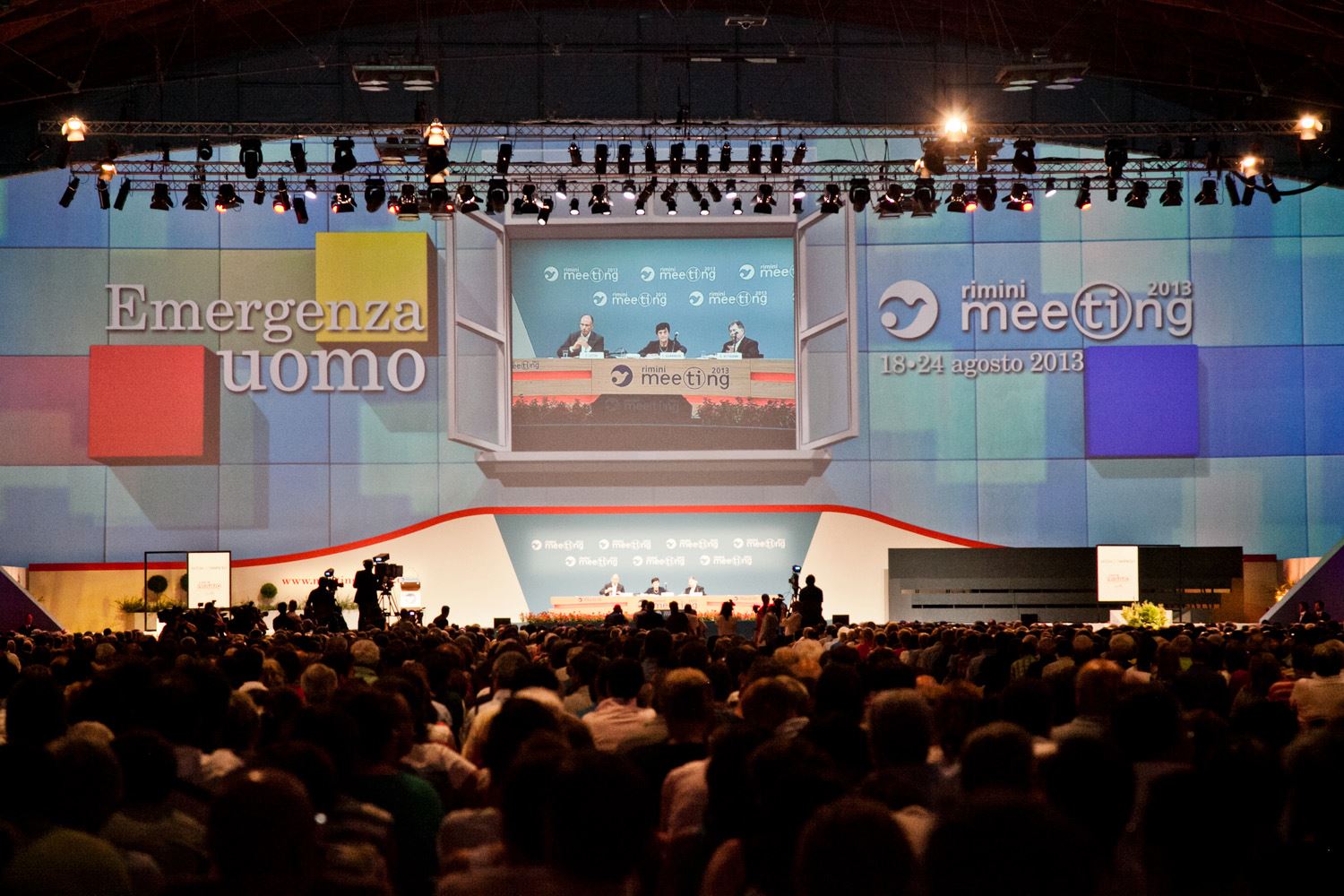
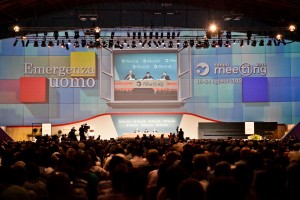
The 34th Meeting for the Friendship Among the Peoples opened in Rimini, Italy on 18 August. The for this year is “The Human Person: a State of Emergency.”

The Holy Father through the Secretary of State to His Holiness, Tarcisio Card. Bertone, SDB, sent a letter to the bishop of Rimini, the Most Reverend Francesco Lambiasi.

The Meeting is a work of members of Communion and Liberation and it draws around 800K, from Italy and many countries beyond. In past years the Meeting has welcomed the brilliant contributions, among many, of Blessed John Paul II, Blessed Teresa of Calcutta, the Servant of God Father Luigi Giussani, Benedict XVI (when he was the CDF Prefect), Ennio Morricone, David Rosen, Tony Blair and Carl A. Anderson.

The Program for this year…

Here’s Pope Francis’ message…

Most Reverend Excellency, I would like to address with joy the Holy Father Francis’ cordial greeting to Your Excellency, to the organizers and to all the participants in the Meeting for the Friendship Among the Peoples that is now being held for the 34th time. The theme chosen – The Human Person: a State of Emergency – captures the great urgency of evangelization, which the Holy Father following His predecessors, has underlined many times and which caused in Him deep considerations that now I refer here below.

In his first Encyclical, Redemptor hominis (cfr. n. 14), the beatified John Paul II wrote that “man is the way for the Church.”

This truth is still valid, especially in this period in which the Church is called to rediscover its own mission, focusing on the essential and searching for new paths for evangelization, in a more and more globalized and virtual world and in a society more and more deprived of stable reference points.

Man remains a mystery, irreducible to whatever image society creates and the power of the world tries to impose to him. The man is a mystery of freedom and grace, of poverty and grandness. But what does it mean: “Man is the way for the Church?” And especially, what does it mean for us today to walk through this way?

Man is the way for the Church because he is the road that God Himself walks on. From the dawn of humanity, after the Original Sin, God has begun to search for man. “Where are you?” He asks Adam, who is hiding in the garden (Gen 3, 9). This question, that appears at the beginning of the Book of Genesis, and that doesn’t stop resonating throughout the entire Bible and in every moment of the history that God, throughout the millennia, created with humanity, reaches its highest expression through the incarnation of the Son. In his commentary on John’s Gospel, Saint Augustine affirms that: “Remaining with the Father, [the Son] was truth and life; taking our flesh, He became the way” (I, 34, 9). Therefore Jesus Christ is “the chief way for the Church,” but since “He is also the way for each man”, man becomes “the prime and fundamental way for the Church.” (Redemptor hominis, 13-14)
Jesus affirms “I am the gate” (John 10,7): that means, I am the access portal for every man and everything. Without passing through Christ, without concentrating on Him the gaze of our heart and mind, we would not understand anything of the mystery of the human person. Therefore, almost inadvertently, we will be forced to acquire from the world our criteria of judgment and action, and every time we get closer to our brothers in humanity, we will be like those “thieves and robbers” that Jesus talks about in the Gospel (John 10,8). Even the world is in fact, in its own way, interested in man. The economic, political and social power needs man to maintain and inflate itself. And for this reason, the power frequently tries to manipulate the masses, it creates desires to eliminate the most precious thing man possesses: his relationship with God. The power fears those men that have a relationship with God because this relationship sets them free.

This is the state of emergency of the human person the Meeting for the Friendship Among the Peoples has chosen as its main theme this year: the urgency to give back man to himself, at his highest dignity, to his own uniqueness and preciousness of each human existence from his conception to the natural end of life.

It is necessary to take into consideration again the sacredness of man and, at the same time, to strongly state that only in the relationship with God, that is in the discovery and adhesion of one’s own vocation, that man can achieve his true stature.

The Church to which Christ entrusted His Word and Sacraments takes care of the greatest hopes, the most authentic possibility of fulfillment for man, in any place and any time. What a big responsibility we have! Do not keep just for us this precious treasure that everybody, aware or not, is looking for himself or herself.

Let’s meet with courage all the men and women of our time, children and old people, “wise” people and those without education, young and families. Let’s meet everybody and do not wait the others to look for us! Let’s imitate in this our Divine Master, who left His Heaven to become man and to be closed to everybody. Let’s bring the perfume of Christ’s love (2 Cor 2,15) not only in churches and parishes, but in every environment. In the schools, in the universities, in workplaces, in hospitals, in prisons; but also in the city squares, in the streets, in the sport centers, in places where people gather. Don’t be greedy in giving what we have gained without any merit! Let’s not be afraid to announce Christ in favorable or unfavorable occasions (2 Tm 4,2) with respect and frankness. This is the Church’s task, this is every Christian’s task: to serve men and look for them even in the social and the most inner spiritualist corners.

The condition of credibility of the Church in its mission of mother and teacher is its fidelity in Christ. The openness towards the world is accompanied and, in a certain sense, is possible thanks to the obedience to the truth of which the Church itself cannot dispose. “The Human Person: a State of Emergency” thus signifies the urgency to go back to Christ, to learn from Him the truth about ourselves and the world and with Him and in Him to go and meet every man, especially the poorest, for which Jesus has always manifested His predilection. And poverty is not only material. There is a spiritual poverty that grips every contemporary men. We are poor in love, thirsty for truth and justice, beggars of God, as wisely the servant of God Father Luigi Giussani has always underlined. The greatest poverty is in fact the lack of Christ, and until we do not bring Jesus to people, we would have done too little for them.

Your Excellency, I hope these brief thoughts may help those who are taking part in the Meeting. His Holiness Pope Francis assures everybody His closeness in prayer and His affection. He hopes that the meetings of these days may light in the hearts of all the participants a fire that nourishes and sustains their testimony of the Gospel in the world. And we send a particular Apostolic Benediction to You, to all the responsible people, the organizers of this manifestation, as well as those who are present.
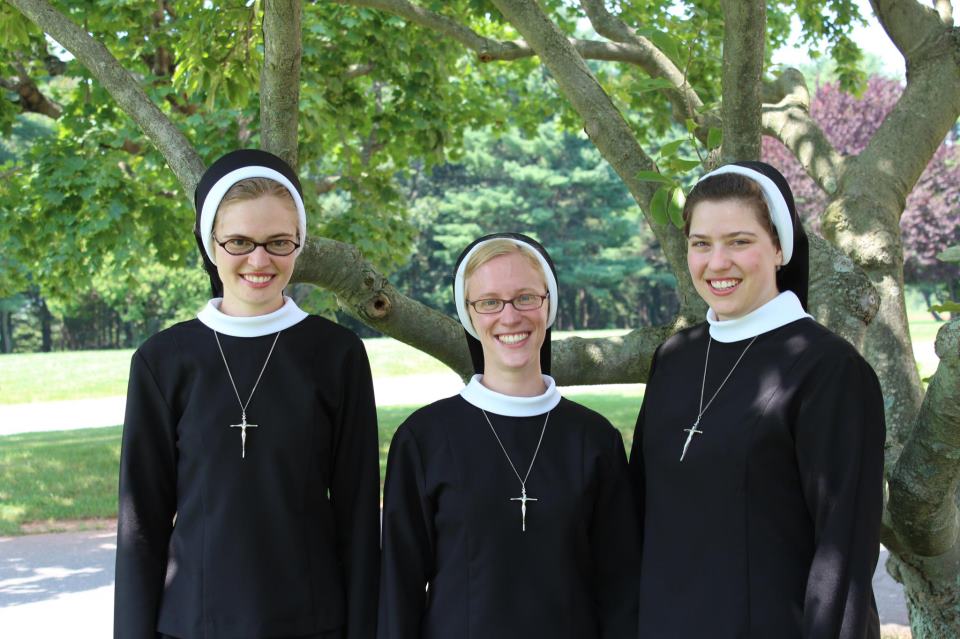
Millennials becoming priests and nuns???

Good question. I hope so. We need people to help all people to see the face of Christ in a new and dynamic way. The radical nature of the vocation –following Jesus Christ and serving in the Church– requires of all people the total gift of self until death with eyes fixed on heaven.

Emma Green’s article, “Why Would a Millennial Become a Priest or a Nun?” published by The Atlantic online surfaces some good questions to consider about the current generation, the millennials, the 20-somethings, who are in discernment to serve the Lord as a priest, nun, or sister.

Ms Green’s articles doesn’t do any heavy lifting. Her approach is more of a sociological look at vocations to Catholic religious orders. Nevertheless, she helps frame other questions and concerns.

What Emma Green misses in the article is the fact a person becomes a member of a religious order or joins the secular priesthood because he or she is in love with Jesus Christ as Lord and Savior; that relationship with Christ reveals the desire of giving of oneself in a singular manner, forever. Social justice concerns, teaching, serving in a hospital, going on mission, etc., all good and necessary things, are but consequences of the relationship one has with Christ.

Early September I will publish my annual survey of random religious orders who accepted newcomers.

In praise of saints

I find saints to be helpful, provocative and needed. Christian living is difficult enough that I find myself in need of good witness to help me understand the horizons of Christian life, to invite me to live differently and to anchor me more squarely in the reality of what Scripture and tradition propose. Read the Roman Martyrology and you’ll notice through the centuries there are men and women lifted up by the Church as worthy of following. Recall that a saint’s purpose to is to point us not to himself, but to Jesus Christ. Saints are not self-referential.

Christianity can really be characterized as a genealogy beginning with the Trinity right down to our present age. In history we count the Mother of God, Mary, as the first disciple of God; in the coming months we’ll have two new disciples honored at the altar, John XXIII and John Paul II. These men for me, indicate a path to a right relationship with the Lord.

On one hand saints tell us not to be overly anxious, that following Christ is humanly possible and yet, work is needed to be a true follower of Christ. By work I mean a personal attention to the desires of the heart, knowing the person of Jesus, having a substantial freedom from a divided heart and tongue (sin) and a life worthy of being in the presence of God. A saint realizes he or she is a sinner and the only to be with God is to rely on His grace.

The other day Andy Crouch of the WSJ wrote a good piece titled, “Saints Be Praised–Officially or Otherwise: Catholics have the most rigorous process for naming them, but even Protestants have informal ones.” Here we have a broad approach among Christians in recognizing holy men and women.

In part Mr Crouch writes,

Saints, whether formally recognized by Catholicism or informally regarded as such by other denominations, are bracing reminders that the transformation of spirit promised by religion—so elusive for most of us—is possible in this life. Christians of any kind can appreciate the remarkable lives of the two men the Catholic Church will canonize later this year.

Saint Roch

Saint Roch (+1327) is a patron of the sick. He knew first hand the sufferings sick people face, and how the illness, though a cross, makes a bridge to something greater.

Saint Roch was a layman who followed the good example of Saint Francis of Assisi, and it is said that he was a member of the Secular Franciscans though there are no records attesting to this and yet the Franciscans observe his liturgical memorial on August 17.

Catholic healthcare was emboldened in the time following Roch’s death with various hospice works and groups gathering as a confraternity to assist the professionals and families. Many were healed of their diseases through Saint Roch’s intercession.

Blessings on my friend, Father Matthew Rocco Mauriello and his parish, Saint Roch, Greenwich, CT.

Letter of Father Pedro Arrupe on Humanae vitae

Today is the 45th anniversary of the Servant of God Father Pedro Arrupe’s letter to the Society of Jesus on the Servant of God Pope Paul VI’s teaching, Humanae vitae. This is the first time I’ve seen this letter and it portrays the Jesuit’s in a different light, one that is unexpected and consistent with what we know to be the mind of Saint Ignatius and the Church. Without a doubt, Father Arrupe wrote a beautiful letter, too bad it was buried for so long.

Epistula A.R.P.N. Generalis ad omnem Societatem occasione Litterarum Encyclicarum “Humanae vitae.” Acta Romana Societatis Iesu.  Vol. XV, Fasc. II, anno 1968

Dear Fathers and Brothers,  Pax Christi

We are all aware of the response given to the most recent encyclical of Pope Paul VI, Humanae vitae, about the problems raised by the question of contraception.  While manycompletely accept the teaching of the encyclical, a number of the clergy, religious and laity violently reject it in a way that no one in the Society can think of sharing.  Yet, because the opposition to the encyclical has become widespread in some places, I wish to delay no longer before calling to mind once more our duty as Jesuits. With regard to the successor of Peter, the only response for us is an attitude of obedience which is at once loving, firm, open and truly creative.  I do not say that this is necessarily painless and easy.

In fact, on various grounds and because of particular competence, some of us may experience certain reservations and difficulties.  A sincere desire to be truly loyal does not rule out problems, as the Pope himself says.  A teaching such as the one he presents merits assent not simply because of the reasons he offers, but also, and above all, because of the charism which enables him to present it.  Guided by the authentic word of the Pope- a word that need not be infallible to be highly respected – every Jesuit owes it to himself, by reason of his vocation, to do everything possible to penetrate, and to help others penetrate, into the thought which may not have been his own previously; however, as he goes beyond the evidence available to him personally, he finds or will find a solid foundation for it.

To obey, therefore, is not to stop thinking, to parrot the encyclical word for word in a servile manner.  On the contrary, it is to commit oneself to study it as profoundly as possible so as to discover for one self and to show others the meaning of an intervention judged necessary by the Holy Father.

Once we have correctly grasped the meaning of the encyclical, let us not remain passive.  Let us not be afraid to rectify our teaching, if need be, while at the same time explaining why we are doing so.  Let us develop our teaching as profoundly as possible rather than restrict it.  Let is strive for a better pastoral theology of the family and of the young people.  We must not forget that our present world, for all its amazing scientific conquests, is sadly lacking a true sense of God and is in danger of deceiving itself completely.  We must see what is demanded of us as Jesuits.  Let us collaborate with others in centers of the basic research on man, where the specific data of Christian revelation can be brought together with the genuine achievements of the human sciences and thus achieve the happy results that can be legitimately anticipated.  In all this work of sympathy, intelligence, and love, let us always be enlightened by the Gospel and by the living tradition of the Church.  Let us never abandon the papal teaching we have just received.  Rather, we must continually seek to integrate it into an ever-widening anthropology.  The present crisis makes clear this urgent need.

In so fulfilling our mission as Jesuits, which is to make the thought of the Church understood and loved, we can help the laity, who themselves have much to bring to the problems touched on in the encyclical, and who rely on us for a deep understanding of their points of view. [“atque nostram expectant cooperationem pro intimiore penetratione magisterii Pauli VI.”]

You understand well that it is the spirit of the Constitutions which inspires me as I write these words.  For, as the Constitutions tell us in substance, each member of the Society must remember that his personal manner of serving God is realized through a faithful obedience to the Roman pontiff.  That is why I am certain that today too, the Society is able to show itself worthy of four centuries of complete fidelity to the Holy See.

It certainly cannot be said that the Second Vatican Council has changed all this.  The Council itself speaks formally of “this religious submission of will and of mind,” which “must be shown in a special way to the authentic teaching authority of the Roman pontiff, even when he is not speaking ex cathedra.  That is, it must be shown in such a way that his supreme magisterium is acknowledged with reverence and the judgments made by him sincerely adhered to according to his manifest mind and will” (Lumen Gentium, n.25).

Nor can it be said that the Pope was speaking of matters that do not involve our faith, since the essence of his teaching directly concerns the human and divine dignity of man and of love.  In the enormous crisis of growth which envelops the whole world, the Pope himself has been what the entire Church must be, and Vatican II affirmed, “both a sign and a safeguard of the transcendence of the human person” (Gaudium et Spes, n.76).  For this reason the service we as Jesuits owe to the Holy Father and to the Church is at the same time a service we owe to humanity itself.

In my awareness of our obvious duty as Jesuits I could say much more, particularly at this time which seems to me crucial for the Church. Difficult times are times made for the Society, not to seek its own glory, but to show its fidelity.  This is why I am certain that all of you will understand my words.  As for those for whom the encyclical presents  personal problems of conscience, I wish to assure them that for that very reason I am keeping them in my affection and prayers.

May St. Ignatius help each of us to become, with the aid of the Holy Spirit, more Ignatian than ever.  May he obtain for us the understanding that our legitimate desire to be totally present to this world demands of us an ever-increasing fidelity in the service of the Church, the Spouse of Christ and the Mother of all mankind.

I commend myself to the prayers of all of you.

Rome, 15 August 1968.
Most devotedly in Christ,

Pedro Arrupe
Praep. Gen. Soc. Iesu.

[This English translation was transcribed by Fr. Joseph Carola, S.J., from the article “Father Arrupe: ‘Think with the church’,” which appeared in the National Catholic Reporter, September 18th, 1968, p. 7]

Paolo Dall’Oglio “reported killed” by Islamic rebels in Syria

The Reuters news agency, and several other agencies are reporting, though not the Holy See as yet, that Al-Qaeda-linked rebels in Syria killed Jesuit Father Paolo Dall’Oglio, 59, who was kidnapped on 29 July. But there is NO definitive evidence this news is certain.

What we do know is that Pope Francis mentioned his name at Mass on the feast of Saint Ignatius of Loyola on 31 July.

For the past 30 thirty years Father Dall’Oglio has been leading a religious and cultural life at the Monastery of Saint Moses (Deir Mar Musa). The Monastery and its community was known to be an interfaith center devoted to Muslim-Christian friendship. Rebuilding this 6th century but abandoned monastery was Father’s and his small community’s attempt at preserving Syrian Christian establishments. One of the stunning pieces of Syrian religious patrimony Dall’Oglio preserved was an 11th century fresco of the Last Judgment.

Father Dall’Oglio was ordained as a Syrian Catholic priest; he spoke Arabic and studied Islamic theology and philosophy. His doctoral studies and writing at the Gregorian University concentrated on the virtue of hope in Islam.

Father was expelled from Syria in 2012, though he would sneak back into the country from time-to-time.

More recently his voice has been heard in calling for the deposition of the Syrian President Bashar al-Assad and some Islamist rebel groups.

Assumption of the Blessed Virgin Mary

Inspired from on high by God’s Spirit,
the apostles convened from all over the world,
in honor of you, O Mother of light!

And all heaven’s powers stood by the Master,
filled with awe and love,
as they prepared to welcome you,
in whom the Word of God had dwelt.

With joyful voices they sang forth their hymns of praise:
Today, all creation rejoices,
for the Queen of all,
the very handmaid of the Lord, is nigh!

Open wide, all your portals on high:
Make way for the Mother of light to enter in,
for through her all the world received salvation,
from this Maid who exceeds all praise,
for her greatness is beyond all understanding.

So the, O fairest Lady,
we, too, celebrate your holy Dormition.
Now that you dwell in everlasting glory with your divine Son,
we give you thanks on this glorious day and we bless you,
for you never cease praying for us!

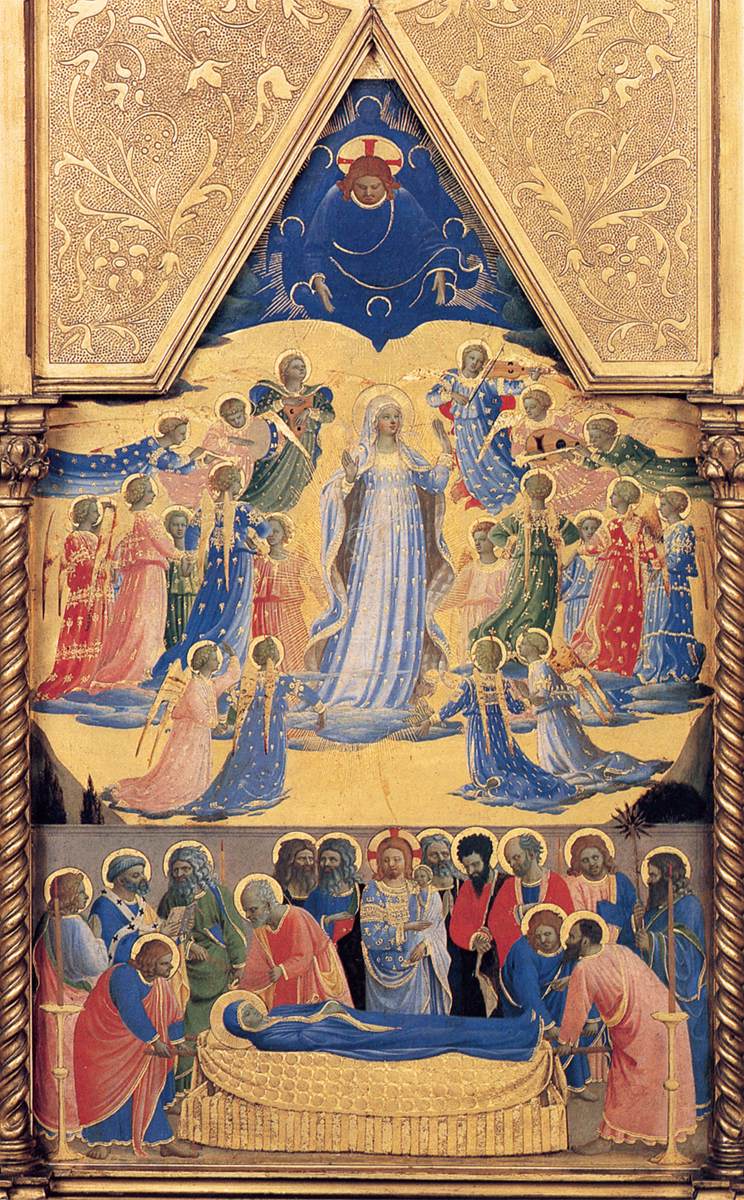
The above text from Vespers sung by Byzantine Church which celebrates a vigil of the Dormition, as they call the feast. They use the term for the vigil as the “foretaste” of the Dormition of the Theotokos and Ever-Virgin Mary. Hymn texts are very great communicators of what the Church believes to be beautiful, good and true. Like music, sacred art has an interesting way to move a believer to know a truth. In the image I placed with the text was painted by the Dominican Fra Angelico (Blessed John of Fiesole). You’ll notice the dormition (the falling asleep) of Mary and her Assumption, an act seemingly happening at the same moment. From a dogmatic point of view, the Catholic Church never definitively taught whether Mary experienced death, or not. Pope Pius XII left it an open question. Perhaps it is a both/and point.

Today is a day to Bless Herbs. This is the blessing used by the Byzantines. More info: the Blessing of Herbs AND another Blessing.

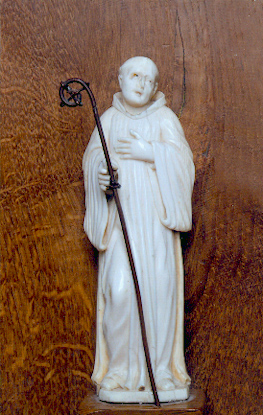
Saint Arnold of Soissons, patron of hop pickers, beer brewers

I didn’t know until I saw the following post on the Daylesford Abbey FB page:

Today we remember Saint Arnold of Soissons (1040–1087), the patron saint of hop-pickers and beer brewers. Arnold, born in Belgium, founded the Abbey of St. Peter in Oudenburg. At the abbey, he began to brew beer, as essential in medieval life as water. He encouraged local peasants to drink beer, instead of the contaminated village water, due to its “gift of health.” During the process of brewing, the water was boiled and thus, unknown to all, freed of pathogens.

As one would have thought, a Benedictine monk perfected beer making. Saint Arnold did good work for the health of his people through brewing beer.

Saint Arnold, pray for hop pickers, beer brewers, and for all of us who enjoy a good beer.

Saint Maximilian Kolbe

O God, who filled the Priest and Martyr Saint Maximilian Kolbe with a burning love for the Immaculate Virgin Mary and with zeal for souls and love of neighbor, graciously grant, through his intercession, that striving for your glory by eagerly serving others, we may be conformed, even until death, to your Son.

I think the first canonization of a saint, in this case a martyr, that I first encountered as a child was Kolbe’s. It was a brilliant move of John Paul II. This Conventual Franciscan’s ability to love another to the point of sacrificing his life portrays the theodrama of the Paschal Mystery in great proportions. When I went to the death camp where he met his Lord and Savior I was filled with peace and love. But I was also aware that only a Christian’s love like Kolbe’s could rightly interpret the experience.

“No one in the world can change Truth. What we can do and should do is to seek truth and to serve it when we have found it.”

Prosper Grech’s admonition to cardinals in 2013 conclave

Before all the “extras” are dismissed from the Sistine Chapel so that the cardinal-electors gathered to elect a new Bishop of Rome, can get to work, the cardinals hear a admonition, typically from one of their own. A papal election is not only an ecclesial act, but also a formation of mind and heart. Cardinal Prosper Grech, OSA, 87, was that admonitor. The Cardinal is a brilliant man with a good sense of humor. What he’s given us to ponder is yet another path into the heart of the gospel and the Church, today. Grech’s ideas just might open a new door for the work of the new evangelization and one’s own formation in the Faith.

What is fascinating is that the text of the secret session was made public recently. Last week I saw somewhere in cyberspace some paragraphs of Cardinal Grech’s text. This hasn’t happened prior to now. The text, in Italian, was published in the recent edition of the Acta Apostolicae Sedis.

A portion of the text now appears on Sandro Magister’s website, La Chiesa, under the title, “Groundbreaking: The Last Warning to the Pope’s Electors.” The following several paragraphs are indeed very, very interesting.

As Grech said, “The action you are about to carry out within this Sistine Chapel…”

[…] I have no intention of making the identikit of the new pope, and much less of presenting a plan of action for the future pontiff. This very delicate task belongs to the Holy Spirit, who in recent decades has gifted us with a series of excellent holy pontiffs. My intention is that of drawing from Scripture some reflections to help us understand what Christ wants from his Church. […]

GOSPEL WITHOUT COMPROMISE

After his resurrection Jesus sent the apostles into the whole world to make disciples of all peoples and baptize them in the name of the Father, and of the Son, and of the Holy Spirit (Mt 29:19). The Church does this by presenting the Gospel without compromise, without diluting the word. […] When one descends to compromises with the Gospel one empties it of its “dynamis,” as if one were to remove the explosive from a hand grenade. Nor must one give in to temptation thinking that, since Vatican Council II is believed to have leveled out salvation for those who are outside of the Church as well, the need for baptism has been relativized. Today is added the abuse of many indifferent Catholics who neglect or refuse to baptize their children.

THE SCANDAL OF THE CROSS

The proclamation of the Gospel of the Kingdom of God is made concrete in the proclamation of “Jesus Christ, and him crucified” (1 Cor 2:2). […] It is precisely this scandal of the cross that humbles the “hybris” of the human mind and elevates it to accept a wisdom that comes from above. In this case as well, to relativize the person of Christ by placing him alongside other “saviors” means emptying Christianity itself of its substance. It is precisely the preaching of the absurdity of the cross that in less than three hundred years reduced to the minimum the religions of the Roman empire and opened the minds of men to a new view of hope and resurrection. It is for the same hope that the modern world is thirsting, suffering from an existential depression.

CHURCH OF MARTYRS

Christ crucified is intimately connected to the Church crucified. It is the Church of the martyrs, from those of the first centuries to the many faithful who, in certain countries, are exposing themselves to death simply by going to Sunday Mass. […] Jesus predicts: “if they have persecuted me, they will persecute you” (Jn 15:20). Therefore, persecution is a “quid constitutivum” of the Church, […] it is a cross that it must embrace. But persecution is not always physical, there is also the persecution of falsehood: “Blessed are you when they insult you and persecute you, and say all manner of evil against you falsely for my sake” (Mt 5:11). You have recently experienced this through some media outlets that do not love the Church. When the accusations are false one must not pay attention to them, even if they cause immense pain.

WHEN THE ACCUSATIONS TELL THE TRUTH

It is another thing when what is said about us is the truth, as has happened in many of the accusations of pedophilia. Then we must humble ourselves before God and men, and seek to uproot the evil at all costs, as did, to his great regret, Benedict XVI. And only in this way can we regain credibility before the world and give an example of sincerity. Today many people do not arrive at believing in Christ because his face is obscured or hidden behind an institution that lacks transparency. But if recently we have wept over many unpleasant events that have befallen clergy and laity, even in the pontifical household, we must consider that these evils, as great as they may be, if compared with certain evils in the history of the Church are nothing but a cold. And just as these have been overcome with God’s help, so also the present crisis will be overcome. Even a cold needs to be taken care of well to keep it from turning into pneumonia.

SMOKE OF SATAN IN THE CHURCH

The evil spirit of the world, the “mysterium iniquitatis” (2 Thes 2:7), constantly strives to infiltrate the Church. Moreover, let us not forget the warning of the prophets of ancient Israel not to seek alliances with Babylon or with Egypt, but to follow a pure policy “ex fide” trusting solely in God (cf. Is 30:1; 31:1-3; Hos 12:2) and in his covenant. Courage! Christ relieves our minds when he exclaims: “Have trust, I have overcome the world” (Jn 16:33). […]

LURKING SCHISMS

No less easy for the future pontiff will be the task of keeping unity in the Catholic Church itself. Between ultratraditionalist extremists and ultraprogressive extremists, between priests who rebel against obedience and those who do not recognize the signs of the times, there will always be the danger of minor schisms that not only damage the Church but also go against the will of God: unity at all costs. Butt unity does not mean uniformity. It is evident that this does not close the doors to the intra-ecclesial discussion present in the whole history of the Church. All are free to express their thoughts on the task of the Church, but they should be proposals in line with that “depositum fidei” which the pontiff together with all of the bishops has the task of guarding. […]

SEXUAL FREEDOM AND PROGRESS

Unfortunately today theology suffers from the feeble thought that dominates the philosophical environment, and we need a good philosophical foundation in order to be able to develop dogma with a valid hermeneutic that speaks a language intelligible to the contemporary world. It often happens, however, that the proposals of many faithful for the progress of the Church are based on the level of freedom that is granted in the area of sexuality. Certainly laws and traditions that are purely ecclesiastical can be changed, but not every change means progress, it must be discerned whether such changes act to increase the holiness of the Church or to obscure it. […]

THAT LITTLE REMNANT WHICH DOES NOT BEND THE KNEE TO BAAL

In the West, at least in Europe, Christianity itself is in crisis. […] There reigns an ignorance and disregard not only of Catholic doctrine, but even of the ABC’s of Christianity. The urgency is thus felt of a new evangelization that begins from pure kerygma and plain proclamation to nonbelievers, followed by a continual catechesis nourished by prayer. But the Lord is never defeated by human negligence and it seems that, while they are closing the doors to him in Europe, he is opening them elsewhere, especially in Asia. And even in the West God will not fail to keep for himself a remnant of Israel that does not bend the knee before Baal, a remnant that we find mainly in the many lay movements endowed with different charisms that are making a strong contribution to the new evangelization. […] Care must be taken, however, that particular movements should not believe that the Church is exhausted in them. In short, God cannot be defeated by our indifference. The Church is his, the gates of hell can wound its heel but can never suffocate it. […]

THE FAITH OF THE SIMPLE

There is another factor of hope in the Church that we must not overlook, the “sensus fidelium.” Augustine calls it “the inner teacher” in each believer. […] This creates in the depths of the heart that criterion of discernment of true and false, it makes us distinguish instinctively that which is “secundum Deum” from that which comes from the world and from the evil one (1 Jn 4:1-6). […] The coals of devout faith are kept alive by millions of simple faithful who are far from being called theologians but who in the intimacy of their prayers, reflections, and devotions can give profound advice to their pastors. It is these who “will destroy the wisdom of the wise and nullify the intelligence of the intelligent” (1 Cor 1:19). This means that when the world, with all of its knowledge and intelligence, abandons the logos of human reason, the Logos of God shines in simple hearts, which form the marrow from which the backbone of the Church is nourished. […]

UNDER THE HAND OF CHRIST THE JUDGE

While professing that the Holy Spirit is the soul of the Church, we do not always take him into consideration in our plans for the Church. He transcends all sociological analysis and historical prediction. He surpasses the scandals, the internal politics, the ambition, and the social problems, which in their complexity obscure the face of Christ that must shine even through dense clouds. Let’s listen to Augustine: “The apostles saw Christ and believed in the Church that they did not see; we see the Church and must believe in Christ whom we do not see. By holding fast to what we see, we will arrive at seeing the one whom now we do not see” (Sermo 328, 3). […] In 1961 John XXIII received in audience in this Sistine Chapel the diplomatic corps accredited to the Holy See. He indicated the dominant figure of Christ the judge in the fresco of Michelangelo, and told them that Christ will also judge the actions of the individual nations in history. You find yourselves in this same Chapel, beneath the figure of that Christ with his hand raised not to crush but to illuminate your voting, that it may be “secundum Spiritum,” not “secundum carnem.” […] It is in this way that the elected will be not yours, but essentially His. […]