The NEW Blackfriars Films … Come, my Way, my Truth, my Life

Blackfriars filmsThe New York Province of Dominicans have brought together several media initiatives and created for themselves a new media division under the sponsorship of the Province of Saint Joseph with the debut of Blackfriar Films. They are off and running…

Here we have a treat with Father Austin Dominic Litke, OP, Father Robert Koopman, OSB and Leah Sedlacek performing a new arrangement of the beautiful 17th century hymn, “Come, My Way, My Truth, My Life.” The beautiful scenery of New York City is the God-given canvas for preaching Gospel and sharing the Christian faith with the world.

Father Austin is a campus minister at NYC and Father Robert is a monk of Saint John’s Abbey (MN) where he’s a music educator and artist.

In case you want to meditate on the beautiful words Father Austin is singing, here they are:

Come, my Way, my Truth, my Life:
such a way as gives us breath,
such a truth as ends all strife,
such a life as killeth death.

Come, my Light, my Feast, my Strength:
such a light as shows a feast,
such a feast as mends in length,
such a strength as makes his guest.

Come, my Joy, my Love, my Heart:
such a joy as none can move,
such a love as none can part,
such a heart as joys in love.

The Garima Gospels witness to a living Christian faith

Gramina GospelsIn 2010, there was an interesting “find” for the biblical world of our era. This article is three years old but it ought to raise our interests in the biblical narrative not merely for literary and artistic considerations, but for matters pertaining to divine revelation. We have a lot more work to do if we are to say we “know it all” when it comes to the bible.

I say this because while news reports reveal what can be viewed as a testimony to the attractiveness to the biblical tradition of the Christian Church. The attractiveness of a dynamic faith in Jesus as Savior and Messiah. The realization that our Christian faith is based on meeting God and that we just don’t make things up as we go along.

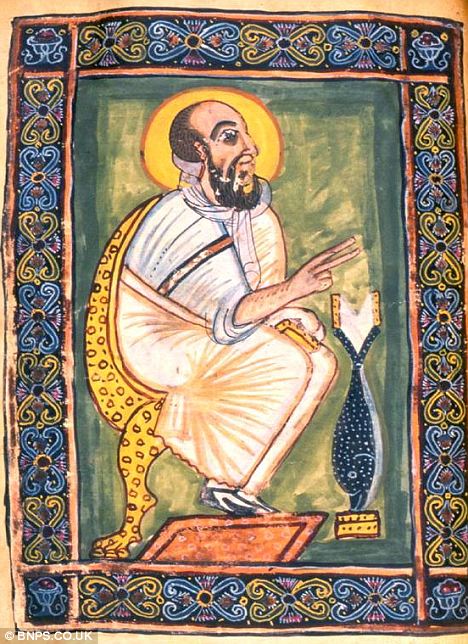
What is now considered to be among the oldest surviving works of Christianity, the Garima Gospels date perhaps to the early fourth century first came to light in the 1950s; scholars and philanthropists in England are helping to preserve the treasure today.

The Monastery of Abba Garima in northern Ethiopia is one of many places where Christians have conserved their ancient texts relating to the Good News preached by Jesus Christ. That we have a fourth century manuscript with some very early extant Christian illustrations is stunning. The images have Coptic similarities. One more reason we need to have concern for Christians who live in Egypt, Ethiopian and Eritrea. According to reports, the Garima Gospels contain portraits of the Evangelists. A literary and cultural find for some, another piece for biblical archeology for scholars, these Gospel pages are relics of a living faith.

Getting to the heart of what St Augustine teaches us today

The Church put on the lips of the priest, and also on our own lips, yesterday this prayer at Mass:

Renew in your Church, we pray, O Lord, that spirit with which you endowed your Bishop Saint Augustine that, filled with the same spirit, we may thirst for you, the sole fount of true wisdom, and seek you, the author of heavenly love.

I am stimulated by what we ask the Lord: to be filled with the same spirit as Augustine, thirsting for Him and seeking divine love.

Shortly into the papacy of Benedict XVI he went to pray before the relics of Saint Augustine in Pavia, Italy. When I saw this picture yesterday I immediately got to wondering why is Augustine so important to some, and irrelevant to others. Why does Augustine have such an crucial influence on us 1600 years after his death? The answer is still being formed but I think part of an answer is his capacity for friendship, and to relentlessly seek God.

The Augustinians are meeting for their 184th General Chapter and Pope Francis opened the Chapter with Mass. Here is a report on the gathering of the Augustinians with His Holiness.

BUT let me offer you an opportunity to hear what Saint Augustine’s spirituality is and how it is relevant to us today. I found a 2009 presentation on Augustinian spirituality given by Father Theodore E. Tack, OSA, who, at the time of his death in February (’13) been a professed member of the Augustinian friars for more than 60 years; he was the 93rd Prior General of the Augustinians, a headmaster, and until his death a high school teacher in Tulsa, OK. Tack gives a great overview of Christian life through the eyes of Saint Augustine.

Father Tack’s presentation, “The Relevance of Augustine for Young Adults Today,”  is a very good introduction to the person and perduring influence of Augustine of Hippo. Like the Pope visiting the relics, we need to visit a man who has a profound influence on the Church. Don’t be fooled by the title; his presentation is really for all. He offered this work as the opening presentation for the Society of St Augustine at Villanova University.

The Passion of Saint John the Baptist

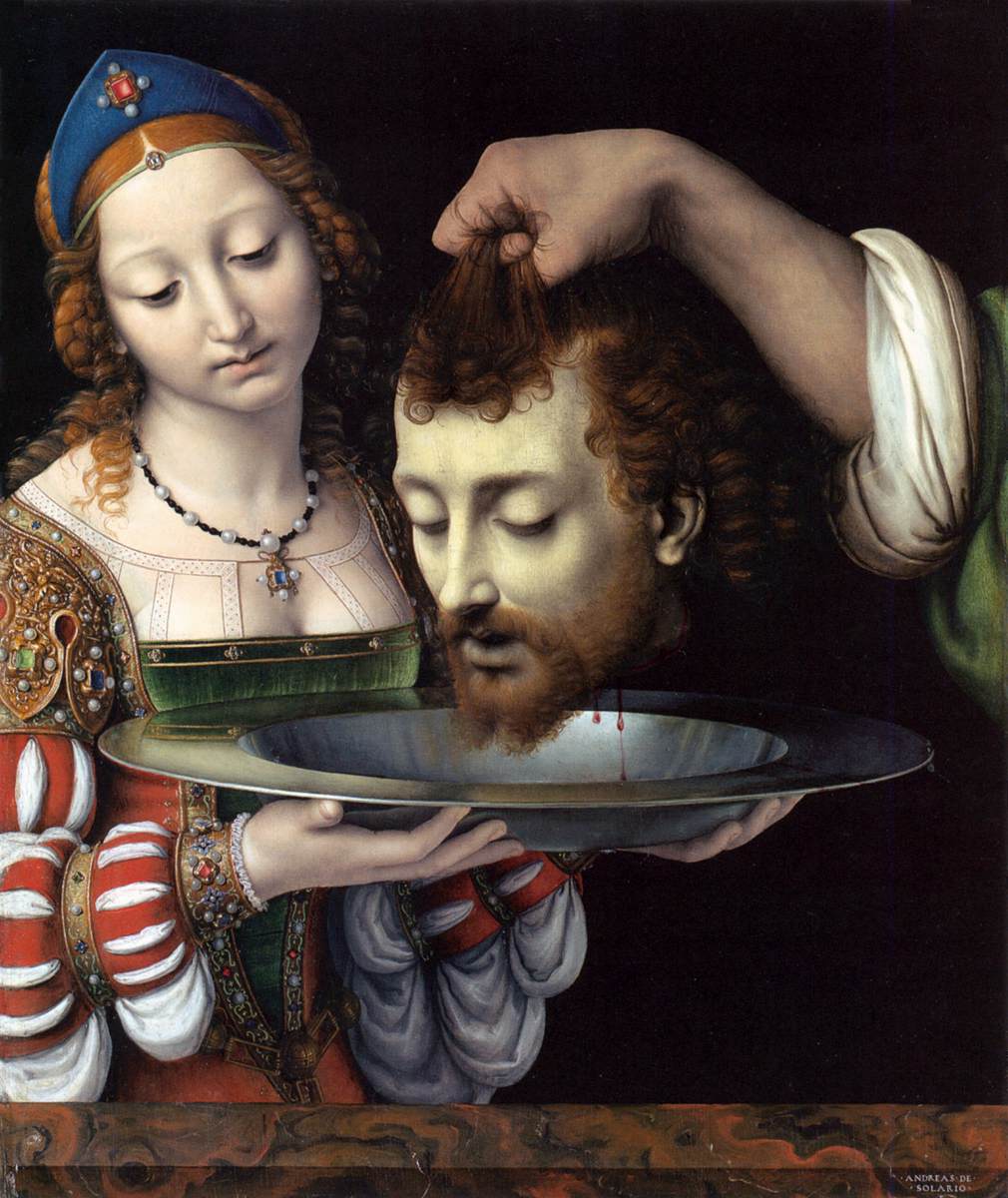
As forerunner of our Lord’s birth, preaching and death, the blessed John showed in his struggle a goodness worthy of the sight of heaven. In the words of Scripture: Though in the sight of men he suffered torments, his hope is full of immortality. We justly commemorate the day of his birth with a joyful celebration, a day which he himself made festive for us through his suffering and which he adorned with the crimson splendor of his own blood. We do rightly revere his memory with joyful hearts, for he stamped with the seal of martyrdom the testimony which he delivered on behalf of our Lord.

Saint Bede the Venerable
Office of Readings

In an era where nihilism is prevalent, hearing that someone is full of hope for immortality is striking. What does Saint Bede mean? We know from experience that the life we live is full of contradictions and divisions in mind and heart. But we have today a man who knows his humanity and the truth of a promise that only Someone else can make good. Losing one’s head in this world allows for the soul to truly live in the next.

Saint Augustine of Hippo

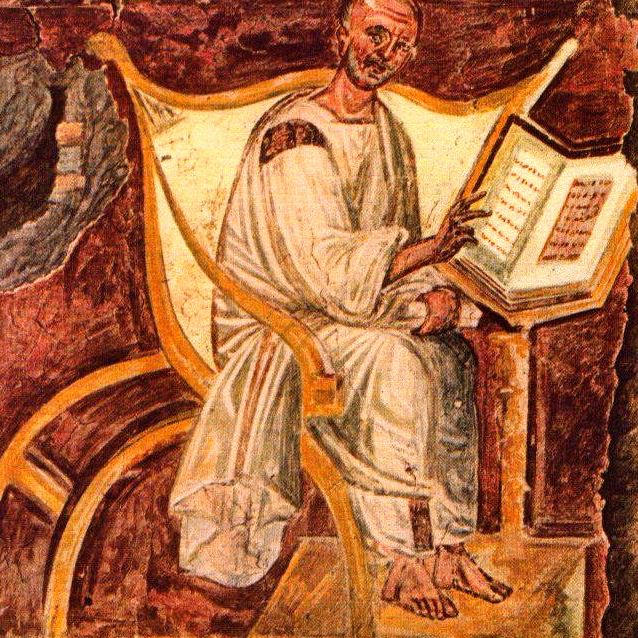
St Augustine readingSaint Augustine was born in Tagaste, Souk-Ahras, Algeria on November 13, 354 to Patricius, a pagan, and Monica, a fervent Catholic. We liturgically observed Saint Monica’s feast yesterday.

We know from his writings and the witness of many others that Augustine was endowed with brilliant human, intellectual and spiritual gifts which lead him on a wild pilgrimage of heart and mind.

Following his education, Augustine was an accomplished rhetorician and teacher in Africa, Rome and Milan. His faith journey began with his mother Monica when he was a child but he didn’t complete his theological formation and wasn’t baptized for many years. In fact, he adopted the Manichean heresy as an intellectual lens to judge reality. But as we know from his Testimony, Augustine discerned moments of spiritual growth he decided to embrace Jesus Christ fully Catholic. By this time his common law wife named Una by scholars and who bore him a son, had departed. Conversion meant that marriage was not possible for him.

The gift of Baptism was given him by Saint Ambrose in Milan in 387. It is said that together with his son and some friends, he returned with them to Tagaste to begin a monastic life. While the ministerial priesthood was not in his personal discernment, the Church had decided that Augustine’s vocation was to serve as a priest in Hippo in 391, and later a bishop of that See in 397. Augustine’s ordination was lived lived in the monastic context.

Augustine was a prolific writer, an accomplished preacher, a monastic leader, a theologian, pastor, contemplative, and mystic. On this date in 430 at nearly 76 years of age, with North Africa being invaded by the Vandals and the Church devastated. Augustine mortal remains were first taken to Sardinia and later to Pavia, Italy, where they are now rest in the Basilica of San Pietro in Ciel d’Oro.

I have a dream –50 years later

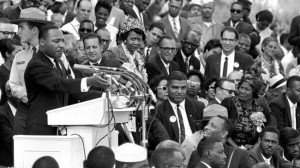
MLK I Have a DreamThe 17 minute “call to arms” speech delivered by Doctor Martin Luther King, Jr, on this date in 1963, at the Lincoln Memorial, Washington, DC, is recalled today. Few of the key people from 1963 are still around but many of the listeners are plentiful.

Benedictine monk, scholar and hymn writer Father Harry Hagan, wrote this hymn “We Have a Dream,” a meditation on and a prayer for our aspirations for peace.

Speeches are meant to move its hearers to action. In what ways am I working for peace today?

We have a dream that we shall see
all races rise as one
a dream of vast equality:
the day God’s will is done.

Lord grant that this may be the day.
Lift us so we may rise
and lift each other by your Word
filled with divine surprise.

We have a dream that we shall touch
each person’s self and soul;
with cords of mercy bind them up
till they, as you, are whole.

Lord, grant that this may be the day
when wounds begin to heal,
when enemies are reconciled
and share a common meal.

We have a dream that we shall know
the coming of the Lord;
when in the twinkling of an eye
earth’s goodness is restored.

Lord, grant that this may be the day
when you shall draw so near
and in your presence we are filled
with love that casts out fear.

We have a dream that we shall feel
your justice and your sway
when we shall follow you alone
though we be framed of clay.

Lord, grant that this may be the day
when justice sets us free
and we by being true to Christ
shall claim our dignity.

We have a dream that we shall live
in harmony and peace
when lamb and wolf together lie
as heirs of your increase.

Lord, grant that this may be the day
when walls are broken down;
and we as sisters, brothers, all
shall one in Christ be found.

We have a dream that we shall reach
Jerusalem the New
where every tear is wiped away,
where all is held by you.

Lord, grant that this may be the day
when life begins to reign
and gathers all into the life
that you yourself sustain.

Hymn written for the Fiftieth Anniversary of Martin Luther King’s Speech: “I Have a Dream”, written at the request of Westwood Hills Congregational Church, UCC.

Father Harry Hagan, OSB
Archabbey of Saint Meinrad
28 August 2013
Saint Monica

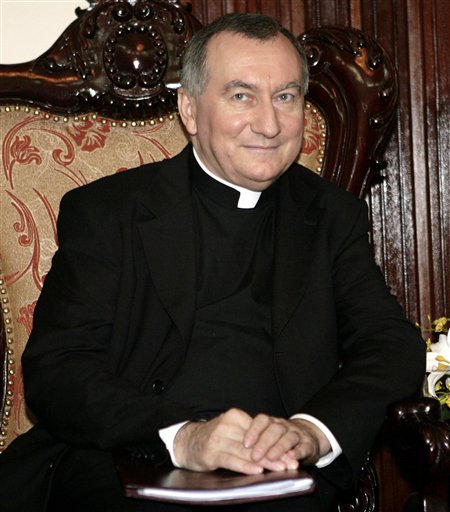
Son, nothing in this world now affords me delight. I do not know what there is now for me to do or why I am still here, all my hopes in this world being now fulfilled.

Saint Monica about the conversion of Augustine

Saint Monica gives hope to mothers (parents and family) that perseverance in prayer and friendship does influence others.  Good witness can’t be exchanged for anything else. Monica realized, no doubt, that her son, as bright as he was, had free will and that even God respected that fact. What does that say about praying in singular way, for the conversion of someone for 30+ years? It says that our heart and mind expands and makes room of God’s grace to come in new and unexpected ways.

Saint Monica, pray for us.

@ started with the Benedictine monks

@The theory of how the image ‘@’ came into being is passing through cyberspace, again, these days. We all know that monks of all types, Benedictines, Cistercians, Augustinians, etc., had much to do with culture. This is particularly true, I believe with the Benedictine and Cistercian monks who worked out tools for writing but also useful things for art, cooking, gardening and beer making to name just a few ideas. What was helpful and labor-saving in the monastery had applications for the rest of the world.

Here is a 2009 story on @ found at Wired.

Just the other day the Huffington Post published this note about the ubiquitous @.

The point is not raise your awareness about the history of the @. It is to help you recall that things don’t fall out of the sky on to your plate, or your computer screen. A real person has had to dream and work out the tool used.

Our intellectual and religious history needs to be recalled and honored. Much of the world that uses email has to use ‘@’ to send a message. Next time you do, pray for the Benedictines.

Remembering John Paul I

John Paul I

On this day in 1978, the Cardinals elected Cardinal Albino Luciani, 65, as the Pope to follow Pope Paul VI who died on August 6.

Luciani took the name John Paul and died 33 days later. Luciani had been the Patriarch of Venice.

On this day in 2002 the diocesan phase studying the possible cause for canonization was opened. It was closed in 2006 and the Roman phase opened in 2009. A miracle is being proposed for the Pope’s cause.

Eternal Memory.

John Paul I, pray for us.

Reported Benedict XVI mystical experience untrue

GansweinCindy Wooden of Catholic News Service is reporting that the recent press on the mystical experience of the emeritus pope is untrue. She writes,

Archbishop Georg Ganswein, retired Pope Benedict XVI’s longtime personal secretary, said a story about the pope resigning after a “mystical experience” was completely invented.

“It was invented from alpha to omega,” the archbishop said Aug. 24 in an interview on Italy’s Canale 5 television news. “There is nothing true in the article.”

Ms Wooden’s CNS article is here in full.