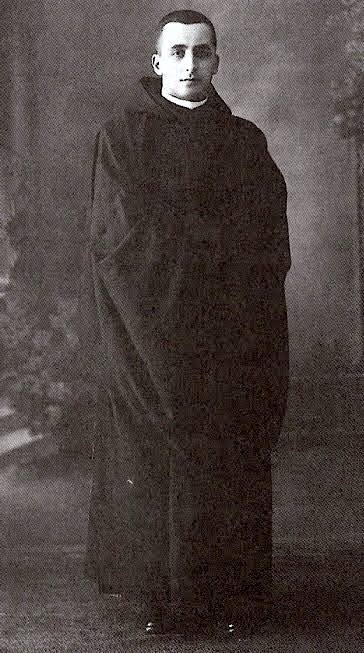
Servant of God Brother Bernardo Vaz Lobo Teixeira de Vasconcelos

Bernardo de VasconcelosBernardo Vaz Lobo Teixeira de Vasconcelos was a Benedictine monk, mystic, poet, and authored Cântico de Amor. Studied at the University of Coimbra and there was part of the Saint Vincent de Paul Society which did works of evangelization and charity especially with the poor. Likewise, he was devoted to regular eucharistic adoration. Professionally, he was an editor of the journal which studied democracy.

Bernardo was born in São Romão Corgo (Celorico de Basto), Portugal, on July 7, 1902.  He discerned a call to the monastic life and entered the Monastery of Singeverga on 16 August 1924 and professing vows in September 29, 1925. His name in religion was Brother Bernardo da Anunciada. The superior sent him to the Abbey of Mont-César in Beligium to study theology. He was back home in a year’s time due a diagnosis of TB.

Bernardo illness weakened his body and yet he was peaceful and trusting in Divine Providence. The hundredfold was very present in Brother Bernardo’s life. In a letter to a fellow patient Bernardo wrote:

“don’t get delivered to sadness that only serves to disable our best energies … it expands your heart and let him the life-giving Sun of joy. Joy, but with so many ordeals? I’m telling you: who did you see still no cross? The cross follows us wherever we go and we have to take; and, if we don’t want to raise our arms and generously to hugs, I mean: with all the ardor of our hearts-what do we have to take a challenge behind us, the drags.”

Brother Bernardo died in the early hours of July 4, 1932, after a long suffering caused by TB. He is buried in the parish church of São Romão do Corgo

Brother Bernardo Vaz Lobo Teixeira de Vasconcelos is now honored with the title of Servant of God.

In all things may God be glorified.

A Catholic view of a religious pluralism

The Synod Fathers spoke of the importance of respect for religious freedom, viewed as a fundamental human right. This includes “the freedom to choose the religion which one judges to be true and to manifest one’s beliefs in public”. A healthy pluralism, one which genuinely respects differences and values them as such, does not entail privatizing religions in an attempt to reduce them to the quiet obscurity of the individual’s conscience or to relegate them to the enclosed precincts of churches, synagogues or mosques. This would represent, in effect, a new form of discrimination and authoritarianism. The respect due to the agnostic or non-believing minority should not be arbitrarily imposed in a way that silences the convictions of the believing majority or ignores the wealth of religious traditions. In the long run, this would feed resentment rather than tolerance and peace.

Pope Francis
Evangelii gaudium, 255

First thoughts for our national day of Freedom.

Raica speaks of his meeting Communion and Liberation

Steven Raica“I’ve developed a great appreciation for the writings of Monsignor Luigi Giussani, founder of Communion and Liberation, a mostly lay movement that began in Italy. I meet regularly with people in this area who are interested in following its charism. It’s based on the encounter with Christ that one has by the very fact that Christ took on our flesh and became one of us to show us the way back to God.”

Bishop-elect Steven Raica
Gaylord, MI

This past week the Holy Father appointed Father Steven John Raica, priest and Vicar General and Chancellor of the Diocese of Lansing, MI, as the fifth bishop of Gaylord, MI. The Diocese of Gaylord is one of the newer dioceses in the USA having been established by Pope Paul VI on July 20, 1971.

For several years Father Raica, 61, has been following the ecclesial movement of Communion and Liberation and the various gestures of CL, including the annual gathering called the New York Encounter.

All of us are full of joy with the news of Father Raica being made a bishop, and a brother who makes the journey of faith in the companionship of Communion and Liberation.

Council of Cardinals expands, other changes in the curia coming

C8Meeting for the 5th time this week in Rome, the Council of Cardinals is working on matters of Church’s governance. On many minds is the forthcoming (in 2015) new apostolic constitution replacing the current constitution, Pastor Bonus, of John Paul II. On some level the work of the Council has been seen as a mere reshuffling of Vatican offices and improving apostolic effectiveness. Or, so we are led to believe. It may sound cynical, but look at the historical reality of the Roman curia and you’ll notice some discouraging facts. You can rearrange the deck chairs but if the deeper matters are not addressed, e.g., personal conversion, true discipleship, protection of the marginalized (children, elderly, ill) then whatever materializes is meaningless. Christ asks for more than mediocre plotting and planning; the Church requires more in order to proclaim the Good News of Salvation in Christ Jesus.

As you know, the Council of Cardinals  has been known as the C8 but is now to referred to as the “C9” because of the Secretary of State Pietro Cardinal Parolin has become a key interlocutor. Jesuit Father Lombardi stated: “While before it was referred to as the C8 plus one, I can now confirm it has now become the C9 because the Secretary of State Pietro Cardinal Parolin is “systematically taking part” in the discussions held by the Council of Cardinals and is a full member.

The addition of Cardinal Parolin to the Council will be made official when the pope issues his decision in a document. Regrettable, in my opinion, is the fact that heretofore NO member of Eastern Christianity is represented on the Council. The Catholic Church is a communion of churches and the Eastern Churches are constituent. One would think with the friendship Pope Francis shares with members of the Eastern Churches there would be a Patriarch on the Council. We ought to have a C10!

It comes to mind that that there ought to be an equivalent council to the C9 made of laity. There are analogues for this idea in Eastern Christianity. Ecclesial life, not debate on dogma and liturgical praxis, needs the Pope’s consultation with laity. While the Pontifical Council for the Laity does real good work, something broader is needed.

An announcement on changes in the Pope’s curia will be made next Wednesday that will affect, in particular,  the Secretariat for the Economy and Institute of Works of Religion (IOR), AKA the Vatican Bank.

The C9 will meet 15 to 17 September, 9 to 11 December and 9 to 11 February.

First woman named Rector of a Roman School

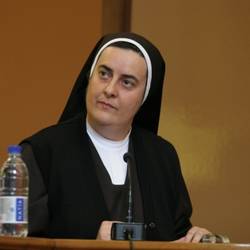
Sr Mary MeloneSister Mary Melone, a  Franciscan Sisters of Blessed Angelina, born in 1964, is the next Rector of the Faculty of Theology of the Pontifical University Antonianum. The venerable Antonianum is run by the Order of Friars Minor.

In recent history of this Roman pontifical university, Sister Melone is the first woman to be appointed a dean, and now the first woman to become a rector of a pontifical university in Rome. Cardinal Zenon Grocholewski, prefect of the Congregation for Catholic Education appointed Melone to a term lasting from 2014-2017. She is an expert on St. Anthony of Padua, and other points in Franciscan theology.

May Saint Anthony of Padua intercede for Sister Mary Melone’s intentions.


When Sr. Melone was elected the dean of the Antonianum she gave an interview to L’Osservatore Romano where she said: 

The approach of a woman: “I don’t give much importance to these kinds of labels, female theology. Above all, I don’t like comparisons although I recognize that in the past there may have been a reason for making comparisons. Maybe there is one today as well, I don’t know. More space definitely needs to be given to women. The reference to female theology does not really fit with my vision of things: all that exists is theology. Theology as research, as a focus on mystery, as a reflection on this mystery. But precisely because this requires different sensitivities. A woman’s approach to mystery, the way in which she reflects on this mystery which offers itself and reveals itself, is certainly different from that of a man. But they do not contrast.  I believe in theology and I believe that theology created by a woman is typical of a woman. It is different but without the element of laying claim to it. Otherwise it almost seems as though I am manipulating theology, when it is instead a field that requires honesty from the person who places him/herself before the mystery.”

More on women:  “a reflection on this cannot be commensurate to the Church’s age as this reflects a development of thought that has gone on for hundreds of years. However, in my opinion a new space does exist and it is real. I also think it is irreversible, meaning that it is not a concession but a sign of the times from which there is no return. It is no pretense. I believe this depends a great deal on us women too. It is us who should get the ball rolling. Women cannot measure how much space they have in the Church in comparison to men: we have a space of our own, which is neither smaller nor greater than the space men occupy. It is our space. Thinking that we have to achieve what men have, will not get us anywhere. Of course, although the steps we take may be real, this does not mean the job is complete. A great deal more can be done but there is change, you can see it, feel it. I think that (my case aside) the election of a woman in a pontifical university is also proof this. The body who elected me was made up entirely of men!”

The Church does NOT need gender quotas?  “No, it doesn’t need quotas, it needs collaboration. And collaboration needs to grow!”

Saint Thomas

Sts Andrew and Thomas Bernini 1627Although the doors were closed,
Jesus appeared to his disciples.
He took away their fear and granted them peace.
Then He called Thomas and said to him:
“Why did you doubt My resurrection from the dead?
Place your hand in My side;
see My hands and My feet.
Through your lack of faith,
everyone will come to know of My passion and My resurrection,
and they will cry out with you:
My Lord and My God, glory to You!

Through the Apostles we come to know and love the Savior of humanity in ways unimaginable. Thomas, as the text from the Byzantine Liturgy for “Thomas Sunday” suggests, is a keen witness to the resurrection of Jesus from the dead. The miracle of trampling death by death itself requires of man and woman the openness to follow a witness who points, who interrogates, who gives voice to, a wonder never seen and experienced for now. The so-called doubts of Thomas can really be understood from the viewpoint of faith and reason: is it reason that a man be raised from the dead? Is it reasonable to speak about this fact from the eyes of faith? Thomas stands before the Lord and gives the answer in the affirmative. Faith is the capacity to see all of life, the small and the great, the seen and unseen, the common and the miraculous as a way of knowing. Thomas knows because of evidence; he has faith in the Lord Jesus because what the Lord taught is reasonable and recognizable. Blessed are those who believe.

Here is the post from last year.

The Good Priest

vB on priesthoodIn the region of the country in which I live there are some very good priests: attentive to matters of faith and reason, attentive to their spiritual life, eager for apostolic work, work on being truly human and serious about the offering sacrifice as a priest of Jesus Christ. The men I am thinking of are not clowns. They prepare for the sacred Liturgy, want to do good by the Church and the Lord, they see their spiritual director monthly,  and spend time in daily prayer. These priests also read books, visit musea, and like people. Theirs is a real life of prayer, work and study.

On the other hand, I have known lots of priests who seek preferment in civil and ecclesial circles under the guise of “obedience”, develop a personality cult, I know who one is a frequent visitor to sex shops, others are alcoholic, addicted to power, I know one is in prison for drug related charges, others are lazy, economical with the truth, ignorant and ill mannered, superficial and these are their good qualities. Just recently a priest proudly stated that he was leaving his venerable religious order and the exercise of Catholic priesthood and joining the Episcopal Communion. Another priest I know who falls in this category of “bad priest” was recently given a new job of considerable authority and influence in his diocese and who has little integrity, or care for others. This same priest has had charge of men preparing for sacred priesthood, too.

For the record, there is no time when the words “I’m the priest, and this is my parish” are to be uttered and heard. Otherwise, the one who thinks in such way betrays his baptismal and priestly ordination.

The sinful aspects of what I described above are the result of the thoughts, will and affections being disordered by someone other than the Most Trinity — that is, Satan. We too often allow the circumstances of life control the beauty of personhood slowly moving us away from our true self as we are made in God’s image. And in moving away from our true center we move away from God who gave us those beautiful desires to know, love and to serve in this world –that is, to have the hundredfold promised Jesus– to serve under another banner not divine or holy. Hence, the metaphor of the “bad priest.”

So, when you read this phrase, “A good priest is a miracle of grace” it ought to be a striking idea upon which to reflect. Thanks be to God of Balthasar!

Loyola taught us that the three devices of Satan are money, power and fame. He also notes the sin of ingratitude –a big sin for Saint Ignatius.

Those who reflect on this issues with depth and sincerity will notice the ways in which the devil corrupts those who have consecrated their lives to God for the service of the Church. Think of CS Lewis’ book, Screwtape Letters. Recall the agenda of the tempter: the priesthood and sacramentality are messed around with by Satan. Many fall prey, others don’t. And that is why I’m so grateful for priestly vocations lived well.

Well-formed consciences give witness to something greater

These days the use of the word of conscience is bantered around without much substance to my line of thinking. Some really crazy (unreasonable) things are said about conscience and the use of it. Certainty is about reasonable things is not well accepted thinking persons. Additionally, the public forum is beginning to be more belligerent if a course correction is needed because we live in a “culture of nice” that dictates don’t be judgmental. All sorts of media outlets, politicians, talking heads and professors derail the conversation to force a fallacious agenda that allows for all things that indicate “just because.” We easily trot out the word conscience thinking that we know what it means, that our interlocutors know what the word conscience means, and that that the context within which we find ourselves can handle a fully functioning, clear definition that focuses on truth.  Less confusion is needed: clear principles and identifiable conclusions are absolute. The contours of what conscience really is under assault.

This morning I read the following spiritual reflection from a sermon by Saint Augustine on conscience and began to think –not brilliantly of course– that a new level discourse that gets to the heart of the truth and gives proper witness to a life of good conscience is needed. No longer is it acceptable to use conscience in flippant ways that divorce God from every level of our life. In a concrete way it is true to say that without a personal relationship with Jesus Christ a fully formed conscience is impossible. Fuzzy thinking will lead to absurd actions. In positive terms: only with  Jesus is man and woman fully alive and capable of giving witness to freedom. Too much is at stake: personal freedom, life in the Christian community, work in society, the arts, medicine, politics. Faith and reason are expected and valued dialogue partners. 

This is our glory: the witness of our conscience. There are men who rashly judge, who slander, whisper and murmur, who are eager to suspect what they do not see, and eager to spread abroad things they have not even a suspicion of. Against men of this sort, what defense is there save the witness of our own conscience?

My brothers, we do not seek, nor should we seek, our own glory even among those whose approval we desire. What we should seek is their salvation, so that if we walk as we should they will not go astray in following us. They should imitate us if we are imitators of Christ; and if we are not, they should still imitate him. […]

And so, my brothers, our concern should be not only to live as we ought, but also to do so in the sight of men; not only to have a good conscience but also, so far as we can in our weakness, so far as we can govern our frailty, to do nothing which might lead our weak brother into thinking evil of us. Otherwise, as we feed on the good pasture and drink the pure water, we may trample on God’s meadow, and weaker sheep will have to feed on trampled grass and drink from troubled waters.

Pope Francis’ prayer intentions for July

Pope Francis in prayer at MassThe prayer intentions of Pope Francis for July:

The general intention

That sports may always be occasions of human fraternity and growth.

The missionary intention

That the Holy Spirit may support the work of the laity who proclaim the Gospel in the poorest countries.

Having completed the month of June which is dedicated the Sacred Heart of Jesus, we begin July as the month dedicated to the Most Precious Blood of Christ. The deeper we move into summer the more I think it is fitting to recommit ourselves to a daily offering of the whole self to the Lord, leaving nothing out, returning to Him what we have received as a gift: life and freedom. Prayers for the daily offering are found on the Apostleship of Prayer website. Do you belong to the network of people making up the Apostleship of Prayer?