Saint Gregory the Great

Gregory the GreatSaint Gregory the Great (540-604) is a Church father, founder of monasteries, and pastor of souls. The Church benefitted by Gregory’s vision of taking the Gospel to the margins. Gregory’s personal witness to the evangelical vows was demonstrated by his living as a simple monk who showed concern for those on the margins; he had a purity of heart in the midst of his new ministry’s numerous responsibilities as the Roman Pontiff. Pope Gregory set as his first priority the service of those who were considered the last in the diocese. Besides his significant contribution to the organization of sacred music Gregory is remembered for his writings, his commitment to the praying with Scripture in lectio divina and his love of Benedictine monasticism. What we know about Saint Benedict, for instance, comes from Saint Gregory.

Benedetto Calati has this reflection on Gregory who is great:

The community of faith is a hermeneutic criterion of the Word of God. “Often, many things in holy Scripture that I was not able to understand on my own,” Gregory said courageously to his brothers, “I understood when I found myself among my brothers. After I realized this, I also tried to understand by whose merit such knowledge had been given to me.” What is even more surprising is that, for Gregory, every member of God’s people who obeys the Word is “an organ of truth” for his or her brothers and sisters in the faith. “When we who are filled with faith try to make God resound for others, we are organs of truth, and truth has the power to reveal itself to other people through me, or to reach me through other people.” Gregory’s humble discretion with regard to the action of the Spirit, and the Word whom he obeys, generates a model of Church leadership that is expressed in the formula, “Gregory, servant of the servants of God.”

”Treasures of the Divine Life”: revisiting the sacraments of Initiation

Pastors, DREs, catechists, parents, and others concerned for religious education and sacramental prep all have some pastoral questions regarding the sacramental life of our children. Clearly, the current practice of separating the sacraments of initiation (Baptism, Eucharist, Confirmation) as much as 7 seven years from one another seem to be more problematic than helpful, and our theology for such a bit weak. News this week announced that the Archbishop of Denver and his theologians and catechists are hosting a conference to explore the status of the question and see what can be done to better be faithful to a truly Catholic sacramentality.

At last I knew the were 15 dioceses in the USA giving the sacrament of Confirmation at the time of First Communion. We need an evaluation on this practice.

Anthony Lilles, the academic dean of Saint John’s Seminary in Camarillo, CA, writes on his blog:

The Catechetical Congress draws its name from a passage in the Catechism, “Treasure of Divine Life.”  These are notes from a presentation in which we will consider how the signs used in the sacraments of Baptism, Confirmation and Eucharist have a certain order in the Bible, and this order reveals the splendor of what it means to be fully human and fully alive.

“Christ instituted the sacraments of the new law. There are seven: Baptism, Confirmation (or Chrismation), the Eucharist, Penance, the Anointing of the Sick, Holy Orders and Matrimony. The seven sacraments touch all the stages and all the important moments of Christian life: they give birth and increase, healing and mission to the Christian’s life of faith. There is thus a certain resemblance between the stages of natural life and the stages of the spiritual life” (CCC 1210).

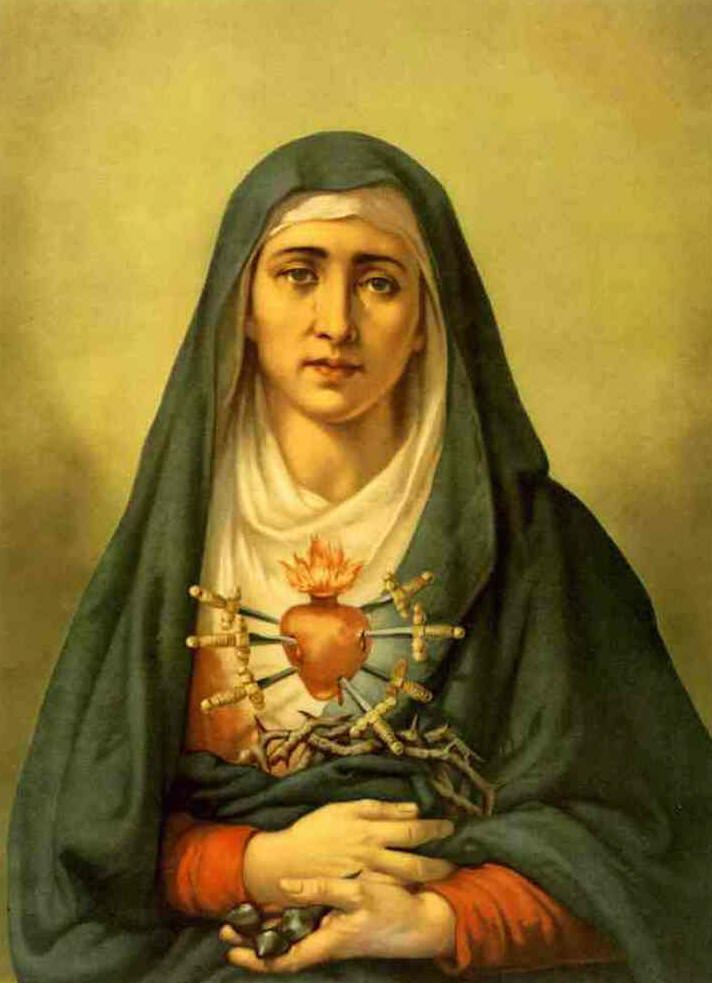
September’s Marian Devotion – Our Lady of Sorrows

OL of SorrowsThe Seven Sorrows of Mary is September’s Marian devotion.

The Marian side of the Catholic Church helps us to see the human aspect of the act of faith: do we comfort the sorrowing as they grieve the death of a loved one? Always a mother, the Church directs our attention to the seven sorrows suffered by Mary, who witnessed her Son’s death for us on the cross.

A short prayer that we can offer: Mary most sorrowful, Mother of Christians, pray for us!

The feast day of Our Lady of Sorrows on September 15 which follows feast of the Exaltation of the Holy Cross is September 14. The Seven Sorrows  unites us to Passion of the Lord on Calvary by having a Marian feast that uses the sorrows of to point to the salvific work of the Lord.

The famous Passionist Saint Gabriel of The Sorrowful Mother, said he was never denied any petition that he confided to the Mater Dolorosa (Mother of Sorrows).

In 1815, Pope Pius VII approved of the Seven Dolors of Mary but it was well used and promoted by the Servite Order since 1668 when a feast formally approved. The Servite Order dates back to 1239. The Seven Sorrows of Mary, taken from Scripture, are:

  • The prophecy of Simeon. (Luke 2: 34, 35)
  • The flight into Egypt. (Matthew 2:13-14)
  • The loss of the Child Jesus in the temple. (Luke 3: 43-45)
  • The meeting of Jesus and Mary on the Way of the Cross. (John 19:1; Luke 23:26-32)
  • The Crucifixion. (Mark 15:22; John 19:18, 25-27; Mark 15:34; Luke 23:46)
  • The taking down of the Body of Jesus from the Cross. (John 19:31-34, 38; Lamentations 1:12)
  • The burial of Jesus. (Matthew 27:59; John 19:38-42; Mark 15:46; Luke 27:55-56)

Blessed Labor Day

“Work is a duty, because our Creator demanded it and because it maintains and develops our humanity. We must work out of regard for others, especially our own families, but also because of the society we belong to and in fact because of the whole of humanity.” Laborem exercens, 16

AND

“The most profound motive for our work is this knowing that we share in creation. Learning the meaning of creation in our daily lives will help us to live holier lives. It will fill the world with the spirit of Christ, the spirit of justice, charity, and peace.” Laborem exercens, 25

St. John Paul II clearly orients our ideas to how we live and work, the sign of a great pastor of souls.

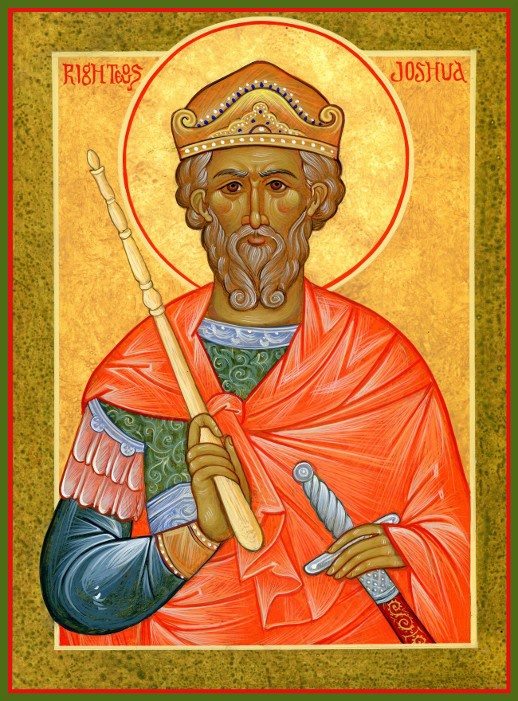
Saint Joshua

St JoshuaThe Roman Martyrology offers us the commemoration of the holy Joshua (Jesus), son of Nun, servant of the Lord. It is he who, having had hands laid on him by Moses, became full of the spirit of wisdom. After the death of Moses, he led the people of Israel across the Jordan River, accompanied by many miracles, into the Promised Land.

Even though the Roman Martyrology has OT holy men and women noted for liturgical remembrance, the current liturgical calendar does not have them listed. Hence, I like to draw our attention to these types of commemorations.

Blessed feast!

The temporary silence

A brief note on the recent silence regarding the blog. More than a week ago both my mom and aunt Gloria fell, hitting their heads. They were in the ER together requiring significant medical attention. My mom is fine, coming home with a bump on her head and pain in side. My aunt, however, suffered a traumatic brain injury. Following several medical procedures, including surgery, the Lord of Life called her home in the morning of the feast Saint Monica. My aunt’s Mass of Christian Burial was offered on August 30.

May I ask that you pray for God’s mercy and Gloria’s eternal memory.

Saint Bartholomew

St Batholomew DurerSaint Bartholomew, known also as Nathanael, apostle and martyr, died in AD 71, is liturgically recalled today. However, his feast comes after the Sunday’s precedence. Nonetheless, we need to closely attend to the life and ministry of the 12, those who personally and dramatically lived with the Lord for three years. Why? Because we follow their experience and we continually ask ourselves the key question of the Christian life: “Who are you, Jesus?”

Saint Bartholomew, Bar-Tolmai or son of Tolmai, was one of the twelve Apostles called to the apostolate by our Blessed Lord Himself. His name is more adequately rendered by his given name, Nathanael. If one wonders why the synoptic Gospels always call him Bartholomew, it would be because the name Nathanael in Hebrew is equivalent to that of Matthew, since both in Hebrew signify gift of God; in this way the Evangelists avoided all confusion between the two Apostles. He was a native of Cana in Galilee, a doctor of the Jewish law, and a friend of Philip.

Philip, advised by Peter and Andrew, hastened to communicate to his friend the good news of his discovery of Christ: We have found Him whom Moses in the Law, and the Prophets, wrote! Come and see. Jesus saw Nathanael coming to Him, and said of him, Behold a true Israelite, in whom there is no guile. (Cf. John 1:45-49) His innocence and simplicity of heart deserved to be celebrated with this high praise in the divine mouth of Our Redeemer. And Nathanael, when Jesus told him He had already seen him in a certain place, confessed his faith at once: Rabbi, Thou art the Son of God, Thou art the King of Israel!

Being eminently qualified by divine grace to discharge the functions of an Apostle, he carried the Gospel through the most barbarous countries of the East, penetrating into the remoter Indies, baptizing neophytes and casting out demons. A copy of the Gospel of Saint Matthew was found in India by Saint Pantænus in the third century, taken there, according to local tradition, by Saint Bartholomew. Saint John Chrysostom said the Apostle also preached in Asia Minor and, with Saint Philip, suffered there, though not mortally, for the faith. Saint Bartholomew’s last mission was in Greater Armenia, where, preaching in a place obstinately addicted to the worship of idols, he was crowned with a glorious martyrdom. The modern Greek historians say that he was condemned by the governor of Albanopolis to be crucified. Others affirm that he was flayed alive, which treatment might well have accompanied his crucifixion, this double punishment being in use not only in Egypt, but also among the Persians.

Reflection: The characteristic virtue of the Holy Apostles was zeal for the divine glory. A soldier is always ready to defend the honor of his prince, and a son that of his father; can a Christian say he loves God if he is indifferent to His honor?

Dictionnaire de la Bible, Ed. F. Vigouroux (Letouzey et Ané: Paris, 1912), Vol. 5, Philippe, Apôtre; Little Pictorial Lives of the Saints, a compilation based on Butler’s Lives of the Saints and other sources by John Gilmary Shea (Benziger Brothers: New York, 1894).

The Christ, the Son of God, St Peter declares

St Peter with key to heavenOur reflection for the 21st Sunday through the Year on Matthew 16:13-20 comes from St. Cyril of Alexandria:

“Peter did not say ‘you are a Christ’ or ‘a son of God’ but ‘the Christ, the Son of God.’ For there are many christs by grace, who have attained the rank of adopted sons, but only one who is by nature the Son of God. Thus, using the definite article, he said, ‘the Christ, the Son of God’. And in calling him the Son of the living God, Peter indicates that Christ himself is life and that death has no authority over him. And even if the flesh, for a short while, was weak and died, nevertheless it rose again, since the Word, who indwelled it, could not be held under the bonds of death.”

Sign of Peace at Mass

Recently, the Congregation for Divine Worship and the Discipline of the Sacraments published a Circular Letter entitled “The Ritual Expression of the Gift of Peace at Mass” (July 8, 2014).  Pope Francis approved and ordered its publication. The letter deals with the question of the Sign of Peace resolving the question whether the Holy See would move the Sign of Peace to an earlier part in the Mass; a question bantered around by liturgists for years. As a note, the Eastern Churches place the Sign of Peace before the Eucharistic prayer; I am speaking about the Western Church here.

At the 2005 Synod of Bishops on the Eucharist, the synod fathers raised the question of the moving of the Sign of Peace because of the perceived disruption of what the Sign of Peace  has become. Pope emeritus Benedict XVI noted in his Post-Synodal Apostolic Exhortation Sacramentum caritas (2007), stated:

“[D]uring the Synod of Bishops there was discussion about the appropriateness of greater restraint in this gesture, which can be exaggerated and cause a certain distraction in the assembly just before the reception of Communion. It should be kept in mind that nothing is lost when the sign of peace is marked by a sobriety which preserves the proper spirit of the celebration, as, for example, when it is restricted to one’s immediate neighbors.”

The Church made the decision to leave the Sign of Peace where it is. The Letter explains:

In the Roman liturgical tradition, the exchange of peace is placed before Holy Communion with its own specific theological significance. Its point of reference is found in the Eucharistic contemplation of the Paschal mystery as the “Paschal kiss” of the Risen Christ present on the altar as in contradistinction to that done by other liturgical traditions which are inspired by the Gospel passage from St. Matthew (cf. Mt 5: 23: “So if you are offering your gift at the altar, and there remember that your brother has something against you, leave your gift before the altar and go; first be reconciled to your brother, and then come and offer your gift”).

The ritual gesture needs to cohere with the theology. The Church makes a crucial distinction that we need to be aware of: the sign of peace at Mass refers to the Risen Christ’s gift of His peace, it is paschal in nature. The fitting-ness of this rite is placed just before the moment when Jesus will feed His people with His own Body and Blood in Holy Communion. Jesus Christ is our peace, and only from Him is our peace known, lived and an invitation to our conversion. The sign of peace, as a minor rite in the Mass, must reflect this divine gift and not distract us as we prepare to receive that gift of Christ’s peace in the Holy Eucharist. The exchange of peace in many places is done with a superficial and sentimental bearing no mind to who is before us.

 Too often the sign of peace is a breaking of contemplation, a turning away from the Eucharistic Lord present before us on the altar; too often the focus is on the person and community.

Now with the Circular Letter the application of the rite calls for the need to be reverent and sober in the exchange of a sign of the Lord’s peace. It gives “practical guidelines. . .to better explain the content of the exchange of peace and to moderate excessive expressions that give rise to disarray in the liturgical assembly before Communion.”

Moreover: “If it is foreseen that it will not take place properly due to specific circumstances or if it is not considered pedagogically wise to carry it out on certain occasions, it can be omitted, and sometimes ought to be omitted. It is worth recalling that the rubric from the Missal states: ‘Then, if appropriate, the Deacon of the Priest, adds: Let us offer each other the sign of peace.’”

The Sign of Peace, therefore, is not required at Mass. The Holy See is clearly concerned that this optional rite has become the occasion for all sorts of problems and distractions. The Letter lists “abuses” that we must “definitively avoid”: singing a song of peace during the exchange of the sign of peace, people moving around the church to exchange the sign of peace with others, the priest leaving the altar to give the sign of peace to the faithful in the pews, and the not uncommon practice of using the sign of peace at special Masses such as weddings or funerals as an “occasion for expressing congratulations, best wishes or condolences among those present.”

The faithful accustomed to a more free manner of the sign of peace will say that “this is a key moment of connection with others at Mass, it helps to focus on what we are doing, I like saying hello to my friends, and meeting new people,” or some such thing. At a local parish the people are now waving at each other, which is yet another problem. While all of these things are good, they are not fitting in the praying of the Mass. Let me say decisively, we are not under attack from Rome; we are asked to consider what we are doing, why we are doing it, and to be coherent in liturgical practice and tradition.

Liturgical order in Mass is important in the worship of God. I have come to worship the Trinity; not to be distracted.

Mary Immaculate, Queen of heaven and earth

Mary's QueenshipThe Latin Church using the Novus Ordo Mass honors Mary today under the title of the Queen; those praying the Missal of St John XXIII would be celebrating feast of the Immaculate Heart of Mary. Either way, we are at the 8th day since the great solemnity of the Assumption.

The teaching is that Jesus, the King, Second Person of the Trinity, the human face of the Invisible God, exercises His kingship –given Him by God the Father– over the cosmos as servant, teacher, mediator, healer, Savior of the world. There are more Christological images to note which are quite beautiful and necessary to understand the complete package of what it means to be an adopted Son and Daughter of God through Baptism. Recall, what is said of Mary reflects directly back to her Jesus.

Jesus is Lord, His mother is Queen. We follow.

In a democratic and ideological society such as ours, regal images are hard to accept for some people with good reason. Yet, in the spiritual realm, the noble images given in our Liturgy are not crowns of money, power and fame but of a spiritual nature: service, love and humility. Because of the inheritance given in Baptism we share squarely in the divine life. Sacred Scripture reveals to us that adhering to Jesus till the end we will receive a crown of glory (1 Peter 5:4); crowns of gold will be given to “the 24 ancients (Rev 4:4).”

Mary is the new Eve, the Mother of God, Mother of the Church, Refuge of Sinners, and thus Queen above all queens. Mary as the Queen Mother wear a crown like no other. Her crown is not made of gold and precious stones; no her crown is  a crown of twelve stars (Rev. 12:1), and the only crown made up of stars mentioned in the Bible.

What is the crown of stars? The tradition tells us that her crown is given directly by God Himself: the Divine Majesty bestowing on His creature a crown of stars with cosmic importance reflecting the brilliance of God Himself. Hence we believe that the stars of the crown guide in the darkness of night, and through the dark times in our lives.

We Christians think biblically: we have 12 gates of the Temple, 12 tribes of Israel, and 12 apostles. Mary, given to the Church by the Lord from the Cross. The Queenship means for us that she the Queen of the Church: the Church Militant (on earth), the Church Suffering (in purgatory) and the Church Triumphant (in heaven). BUT this power exercised in relation to what God has given.

Mary as Queen intercedes for us with her Son, the King.